












In e-commerce today, where 70–80% of online shopping carts are abandoned, AI sales agents are emerging as powerful tools to recover lost revenue. These intelligent agents don’t just reply; they reason, recommend, upsell, and guide customers, unlike traditional chatbots. They come in two types: supportive or fully autonomous. With features such as product advice, personalized scripts, and 24/7 availability, they help reduce acquisition costs, increase average order value, and boost conversion rates. In this guide, we’ll explore what AI sales agents are, how to build them, proven AI use cases in sales, and common implementation mistakes.
Let’s dive in!
- 70 to 80 percent of carts are abandoned — AI sales agents exist to recover that revenue. Unlike traditional chatbots built to deflect support tickets, AI sales agents reason, recommend, and guide customers through purchase decisions to recapture intent that would otherwise leave the store.
- A chatbot responds to questions while an AI sales agent actively closes the sale. AI sales agents interpret natural language beyond keywords, compare products, support multi-step reasoning, and can take actions like adding items to a cart — capabilities rule-based bots cannot replicate.
- Supportive and autonomous agents serve fundamentally different purposes within a sales workflow. Supportive agents work alongside humans by qualifying leads, while autonomous agents manage full conversations independently — the right choice depends entirely on the complexity and volume of interactions.
- Autonomous AI sales agents are most valuable for high-traffic stores with large volumes of simultaneous inquiries. They can engage customers directly, provide detailed product guidance, offer dynamic promotions, and guide shoppers through checkout without waiting for human intervention — functioning as always-on digital salespeople.
- An AI sales agent requires product knowledge, conversation history, and commerce action capability to function properly. The key differentiator from simpler tools is analyzing product data, customer signals, and past interactions simultaneously — then taking real actions like cart updates, not just producing text responses.
What is an AI sales agent?
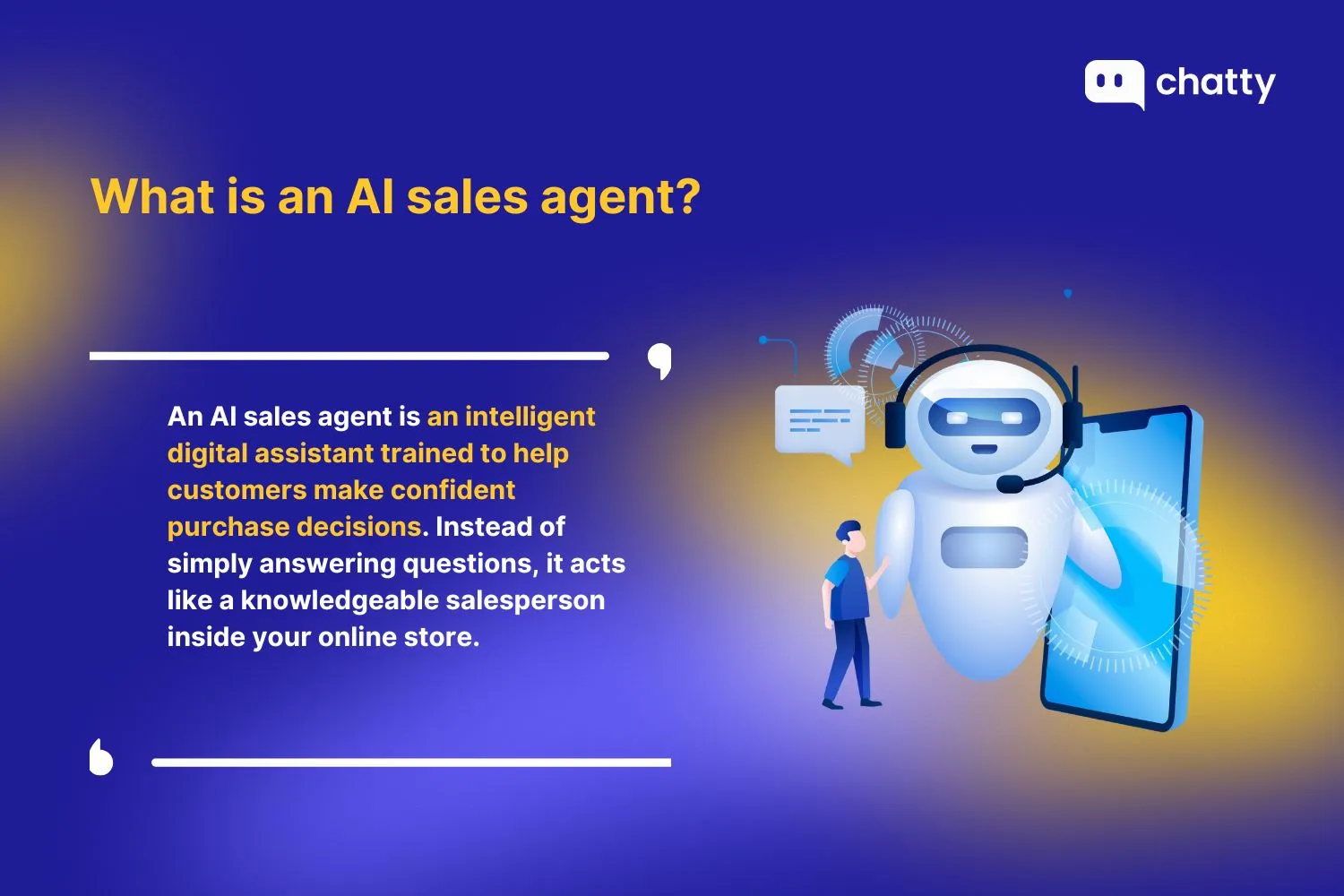
An AI sales agent is an intelligent digital assistant trained to help customers make confident purchase decisions. Instead of simply answering questions, it acts like a knowledgeable salesperson inside your online store. It can:
- Understand customer intent.
- Ask clarifying questions.
- Recommend the right products.
- Handle objections or concerns.
- Guide shoppers toward checkout.
- Personalize suggestions based on preferences and context.
An AI sales agent uses advanced language understanding and reasoning to deliver tailored guidance in real time. It analyzes product data, customer signals, and conversation history to provide accurate, human-like recommendations. Its goal is to increase conversions, build trust, and help shoppers find the best fit with minimal friction.
Traditional chatbots follow rules and scripts. They provide basic answers but often fail when conversations become complex.
AI sales agents are different because they can:
- Interpret natural language beyond keywords.
- Compare products and explain differences.
- Support multi-step reasoning.
- Adapt responses based on evolving customer needs.
- Perform sales actions such as adding items to the cart.
In short, a chatbot responds, while an AI sales agent sells.
Types of AI sales agents
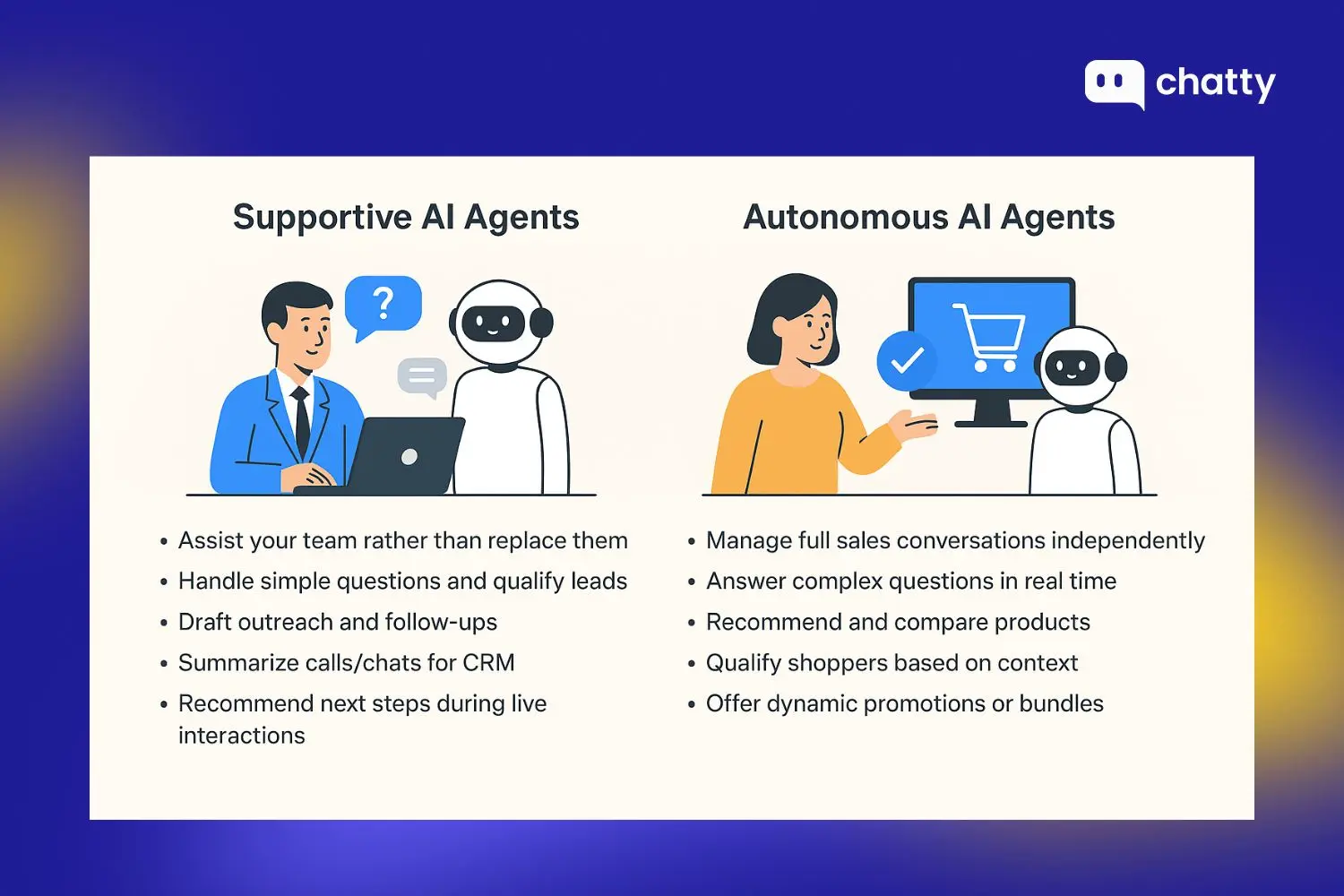
AI sales agents generally fall into two categories, based on how independently they operate and how deeply they participate in the sales journey.
1. Supportive AI sales agents
Supportive AI sales agents function as intelligent helpers that work alongside your human team. Their goal is to remove manual tasks and improve sales productivity rather than take over the full conversation.
They typically assist with:
- Qualifying or enriching leads.
- Handling simple inquiries before a human joins.
- Drafting outreach messages or follow-ups.
- Summarizing calls or chats for CRM updates.
- Recommending next steps during live interactions.
These agents streamline sales workflows and ensure no opportunity slips through the cracks. They operate in the background, enhancing human performance and freeing sales teams to focus on relationship-building and closing deals.
2. Autonomous AI sales agents
Autonomous AI sales agents operate with far greater independence. They can engage customers directly, understand intent, provide detailed product guidance, and move shoppers toward conversion without waiting for human intervention.
Their capabilities often include:
- Answering complex questions in real time.
- Recommending and comparing products.
- Qualifying prospects based on conversation context.
- Offering dynamic promotions or bundles.
- Guiding customers through checkout actions.
Because they can manage full sales conversations at scale, autonomous agents are beneficial for high-traffic ecommerce stores or businesses with large volumes of customer interactions. They act like always-on digital salespeople who can sell, educate, and support around the clock.
What are the features of an AI sales agent?
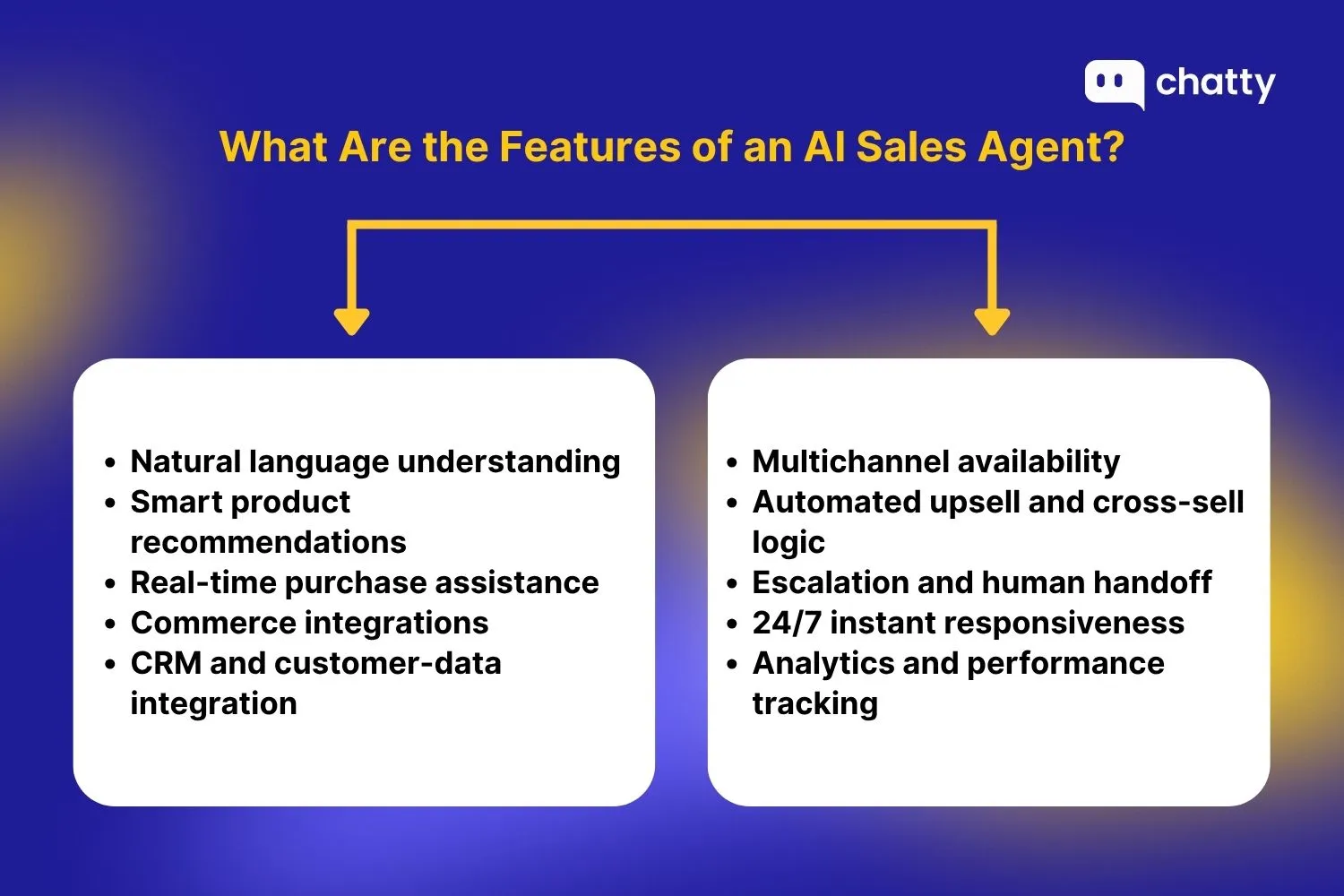
An actual AI sales agent combines language intelligence, product knowledge, and commerce actions to guide shoppers like a real salesperson. Key features include:
- Natural language understanding: Interprets intent, context, and follow-up questions to create smooth, human-like conversations.
- Smart product recommendations: Suggests relevant items, bundles, upgrades, and comparisons based on customer needs and product data.
- Real-time purchase assistance: Helps with coupon issues, shipping questions, sizing, compatibility, and checkout friction points.
- Commerce integrations: Connects to product catalogs, inventory, pricing, discounts, and shipping logic for accurate answers.
- CRM and customer-data integration: References past purchases, preferences, and browsing behavior to personalize recommendations.
- Multichannel availability: Operates on website chat, product pages, Messenger, WhatsApp, SMS, or post-purchase email flows.
- Automated upsell and cross-sell logic: Builds bundles, suggests add-ons, and increases average order value during natural conversation.
- Escalation and human handoff: Routes complex cases or high-value leads to human reps with full conversation context.
- 24/7 instant responsiveness: Provides continuous support and sales guidance without wait times or staffing needs.
- Analytics and performance tracking: Shows conversion impact, message effectiveness, FAQs, and customer behavior insights for ongoing optimization.
Why AI sales agents matter for your business?
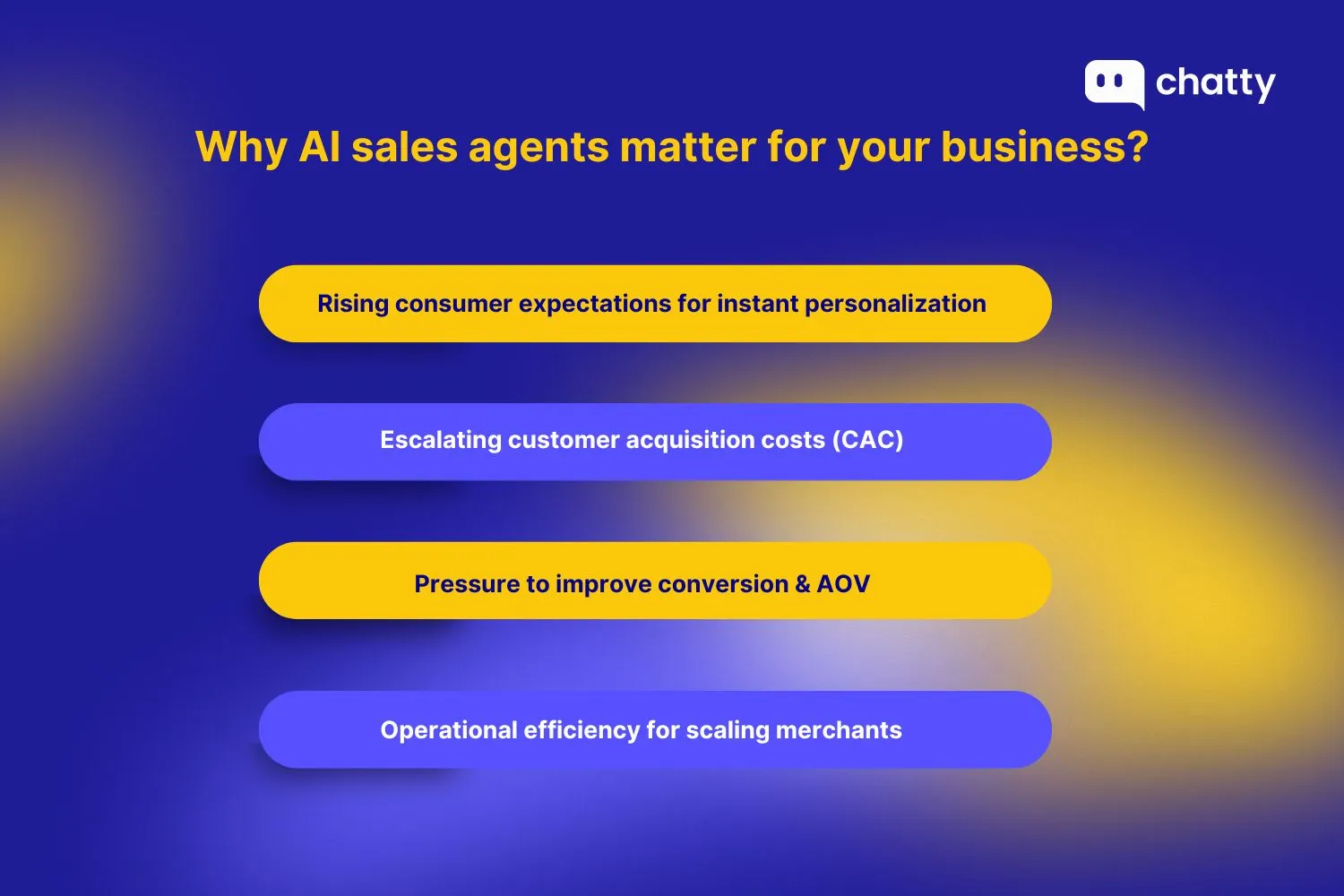
Here are four clear reasons why AI sales agents now matter more than ever for modern businesses
Rising consumer expectations for instant personalization
Modern shoppers expect immediate and tailored responses. AI agents provide personalized product recommendations based on a visitor’s taste, budget, and context. Customers increasingly use chat as a digital “store associate,” and AI delivers consistent guidance around the clock. This real-time support enhances the shopping experience, improves engagement, and builds customer trust.
Escalating customer acquisition costs (CAC)
The cost of acquiring new customers through paid traffic continues to rise. AI sales agents help businesses maximize the value of existing traffic by engaging visitors instantly, qualifying leads, and re-engaging returning users at minimal cost. One case study reported a 68% reduction in customer acquisition costs, decreasing from $147 to $47 per customer by using AI to qualify leads and nurture them in real time. Another provider demonstrated a 71% reduction in CAC within 30 days through fast responses and intelligent lead scoring.
Pressure to improve conversion & AOV
AI sales agents directly impact revenue by guiding users through purchases. Studies show that 26% of transactions involve chatbot assistance. AI also increases average order value by 10 – 20% through personalized upsells and product bundles, reducing friction by clarifying product fit and prompting checkout completion.
Operational efficiency for scaling merchants
AI sales agents provide 24/7 coverage, delivering consistent product education and reducing workload on human teams. According to Salesforce, organizations using AI agents reduce total cost of ownership by 20% while improving service speed and operational efficiency. By automating routine interactions, AI allows teams to focus on complex tasks that require human expertise, enabling businesses to scale efficiently.
AI sales agents help businesses meet rising customer expectations, reduce costs, increase revenue, and improve operational efficiency. They are no longer optional tools but essential assets for success in the digital marketplace.
Chatty: The best AI sales agents for your e-Commerce store
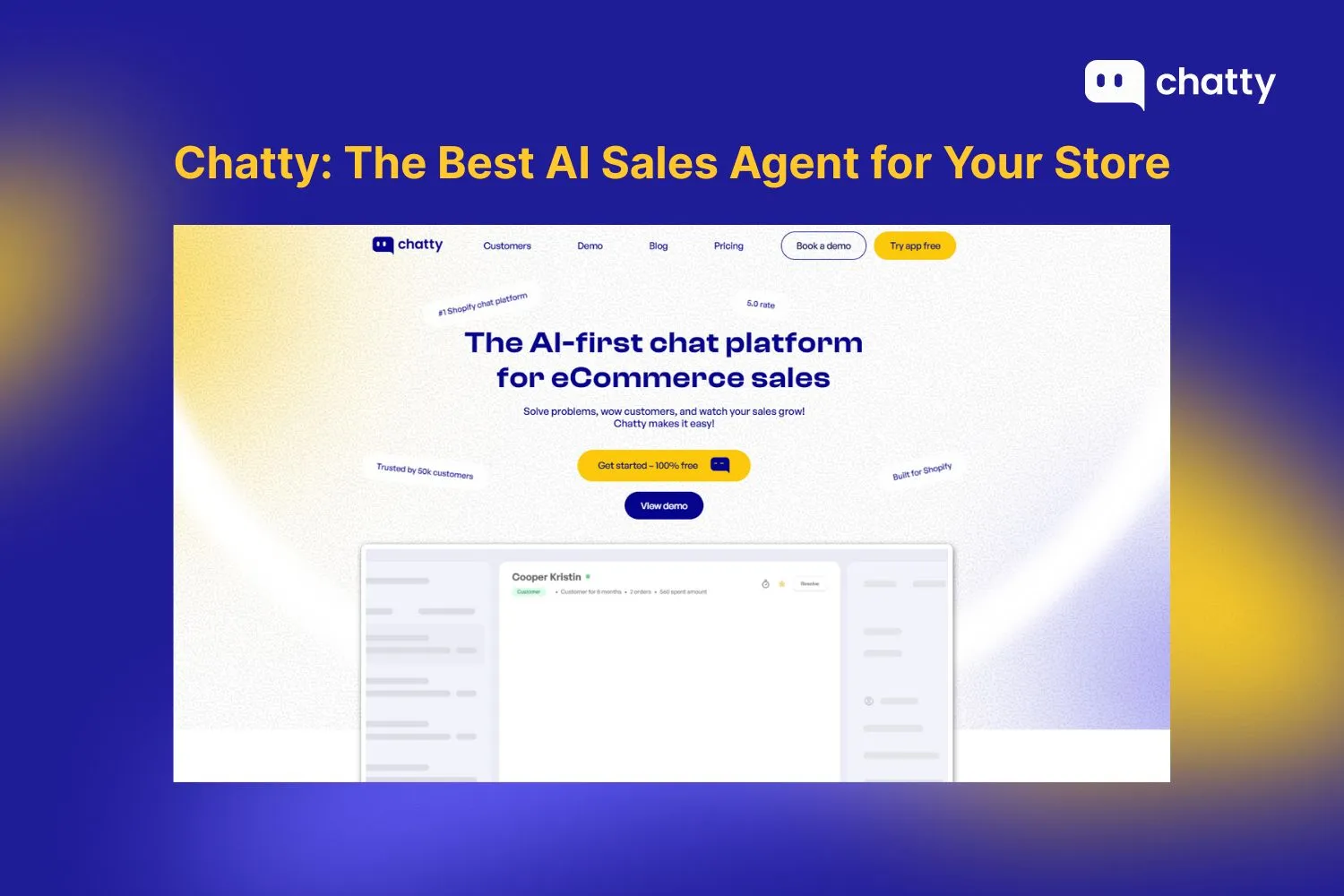
Chatty isn’t just another AI chatbot. I see it work like a true sales teammate that understands Shopify, reacts in real time, and actually helps you close more orders. It brings live chat, AI chat, helpdesk, and FAQs into one clean platform so you can manage every customer conversation, WhatsApp, Instagram, Messenger, Email, and onsite chat, from a single inbox. With a 4.9-star rating from 1,600+ Shopify merchants, it’s clear that brands trust Chatty to lift conversions, reduce support load, and create faster buying experiences.
What makes Chatty different is how it supports shoppers and drives revenue at the same time. It answers product questions instantly, checks stock, tracks orders, and suggests items based on context, even at 2 AM when your team is asleep. I like that shoppers can also help themselves through a built-in FAQ center, which cuts down repetitive “Where is my order?” messages.
But the real power shows up when Chatty starts selling for you:
- Proactive messages that trigger when shoppers hesitate or browse high-intent pages.
- Smart product recommendations that feel natural, not pushy.
- Cross-sell and bundle suggestions that increase AOV without extra apps.
- Mobile access so you (or your team) can jump in anytime from your phone.
The impact is evident in real-world success stories. Decathlon trained Chatty on 10,000 products, including technical specs, sizing, and compatibility. In just seven days, Chatty handled 2,000+ conversations, achieved a 96.6% resolution rate, and generated over €10,900 in assisted revenue.
Yoeleo Bike also leveraged Chatty to handle complex product compatibility questions. Within 30 days, the AI managed 90% of conversations, reached a 98.9% resolution rate, drove nearly $30,000 in assisted revenue, and saved staff 19 hours per day.
Chatty offers flexible plans starting with a free option for small stores, up to professional and enterprise plans for larger catalogs with unlimited agents, advanced AI models, and dedicated support.
How to build and deploy your AI sales agent
In this section, we’ll guide you step by step to build and deploy your AI sales agent using Chatty.
Step 1: Define selling roles
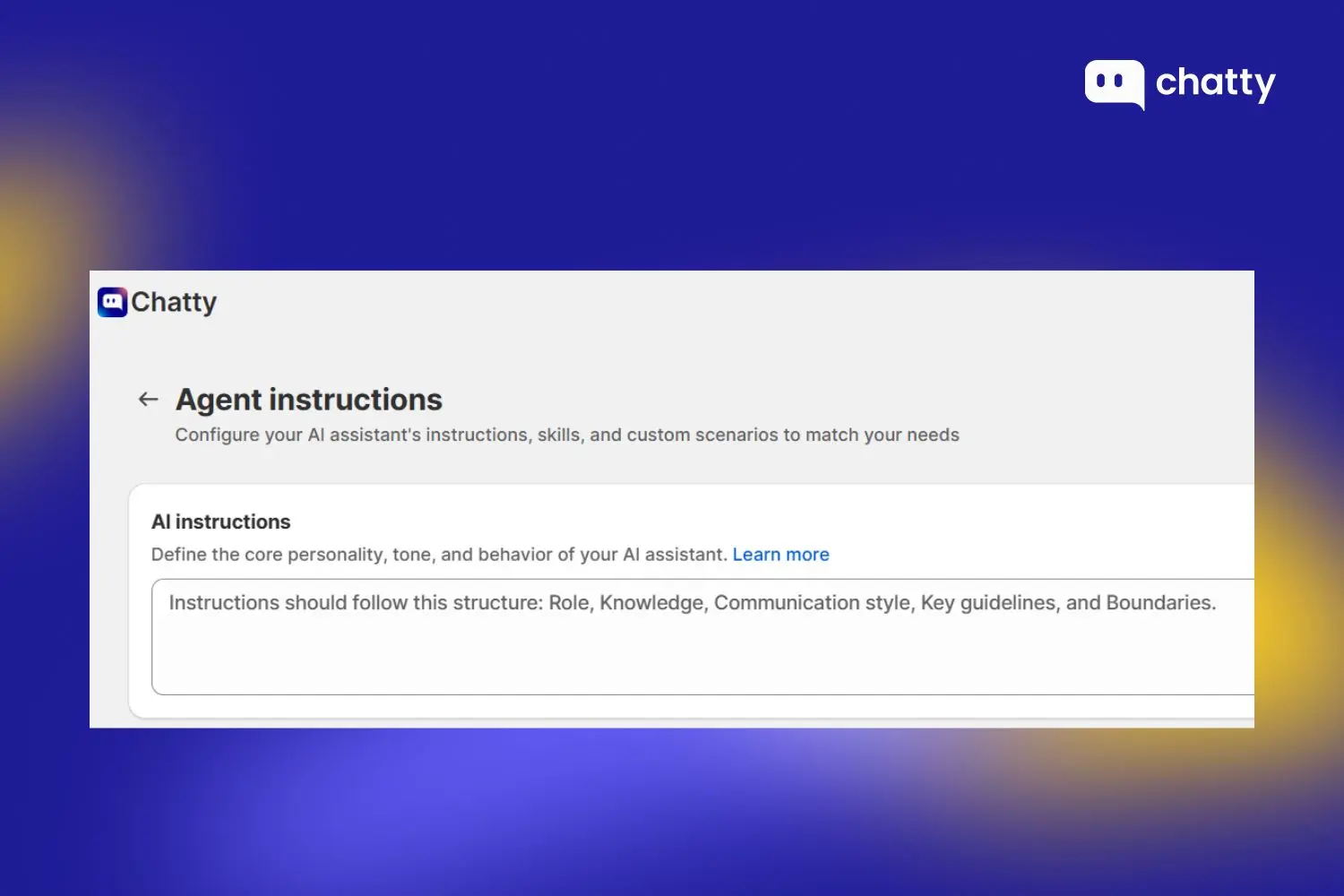
The first step is to identify the specific roles your AI agent will play. These roles determine how your AI interacts with customers and the type of expertise it needs to display. Common roles include:
- Product Advisor: Helps customers choose the right product based on preferences, needs, and past purchases.
- Stylist/Consultant: Offers personalized recommendations, especially in fashion, beauty, and lifestyle sectors.
- Technical Specialist: Explains technical details and product specifications, ideal for electronics or software.
- Lead Qualification Agent: Engages potential leads, gathers information, and determines readiness to purchase.
- Post-Purchase Support Agent: Handles follow-ups, troubleshooting, and customer satisfaction queries.
Clearly defining these roles ensures your AI has the right personality, knowledge, and response style for each interaction.
Step 2: Train the agent
Training is where your AI agent becomes effective. Start by feeding it with product data, including specifications, images, and unique selling points. Next, add scenarios, FAQs, and common objections to help it respond naturally to customer questions.
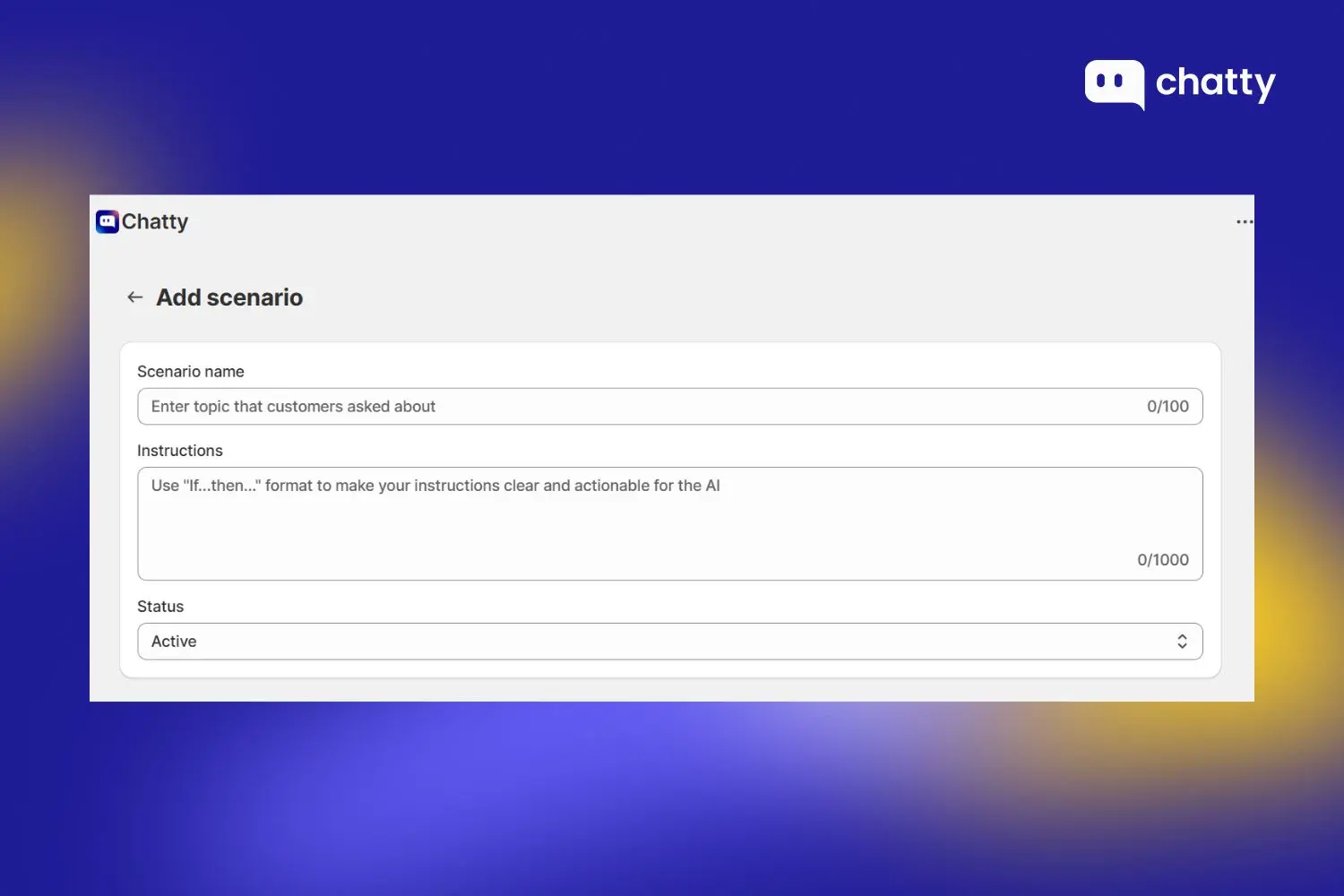
Incorporate your brand tone so the AI communicates consistently with your brand voice. You can also add sales scripts tailored for different product categories or customer segments. Finally, conduct internal testing to identify gaps in responses and refine interactions before going live.
Step 3: Connect commerce actions
An AI sales agent is most effective when it can perform real commerce actions, not just answer questions. Key integrations include:
- Add-to-cart and checkout: Streamline the purchase process directly from the AI interface.
- Discount rules: Apply promotional offers automatically.
- Inventory sync: Prevent overselling by connecting to real-time stock levels.
- Shipping and time estimates: Provide accurate delivery information.
- Appointment booking: Allow customers to schedule services like consultations or demos.
These capabilities make the AI agent an actionable part of your sales workflow.
Step 4: Test live scenarios
Before full deployment, simulate live interactions to ensure the AI can handle:
- Complex questions and comparisons between products.
- Multi-step reasoning where the AI needs to track context.
- Edge cases like unusual requests or conflicting data.
- Pricing confusion or promotions.
- Emotional reassurance scenarios are critical in beauty, wellness, or fashion sectors where customer confidence drives purchase decisions.
Testing with realistic situations ensures your AI can provide value in any conversation.
Step 5: Go omnichannel
Finally, deploy your AI across all customer touchpoints for maximum impact:
- Homepage widgets and product page advisors to guide browsing.
- Checkout assistants to reduce cart abandonment.
- Zalo/Messenger for regional markets with localized messaging.
- Post-purchase follow-ups via email using the AI’s memory to provide personalized recommendations or support.
An omnichannel AI sales agent creates a seamless experience, turning casual visitors into loyal customers while providing consistent, high-quality engagement.
Proven use cases for AI sales agents
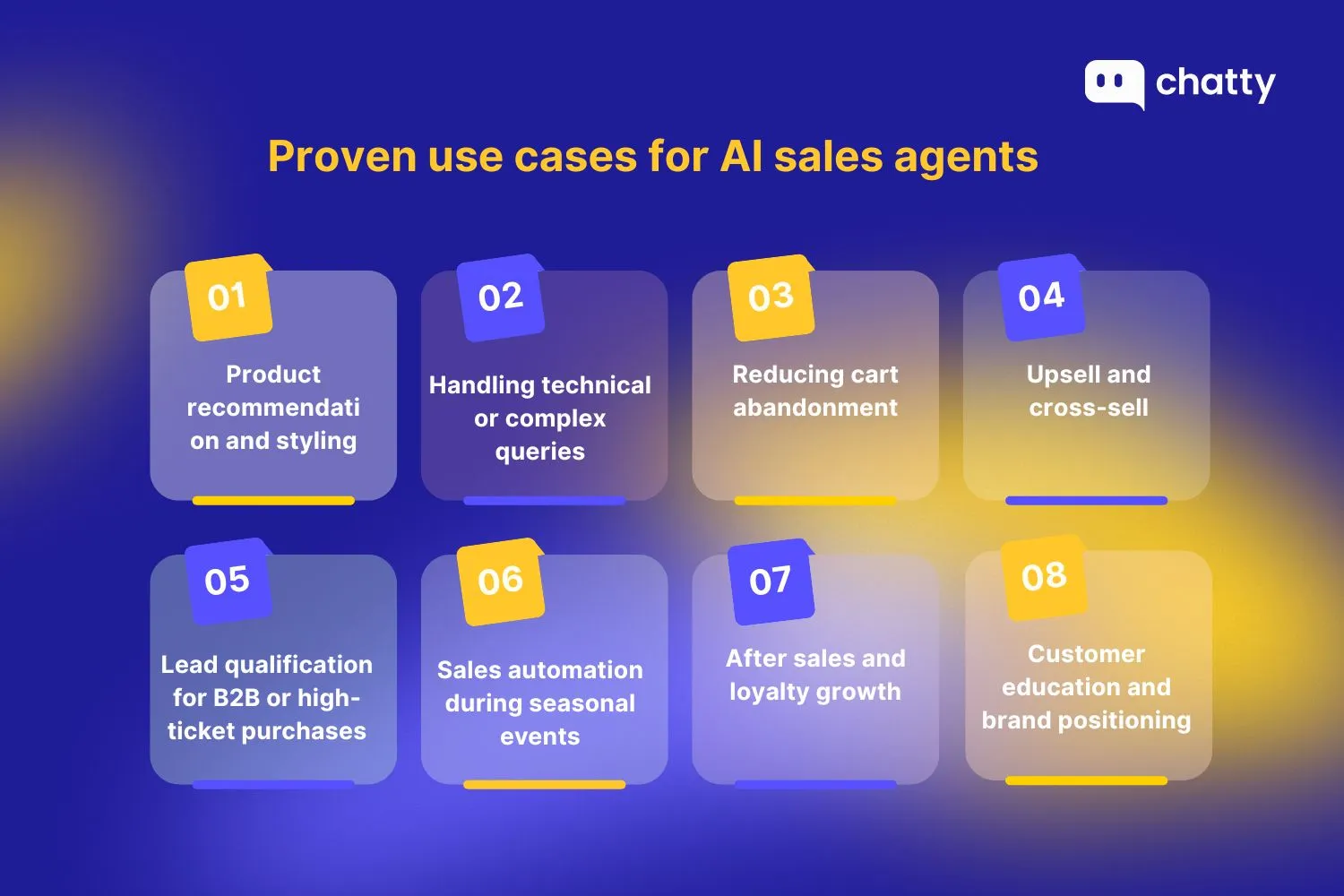
Below are proven use cases supported by real examples from leading brands and platforms.
Product recommendation and styling
AI agents analyze browsing behavior, past purchases, and stated preferences to suggest highly relevant products. Fashion retailers use conversational assistants that ask about style preferences and recommend outfits or matching accessories in real time. WotNot reports that retail chatbots can propose items, offer styling guidance, and even apply discount codes directly inside the chat flow. This creates a personalized shopping experience that increases conversion and average order value.
Handling technical or complex queries
In B2B and technical industries, customers often require detailed explanations before making a purchase. Companies such as Docket provide AI Sales Engineer systems that answer technical questions, assist with RFP responses, and pull information from internal documentation, CRM data, and Slack threads. This makes expert-level support available at all times and shortens the sales cycle for complex products.
Reducing cart abandonment
AI agents can intervene when shoppers hesitate at checkout. Voice.ai highlights how conversational agents clarify return policies, explain shipping costs, provide real-time reassurance, or offer targeted incentives. This intervention reduces friction during the checkout process and leads to stronger conversion rates. Brands use these assistants to recover shoppers who would otherwise leave the site.
Upsell and cross-sell
E-commerce brands increasingly use AI-powered recommendation systems to suggest complementary or upgraded products in real time. For example, many Shopify stores using LimeSpot generate personalized “frequently bought together” bundles and cart-upsell prompts based on browsing and purchase behavior, leading to increases in average order value of up to 32%. Similarly, fashion retailers using Vue.ai employ AI-driven “Complete-the-Look” recommendations to surface matching items, resulting in higher cart additions and revenue lift
Source: AI Recommendation System.
Lead qualification for B2B or high-ticket purchases
AI chatbots engage visitors, ask qualifying questions, and route high-intent leads directly to human representatives. Drift reports that companies like Wrike used AI qualification to increase pipeline contribution by more than four hundred percent. This automation ensures sales teams spend their time on the most promising prospects.
Source: Real-Life Examples of Sales Chatbots In Action
Sales automation during seasonal events
During high traffic periods such as Black Friday or product launches, AI agents manage outreach, respond to inquiries, and schedule follow-ups around the clock. SuperAGI documents a case where a company used an AI-driven virtual sales team integrated with Salesforce to maintain uninterrupted engagement during peak demand.
After sales and loyalty growth
AI agents manage order tracking, refund flows, satisfaction surveys, and proactive follow-up. Voice.ai highlights how these systems collect ongoing signals about customer sentiment and trigger the right next step. This strengthens long-term loyalty and encourages repeat purchases.
Customer education and brand positioning
AI agents also serve as educators. Microsoft’s MSX Sales Copilot uses generative AI to recommend relevant learning or sales content to representatives based on real-time conversations. This helps brands deliver more informed and credible interactions, improving trust and overall brand perception.
Source: A case study of Generative AI in MSX Sales Copilot
Common mistakes brands make when building AI sales agents
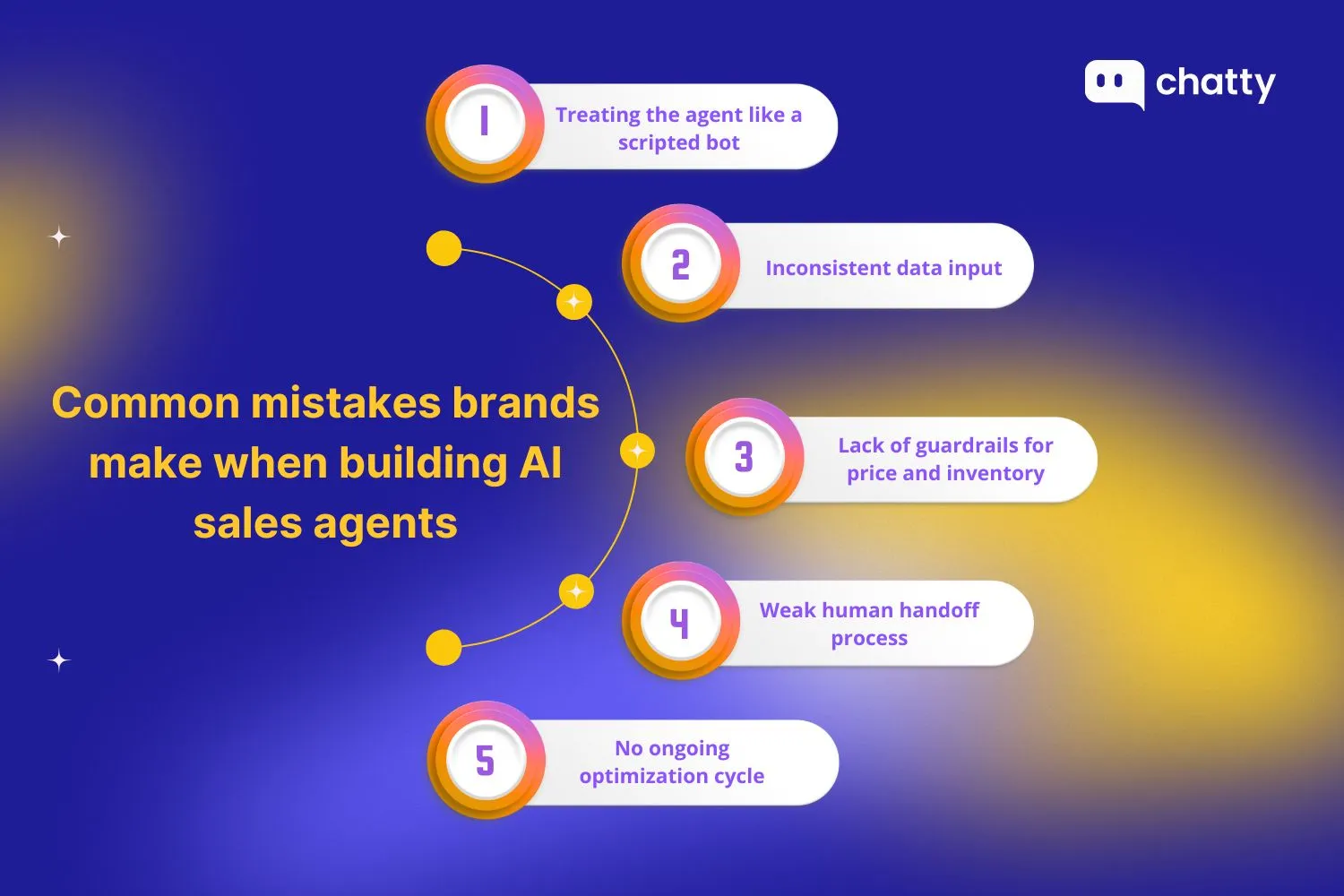
Treating the agent like a scripted bot
A frequent mistake is assuming an AI sales agent functions like a traditional rules-based chatbot. Brands often create rigid scripts instead of leveraging the agent’s ability to understand context, infer intent, and personalize responses. This results in stiff, repetitive conversations that fail to convert. AI sales agents need natural language training, examples of real conversations, and flexible dialogue flows that adapt to each user’s goals.
Inconsistent data input
AI agents are only as good as the data they receive. When product information, FAQs, pricing sheets, or policy documents are outdated or scattered across departments, the agent produces inconsistent answers. This damages trust and can lead to lost sales. Successful teams centralize and clean their data before training the agent, and they maintain a single source of truth for all customer-facing knowledge.
Lack of guardrails for price and inventory
Without constraints, AI agents may recommend sold-out items, share outdated prices, or promise discounts that do not exist. This creates operational headaches and customer dissatisfaction. Brands must set guardrails for pricing, inventory levels, refund eligibility, and promotional rules. Real-time integrations are essential to ensure the agent always speaks from accurate, up-to-date information.
Weak human handoff process
AI should not replace humans entirely. A major failure point occurs when customers cannot seamlessly escalate to a real sales representative. Without clear triggers, live chat routing, and context transfer, high-intent buyers can drop off. A smooth handoff should preserve conversation history and instantly notify the right team.
No ongoing optimization cycle
Many brands treat AI training as a one-time task. However, customer behavior, products, and market conditions evolve continuously. AI agents require ongoing monitoring, conversation review, A/B testing, and retraining to improve accuracy. Teams that adopt a monthly optimization cycle see significantly better performance over time.
Challenges and considerations
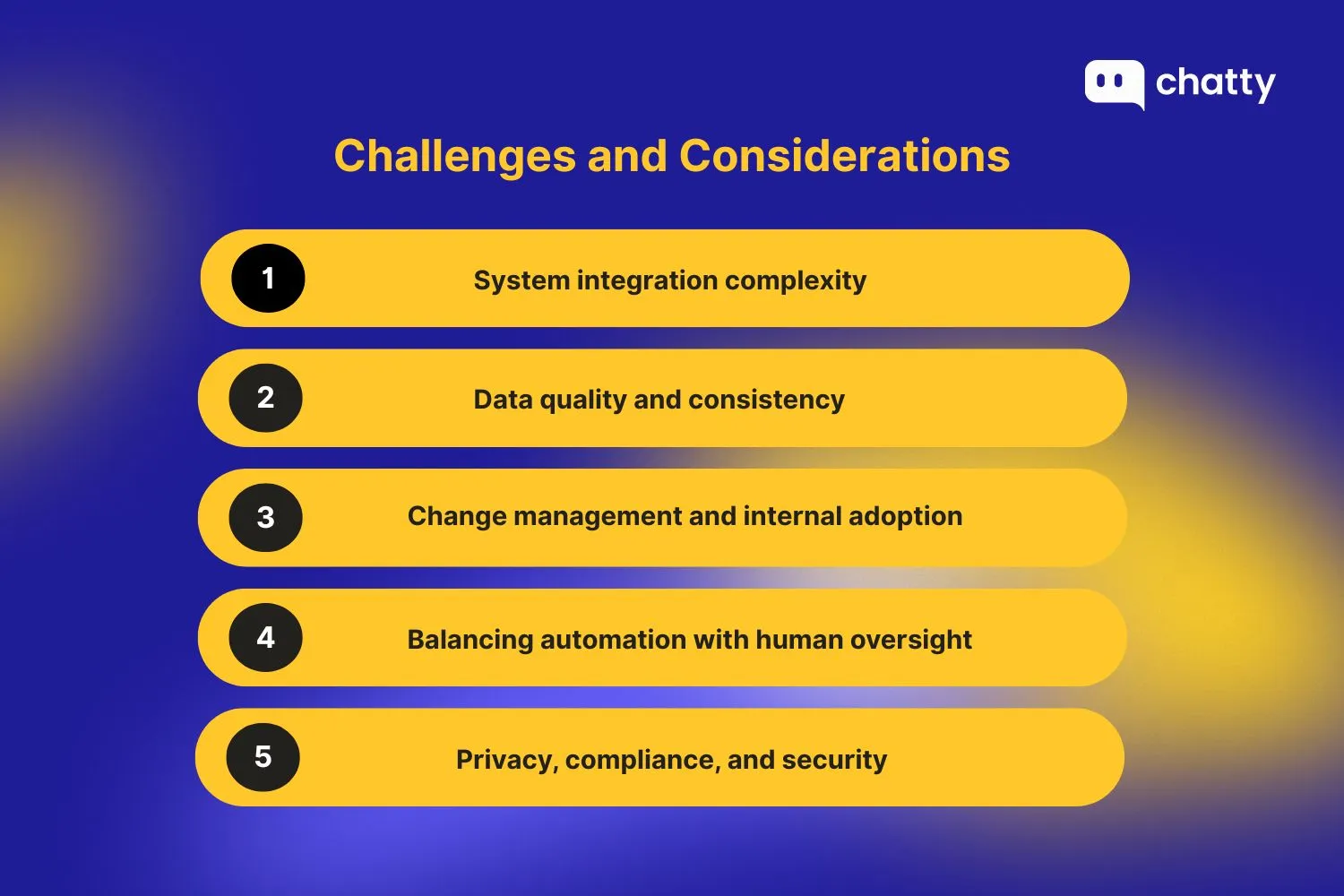
System integration complexity
AI sales agents must seamlessly connect with CRM systems, marketing automation platforms, data warehouses, support tools, and, sometimes, even inventory and pricing engines. Without deep integration, the agent cannot access real-time customer information or execute tasks autonomously. Many companies underestimate the integration effort, leading to incomplete data syncs and inconsistent responses. Choosing tools with strong APIs or native integrations reduces this friction.
Data quality and consistency
AI agents rely heavily on structured, accurate, and unified data. When product catalogs, customer profiles, or historical interactions are outdated or fragmented across departments, the agent produces incorrect recommendations or misclassifies leads. Maintaining clean datasets, establishing clear data governance rules, and aligning departments on a single source of truth are critical for reliable performance.
Change management and internal adoption
Even the best AI agent will fail if the sales team lacks trust in it. Many reps fear that AI will replace their roles or reduce their control over customer interactions. Effective change management requires transparent communication, hands-on training, and showing how AI reduces repetitive tasks rather than taking over relationship-building or negotiation.
Balancing automation with human oversight
AI cannot handle every scenario, mainly high-value deals, sensitive negotiations, or complex technical questions. Brands must establish clear guidelines for when the agent should escalate to a human, how to track these moments, and how to preserve full context for seamless handoff. A human-in-the-loop approach ensures accuracy while preventing the agent from making risky decisions.
Privacy, compliance, and security
Because AI sales agents process sensitive customer data, companies must ensure compliance with regulations such as GDPR, CCPA, and industry-specific standards. Vendors should offer strong encryption, role-based access, and transparent data handling. Failure to do so can expose brands to legal risk and erode customer trust.
Final thought
AI sales agents are practical tools that help e-commerce stores drive sales and increase customer satisfaction. They also reduce operational strain. By defining roles clearly and training your agent with accurate data, you can build an AI sales agent that delivers personalized experiences. Integrating it across your store ensures it boosts conversions. From product recommendations to post-purchase support, the right AI agent acts like a revenue-generating team member. Start small, test thoroughly, and scale gradually. This approach makes your AI sales agent a core driver of growth for your store.