












When customers browse, hesitate, and leave, the issue is rarely the product; it's the lack of direction. That's why AI product recommendation has become a practical focus for commerce teams today. This article examines where recommendations create real impact, how they shape everyday buying decisions, and which use cases consistently deliver results across the customer journey. Let's take a closer look at how these moments actually play out.
- Customers leave not because they dislike the product but because they lack direction in a crowded catalog.
AI product recommendations solve the direction problem by continuously analyzing behavior and context to surface the one product most likely to match each shopper's actual intent.
- Collaborative filtering learns from millions of similar user interactions to predict what each individual will want next.
This group-intelligence approach means new shoppers with limited history still receive relevant suggestions because the system borrows signal from thousands of comparable behavioral patterns.
- Real-time session models recalculate recommendation relevance scores in milliseconds as shoppers scroll, filter, and search.
This short-term intent detection allows the engine to respond to signals like comparison shopping or price sensitivity within the current visit, not just historical purchase patterns.
- Poor product data tagging is the most common reason AI recommendation engines underperform in practice.
When product attributes, categories, and variants are inconsistently structured, the AI cannot reliably compare or rank items, making even sophisticated models produce irrelevant suggestions.
- AI recommendations influence buying decisions across every channel, from storefronts and search results to emails and chat.
Effective integrations deliver consistent, low-latency suggestions across all touchpoints by reusing recommendation outputs rather than running separate models per channel.
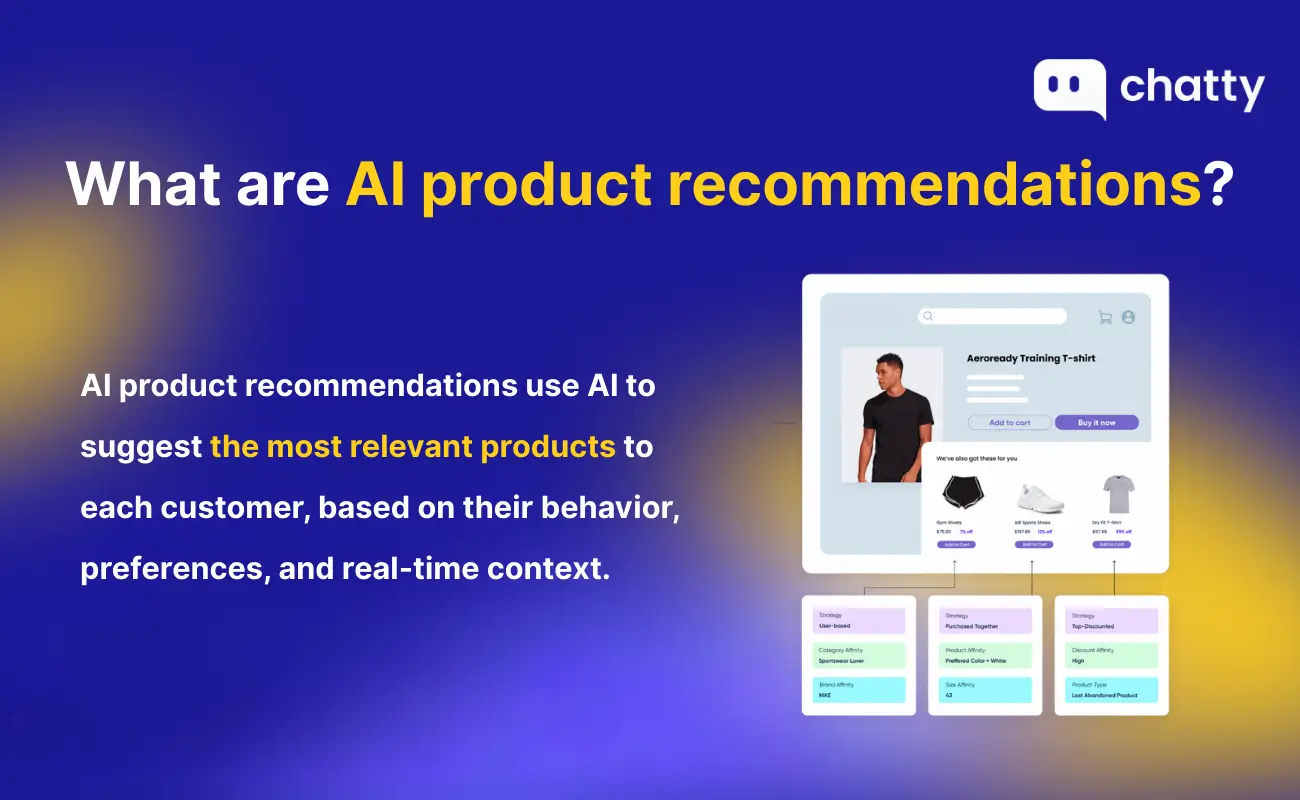
What are AI product recommendations?
AI product recommendations use AI to suggest the most relevant products to each customer, based on their behavior, preferences, and real-time context. Unlike traditional rule-based systems, such as fixed "best seller" lists or manually defined bundles, AI-driven recommendations continuously learn from data. As customer behavior changes, the system adapts automatically, allowing suggestions to reflect both historical preferences and real-time intent.
Behind this decision-making process is a layered set of technologies:
- Machine learning models that identify patterns across users and products
- Neural networks that capture complex relationships beyond simple rules
- Collaborative filtering, which learns from similar users' interactions
- Content-based filtering, which matches product attributes to individual interests
- Contextual and real-time models that adjust recommendations within a live session
AI sits at the top of this stack, while machine learning and data science provide the analytical foundation that powers modern recommender systems.
The accuracy of these recommendations depends directly on the input data. Core signals typically include:
- Customer behavior such as browsing, clicks, and purchase history
- Product metadata, including attributes, categories, pricing, and availability
- Catalog structure, like variants and product relationships
- Contextual signals, including device, location, and timing
When these inputs are structured and reliable, AI recommendations move beyond generic suggestions and become predictively relevant.
How AI product recommendation engines work
At a high level, AI recommendation engines follow a clear pipeline, from collecting signals to delivering personalized suggestions in real time. Here's how that process works in practice.
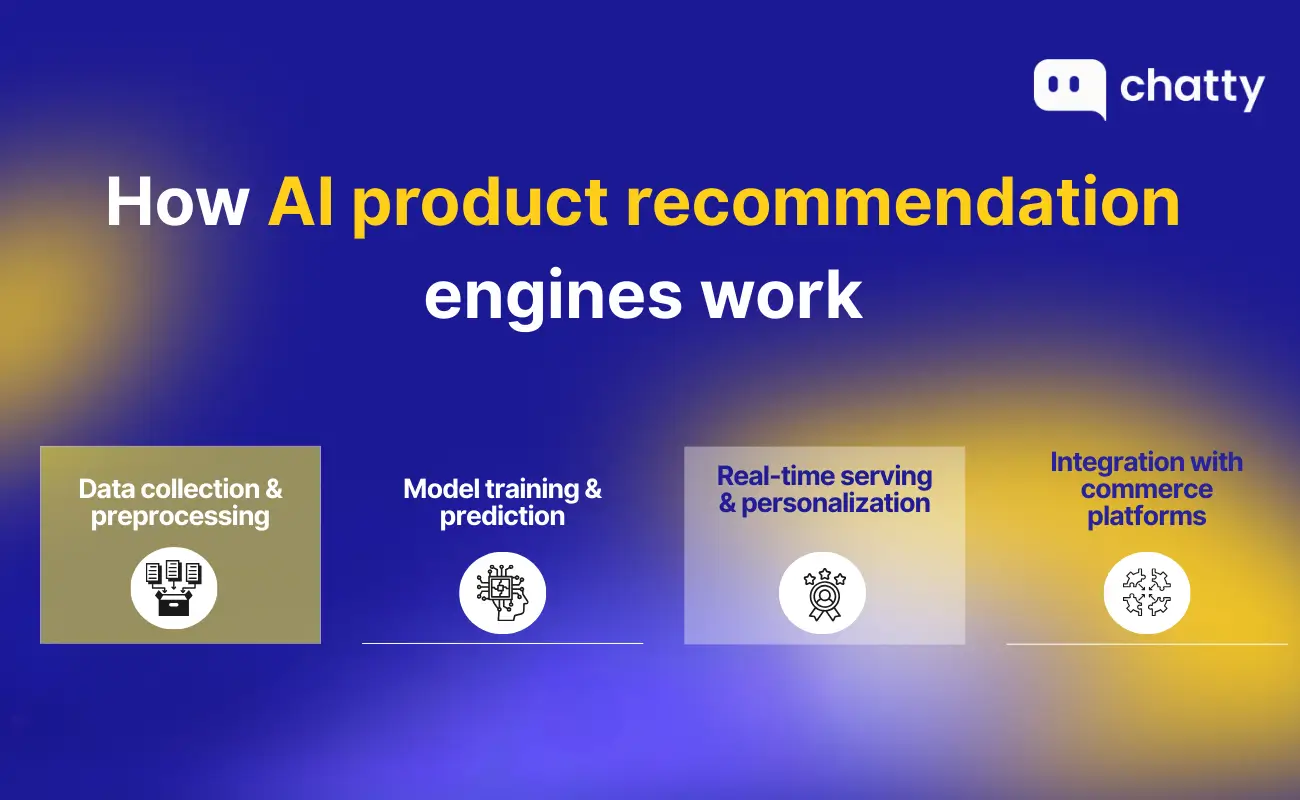
- Data collection and preprocessing: Engines consolidate user signals (views, clicks, carts, purchases) with product data (attributes, pricing, availability, categories). This data is cleaned, standardized, and aligned to a consistent catalog structure. If products are poorly tagged or inconsistently categorized, the engine cannot reliably compare or rank them.
- Model training and prediction: With clean data in place, models are trained to predict outcomes such as click-through or purchase likelihood. Instead of learning "what sells best," the engine learns who is likely to engage with which product under specific conditions. As new interactions occur, models are regularly retrained or updated.
- Real-time serving and personalization: During a live session, recommendations are recalculated continuously. Each interaction (scrolling, filtering, searching) updates relevance scores in milliseconds. This allows the engine to respond to short-term intent, such as comparison shopping or price sensitivity.
- Integration with commerce platforms: Recommendations are delivered via APIs or native plugins into storefronts, search results, emails, or messaging tools. Effective integrations prioritize low latency, respect inventory and pricing logic, and reuse outputs across channels to avoid inconsistent experiences.
Together, these steps turn raw interaction data into actionable product suggestions that scale without manual rules.
Why AI product recommendations matter
At first glance, product recommendations may seem like a small detail, but they influence more decisions than most teams expect.
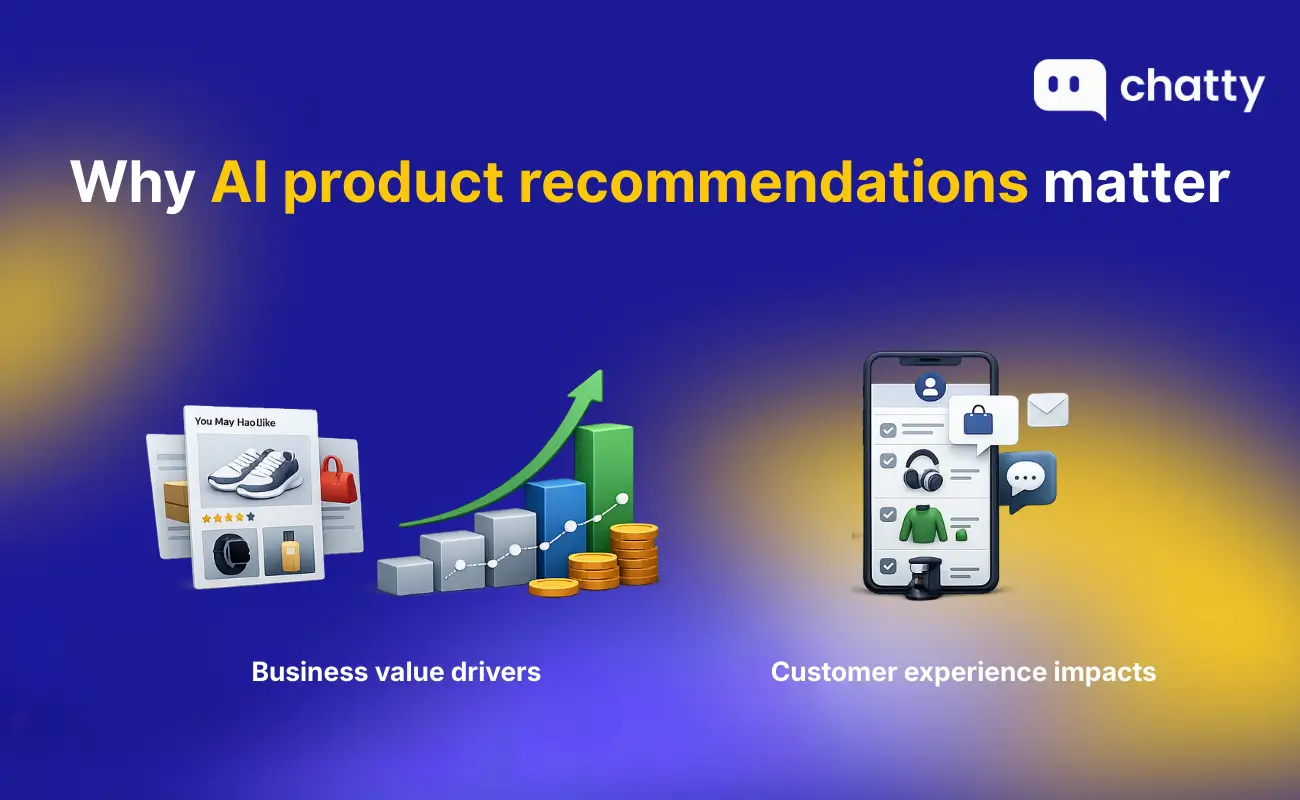
Business value drivers
From the business side, the impact of recommendations often shows up quietly but consistently.
- Revenue uplift through better decisions: AI recommendations improve conversion rates and average order value by prioritizing products customers are statistically more likely to buy next. Common examples include "frequently bought together" bundles or complementary add-ons, both of which increase basket size without aggressive upselling.
- Customer retention and lifetime value: Consistently relevant recommendations keep customers engaged beyond a single purchase. By anticipating repeat needs and surfacing useful follow-up products, AI supports ongoing engagement and directly contributes to stronger user retention over time.
- Cost efficiency and reduced search friction: AI lowers operational overhead by replacing manual rules with automated decision-making. At the same time, customers spend less time searching or filtering, which reduces abandonment and support burden.
Customer experience impacts
Beyond revenue, AI recommendations play a critical role in shaping how effortless the experience feels.
- Personalization that reduces cognitive load: By narrowing choices to what is most relevant, AI helps customers decide faster with less effort. This noise reduction is a defining characteristic of effective personalized customer experience.
- Omnichannel consistency: The same recommendation logic can be applied across web, app, email, and SMS, ensuring customers receive coherent suggestions regardless of where they interact.
AI product recommendation use cases
AI product recommendations show their real value when applied at specific moments in the customer journey. Below are the most common and effective use cases.
1. E-commerce storefront recommendations
On-site recommendations are the most established and widely deployed use case. Here, AI analyzes browsing behavior, purchase history, and product relationships to surface relevant items directly on homepages, category pages, and product detail pages where purchase decisions actually happen.
Common implementations include:
- "Recommended for you" sections tailored to individual behavior
- "Frequently bought together" or bundle suggestions based on co-purchase patterns
- Similar or complementary products shown alongside viewed items
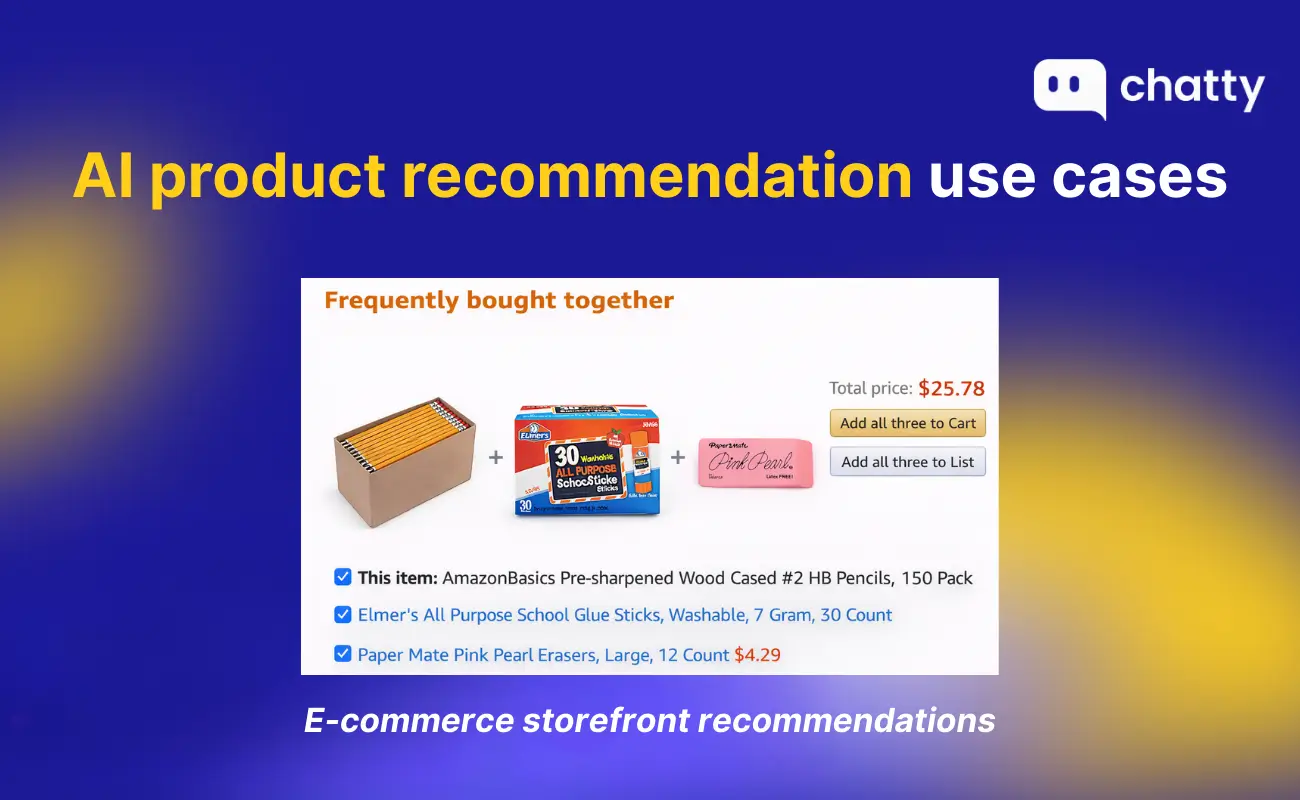
This reduces choice overload by narrowing options to what is most likely to convert. At scale, the impact is measurable: Amazon has publicly stated that product recommendations account for roughly 35% of its e-commerce revenue, driven largely by relevant cross-sell and upsell suggestions shown at the right moment.
2. Search and discovery enhancement
Search is where recommendations compensate for unclear intent. Many queries are broad ("wireless headphones") or exploratory ("gift ideas"), and keyword matching alone cannot infer what the customer will ultimately choose.
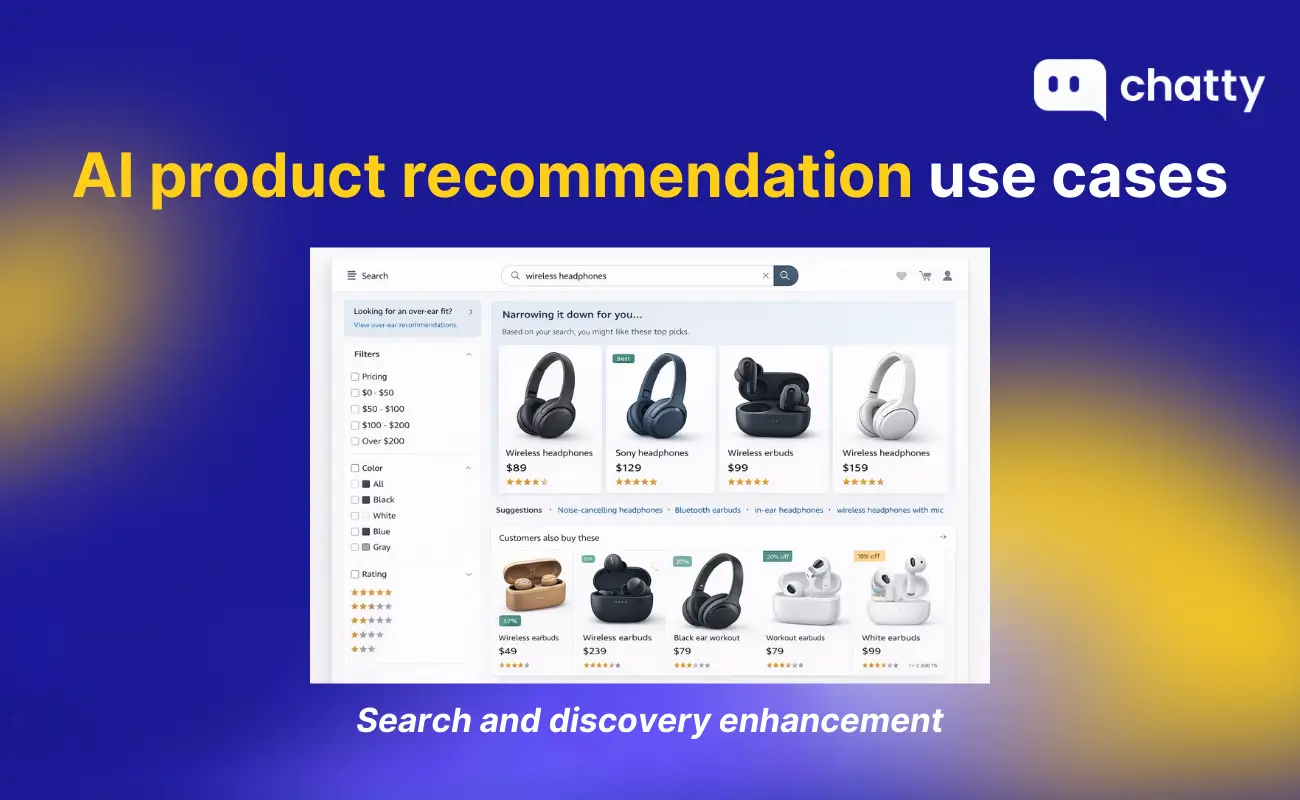
Here, AI recommendation engines work alongside search by:
- Re-ranking results based on predicted likelihood to engage or convert
- Introducing alternatives when the initial query is too narrow or vague
- Personalizing rankings using past behavior and peer patterns
By learning which products similar users ultimately choose, AI helps guide discovery faster, reducing dead-end searches and improving overall conversion without changing the search interface itself.
3. Conversational and chat-based product recommendations
Conversational commerce delivers product recommendations directly inside live chat or chatbot conversations, rather than on static pages. Instead of relying only on historical behavior, AI generates suggestions dynamically as the conversation progresses.
Here, AI evaluates:
- The customer's questions and stated intent
- Conversation context and follow-up clarifications
- Product attributes, pricing, and real-time availability
Because recommendations respond to what customers actively say, this approach is effective at reducing hesitation and helping conversations drive sales without feeling scripted. Gartner estimates that by 2027, chatbots will become the primary customer service channel for roughly 25% of organizations, accelerating the adoption of conversational discovery.
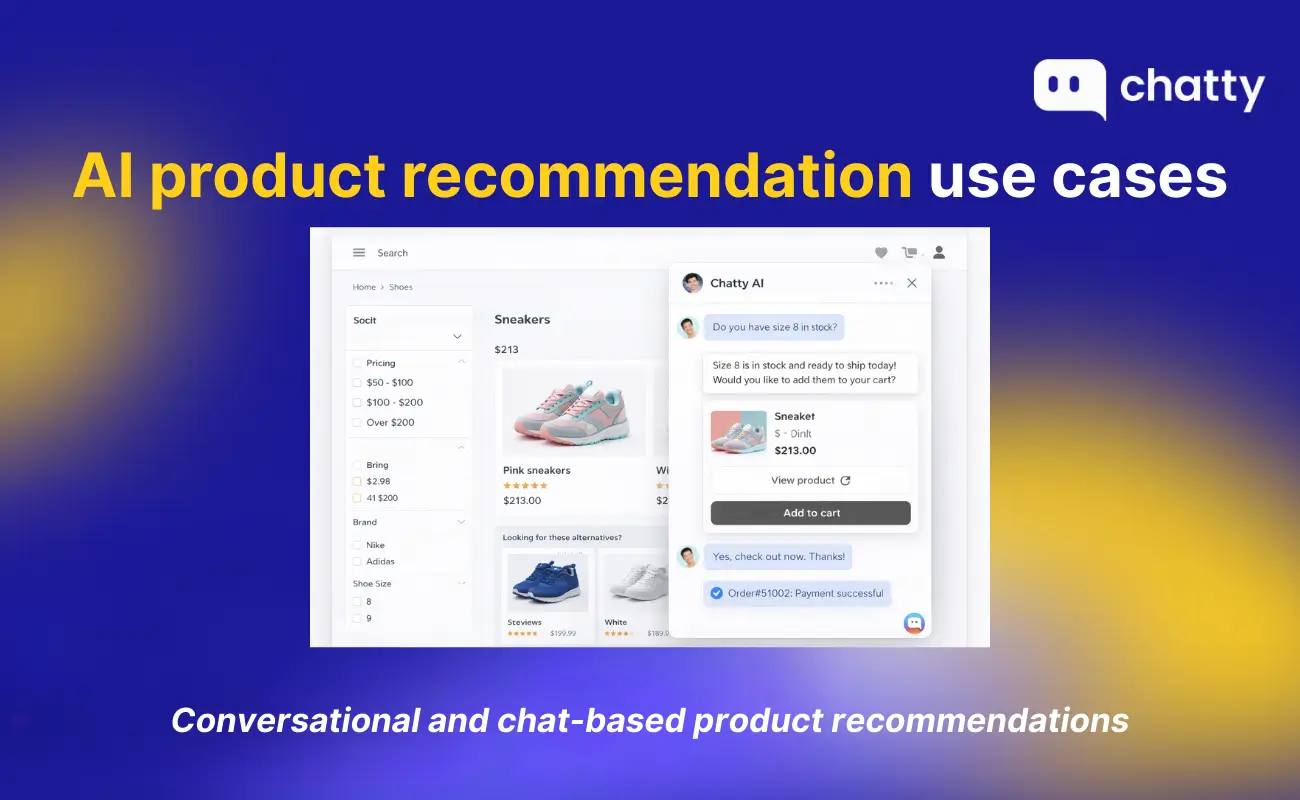
AI-powered chat assistants such as Chatty AI follow this approach by syncing the product catalog into the AI's knowledge layer and using live conversation signals to deliver intent-driven recommendations during customer chats. This shifts recommendations from behavior-only signals to language- and intent-based personalization.
[banner-option-2 title="See AI recommendations in action." meta="Decathlon trained Chatty on 10,000+ products and hit 96.6% auto-resolution with €10,964 in assisted revenue. Try it on your store." button_text="Try Chatty Free" button_link="https://apps.shopify.com/chatty?utm_source=chatty_blog&utm_medium=cta_banner&utm_campaign=banner_2_social_proof&utm_content=ai-product-recommendation"]4. Email and campaign personalization
In marketing automation, AI product recommendations personalize outbound messages at scale. Instead of inserting static product blocks, AI dynamically selects products for each recipient based on predicted intent and past interactions.
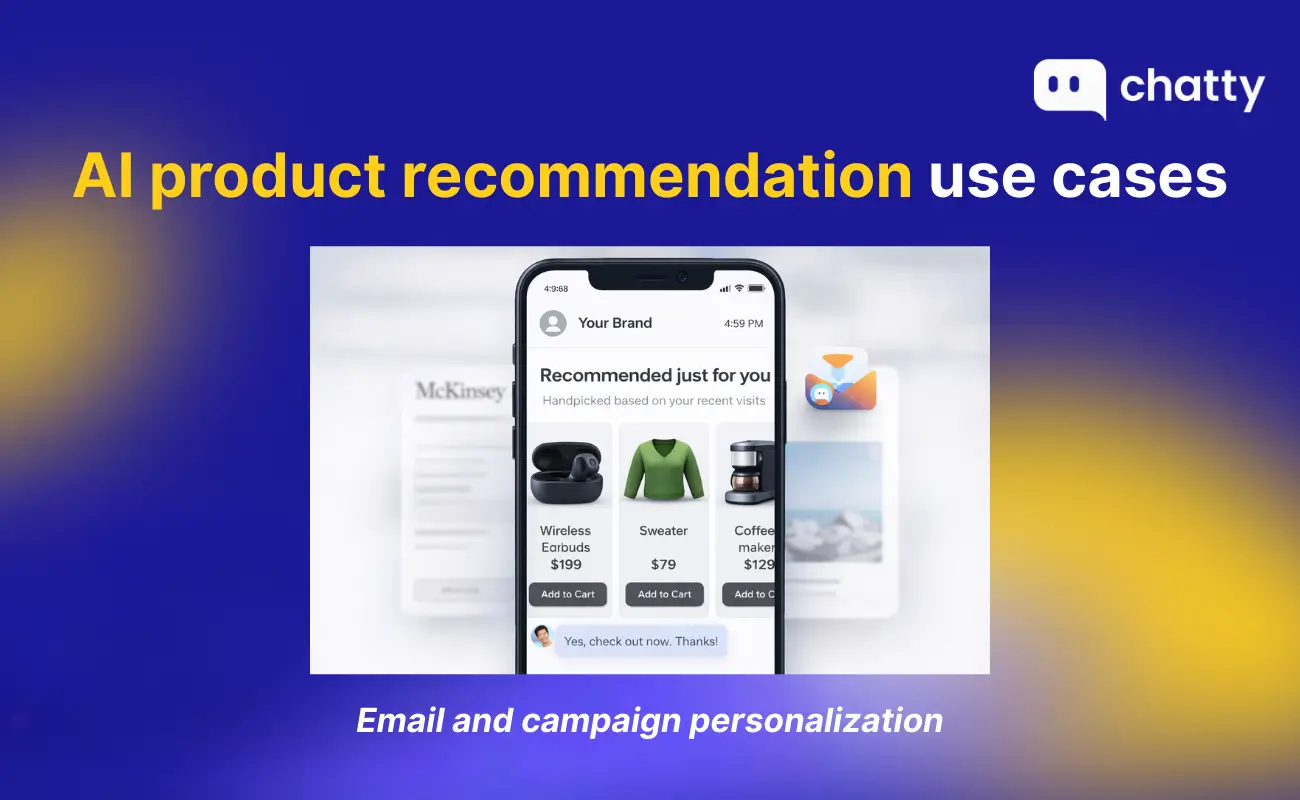
Typical applications include:
- Personalized product grids in promotional emails
- Abandoned cart and browse recovery recommendations
- Replenishment or repeat-purchase suggestions
This approach mirrors how customers now expect brands to communicate, closely aligning with principles of personalized customer service across digital touchpoints. McKinsey estimates that effective personalization can lift revenue by 10-15%, which explains why AI-driven product selection is now a core part of email and campaign automation.
5. Cross-channel and omnichannel recommendations
Advanced recommendation strategies focus on consistency rather than isolated optimization. The same AI logic is applied across multiple touchpoints to ensure customers receive coherent suggestions wherever they interact.
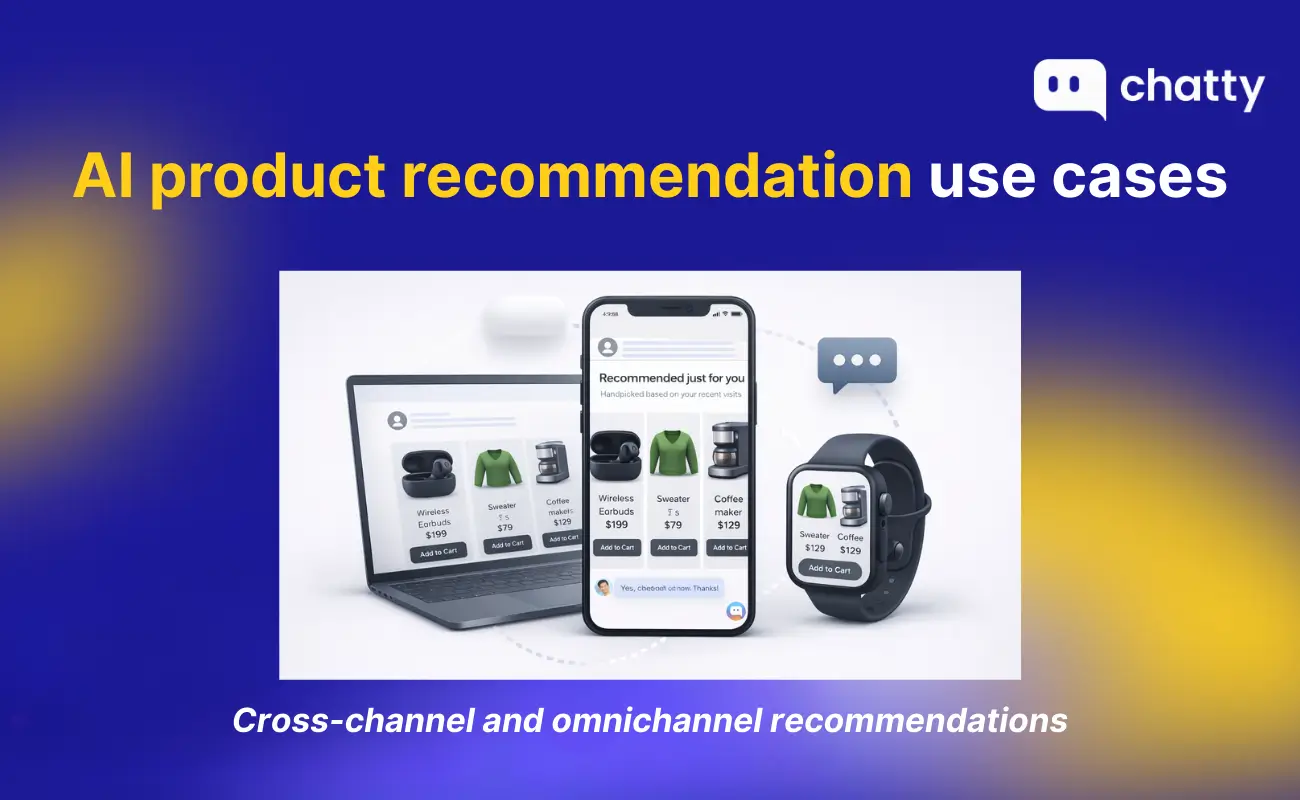
In practice, recommendations can be delivered consistently across:
- Websites and mobile apps, where browsing and purchasing occur
- Email and SMS campaigns, where re-engagement happens
- Live chat and AI assistants, where intent is expressed directly
This approach relies on a unified product data source and shared customer profile. When interactions in one channel inform recommendations in another, businesses avoid fragmented experiences and repeated discovery. The result is a smoother journey where recommendations feel continuous, not disconnected.
6. Post-purchase and retention use cases
After checkout, the role of recommendations shifts from driving conversion to sustaining long-term value. AI uses ownership and usage signals to determine what customers are likely to need next.
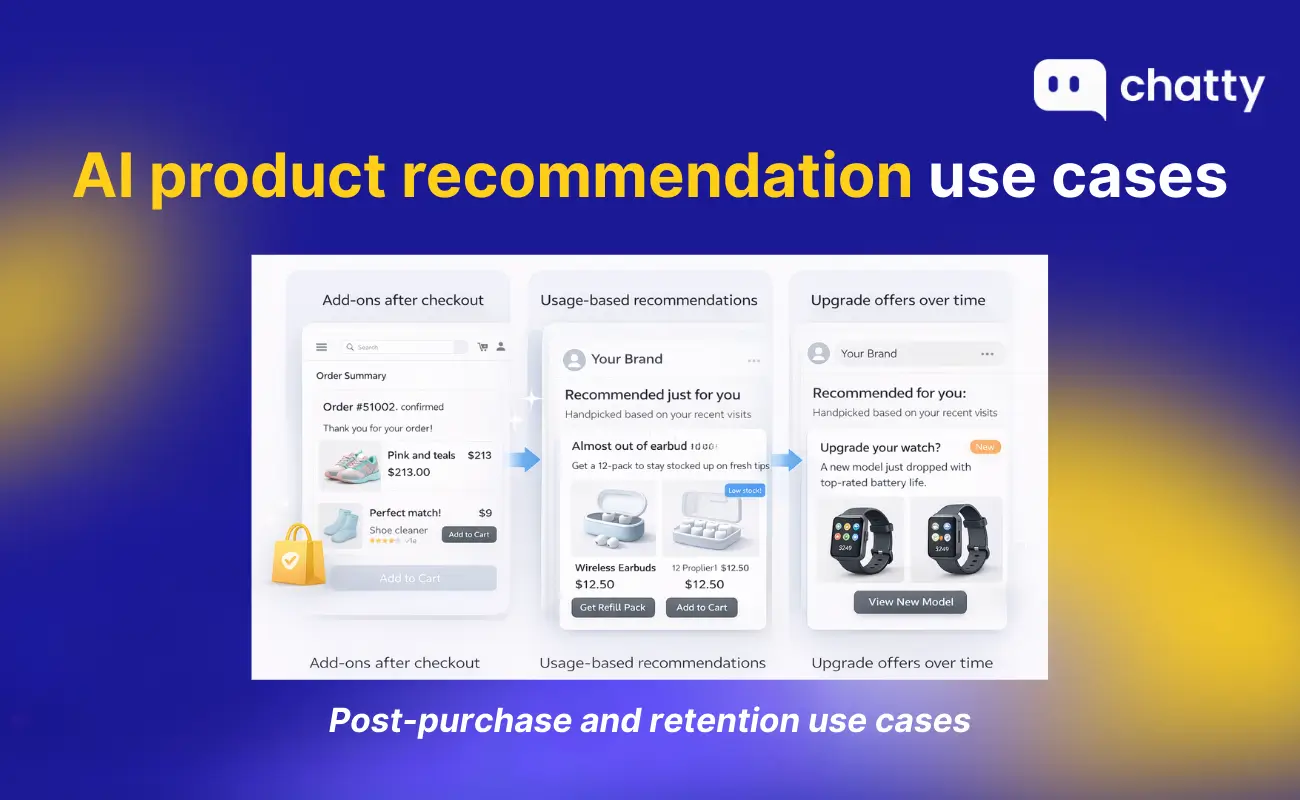
Common post-purchase applications include:
- Accessories or add-ons suggested immediately after checkout
- Usage-based product recommendations surfaced over time
- Replacement or upgrade prompts triggered by lifecycle patterns
Because these recommendations are tied to real product usage, they feel timely rather than promotional. Over time, this improves repeat purchase behavior and strengthens the customer satisfaction score by aligning recommendations with genuine customer needs.
Emerging trends and future of AI recommendations
Looking ahead, AI product recommendations are evolving in a few notable directions.
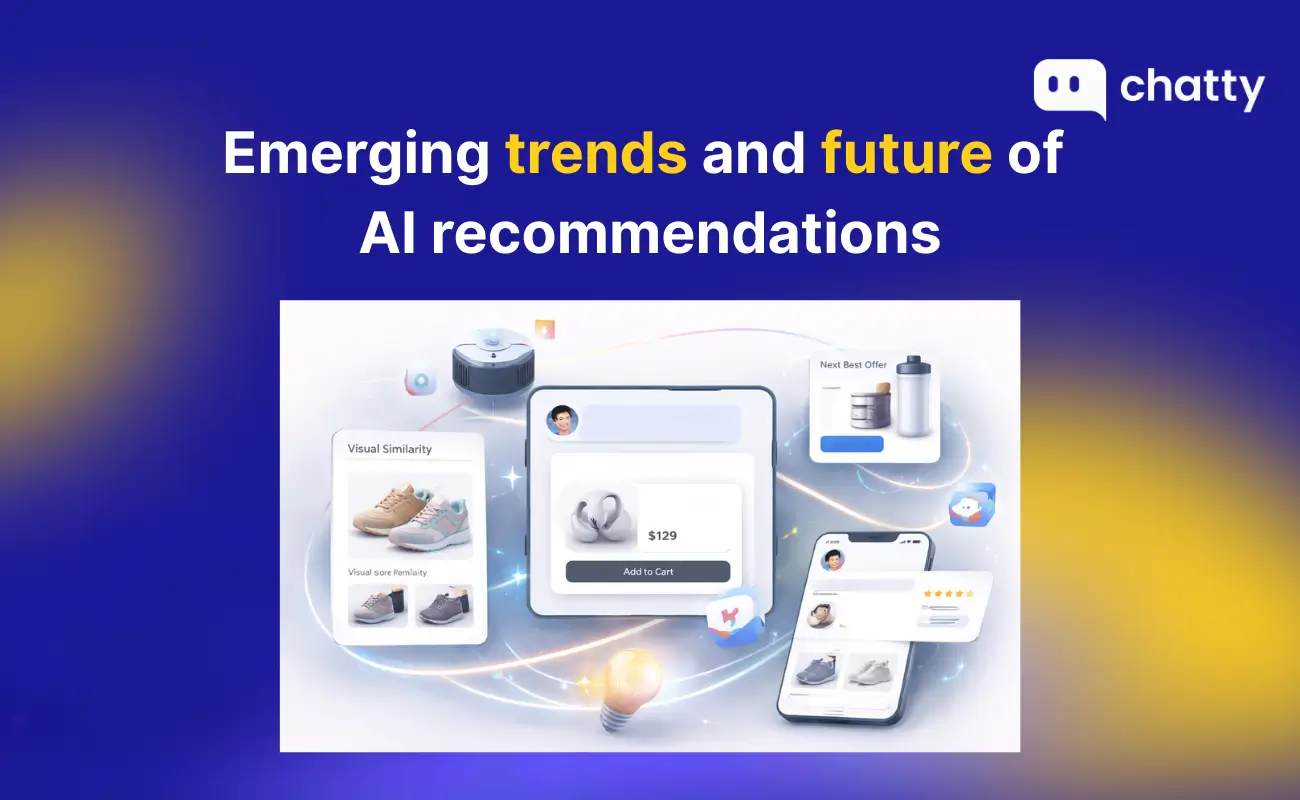
- Conversational and generative recommendation interfaces: Recommendations are moving into natural conversations. Instead of clicking filters or scrolling grids, customers explain needs in plain language, like budget, use case, constraints, and the system narrows options step by step. Practically, this reduces abandoned searches because customers no longer have to restart the search process.
- Multimodal recommendations using richer signals: Future engines combine multiple signals rather than relying solely on clicks. Images help identify visual similarity, reviews reveal why products work well (or poorly) in specific situations, and social signals highlight rising preferences. This allows recommendations such as visually similar alternatives with better reviews, rather than generic "related products."
- Predictive anticipation and next-best offers: By learning from repeat purchase cycles and patterns across similar users, systems can predict what a customer is likely to need next, such as refills, accessories, or upgrades, and surface them at the right time. This shortens the gap between need recognition and purchase, especially in high-frequency categories.
- Integration with voice and AI-powered search: As search becomes more conversational, recommendation logic is embedded directly into answers. Customers ask questions rather than browse categories, and suggested products are ranked as part of the response. This shifts recommendations from a separate feature to a core part of product discovery.
Final thought
AI product recommendation reshapes how customers discover and choose products by prioritizing relevance over volume. When driven by clean data, clear intent, and consistent logic across channels, it reduces friction and delivers measurable business impact. The real advantage isn't automation itself, but using AI to guide decisions at the moments that matter most.
FAQ
Yes, but the approach changes. When historical data is limited, AI relies more on contextual signals, product relationships, and real-time behavior. As interactions grow, recommendation accuracy improves naturally without needing large datasets upfront.
Yes. Modern AI systems do not require massive datasets to start delivering value. Even with moderate traffic, recommendations can improve relevance using real-time behavior and product relationships, then scale as data grows.
Yes. A single recommendation engine can power web, app, email, SMS, and chat. When channels share product data and customer signals, recommendations remain coherent rather than fragmented.
Early impact is typically visible within weeks. Conversion rates and average order value tend to improve first, while gains in repeat purchases and customer value become clearer over time as the system continues learning.
No. AI optimizes decision-making at scale, while humans define boundaries, such as margin priorities, brand constraints, or inventory rules. The strongest outcomes come from combining automation with strategic oversight.