












Last month, Decathlon made €1,000 in revenue through chat. But not by solving support tickets. The results were generated by AI-powered product recommendations. This marks a significant shift. Chat is no longer just a support channel. It’s turning into a direct path to purchase, with AI support.
Shoppers today expect more than answers. They want suggestions, shortcuts, and a faster way to get what they need. So, welcome to the age of conversational commerce, where messaging, AI, and personalization converge to help customers buy faster and enable merchants to sell proactively!
- Chat is no longer a support tool — it's now a direct revenue channel. Decathlon generated €1,000 in revenue through AI-powered product recommendations inside chat, not by resolving support tickets.
- Modern AI doesn't wait to be asked — it leads with proactive suggestions. Unlike old bots that opened with 'How can I help?', today's AI opens with 'Here's what you need,' driving sales first.
- Conversational commerce is best defined as a selling opportunity inside a conversation. Shopify describes it as using live chat or chatbots to guide customers, make product suggestions, and complete purchases within the chat experience.
- Smartphones in 2007 fundamentally changed what customers expect from brand interactions. Once messaging apps like WhatsApp and Messenger became daily habits, customers began expecting brands to respond quickly, casually, and helpfully.
- AI crossing into proactive selling marks the most significant shift in chat's entire history. From slow human agents in the 1990s to scripted bots to intent-aware AI, chat has evolved from reactive support to proactive commerce.
What’s conversational commerce?
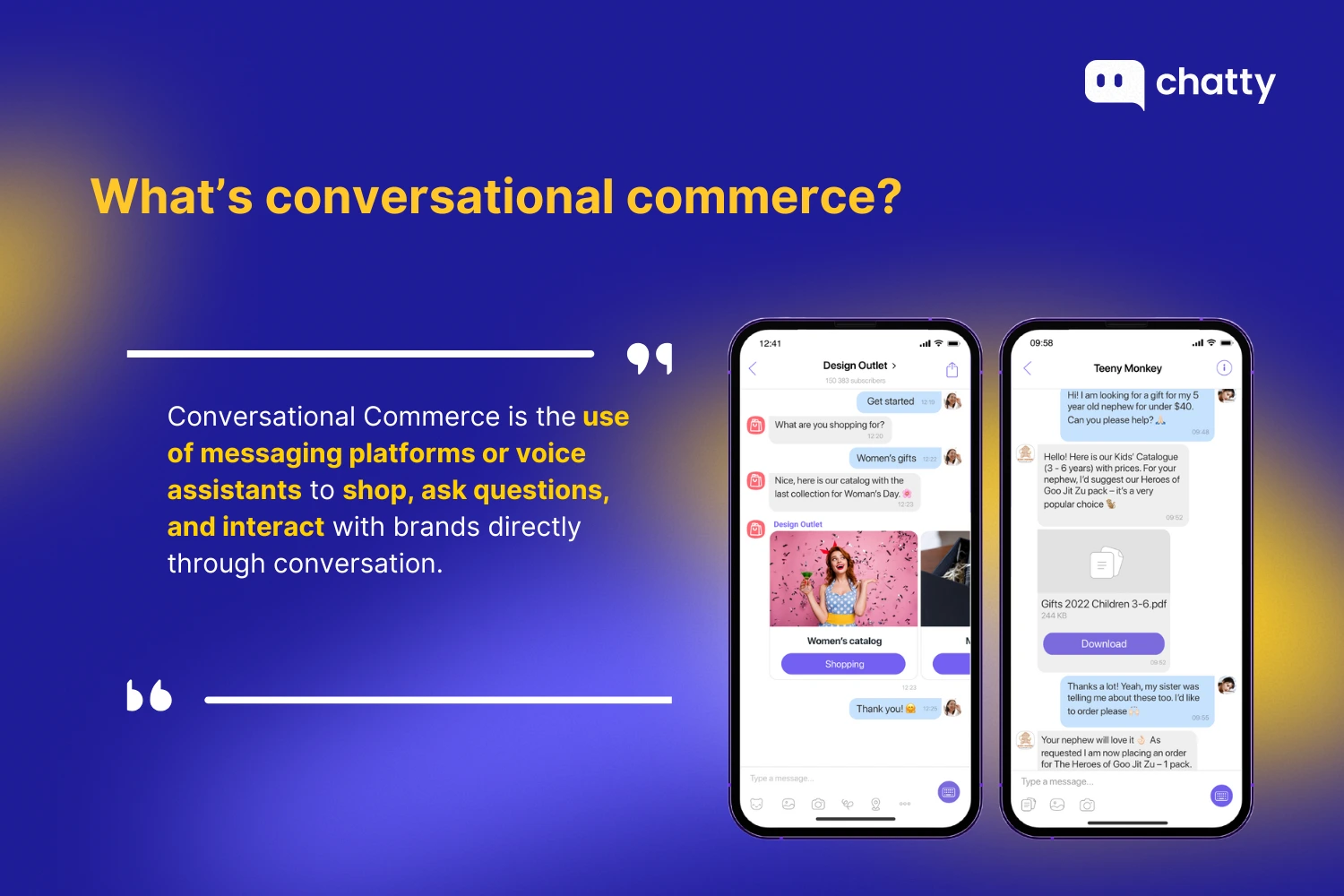
Chris Messina, who coined the term “Conversational Commerce”, defined it as the use of messaging platforms or voice assistants to shop, ask questions, and interact with brands directly through conversation.
Meanwhile, Shopify describes conversational commerce as a way for businesses to use live chat or chatbots to guide customers, make product suggestions, and drive purchases inside the chat experience.
In short, conversational commerce is best defined as a selling opportunity that happens inside a conversation.
Let’s go back: The journey of conversational commerce
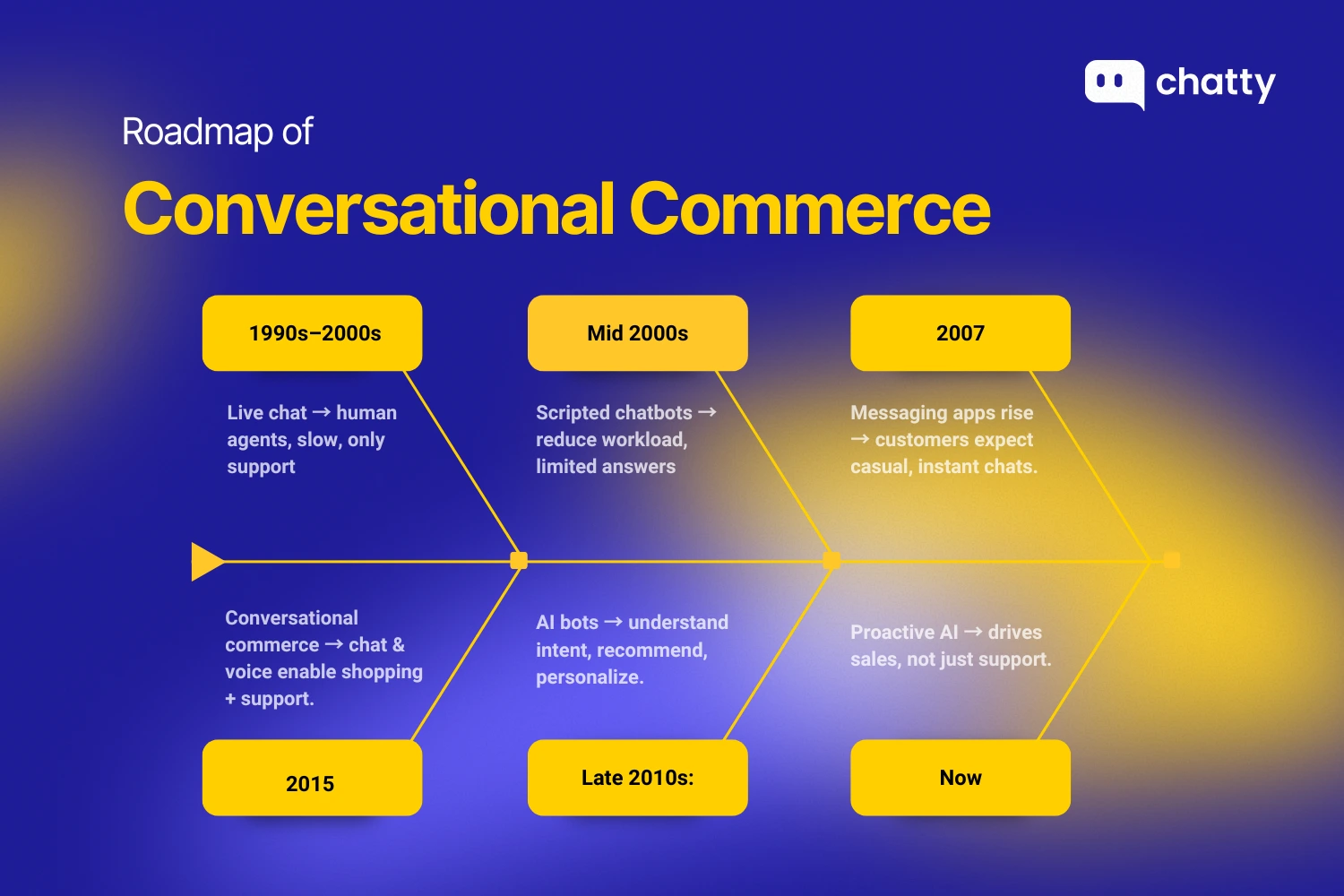
In the late 1990s and early 2000s, websites began using live chat with human agents to answer customer questions. It was slow and focused only on support, not sales.
Later, basic chatbots appeared. They followed fixed scripts and gave robotic answers to common questions. It’s limited, but valuable for reducing workload.
Everything shifted around 2007, when smartphones and messaging apps like WhatsApp, Messenger, and LINE became part of daily life. Customers have started expecting brands to chat like friends, quickly, casually, and helpfully.
In 2015, Chris Messina introduced the term “conversational commerce”. Messaging and voice became tools for discovering products, asking for help, and even completing purchases within the conversation. Platforms like Messenger and Alexa have added features that enable businesses to sell and support customers directly through chat.
By the late 2010s, AI made chat smarter. Bots began to understand intent, recommend products, and remember past interactions.
And now, conversational commerce is entering a new era, where AI doesn’t wait for the customer to ask. Instead of saying “How can I help you?” like old bots, modern AI leads with innovative suggestions, such as “Here’s what you need.” It’s not just support anymore. It’s proactive selling.
Why does conversational commerce matter?
After years of rapid evolution, conversational commerce is no longer just a trend; it’s a proven channel that helps buyers shop smarter and brands sell better.
Let’s break down its real benefits:
For customers: Faster, easier, more personal
- Get instant support through live chat: Customers no longer have to wait or call hotlines. Chatbots answer questions immediately, whether it’s about stock, delivery, or returns. The experience feels fast and effortless.
- Shop inside familiar apps: They do not need to visit a website. They can chat, explore options, and complete a purchase right inside apps like Messenger, WhatsApp, or Instagram.
- Receive more brilliant suggestions: AI-powered chatbot learns what each person likes. It recommends products based on behavior and preferences. That’s why 90% of shoppers prefer personalized offers.
For brands: Sales grow, costs drop
- Reduce support costs: Conversational commerce automates the handling of common questions. This helps businesses save up to 70% on customer service. It also improves response time for simple issues.
- Increase your profit: Conversational commerce can help your business earn more in several ways, such as:
- Drive more conversions: According to a Salesforce-backed study, brands that use conversational techniques on sales channels deliver an average 42% higher conversion rate than traditional eCommerce strategies
- Boost order value: Chatbots can upsell (suggest better or premium versions) and cross-sell (recommend related products) based on the customer’s real-time actions. These personalized nudges result in up to 20% higher cart values and up to 30% more profit, without requiring additional sales effort.
What’s driving conversational commerce now and in the future?
The answer is simple: AI chatbots that sell.
Here’s why:
Support-focused chatbot only steps in after something happens:
- A customer has a problem with a product
- They can’t find the correct information.
- They want to return or cancel
By that point, the sales opportunity is already gone. Now compare that to an AI chatbot that sells:
- It shows up when a visitor just lands on your site
- It engages when they’re comparing products
- It nudges when an item sits in their cart.
These are the golden moments to convert, and an AI chatbot that sells is designed to act in real-time. Here’s how that plays out in the real world:
- Decathon

Decathlon, the global sports retailer, struggled with complex product questions: wetsuit sizing, gear compatibility, and more. Their human team couldn’t keep up. Customers left, and carts were abandoned.
Then they deployed Chatty, a selling AI chatbot for a Shopify store, trained on over 10,000 SKUs. Chatty didn’t just answer questions; it sold. It recommended accessories, suggested bundles, and knew when to loop in a human.
In just 7 days, the impact was clear:
- 2,000+ chats handled automatically
- 96.6% resolution rate
- €10k+ in AI-driven revenue
Customers got instant answers. Staff regained time for expert support. And Decathlon discovered that when AI truly understands your catalog, it becomes your best salesperson!
- Happy Hair Brush
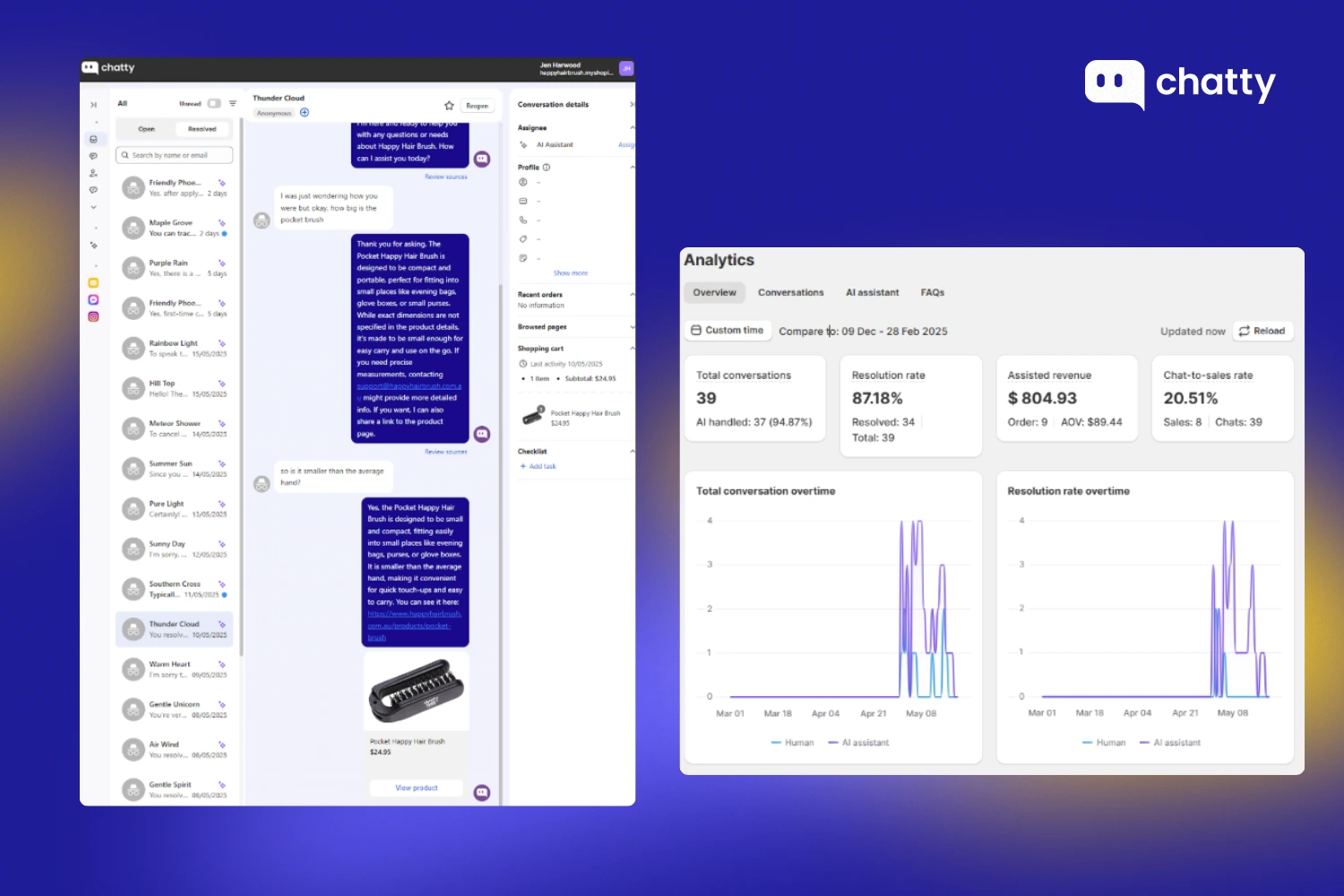
This fast-growing Australian brand was flooded with repeat questions (hair type compatibility, product comparisons, and more). Their small team couldn’t cope. Sales were slipping. Then came Chatty.
Just in 30 days:
- 95.83% AI involvement
- 80.43% resolution rate
- 18.75% chat-to-sales conversion
- $900 in AI-attributed revenue
- 7h 42m saved daily
You noticed it too? Yep, they both picked Chatty!
So, why choose Chatty?
Chatty is an AI-powered chatbot app built for Shopify brands that want to sell. It turns every conversation into a sales opportunity through:
- Trained on 10,000+ products: Chatty was trained on a diverse, structured dataset of thousands of real products across industries. This gave it a foundation to understand how items are described, positioned, and purchased, not just in theory, but in real eCommerce contexts.
- Understood product relationships: Unlike basic bots that memorize product specs, Chatty was built to learn patterns. It understands how a shoe complements a jacket, why someone buying a protein shake might also need a shaker bottle, or which variant of a product fits a customer’s needs best.
- Learned to sell: Most chatbots stop at showing what’s available. Chatty goes further, suggesting, nudging, and cross-selling based on real-time cues. Whether it’s upselling a premium version, bundling accessories, or reminding a user of a previously viewed item, Chatty never forgets a selling opportunity.
It’s time to move from reactive support to proactive selling with Chatty!
Ready to see what AI can sell for you?
To recap
The future of conversational commerce is proactive, intelligent, and revenue-driven. It’s no longer about answering questions; it’s about anticipating needs, recommending in real time, and turning every chat into a selling moment. As AI continues to evolve, so will the way we sell: faster, smarter, and more personal than ever before!