












Customer service teams struggle to keep up with rising expectations. Customers want instant, personalized support across every channel. However, teams still rely on limited agents, rigid workflows, and disconnected systems.
AI customer service addresses this gap. It automates routine work, supports agents in real time, and connects service with business systems. In this guide, you’ll learn what AI customer service is, how it works in practice, and how businesses use it to scale without losing quality.
- AI customer service shifts teams from reactive firefighting to proactive, predictive engagement. By detecting sentiment, intent, and behavioral patterns in real time, AI systems surface issues before customers escalate them to formal complaints.
- Traditional rule-based systems stay static while AI customer service systems improve with every conversation. Unlike fixed workflows that require manual updates, AI learns from new interactions and adapts responses based on intent, history, and channel context automatically.
- Chatty's Shopify integration syncs the entire product catalog automatically, enabling 24/7 AI-powered product support. This means a customer asking complex questions about compatibility or variants at 2am gets accurate, context-aware answers without an agent ever needing to step in.
- AI customer service covers the full support stack, from answering FAQs to routing tickets to coaching agents in real time. Modern implementations are not single-point chatbot solutions but interconnected layers where AI handles what it can and equips humans to handle the rest better.
- Scaling support without AI means hiring proportionally more agents, which is a cost model that breaks at speed. AI customer service is the only approach that lets support capacity scale with business growth without requiring headcount to increase at the same rate.
What is AI customer service?
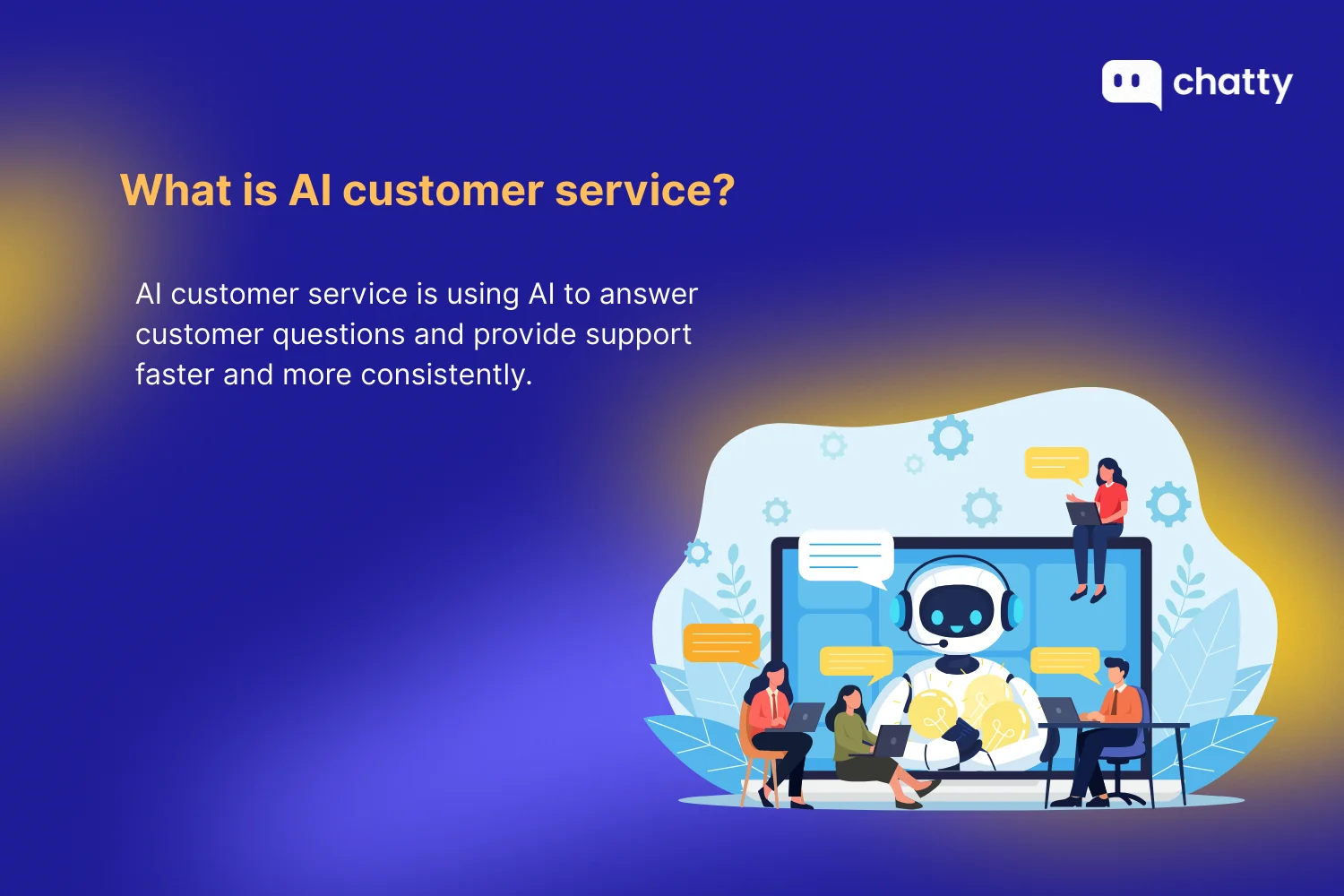
AI customer service refers to the use of artificial intelligence to support, automate, and enhance customer interactions across channels such as chat, email, voice, and self-service portals. Instead of relying solely on human agents or fixed scripts, AI systems understand customer intent, learn from past interactions, and respond in ways that feel faster, more relevant, and more consistent.
In practice, AI customer service covers a broad scope, including:
- Answering common questions
- Routing conversations
- Assisting agents in real time
- Analyzing customer behavior to improve future experiences.
The goal is to remove friction, reduce repetitive work, and help teams deliver better service at scale.
The key difference between AI customer service and traditional customer service systems lies in how decisions are made and improved over time:
- Rule-based vs. learning systems: Traditional systems follow predefined rules, such as “if a customer selects option A, show response B.” In contrast, AI-powered systems learn from data, recognize patterns, and improve their responses as they handle more conversations.
- Static workflows vs. adaptive, predictive, and contextual experiences: Legacy support workflows remain unchanged unless someone manually updates them. AI systems, however, adapt to context, predict customer needs, and adjust responses based on factors like intent, history, sentiment, and channel. As a result, support feels more personalized and proactive, not repetitive or rigid.
Common examples of AI in customer service
AI customer service works best when it operates in layers. Each layer solves a different problem, but together they create faster, smarter, and more reliable support. Below are the most common and practical examples used by modern support teams today:
Conversation layer
This layer handles direct customer interactions. It focuses on speed, availability, and first-contact resolution.
Chatbots and virtual assistants
AI chatbots and virtual agents for enterprise act as the first point of contact across web, mobile apps, and messaging channels. They handle high-volume, repetitive requests while staying available 24/7. In real-world use, they support tasks such as:
- Answering FAQs, including pricing, shipping, and policies
- Tracking orders, deliveries, and payment status
- Managing returns, exchanges, and refunds
- Providing setup guides and usage instructions
In addition, modern chatbots do more than respond. They collect key information, verify identity, and guide users step by step. When an issue becomes complex, they transfer the conversation smoothly to a human agent, including context and history. As a result, customers avoid repeating themselves, and agents start with full visibility.
If you use Shopify, Chatty is a representative example of this approach. It is an AI chatbot powered by large language models that supports customer conversations across the entire shopping journey.
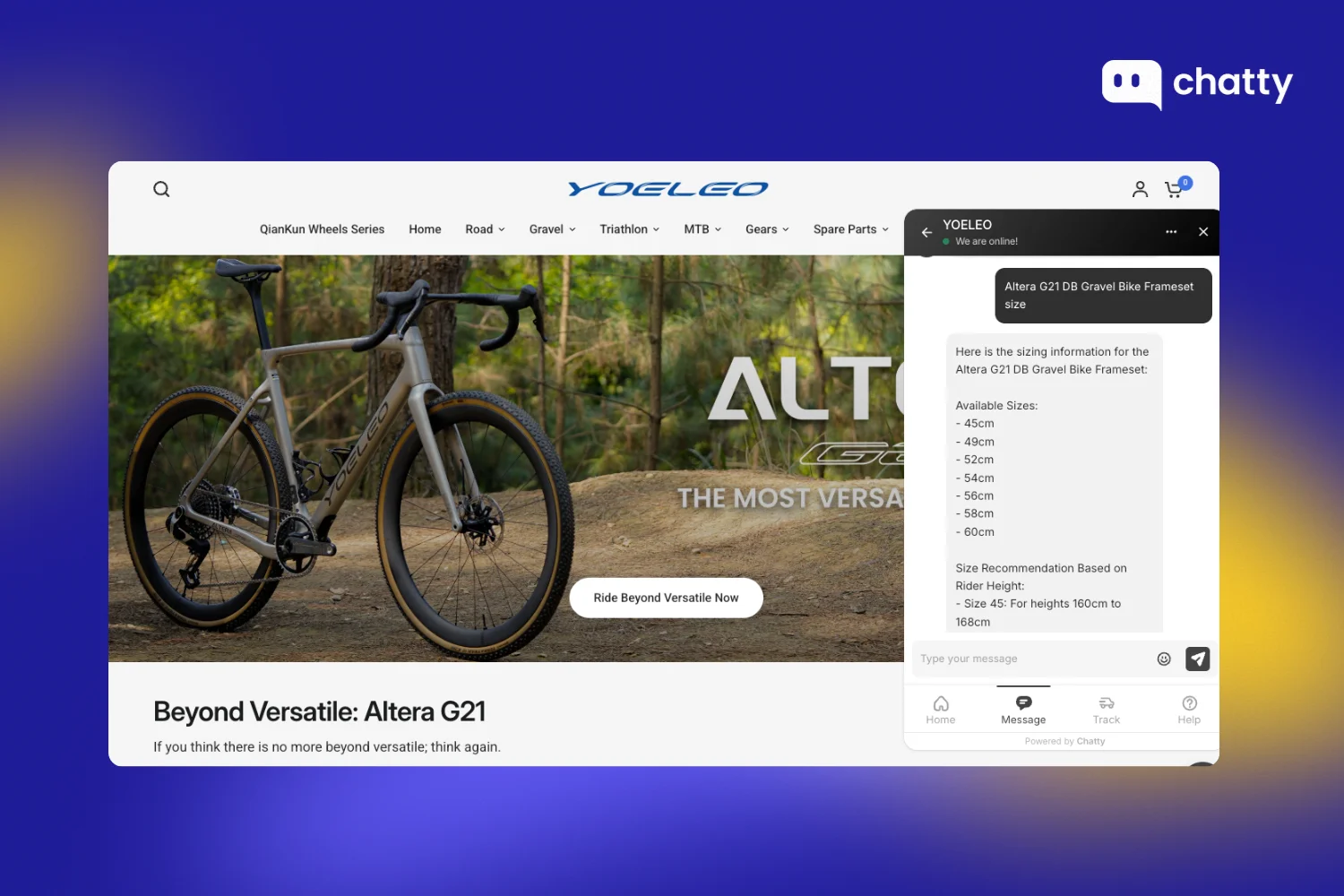
Key capabilities include:
- Answering detailed product questions in real time
- Suggesting relevant and complementary products during conversations
- Supporting order tracking and basic post-purchase inquiries 24/7
- Automatically syncing with the Shopify store to learn the full product catalog, policies, and FAQs
- Using browsing behavior and purchase history to better understand customer intent and identify upsell opportunities
Let’s try Chatty directly and experience AI-driven conversations firsthand.
Voice AI and call center automation
Voice AI has transformed traditional call centers. Instead of rigid menus, modern IVR systems understand natural language. Customers no longer need to press numbers to reach help.
Voice bots handle simple and frequent requests, such as balance checks or appointment confirmations. At the same time, they route calls intelligently based on intent, urgency, and customer profile. During live calls, AI can also assist agents in real time by surfacing answers or next steps. This reduces call duration and improves resolution quality.
AI agents (the next generation of autonomous support)
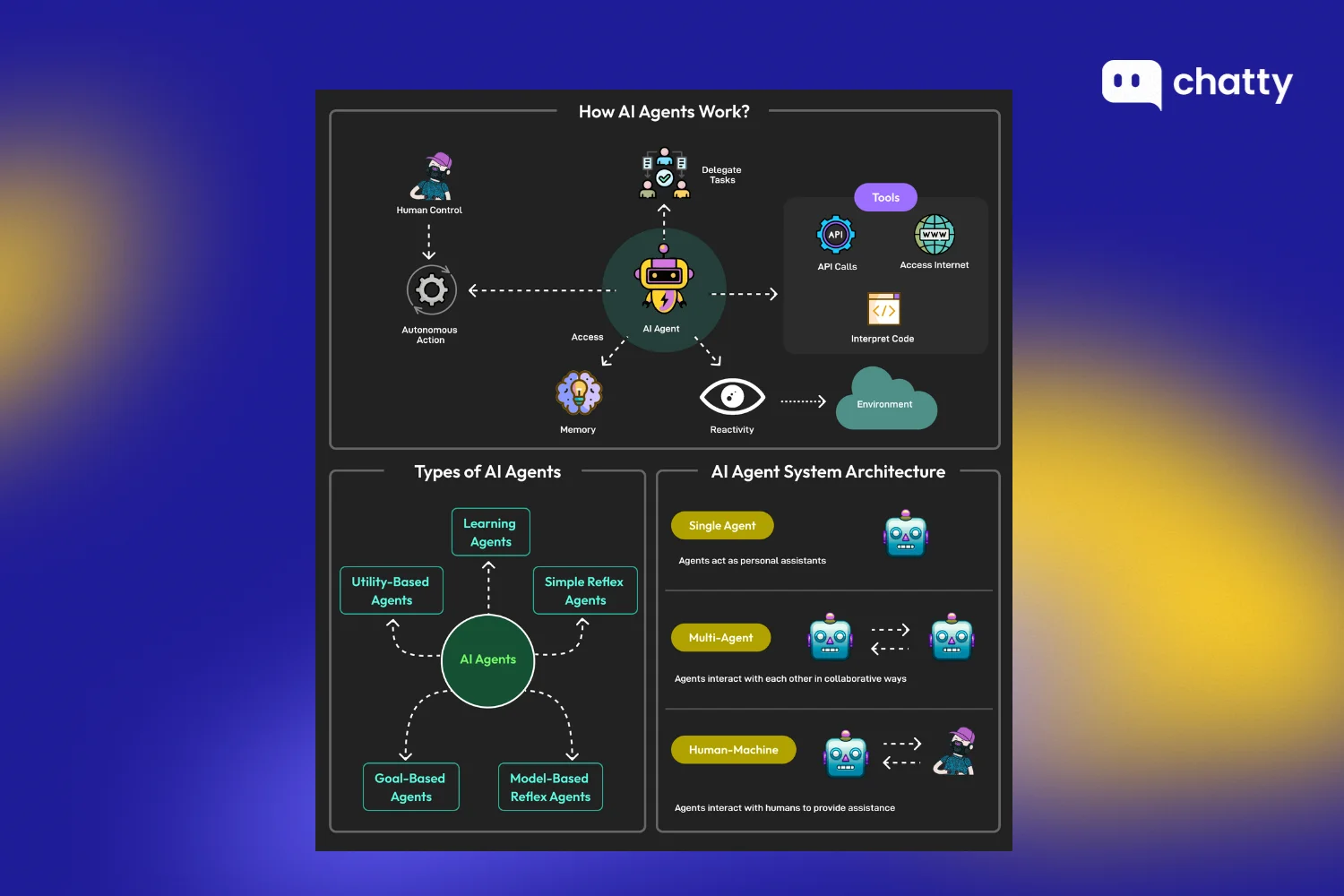
AI agents represent a shift from reactive responses to autonomous action. These systems do not just answer questions. They complete tasks across systems on behalf of customers.
For example, AI agents can reschedule deliveries, issue refunds, reset passwords, update profiles, or coordinate between billing and logistics tools. They follow a plan, check outcomes, and complete tasks end to end. For this reason, AI agents reflect the rise of agentic AI, which focuses on execution rather than conversation alone.
Agent augmentation layer
This layer focuses on helping human agents work faster and more confidently. Instead of replacing agents, AI acts as a copilot.
Agent assist, copilots, and automated responses
AI copilots support agents during live conversations. They suggest accurate replies, relevant policies, and next-best actions based on context. They also recommend upselling or cross-selling when appropriate.
After each interaction, AI summarizes the conversation, creates internal notes, and updates CRM records or tickets. As a result, agents spend less time on admin work and more time solving problems.
Intelligent routing and triage
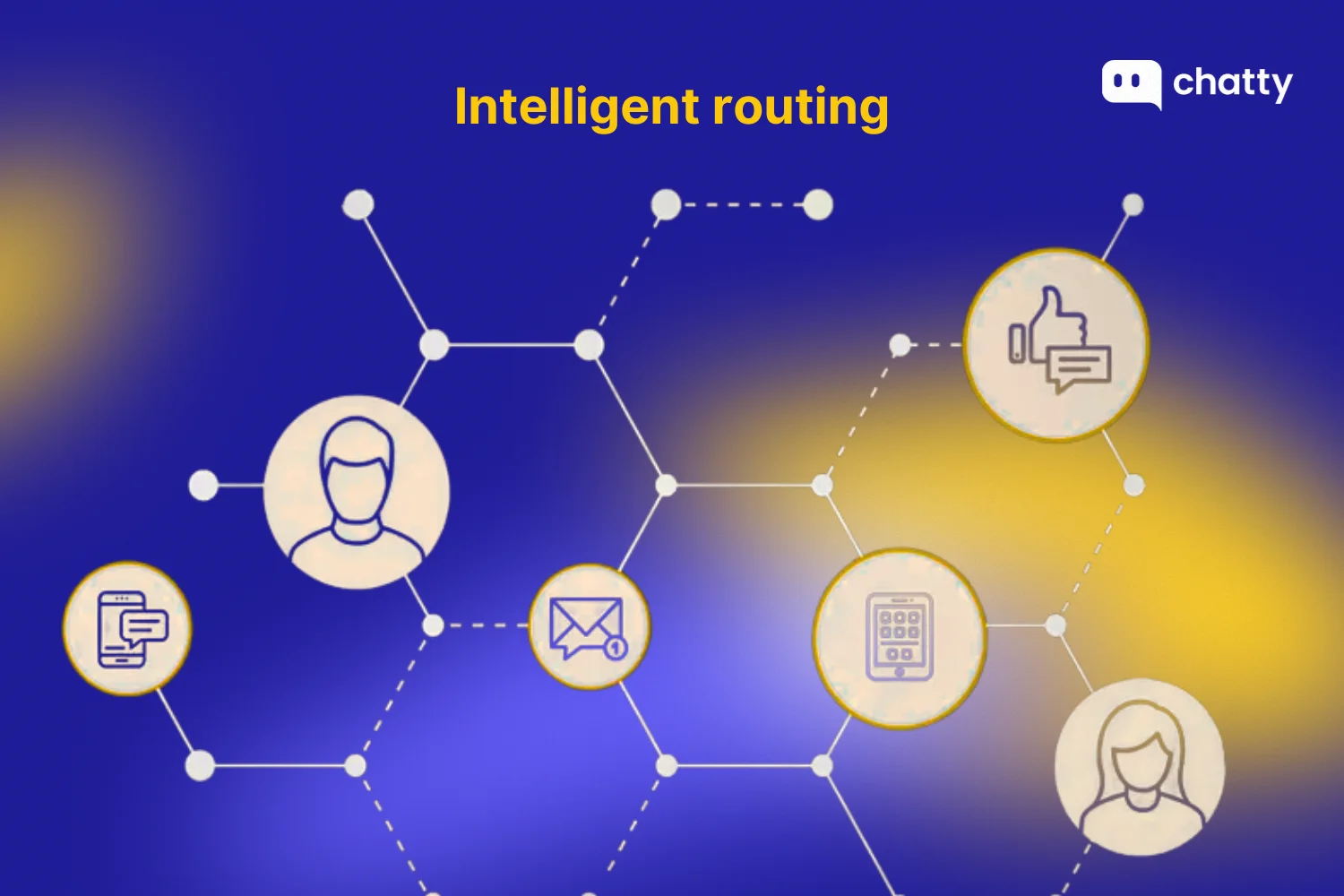
AI improves routing by analyzing more than just keywords. It classifies intent, priority, emotion, language, and customer value. This ensures each case is routed to the right agent from the start.
For example, urgent or emotional cases can go to senior agents. Language-specific requests reach fluent teams. High-value customers receive faster handling. As a result, teams increase first contact resolution and reduce handling time.
Intelligence layer
This layer turns support data into insight. It helps teams improve service quality and prevent issues.
Self-service portals and knowledge base AI
AI enhances self-service by using semantic search instead of exact keywords. Customers find relevant articles even when they phrase questions differently. Guided troubleshooting also helps users solve problems step by step.
In addition, AI identifies content gaps by analyzing failed searches and unresolved cases. It then suggests which articles to create or update. This keeps the knowledge base accurate and useful.
Sentiment analysis and emotion detection
AI analyzes language patterns to understand how customers feel during interactions. It detects satisfaction, frustration, and stress across chat, email, and voice channels.
This insight allows support teams to respond appropriately, not just quickly. Emotional context becomes part of the decision process:
- Prioritizing frustrated or distressed customers
- Triggering real-time escalation to senior agents
- Adjusting tone and response style automatically
As a result, teams reduce conflict and prevent negative experiences from escalating.
Predictive analytics and proactive support
Predictive analytics uses historical data and behavior patterns to anticipate future issues. It identifies churn risk, complaint likelihood, or potential service disruptions before they occur.
This allows support teams to act early rather than react late. Proactive support typically includes:
- Reaching out before customers report a problem
- Sending guidance or warnings ahead of incidents
- Offering solutions before frustration builds
By the end, customer service shifts from reactive problem-solving to experience protection.
Customer segmentation and journey orchestration
AI segments customers based on behavior, needs, and lifetime value. These segments reflect real differences in expectations and service requirements.
Once segmented, AI orchestrates different journeys and service levels for each group:
- Providing more guidance for new or at-risk customers
- Offering faster resolution for high-value accounts
- Adjusting SLAs based on customer context
This ensures consistent service while still delivering personalized experiences.
Personalized recommendations and next-best actions
AI uses real-time context to recommend the most relevant action during a support interaction. These recommendations consider intent, history, and current situation.
In customer service, this often includes:
- Suggesting relevant help articles or tutorials
- Recommending products or services that fit the issue
- Prompting agents with the next best step
Finally, support conversations become more efficient and more valuable for both customers and the business.
Risk and trust layer
AI monitors support interactions to detect fraud, account takeover attempts, and social engineering tactics. It analyzes behavior patterns, not just keywords. When risk signals appear, systems can intervene immediately:
- Flagging suspicious interactions for review
- Triggering additional identity verification
- Limiting sensitive actions automatically
This protects customer data, preserves brand trust, and enables safe scaling of AI-driven support.
Real-world case study: How Decathlon scaled support across 10,000 SKUs
Abstract frameworks only go so far. Decathlon, a global sports retailer with 1,700+ stores worldwide and a product catalog of more than 10,000 items, is a concrete illustration of what AI customer service looks like when deployed against a real operational problem at scale.
The problem: support team as “human FAQ machine”
Before AI, Decathlon’s support team answered identical product questions dozens of times per day — hiking boot sizing, ski compatibility, bike accessory fit. Response times reached 4+ hours during peak periods. Customers abandoned carts when they could not get quick technical answers, and midnight shoppers had no support at all. Technical product knowledge was locked inside the team, inaccessible to the customer at the exact moment of decision.
The solution: full catalog sync overnight
Chatty ingested the entire 10,000-item product database in a single night, including specifications, compatibility charts, and sizing guides. The AI learned product relationships across brands, handed complex queries to human specialists with full conversation context, and adapted seasonally — prioritizing winter sports queries during ski season without manual tuning.
Results
| Metric | Result |
|---|---|
| Conversations handled automatically | 2,000+ |
| Resolution rate | 96.6% |
| Chat-attributed revenue | €10,964.39 |
| Chat-to-sales conversion | 9% (beats industry averages) |
| Response time improvement | From 4+ hours → instant, 24/7 |
“We expected basic FAQ automation. What we got was a sales assistant that works alongside our team 24/7.”
— Digital Experience Manager, Decathlon
The unexpected insight: the AI did not replace the team. It freed them from repetitive work to act as true sports experts for complex queries, and it surfaced product description gaps that drove catalog improvements — a flywheel effect that pure headcount scaling never produces. Read the full Decathlon case study for the complete breakdown.
Key benefits of AI customer service
AI customer service delivers value because it fixes clear weaknesses in traditional support. These benefits become measurable when viewed through the eyes of customers, agents, and the business.
Benefits for customers
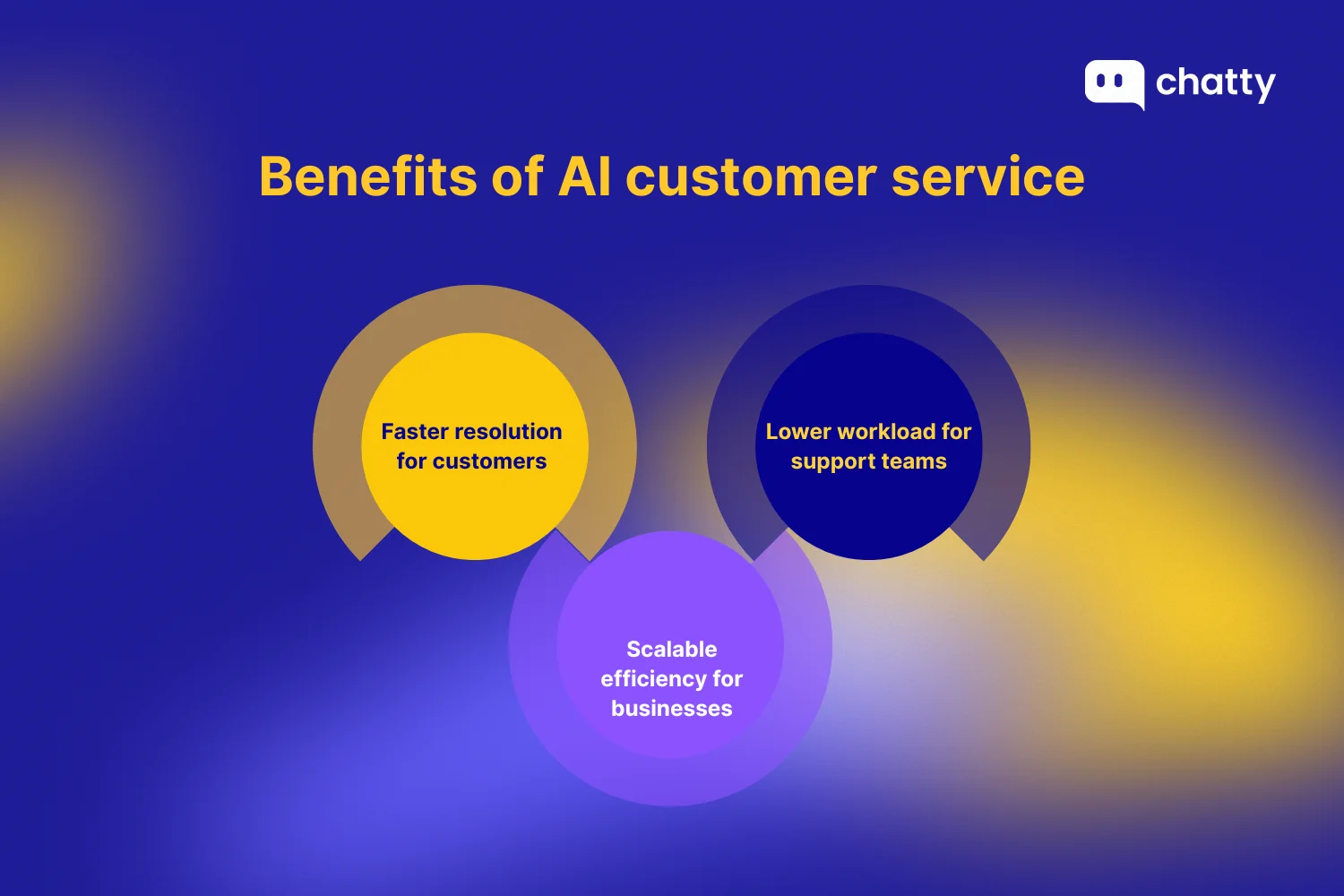
From a customer perspective, the primary benefit of AI customer service is reduced effort. Customers no longer need to wait in queues, switch channels, or repeat information to resolve simple issues. According to Salesforce, over 70% of customers expect companies to understand their needs instantly, yet traditional support models struggle to meet this expectation.
AI-driven support shortens the path to resolution by removing unnecessary friction. Customers experience faster answers, consistent responses aligned with policies and order data, and support availability beyond standard business hours. As a result, issues are resolved earlier in the journey, and fewer customers abandon support interactions out of frustration.
Benefits for agents
For support agents, the value of AI lies in workload redistribution, not replacement. Instead of spending most of their time on repetitive or administrative tasks, agents are freed to focus on cases that require judgment, empathy, or deeper problem-solving.
McKinsey estimates that around 30% of customer service activities can be automated. This shift reduces cognitive overload and burnout while improving agent confidence and performance. Over time, agents spend less effort managing volume and more effort delivering quality outcomes, which leads to higher job satisfaction and lower attrition.
Benefits for the business
At the business level, AI customer service enables scalable growth without linear cost increases. IBM estimates that AI-powered automation can reduce cost per customer contact by up to 30% while maintaining service quality.
Beyond cost efficiency, AI transforms customer service into a strategic insight function. By analyzing patterns across interactions, businesses can identify recurring issues, churn risks, and revenue opportunities earlier. This allows teams to act proactively rather than reactively. As a result, customer service evolves from a cost center into a lever for operational resilience and long-term growth.
AI customer service vendor comparison for e-commerce
Picking the right AI customer service platform depends less on feature count and more on fit with your commerce stack. Below is a practical comparison of four vendors that dominate e-commerce support in 2026, focused on the criteria that actually affect deployment speed and ROI.
| Criterion | Chatty | Zendesk AI | Intercom Fin | Gorgias |
|---|---|---|---|---|
| Primary audience | Shopify merchants, SMB to enterprise (e.g., Decathlon) | Enterprise support orgs | SaaS, mid-market to enterprise | Shopify + e-commerce |
| Catalog sync | Native Shopify, automatic overnight | Manual integration via API | No native commerce catalog | Native Shopify, automatic |
| AI foundation | LLM-based, product-aware | Generative AI + classic NLP | Fin AI agent (GPT-based) | GPT-based, Shopify-tuned |
| Typical deployment time | Under a week | 4–8 weeks | 2–4 weeks | 1–2 weeks |
| Sales-oriented conversations | Yes (built-in upsell/cross-sell) | Support-first, limited sales | Support-first | Support with some sales |
| Pricing model | Monthly subscription, free plan available | Per-agent + AI add-on | Per-resolution | Per-ticket tier |
The general pattern: Chatty and Gorgias are built specifically for Shopify merchants and deploy fastest, Zendesk AI and Intercom Fin suit larger service organizations with complex routing needs. For most DTC and Shopify stores, the deciding factor is how quickly the AI learns your catalog — and that turns on native commerce integration, not raw AI capability.
Challenges and limitations of AI customer service (300-350w)
AI customer service delivers significant benefits but also introduces real challenges. You need to understand these limits to deploy AI responsibly and effectively:
Lack of human empathy
AI can recognize sentiment, but it does not truly empathize. It cannot share emotion or build trust in sensitive moments. This limitation becomes clear during emotionally charged situations, such as billing disputes or service failures. In these cases, customers expect reassurance and understanding. AI should support agents, not replace them, when empathy matters most.
Handling novel or complex queries
AI performs best with known patterns and structured data. However, it struggles with new problems that lack precedent. Complex cases often involve multiple systems, unclear intent, or conflicting information. Without a clear context, AI may stall or provide partial answers. For this reason, seamless handoff to human agents remains essential.
Integration complexity
AI customer service depends on clean data and connected systems. Many organizations operate with fragmented tools and inconsistent data. Integration challenges often include legacy platforms, custom workflows, and limited APIs. These gaps reduce AI accuracy and increase setup effort. Teams must plan integration carefully to avoid broken experiences.
Data privacy and security concerns
AI systems process large volumes of customer data. This raises serious privacy and compliance requirements. Organizations must ensure proper access controls, encryption, and audit trails. They also need to comply with regulations such as GDPR and regional data laws. Weak controls increase the risk of data exposure and loss of trust.
Risk of incorrect or misleading responses
AI can generate confident answers that are wrong. This risk increases when training data is outdated or incomplete. Incorrect responses can mislead customers or violate policies. To reduce this risk, teams need guardrails, validation rules, and human review paths. Continuous monitoring is also critical.
Implementation cost and timeline
AI adoption requires upfront investment in tools, data preparation, and training. Results are not instant. Common challenges include long setup timelines and unclear ROI expectations. Teams should start with focused use cases and scale gradually. This approach reduces risk and accelerates value realization.
In summary, AI customer service works best when teams balance automation with human oversight. Clear boundaries and thoughtful design turn limitations into manageable trade-offs.
30-day AI customer service implementation checklist
Most AI customer service failures are implementation failures, not technology failures. The pattern that works: a focused 30-day rollout that prioritizes data readiness and narrow use cases before broad deployment.
Week 1: Audit and use case selection
- Export the last 3 months of support tickets and classify by intent (product questions, order tracking, returns, billing, complex).
- Identify the top 5 intents that account for ~70% of volume. These are your automation targets.
- Audit knowledge sources: product catalog completeness, FAQ coverage, policy documentation. Flag gaps.
- Set two baseline KPIs to beat: current average first response time and current deflection rate.
Week 2: Integration and training data prep
- Connect the AI platform to your commerce platform (Shopify, BigCommerce, WooCommerce) and customer data source.
- Upload or sync: product catalog, help center articles, shipping/return policies, brand voice guidelines.
- Configure escalation rules: which intents auto-route to humans, which tiers get priority, what keywords trigger handoff.
- Build 20–30 golden-path test conversations covering the top intents identified in week 1.
Week 3: Pilot and refine
- Launch to a small audience (10–20% of traffic, or a single channel like widget-only) with human review on all conversations.
- Review every escalation: is it legitimate complexity or an AI failure? Label each case.
- Tune the knowledge base based on failed interactions. Most issues trace back to missing or inconsistent content, not the model.
- Measure against the week-1 baselines: is FRT improving? Is deflection increasing without CSAT dropping?
Week 4: Full rollout and governance
- Expand to full traffic with continuous human review sampling (e.g., 10% of conversations audited daily).
- Set up a weekly review cadence: top failure modes, catalog gaps, new intents to cover.
- Establish guardrails: confidence thresholds below which AI must escalate, categories that always route to humans (billing disputes, cancellations, complaints).
- Define monthly review triggers: retraining, new intent addition, policy updates.
Stores that follow this rhythm typically see first-week deflection in the 20–40% range and hit their full targets by day 60. The failure pattern to avoid: deploying broadly before the catalog and knowledge base are clean, then blaming the AI for inaccurate answers.
Measuring the success of AI-powered customer support
To track AI customer support effectiveness, your team should prioritize the few that reflect resolution quality, automation impact, and customer experience. In practice, three metrics matter most:
- First contact resolution (FCR) shows whether AI actually helps solve problems. When AI routes or assists correctly, issues end in a single interaction. According to the Zendesk CX Trends Report, high-performing teams achieve FCR above 70% for AI-assisted cases. This level indicates that AI removes friction instead of adding steps.
- Deflection rate measures how many requests AI resolves without agent involvement. It shows automation impact directly. The Salesforce State of Service report shows that mature chatbot deployments deflect 30–40% of tier-one inquiries. These are questions that need no longer reach human agents.
- Customer satisfaction (CSAT) confirms whether customers accept AI-led support. Efficiency gains mean little if satisfaction drops. Data from Zendesk customer experience benchmarks shows that strong AI implementations maintain CSAT above 80%, even as automation scales.
These metrics work together: FCR shows effectiveness. Deflection shows automation value. CSAT confirms customer acceptance.
Calculating AI customer service ROI: a simple framework
Before committing budget, most teams want a defensible ROI estimate. The calculation does not need to be complex. Three inputs determine almost all of the savings, and a fourth captures the revenue upside that enterprise ROI calculators often miss.
The formula
Annual ROI = (Cost savings + Revenue lift) − AI platform cost
Where:
- Cost savings = (Monthly ticket volume × Deflection rate × Cost per human-handled ticket × 12)
- Revenue lift = (AI-attributed conversations × Chat-to-sale conversion × Average order value × 12)
- AI platform cost = Annual subscription + one-time setup
Worked example: $2M/year Shopify store
Assume a Shopify store doing $2M/year with 3,000 support tickets per month, $5 cost per human-handled ticket (blended agent time + tools), and an AOV of $80.
| Input | Value | Annual contribution |
|---|---|---|
| Monthly tickets | 3,000 | — |
| Deflection rate (year 1) | 60% | 1,800 tickets/mo deflected |
| Cost per human-handled ticket | $5 | $108,000 cost savings |
| AI-attributed conversations/mo | 800 | — |
| Chat-to-sale conversion | 5% | 40 orders/mo |
| Average order value | $80 | $38,400 revenue lift |
| Annual AI platform cost | $6,000 | -$6,000 |
| Net annual ROI | — | $140,400 |
The common mistake is ignoring the revenue lift and measuring only cost savings. For most Shopify merchants, AI-attributed revenue matches or exceeds cost savings — because each deflected conversation is also a potential sale if the AI is product-aware. That changes the calculation from “reduce support cost” to “scale sales capacity without headcount,” which is a fundamentally different business case.
Conservative sanity checks before committing budget:
- Halve the assumed deflection rate for year 1. Real rates grow as the knowledge base matures.
- Use your actual, not industry-average, chat-to-sale conversion. If you don’t track it, assume 2–3% initially.
- Include training time: 20–40 hours of internal effort in the first month, valued at a loaded hourly rate.
AI customer service and the future of customer experience
AI customer service is no longer about faster replies. It is reshaping how companies design the entire customer experience. The future points toward systems that act, adapt, and collaborate with humans at scale. Let’s see several clear trends already shaping this future:
Agentic AI and autonomous resolution
The next stage of AI customer service centers on autonomous resolution. Agentic AI systems do not wait for instructions. They plan tasks, coordinate systems, and complete outcomes end-to-end.
This shift is already visible. According to Gartner’s customer service predictions, organizations expect AI to handle up to 80% of routine service interactions without human involvement. This changes customer expectations. Customers will judge support by outcomes, not conversations.
Deeper integration with business systems
AI customer service will increasingly connect directly to core systems. These include billing, inventory, logistics, identity, and fulfillment platforms.
This integration enables real action. McKinsey research on AI in operations shows that companies with deeply integrated AI resolve issues faster and with greater consistency. Support becomes operational execution, not just communication.
The evolving role of human agents
As AI handles routine and predictable work, human agents move up the value chain. Their role shifts toward complex problem-solving, emotional support, and relationship-building.
Rather than replacing humans, AI elevates them. Agents become experience owners, not ticket processors. This balance defines the future of customer experience.
Final thought: So, what does this mean for your business in the next 3–5 years?
Over the next three to five years, your businesses must redesign customer service around outcomes, not conversations. To adapt, companies should focus on four actions.
- Automate resolution, not just replies. Prioritize AI that can complete tasks end-to-end.
- Integrate service with core systems, such as billing, orders, and logistics. This enables AI to act.
- Reskill agents for high-value work, including complex problem solving and relationship management.
AI sets the baseline. Execution strategy determines who leads.
FAQ
- Conversational AI, such as chatbots and voice bots, for handling customer interactions
- Agent assist AI, which supports agents with suggestions, summaries, and next-best actions
- Routing and classification AI, for intent detection, prioritization, and case assignment
- Analytics and predictive AI, for sentiment analysis, churn prediction, and proactive support
- Small teams: $30–$200/month for basic chatbots or AI inbox features
- Growing teams: $200–$1,500/month for agent assist and routing
- Larger teams: $2,000–$10,000+/month for deep integrations and automation
- Basic chatbots or FAQ automation take 2–4 weeks
- Agent assist and routing features take 1–3 months
- End-to-end automation and deep integrations take 3–6 months
- Gathering context and customer history
- Suggesting solutions and next steps
- Routing cases to the right agent
- Supporting agents during live conversations