











When customers face long wait times, repeat their issues, or receive inconsistent answers, frustration grows quickly. At the same time, agents feel overwhelmed, rely too heavily on scripts, and escalate cases they could have resolved with better guidance. These problems are connected. They point to gaps in structure, skill development, and ongoing support. Without a clear training system, service becomes reactive instead of reliable.
This guide shows you how to build a focused 30-day customer service training program that strengthens skills, improves consistency, and drives measurable results.
- Structured training increases CSAT scores by 25 to 40% within 90 days Organizations with formal customer service training programs see measurable gains in satisfaction, first-contact resolution (up 35%), and retention. Even a 5% retention increase can lift profits by 25 to 95%, making training one of the highest-ROI investments a company can make.
- Trained teams resolve issues 42% faster than untrained ones When agents understand tools, workflows, and customer data, they solve problems more efficiently. Faster resolution reduces operational costs per interaction and improves the customer experience, leading to fewer repeat contacts and escalations.
- A complete program develops both soft skills and hard skills together Soft skills like empathy, active listening, and de-escalation shape how customers feel. Hard skills like CRM proficiency, product knowledge, and AI tool usage determine how efficiently problems get solved. The strongest teams train both simultaneously.
- The 30-day curriculum builds agent confidence in four structured phases Week 1 covers foundations (mission, product, workflows). Week 2 focuses on communication and customer psychology. Week 3 layers in tools and efficiency. Week 4 moves to live practice with supervision and QA reviews, ending with certification.
- Ongoing training and coaching reduce agent turnover by 15 to 25% Customer service roles often exceed 40% annual attrition. When agents feel prepared, supported, and confident through continuous development, burnout decreases and job satisfaction improves, directly protecting service quality and reducing recruitment costs.
What is customer service training?
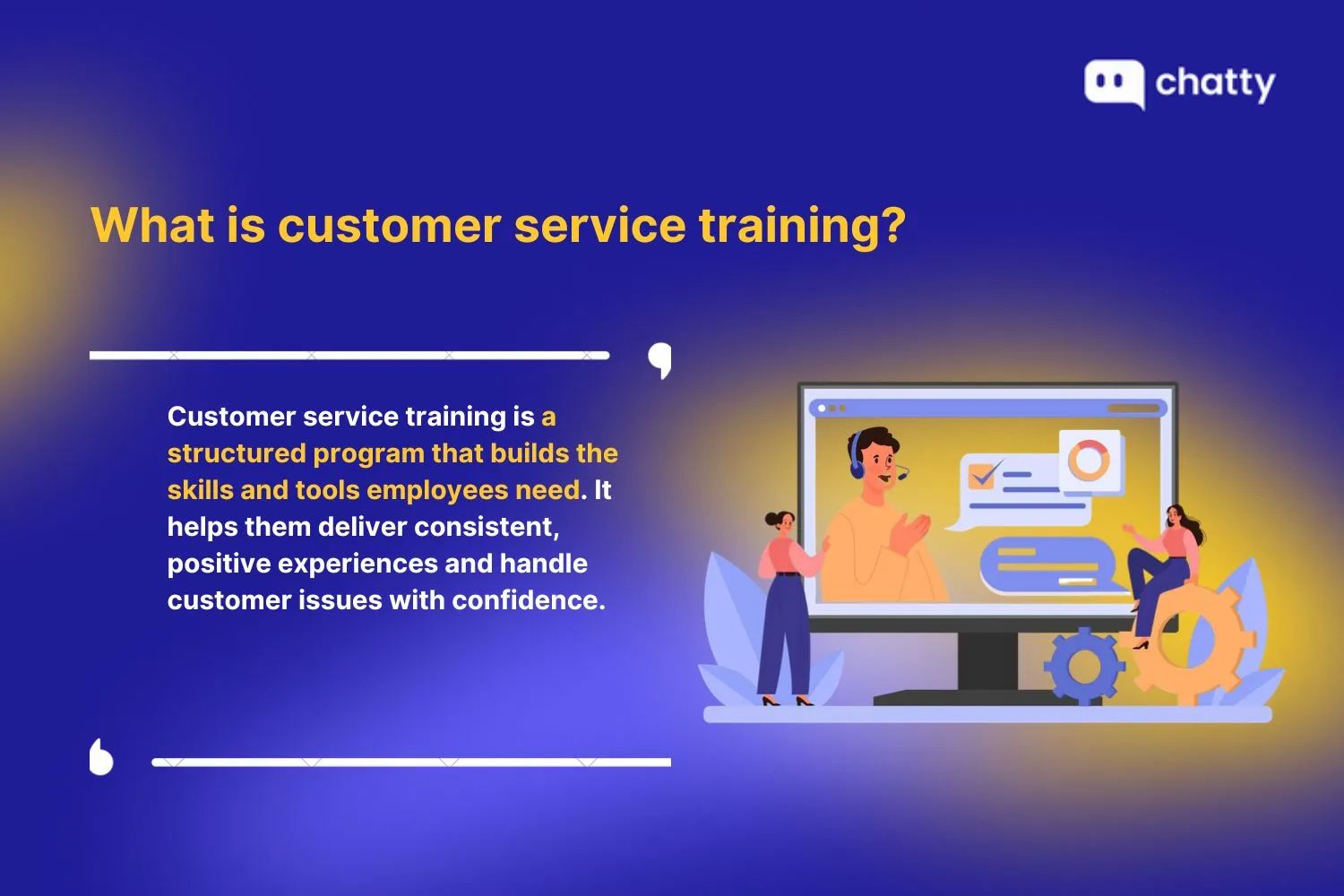
Customer service training is a structured development process that equips employees with the skills, tools, and behaviors needed to deliver consistent, positive customer experiences. It connects human interaction with operational execution so agents can respond clearly, solve problems efficiently, and represent the brand with confidence.
A complete training program typically includes:
- Communication and active listening skills
- Empathy and emotional control in difficult situations
- Product and policy knowledge
- CRM and ticketing system proficiency
- Clear service standards and response workflows
Customer service training is broader than onboarding and different from coaching. Onboarding introduces new hires to company basics, systems, and expectations. Coaching focuses on individual feedback and performance improvement over time. Training lays the shared foundation that everyone relies on, and coaching refines performance further.
When training is structured and practical, the results are visible. Customers receive faster, clearer, and more consistent support. Agents feel more confident and capable in handling complex cases. Teams collaborate better because they follow the same standards and processes. In this way, customer service training strengthens both customer experience and internal team performance at the same time.
Why customer service training is a business advantage
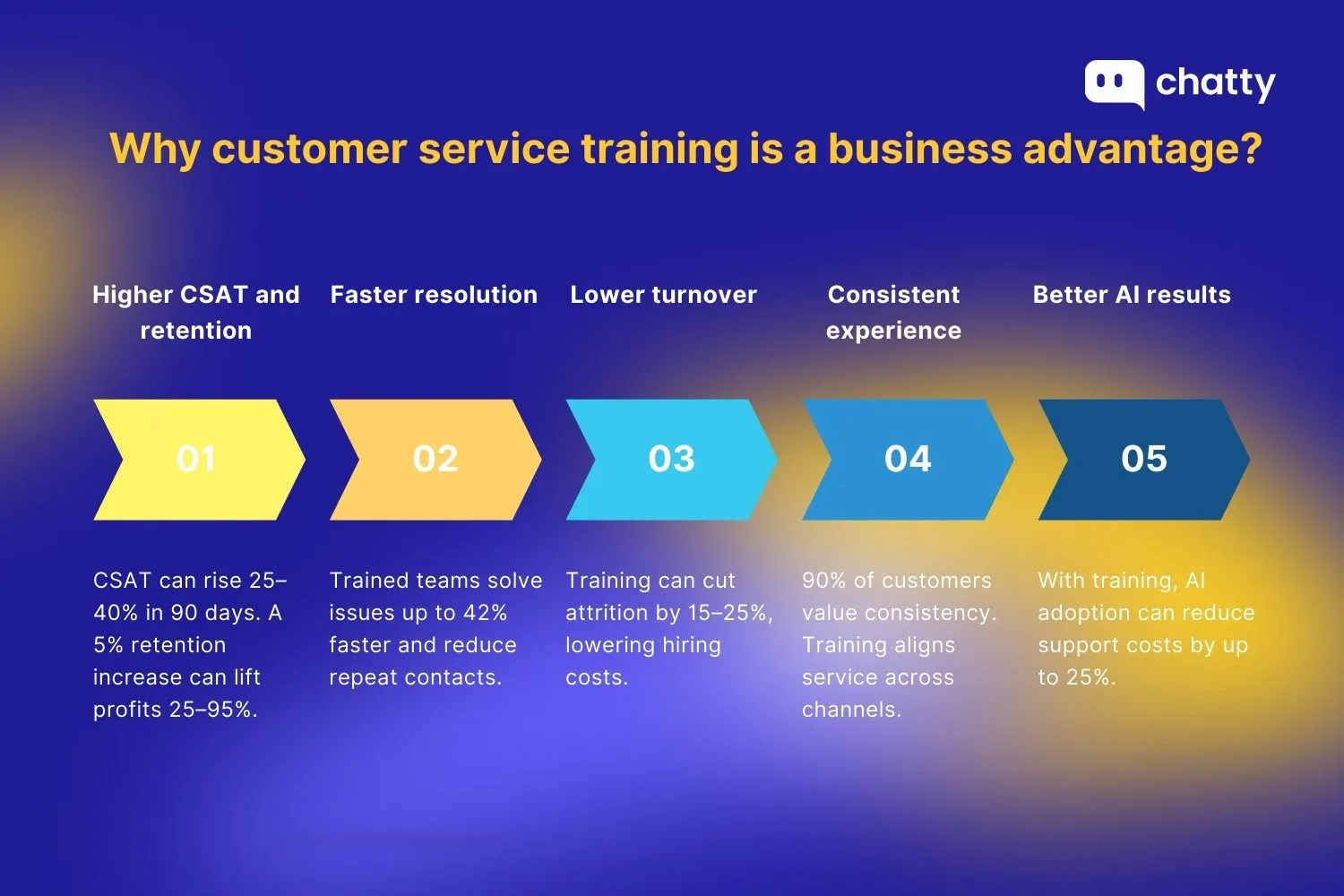
Below are the key ways customer service training creates measurable business value.
Higher CSAT and retention
Training directly improves customer satisfaction. Organizations with structured service training see CSAT scores increase by 25 to 40% within 90 days of implementation, and first-contact resolution goes up 35%, which further boosts satisfaction and loyalty. Better service consistency also correlates with stronger retention; companies with high CSAT have 18% higher retention, and even a modest 5% retention increase can lift profits 25 to 95%.
Faster resolution times
Trained agents resolve issues significantly faster because they know how to use tools, workflows, and customer data efficiently. Research shows trained teams resolve issues 42% faster than untrained ones and increase first-contact resolution rates substantially, reducing repeat contacts. This speed not only improves the customer experience but also reduces operational costs per interaction.
Lower agent turnover
Customer service roles often face high attrition, sometimes exceeding 40% annually in certain industries. Lack of preparation and stress are key reasons. Ongoing training and coaching can reduce turnover by 15 to 25%. When agents feel confident and supported, burnout decreases, and job satisfaction improves. Lower turnover reduces recruitment costs and protects service quality.
More consistent brand experience
Customers expect consistent service across channels and interactions. In fact, 90% of consumers say consistency matters, yet most companies don't deliver it without formal training. Structured programs standardize messaging, tone, and adherence to processes, reducing variability in service quality and building trust. Omnichannel support improvements can lift CSAT from around 28% to 67% when integrated well.
Better adoption of AI and support tools
Technology only works when people know how to use it. Industry reports show that around 75% of customer service organizations are using or planning to use generative AI tools. Companies that combine AI implementation with structured training report faster onboarding and up to 25% reductions in support costs. Training ensures agents use AI to enhance judgment, not replace it, leading to higher productivity and better outcomes.
Types of customer service training
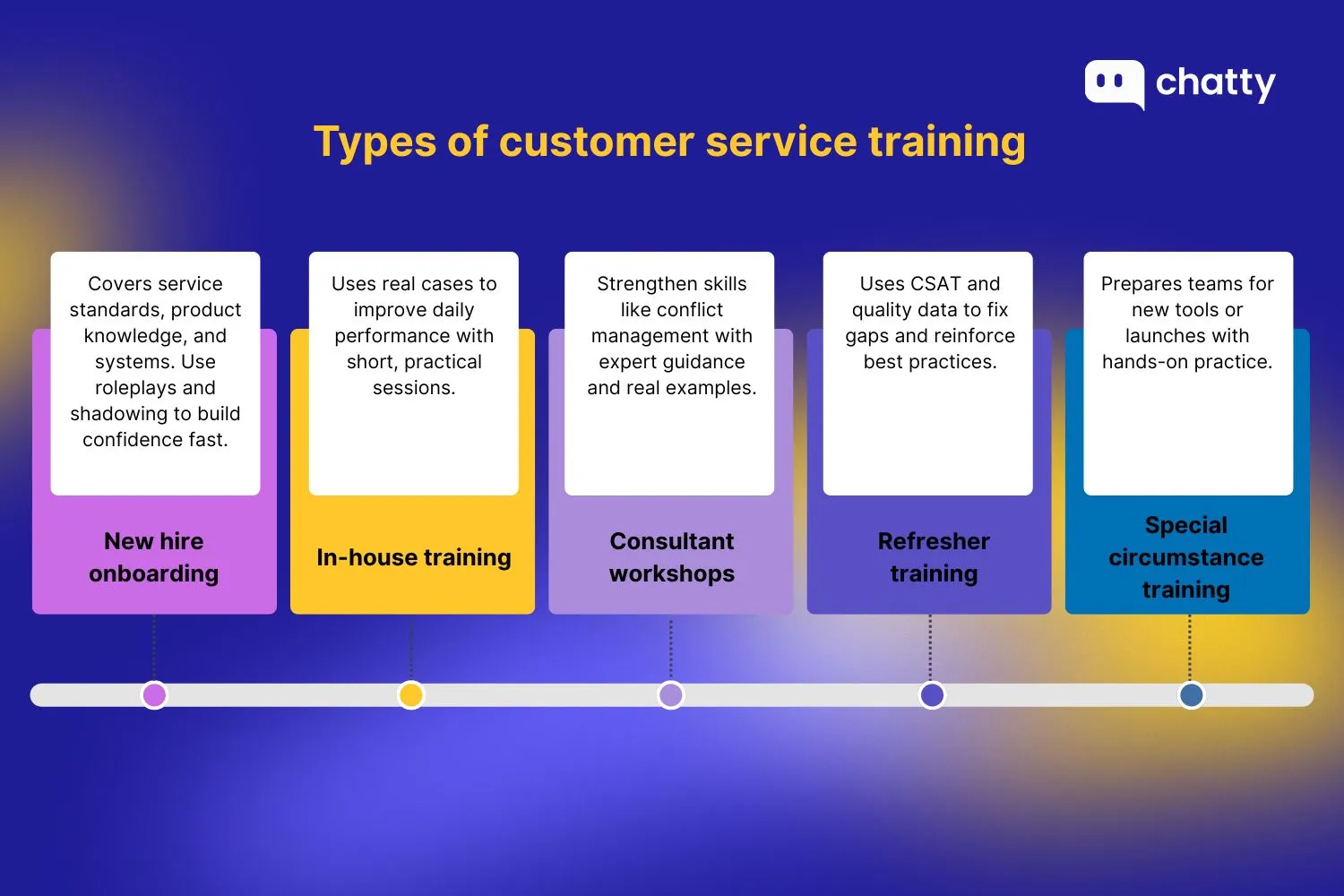
Here are the key types of customer service training every team should use.
- New-hire onboarding training lays a strong foundation from day one. It should cover service standards, tone of voice, product knowledge, and system navigation. Most importantly, include real-scenario simulations so new reps can practice handling common questions, complaints, and escalations before speaking to actual customers. Clear checklists and shadowing sessions help them gain confidence quickly.
- In-house employee training focuses on improving current performance. Use real customer cases, call recordings, and support tickets to identify skill gaps. Short, focused sessions on topics like objection handling or response structure make learning practical and directly tied to daily work outcomes.
- Consultant-led workshops provide expert guidance and fresh insights. External trainers can strengthen areas such as conflict management or emotional intelligence. To maximize value, customize workshops with real company examples instead of generic exercises.
- Refresher training for experienced reps prevents skill decline and bad habits. Use customer feedback, CSAT data, and quality scores to target improvement areas and reinforce best practices.
- Special circumstance training prepares teams for new tools, systems, or product launches. Hands-on practice and guided walkthroughs ensure smooth transitions and consistent service quality.
Who needs customer service training?
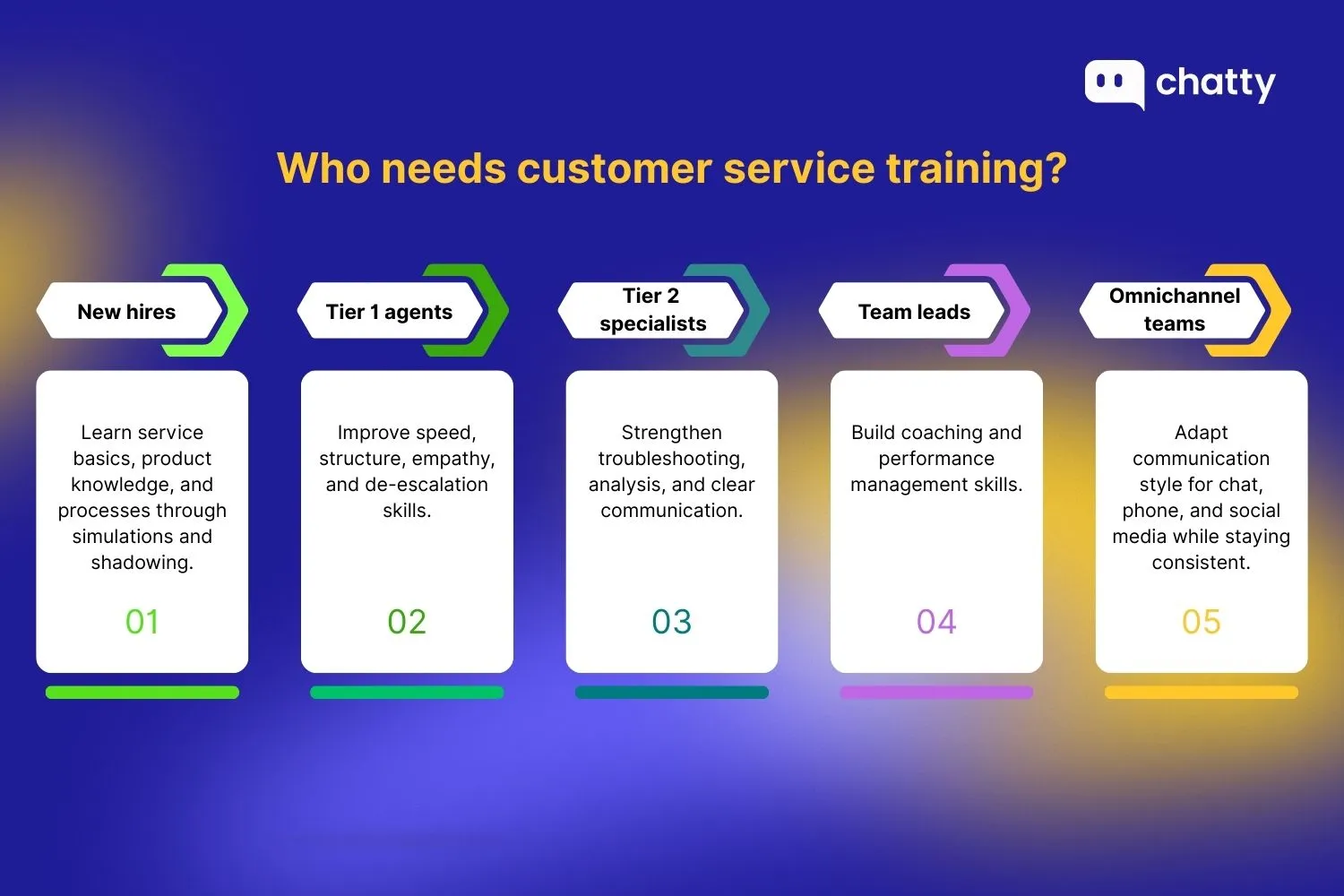
Customer service training should be tailored to different roles, because each level faces unique challenges and performance expectations.
- New hires need strong foundation skills. Training should focus on service standards, communication basics, product knowledge, and process flow. Practical simulations and guided shadowing help them handle common inquiries confidently and reduce early-stage mistakes.
- Tier 1 agents handle high volumes of routine requests. Their training should improve speed, structure, and empathy. They must learn to resolve issues efficiently while still making customers feel understood. Time management drills and de-escalation practice are especially important.
- Tier 2 specialists deal with complex or technical cases. Training should strengthen analytical thinking, advanced troubleshooting, and clear explanations of complicated solutions. They also need skills to manage longer resolution times without losing customer trust.
- Team leads and managers require coaching and quality assurance skills. Training should focus on giving actionable feedback, reviewing performance metrics, and supporting continuous improvement across the team.
- Omnichannel teams need channel-specific communication skills. Chat requires clarity and brevity, phone support demands tone control, and social media requires brand consistency. Training must ensure service quality stays consistent across every platform.
Core customer service training skills
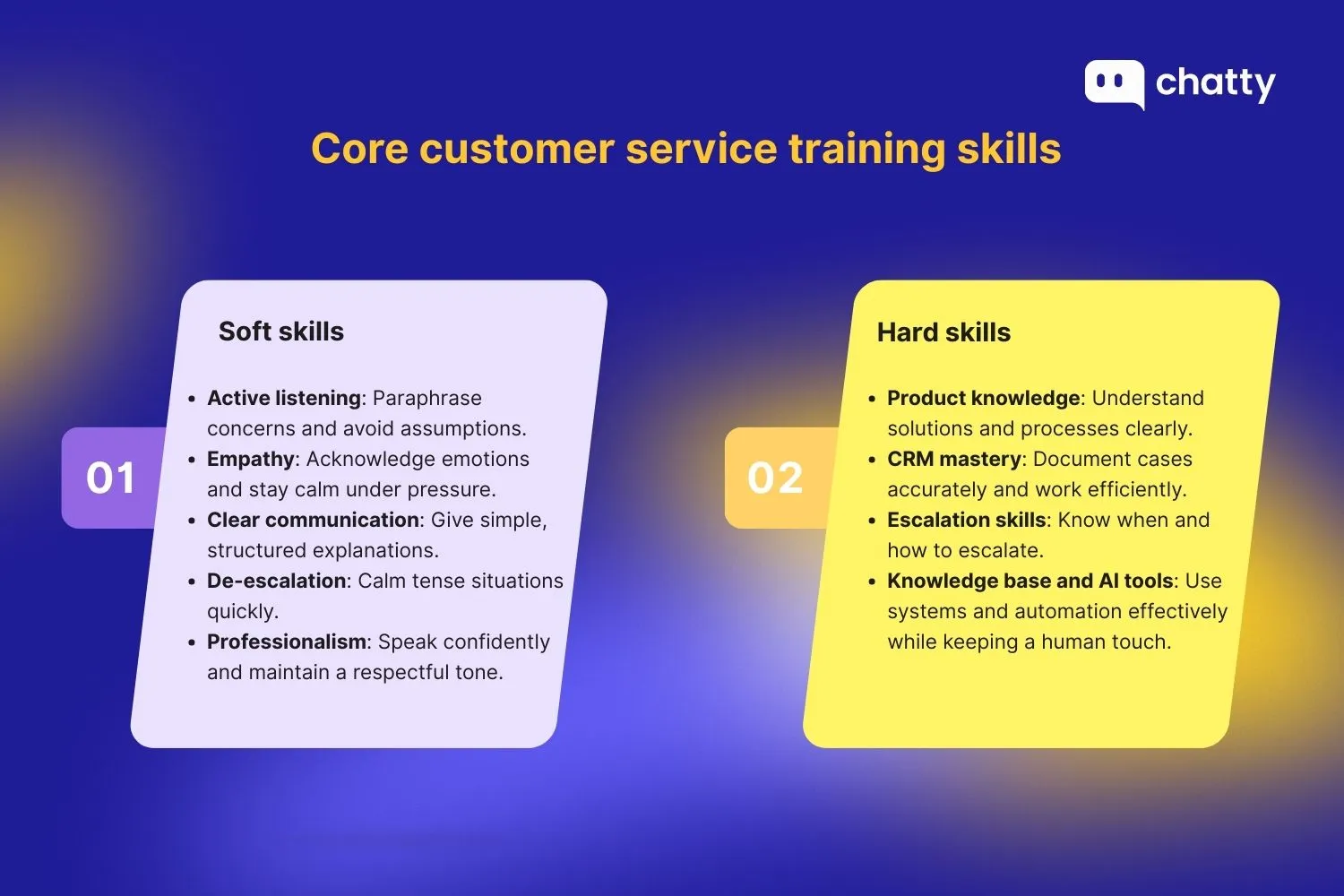
Effective customer service training must develop both human skills and operational skills. Soft skills shape how customers feel during an interaction. Hard skills determine how efficiently and accurately problems are resolved. Strong teams build both at the same time.
Soft Skills (Human Skills)
- Active listening is the foundation of service quality. Reps should practice paraphrasing customer concerns before offering solutions. Training should include listening to recorded calls and identifying missed cues, interruptions, or assumptions. This builds the habit of fully understanding the issue before responding.
- Empathy and emotional control help reps stay calm under pressure. Training should focus on using acknowledgment statements and managing personal reactions when customers are frustrated. Roleplay difficult scenarios so reps practice steady tone control and solution-focused language.
- Clear communication reduces repeat contacts. Reps must explain solutions in simple, structured steps. Training can include rewriting complex answers into plain language and practicing concise responses without losing important details.
- Conflict de-escalation prepares reps for tense situations. Teach them to slow the conversation, acknowledge emotions, and redirect toward resolution. Use timed drills where reps must calm an upset customer within the first few sentences.
- Confidence and professionalism ensure credibility. Reps should avoid filler words, speak decisively, and maintain a respectful tone. Mock calls and peer feedback help strengthen presence and authority.
Hard Skills (Operational Skills)
- Product and process knowledge allows accurate resolutions. Training should include scenario-based quizzes and live demonstrations of workflows, so reps understand not just what to do, but why.
- CRM and ticketing mastery improve efficiency. Reps must learn shortcuts, tagging accuracy, and clear documentation to prevent errors and duplicate work.
- Customer advocacy and escalation training teaches when and how to escalate cases. Provide clear criteria and templates for internal communication to speed up resolution.
- Knowledge base usage (KCS) ensures consistent answers. Reps should practice searching, updating, and contributing articles based on real cases.
- AI tools and automation support training help reps use chatbots, suggested replies, and analytics effectively while maintaining a human touch.
The complete customer service training curriculum (30-day plan)
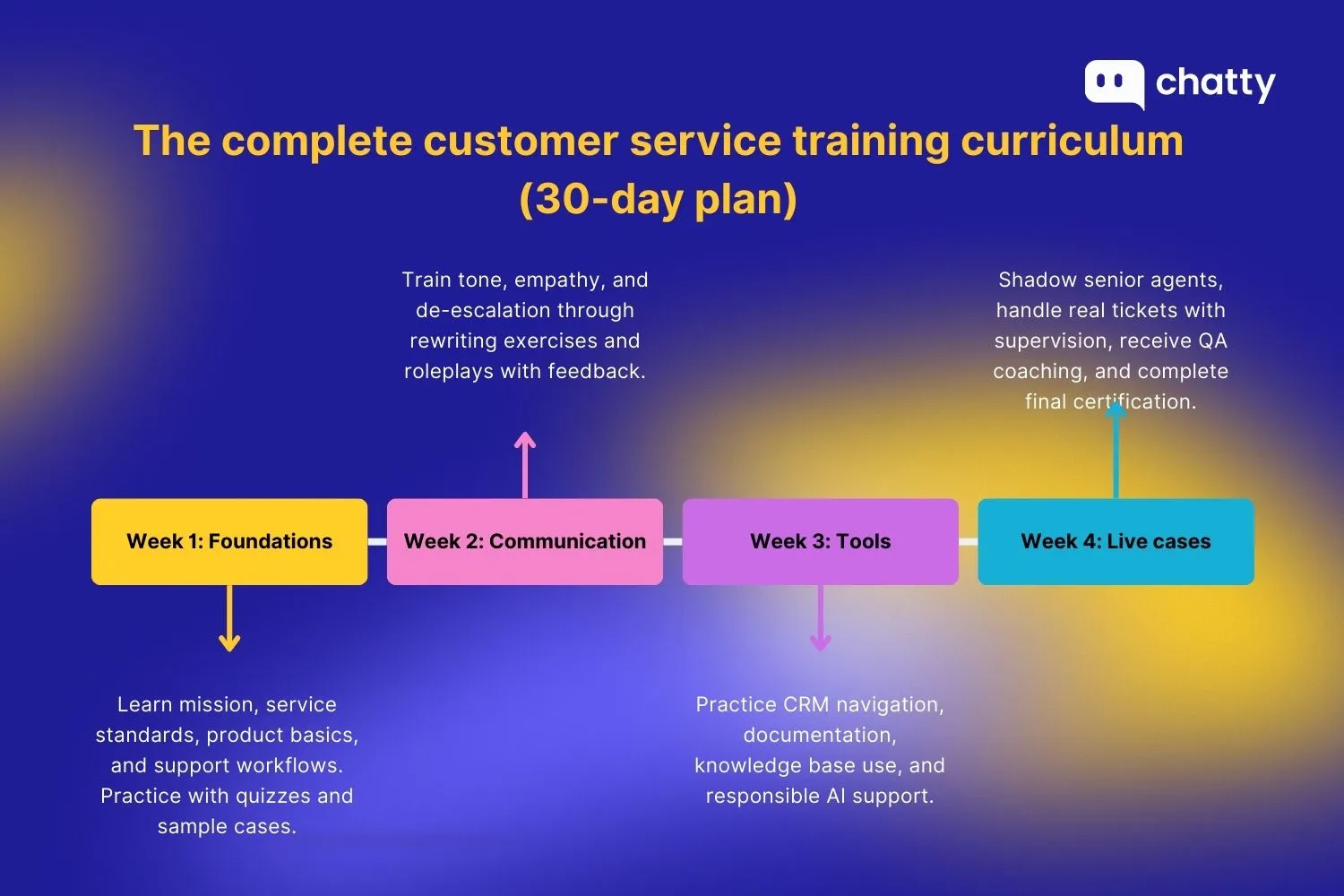
This 30-day curriculum helps new hires gain confidence step by step while using tools and analytics effectively without losing the human touch.
Week 1: Foundations
The first week builds context. New hires learn the company's mission and customer experience standards so they understand not just what to do, but why it matters. Review real customer stories, both positive and negative, to show how service impacts retention and brand trust.
Next, focus on product basics. Agents should be able to explain core features, pricing logic, common issues, and key limitations in simple language. Use short quizzes and teach-back sessions where trainees explain the product to a partner.
End the week with a clear overview of support workflows. Walk through ticket flow, escalation paths, SLAs, and documentation standards. Let trainees map a sample case from first contact to resolution so they see the full journey.
Week 2: Communication + customer psychology
Week two shifts to interaction skills. Train tone and clarity through rewriting exercises. Have trainees turn complex policy language into friendly, customer-facing responses.
Introduce customer psychology. Explain why frustrated customers want acknowledgment before solutions. Practice de-escalation using structured role-play scripts. Rotate roles so each trainee plays both agent and customer.
Provide feedback immediately. Focus on empathy statements, ownership language, and confident closing lines. The goal is natural, calm communication under pressure.
Week 3: Tools + efficiency
Now layer in systems. Teach CRM navigation using real cases that are low-risk. Set timed exercises to log notes, tag correctly, and find account history quickly.
Train agents to use the knowledge base and macros properly. Emphasize personalization. A macro should be a starting point, not a copy-paste reply.
Introduce AI copilots and chatbots responsibly. Show how AI can suggest drafts and summarize tickets, but require agents to review, edit, and ensure tone aligns with brand standards.
Week 4: Real-world performance
In the final week, trainees shadow experienced agents, then handle live tickets with supervision. Start with simple cases before moving to complex issues.
Conduct QA reviews using a clear scorecard focused on empathy, accuracy, clarity, and resolution quality. Provide coaching, not just scores.
End with a final certification assessment that combines product knowledge, live case handling, and communication quality. By day 30, agents are not only efficient but also confident in delivering service that feels human, thoughtful, and consistent.
Customer service training methods that work best
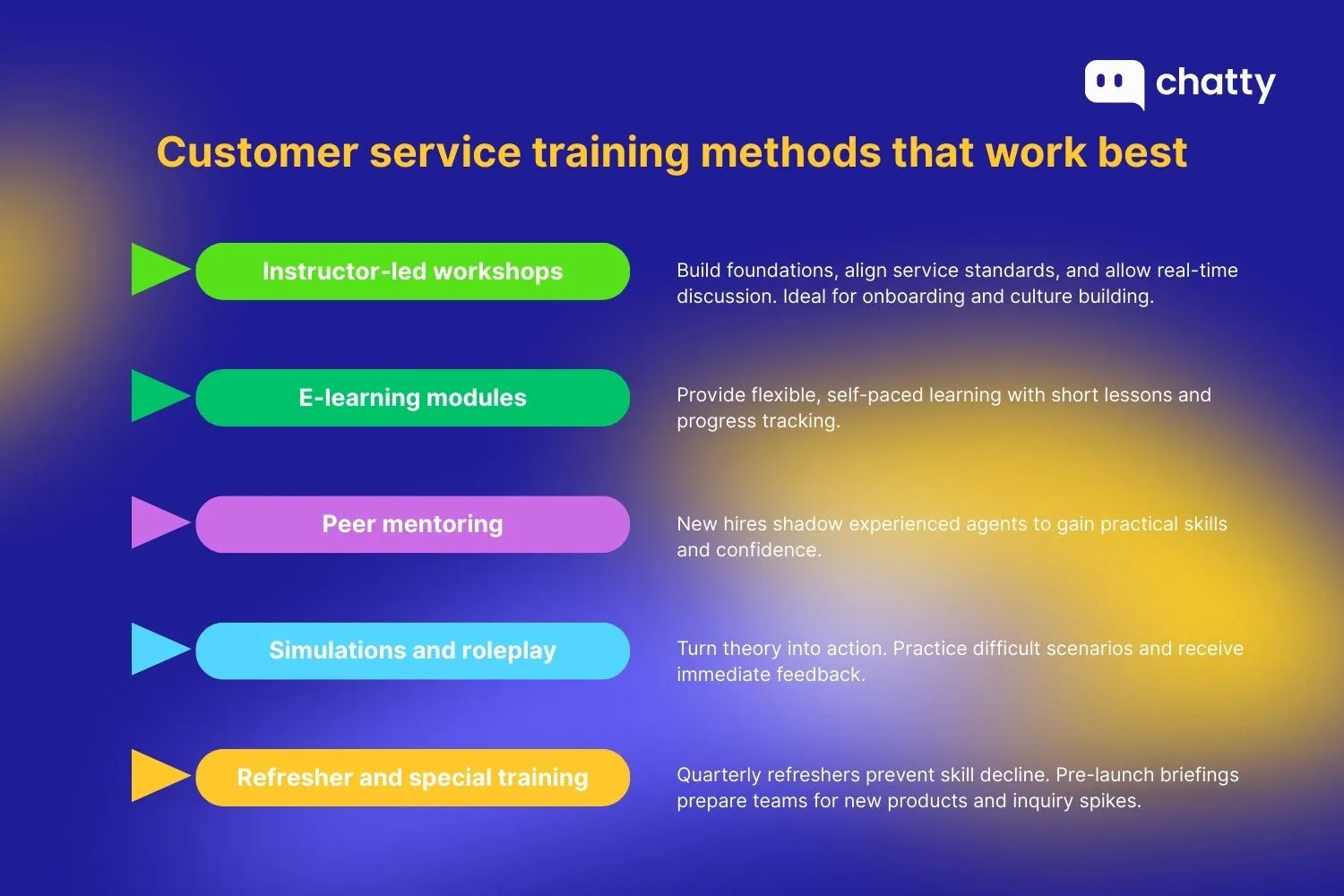
Effective customer service training blends structure, practice, and repetition. The best programs combine multiple methods so employees can learn, apply, and continuously refine their skills.
- Instructor-led workshops create a strong foundation. Trainers can explain standards, demonstrate best practices, and answer questions in real time. Group discussions also help teams align on tone, service principles, and escalation procedures. This format works well for onboarding and culture building.
- E-learning modules support flexible, self-paced learning. Staff can review product knowledge, policies, and communication techniques at any time. Short, focused modules improve retention and allow managers to track progress through quizzes and completion rates.
- Peer mentoring and buddy programs accelerate real-world learning. New hires shadow experienced agents to observe live interactions. This builds confidence and transfers practical tips that are often not written in manuals.
- Simulation and role-playing turn theory into action. Teams practice handling complaints, refunds, or difficult customers in realistic scenarios. Immediate feedback helps refine tone, empathy, and problem-solving.
- Quarterly refresher training prevents skill decline. It reinforces standards, updates teams on policy changes, and corrects bad habits before they spread.
- Special circumstance training, such as before new product launches, prepares teams for spikes in inquiries. Focused briefings reduce confusion and ensure consistent, accurate responses from day one.
Tips for effective customer service training
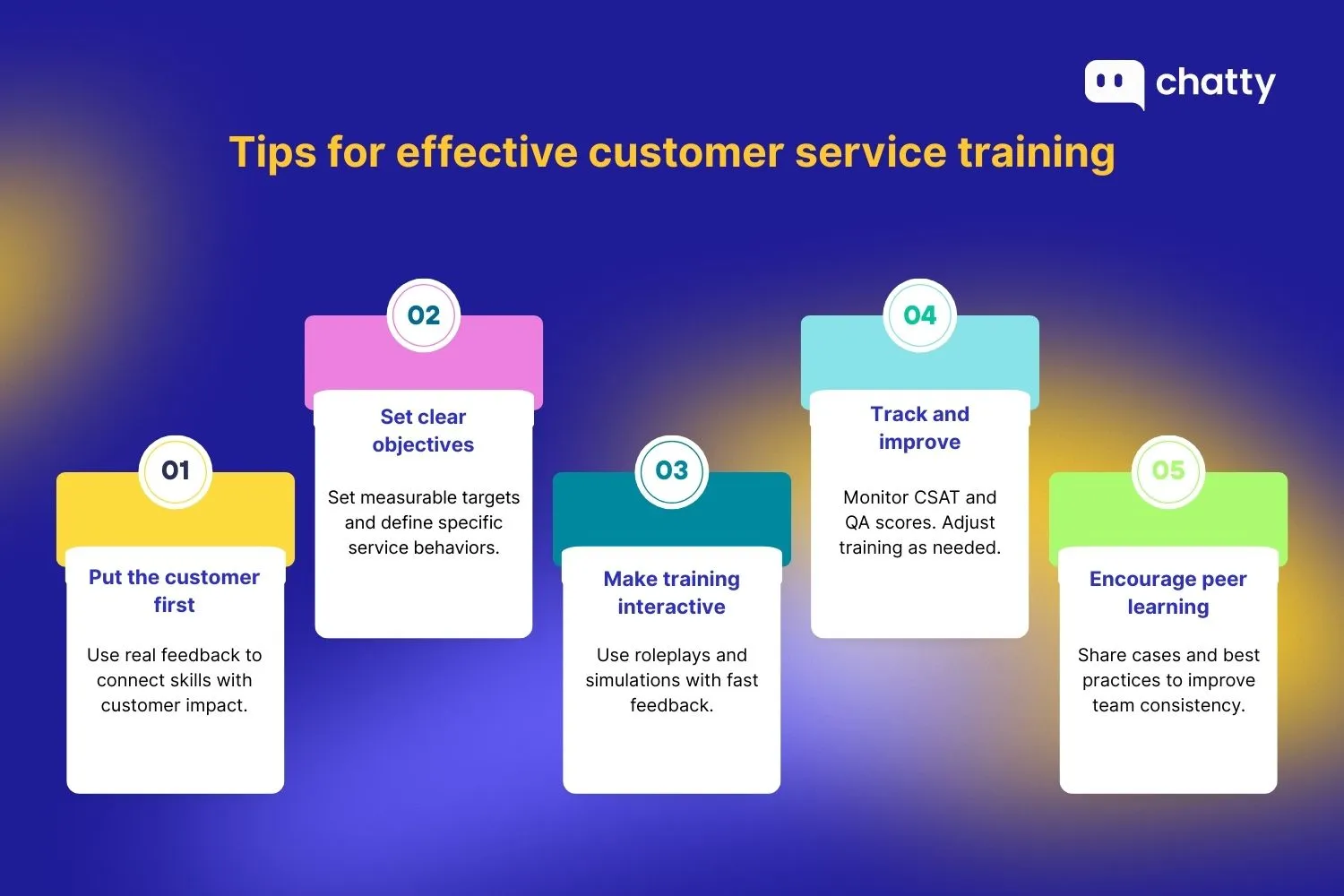
Here are practical customer service tips you can apply immediately.
Put the customer first
Start by grounding all training in real customer expectations. Use real feedback, complaints, and success stories from your company. Instead of teaching abstract communication theory, show how a delayed response affects trust or how a clear explanation reduces repeat calls. Encourage employees to ask, "How does this decision help the customer?" in every scenario. When training is framed around customer impact, employees understand the purpose behind each skill and are more motivated to apply it consistently.
Set clear objectives and expectations
Define specific, measurable goals for the training. These might include improving response time, increasing first-contact resolution, or reducing escalations. Break goals into clear behaviors, such as acknowledging emotions, confirming understanding, or summarizing next steps. Clear expectations make it easier for managers to coach and for employees to track their progress.
Make training interactive (role-play, simulations, games)
Avoid lecture-only sessions. Use role-play, simulations, and small group exercises based on real service situations. Rotate roles so employees experience both customer and agent perspectives. Provide immediate feedback after each activity. Interactive practice builds confidence and helps employees respond effectively under pressure.
Monitor performance and adjust training over time
Training should continue beyond the workshop. Track metrics such as CSAT, resolution time, and quality assurance scores. Review recorded calls or chat transcripts to identify patterns. If certain issues repeat, adjust the training focus. Continuous improvement ensures that training remains relevant to evolving customer needs.
Encourage collaboration and peer learning
Create space for employees to share best practices. Hold weekly debrief sessions for team members to discuss difficult cases and successful resolutions. Peer feedback often feels more practical and relatable than top-down instruction. A collaborative environment strengthens team consistency and builds collective accountability for service quality.
How to develop a customer service training program
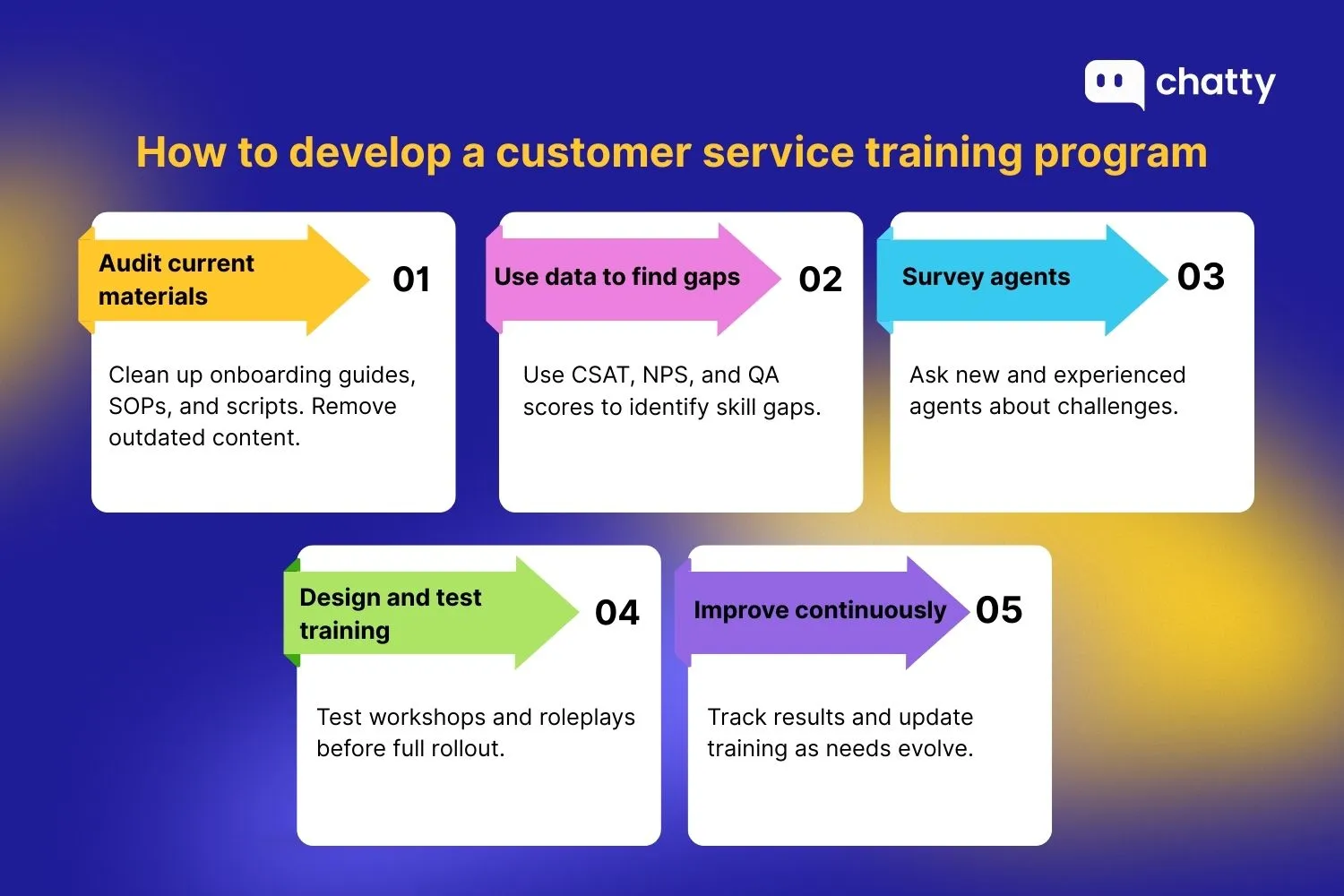
A strong customer service training program is not built in one workshop. It is built through structure, data, and continuous refinement. Here is how to develop it step by step.
- Organize existing training assets: Audit all current materials, including onboarding guides, SOPs, call scripts, QA scorecards, and knowledge base articles. Remove outdated content and merge duplicate documents. Standardize formats so agents can find information quickly. This creates a clean foundation before building anything new.
- Gather data and identify skill gaps: Review CSAT, NPS, first response time, resolution rate, escalation trends, and complaint categories. Analyze QA evaluations and call recordings to detect patterns. Identify whether issues relate to communication, empathy, product knowledge, or process understanding. Let real performance data define training priorities.
- Survey agents (new vs. tenured employees): Ask new hires where onboarding felt unclear or overwhelming. Ask experienced agents what recurring problems they face and what skills they wish they had learned earlier. Compare feedback from both groups to uncover blind spots and training inconsistencies.
- Build training with collaboration and experimentation: Involve team leads, QA analysts, and top-performing agents in module design. Pilot small training sessions first. Use roleplays, real case studies, and practical exercises. Test different formats, such as workshops, microlearning, or coaching sessions, before rolling them out widely.
- Continuously improve based on feedback: After each training cycle, measure performance changes and collect agent feedback. Update materials regularly as products, policies, and customer expectations evolve. Treat training as an ongoing system, not a one-time event.
The Bottom Line
Customer service training is the foundation of sustainable growth. When teams are trained with clear standards, practical skills, and ongoing support, both performance and confidence improve. Strong training drives higher satisfaction, faster resolutions, and better retention. Most importantly, it aligns employee experience with customer experience. Companies that invest in structured, continuous development will stay competitive in 2026 and beyond. Training is not a one-time event. It is a long-term commitment to excellence.