













Not every customer experience trend deserves your attention. Every year, industry reports list ten or fifteen "must-watch" technologies, treating AI agents and metaverse shopping as equally urgent. They're not. Some trends reflect what customers actually want right now. Others are speculative bets that might matter in five years, or never.
The CX trends that matter in 2026 share one trait: customers are already demanding them. According to recent CX research, 88% of customers expect faster response times than they did just a year ago, and 85% of CX leaders say customers will drop brands over unresolved issues. These are current expectations, not predictions.
This article filters the signal from the noise. You'll learn which trends have real customer demand behind them, which are still maturing, and how to decide where to invest your CX budget.
- AI is shifting from support cost-center to sales revenue-driver.
The biggest opportunity is AI that helps customers buy, not just AI that answers questions.
- Personalization is now expected, not impressive.
Customers notice when you don't personalize, not when you do.
- Memory-rich AI is the next frontier.
In fact, 83% of CX leaders say context continuity across conversations is essential.
- Human interaction is becoming premium.
As AI handles routine tasks, human touch becomes a differentiator for complex and high-value moments.
- Ignore metaverse and voice commerce for now.
Customer adoption is too low to justify significant investment.
8 customer experience trends shaping 2026
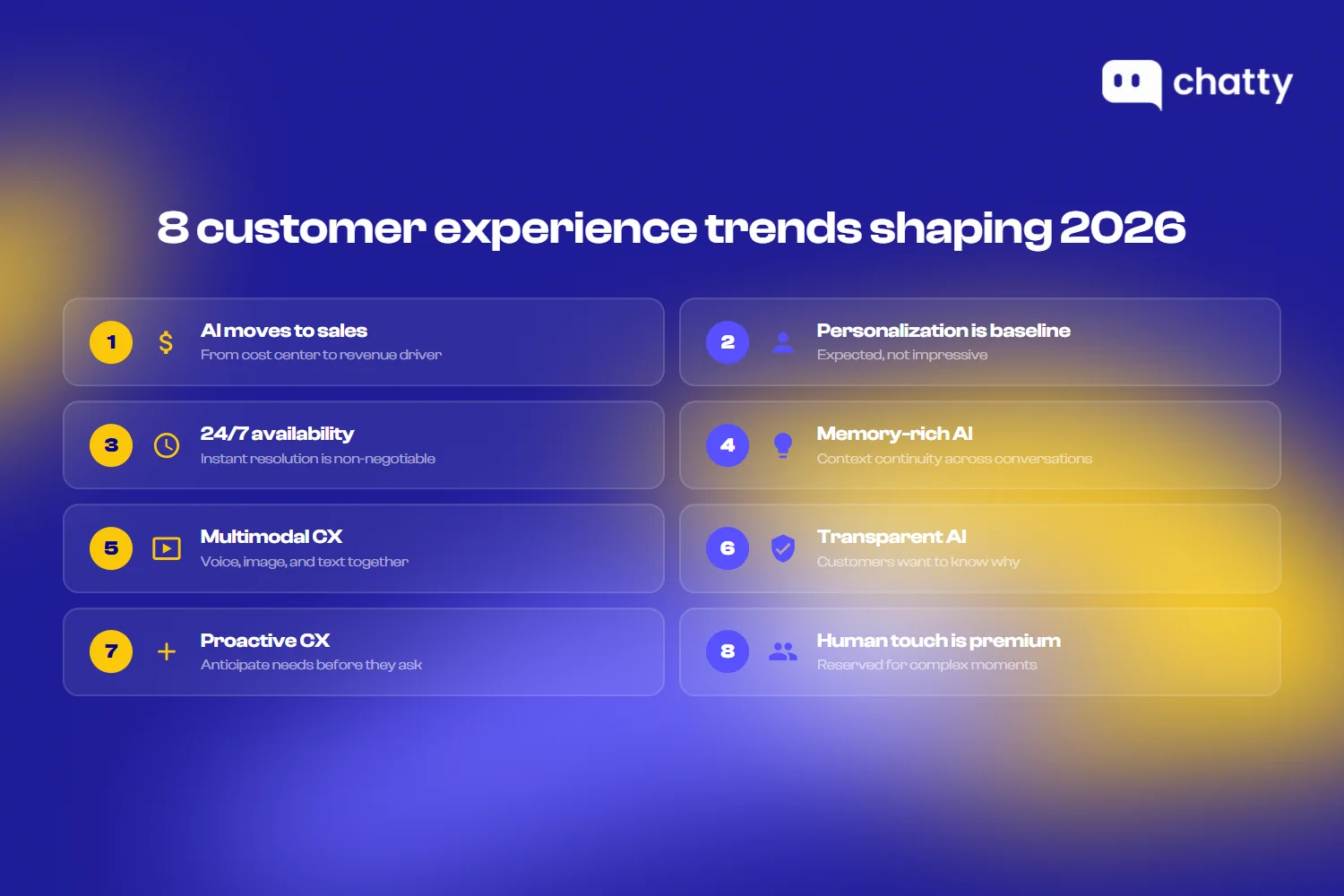
Before diving deep, here's the full picture of what's changing in customer experience. These eight trends have measurable customer demand behind them:
- AI moves from support to sales: In fact, AI has moved beyond deflecting tickets to guiding purchases, qualifying leads, and closing sales.
- Personalization becomes baseline: However, customers now expect you to know their history. The absence of personalization frustrates rather than impresses.
- 24/7 availability is non-negotiable: Also, instant messaging culture has reset expectations. Customers expect immediate responses at any hour.
- Memory-rich AI eliminates repetition: In fact, customers refuse to repeat themselves. AI that remembers context across conversations is essential.
- Multimodal communication expands: Meanwhile, text-only chat feels limited. Customers want to send images, voice messages, and text in the same thread.
- AI transparency builds trust: In fact, customers want to know why AI recommended something, and 95% expect explanations for AI decisions.
- Proactive service replaces reactive support: Also, waiting for customers to contact you is outdated. Anticipating needs before they ask is the new standard.
- Human touch becomes premium: Meanwhile, as AI handles routine, human interaction becomes a luxury reserved for complex or high-value moments.
Each trend connects to customer expectations already visible in research data. The following sections explain what each means for your business and how to act on them.
AI in customer experience: from support to sales
About this trend
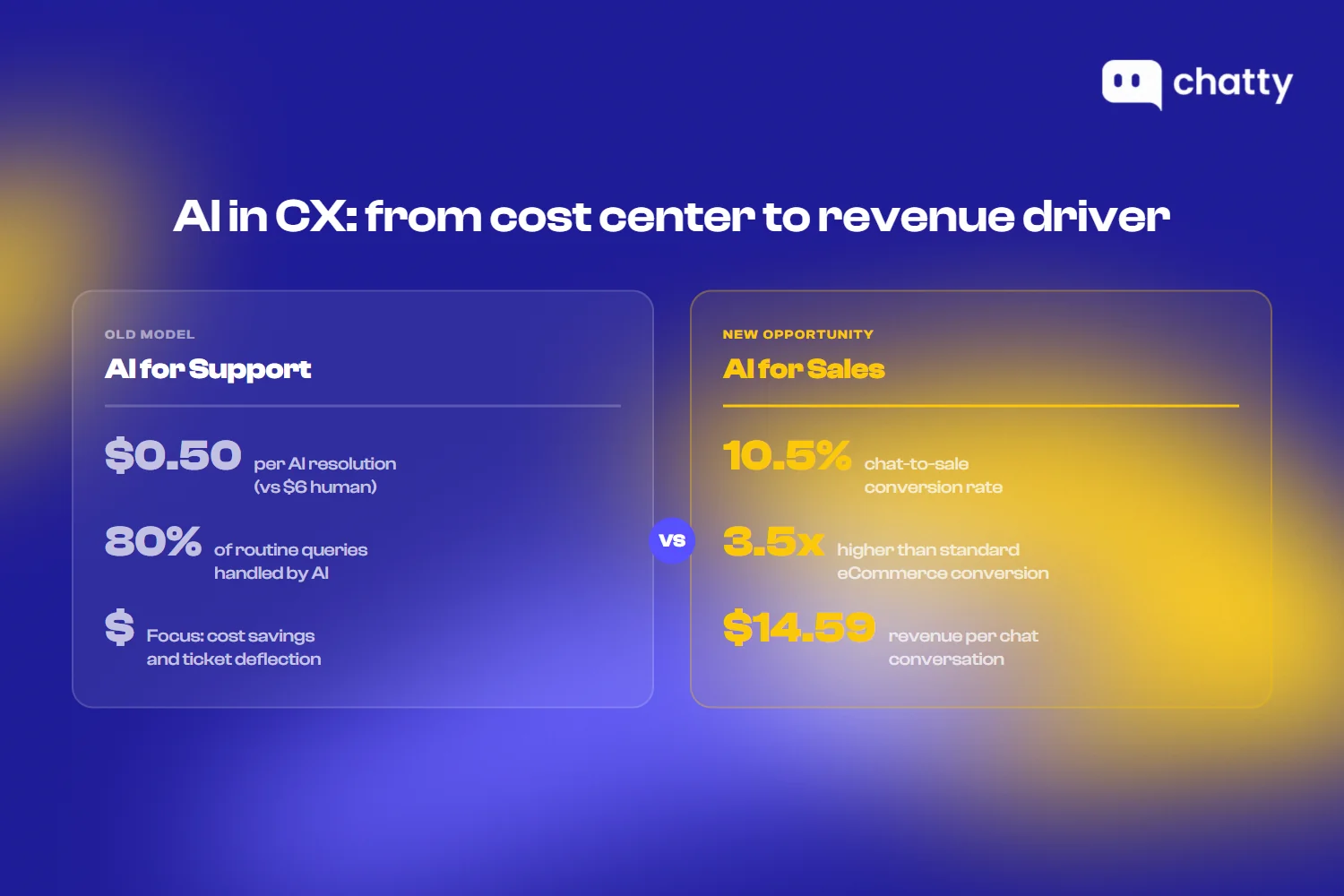
The biggest shift in AI customer experience is AI moving from answering questions to driving revenue, not just building better chatbots.
For years, businesses deployed AI primarily to deflect support tickets and reduce costs. That made sense when AI could only handle simple FAQ queries. But AI capabilities have advanced dramatically. According to Tidio's chatbot research, stores using AI chatbots effectively see annual revenue increases of 7% to 25%. Sephora reported an 11% increase in conversion rates after deploying AI-assisted product recommendations.
The math is compelling: a support ticket costs $6 on average for human handling versus $0.50 for AI resolution. But the revenue opportunity is even larger. Chatty research across 4 industries and 15,600+ conversations shows eCommerce stores using AI chat achieve 10.5% chat-to-sale conversion, which is 3.5x higher than standard eCommerce conversion rates. Each chat conversation is worth $9.70 to $14.59 in expected revenue for stores with $80+ average order values.
AI sales agents like Chatty represent this shift. Rather than simply answering "where's my order?" questions, these AI agents actively help customers make purchase decisions, recommend products based on conversation context, and complete transactions within the chat interface.
What this means for your business
If your AI only handles support, you're solving the smaller problem. Support deflection saves money. AI-assisted sales makes money.
Start by evaluating where AI fits in your customer journey. Most businesses have AI at the end, handling complaints after the purchase. The higher-value opportunity is AI at the beginning, helping customers find the right product, answering pre-purchase questions, and reducing friction in the buying process.
Measure AI's impact on revenue, not just ticket deflection. Track these metrics to reveal whether AI is a cost center or a profit center:
- Chat-to-sale conversion rates
- AI-assisted average order value
- Revenue attributed to AI interactions
Personalized customer experience is now expected
About this trend
Personalization used to impress customers. Now its absence frustrates them.
According to McKinsey research, 71% of consumers expect personalized interactions, and 76% get frustrated when this doesn't happen. The bar has risen because customers experience personalization everywhere: Netflix recommendations, Spotify playlists, Amazon's "frequently bought together" suggestions. They expect the same from every brand.
What changed? Personalization moved from impressive to invisible. Customers only notice personalization when it's missing. A returning customer who has to re-enter their preferences or see irrelevant recommendations feels the friction immediately.
The sophistication bar is rising too. Customers have outgrown segment-based personalization, such as showing "fitness enthusiasts" different content than "casual shoppers." Customers expect individual-level personalization: recommendations based on their specific browsing history, purchase patterns, and stated preferences.
What this means for your business
The real question is how quickly you can move from segment-level to individual-level personalization, since personalization itself is already non-negotiable.
This requires two investments:
- First-party data strategy. Third-party cookies are disappearing, and privacy regulations are tightening. The businesses that win at personalization will be those capturing customer preferences directly through interactions, purchases, and explicit preference settings.
- AI-driven personalization engines. Rule-based personalization ("if customer bought running shoes, show running socks") fails to scale to individual-level relevance. AI systems that learn from behavior and adapt in real-time are now table stakes for competitive personalization.
24/7 customer experience: instant resolution expected
About this trend
Customers demand immediate responses. "Wait until Monday" or "we'll get back to you within 24 hours" drives them to competitors. Instant messaging culture has fundamentally changed expectations.
The data is stark: 74% of consumers now expect customer service to be available 24/7, according to recent CX research. And 88% expect faster response times than they did just one year ago. This is a rapid acceleration driven by messaging apps that trained customers to expect immediate responses.
The challenge for businesses is economic. Running human support teams around the clock across time zones is expensive. For most eCommerce stores, overnight staffing costs rarely justify overnight ticket volume.
AI makes 24/7 service economically viable. AI assistants like Chatty handle routine queries at any hour, including checking order status, answering product questions, and processing simple returns, while routing complex issues to human agents during business hours. This hybrid model delivers the instant availability customers expect without the cost structure of global human teams.
What this means for your business
Only hybrid AI + human models scale to 24/7 for most businesses.
Design your hybrid model deliberately:
- AI handles routine, high-volume queries like order tracking, shipping times, return policies, and product specifications.
- Humans handle complexity, emotion, and edge cases like complaints requiring judgment, VIP customers, and situations where AI confidence is low.
If 24/7 service remains out of reach, set realistic expectations. A clear "we respond within 4 hours during business hours" is better than silence. But recognize that every competitor moving to 24/7 AI-assisted support makes your limited hours a competitive disadvantage.
Customer experience with memory-rich AI
About this trend
The most frustrating customer experience is repeating yourself. You contact support, explain your issue, get transferred, and explain everything again. Memory-rich AI eliminates this friction entirely.
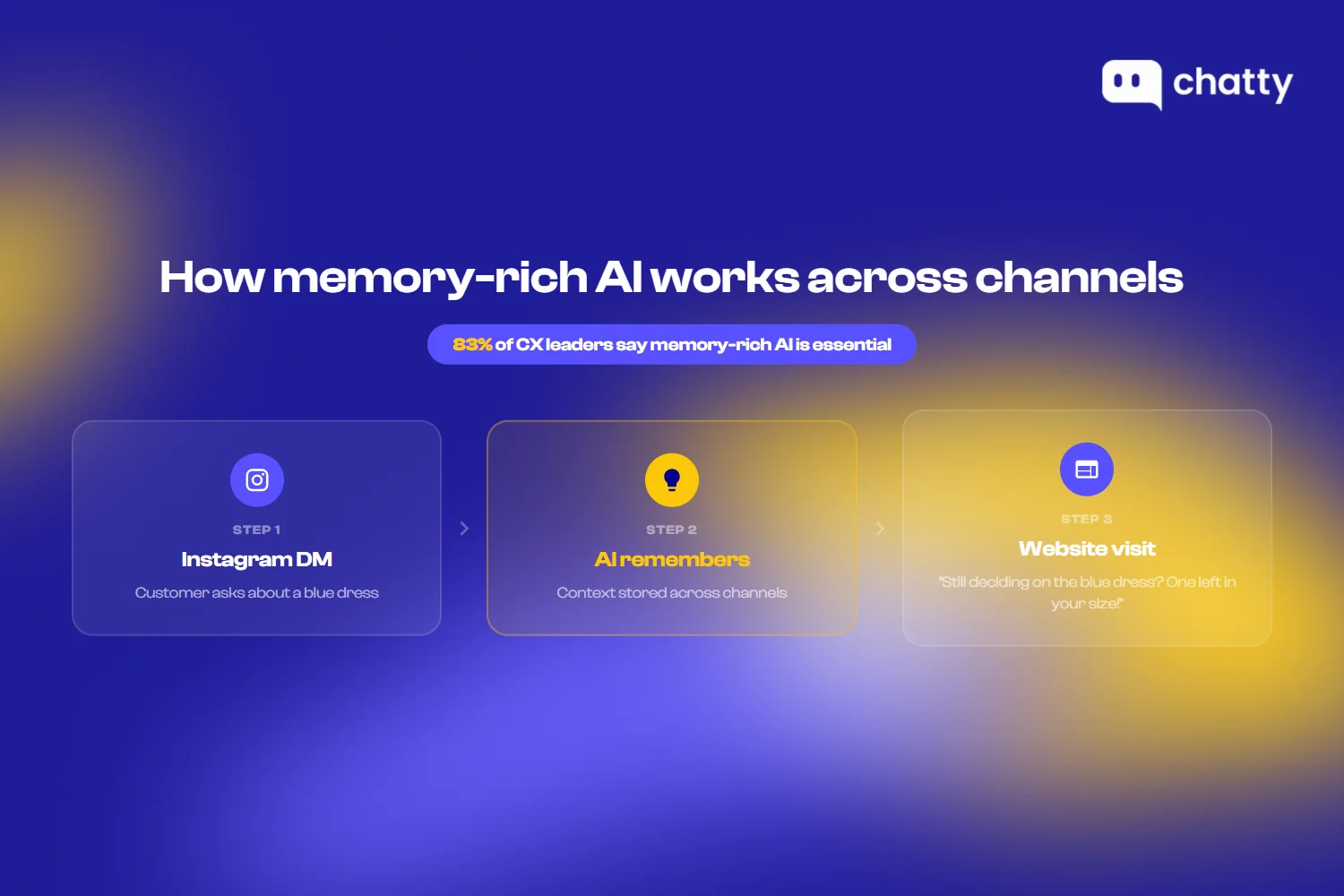
According to recent CX research, 83% of CX leaders say memory-rich AI agents are the key to truly personalized journeys. And 74% of customers find it frustrating to repeat their story to different agents. The expectation is clear: AI should remember context across conversations, channels, and time.
What does memory-rich AI look like in practice? A customer asks about a product on Instagram DM. Two days later, they visit your website. The AI greets them: "Welcome back! Did you decide on the blue dress we discussed on Instagram? I have one left in your size." That continuity feels personal because the AI carried context from one channel to another.
This goes beyond conversation history. Memory-rich AI includes past purchases, browsing behavior, stated preferences, and previous support interactions. When a customer contacts support, the AI already knows their order history, previous issues, and likely reason for reaching out.
What this means for your business
Customers have moved beyond disconnected chatbot sessions where every conversation starts from zero. Building memory architecture into your AI systems is essential.
This requires unified customer profiles that aggregate data across channels: website behavior, chat conversations, purchase history, email interactions, and social media touchpoints. The AI needs access to this unified profile to deliver continuity.
Balance memory with privacy. Customers want AI to remember them, but they also expect transparency about what data you're collecting and storing. Clear privacy policies and easy opt-out mechanisms build trust while enabling the personalization customers demand.
Multimodal customer experience: voice, image, text
About this trend
Text-only chat is starting to feel limited. Customers increasingly want to communicate with images, voice, and text in the same conversation, all without starting over.
The numbers confirm this shift: 76% of consumers say they would choose a company that lets them share text, images, and video in the same conversation thread, according to recent research. Think about why. When a customer receives a damaged product, they want to snap a photo and show you rather than describe the damage in text. When they're trying to match a product, they want to send an image of what they're looking for.
Voice is growing too, though more slowly. Customers browse by voice (asking smart speakers for product information) but still prefer screens for actual purchases. The sweet spot for voice is simple, familiar transactions like reordering coffee pods, checking order status, asking quick questions while hands are busy.
What this means for your business
Single-mode support, specifically text-only chat, will feel increasingly limited to customers accustomed to multimodal messaging apps.
Image recognition for product queries is the highest-impact investment for most eCommerce businesses. Customers sending photos of damaged items, products they want to match, or installation problems they need help with should get AI that understands visual context.
Voice support deserves attention but measured investment. Unless your customers have specific use cases (hands-free shopping while driving, accessibility needs), voice likely won't be your primary channel. Build it for the customers who need it rather than as a headline feature.
Transparent AI in customer experience
About this trend
Customers demand transparency from AI. When AI recommends a product or makes a decision, they want to know why.
The demand is nearly universal: 95% of consumers expect an explanation for AI-made decisions, according to recent CX research. Yet only 37% of companies currently offer any reasoning behind AI recommendations. This gap represents both a risk and an opportunity.
Regulatory pressure is building too. AI explainability requirements are expanding across jurisdictions. Businesses deploying customer-facing AI will increasingly need to demonstrate how decisions are made, not just what decisions were made.
The customer psychology is straightforward. "We recommend this product because…" builds trust. A recommendation with no explanation feels manipulative. "Other customers who bought X also bought Y" works because it shows the logic. Unexplained recommendations trigger suspicion.
What this means for your business
Build explainability into AI interactions from the start. When AI recommends a product, show the reasoning: "Based on your interest in [previous product], you might like ." When AI applies a discount, explain why: "As a returning customer, you qualify for 10% off."
Offer human override availability. Some customers will always want to speak with a human, especially for high-stakes decisions. Making human agents easily accessible builds trust in your overall AI system.
Opt-out options matter too. Let customers choose less personalized experiences if they prefer. Paradoxically, offering opt-out often increases trust in AI recommendations for those who stay opted in.
Proactive customer experience beats reactive support
About this trend
Waiting for customers to contact you with problems is the old model. The new expectation is anticipating needs and reaching out first.
According to Genesys research, 72% of CX leaders believe AI will eventually power all proactive outreach, and 68% of customers now expect brands to provide proactive assistance. The shift makes business sense: resolving an issue before the customer notices costs less than handling an angry complaint after they do.
What does proactive CX look like?
- A shipping delay notification sent before the customer checks their order status
- A follow-up message when a customer abandons their cart, offering to answer questions
- An alert when a subscription product is running low, making reordering effortless
AI sales agents like Chatty can proactively engage customers showing purchase hesitation by offering assistance before they abandon rather than trying to win them back later with discount emails. The intervention happens at the moment of doubt, when it's most effective.
What this means for your business
Building proactive triggers into CX operations requires identifying the moments customers typically have questions or concerns, then addressing them before they ask.
Start with behavioral triggers:
- When a customer visits the same help article multiple times without contacting support, proactively offer assistance.
- When a customer's order is delayed, notify them before they check.
- When browsing behavior suggests confusion, open a helpful chat.
Don't overdo proactive outreach. There's a line between helpful and intrusive. A proactive shipping update is welcome. A proactive message every time someone views a product page is annoying. The test: would you find this message helpful, or would you find it pushy?
Human touch in customer experience becomes premium
About this trend
As AI handles more routine interactions, a counter-trend emerges: human touch becomes premium.
The data backs this up. Premium ecommerce brands using AI-human workflows have seen up to 3x conversion rate increases and 38% higher average order value, according to Alhena research. The reason? AI collects context that makes human interaction more productive and personalized. When a human agent takes over, they already know everything about the customer's situation.
The segmentation is becoming explicit. AI handles routine inquiries at scale. Humans handle complexity, VIP customers, and emotionally charged situations. Some businesses are even offering "speak to a human" as a premium feature for top-tier customers.
Rather than replacing humans, the goal is deploying them where they add the most value. A human agent spending time answering "where's my order?" questions is a misallocation. That same agent helping a frustrated customer navigate a complex return, or guiding a high-value customer through a major purchase decision, creates genuine value.
What this means for your business
Some interactions deserve a human touch. The strategic question is: where do humans add the most value?
Train human agents for high-value conversations. When most routine queries go to AI, human agents need different skills: handling escalations, building relationships with VIP customers, navigating complex situations with judgment and empathy.
Watch out for the "all AI" trap. Customers who struggle to reach a human when they genuinely need one become frustrated quickly. Keep human access available, even if most customers rarely use it. The option itself builds trust.
CX trends you can safely ignore in 2026
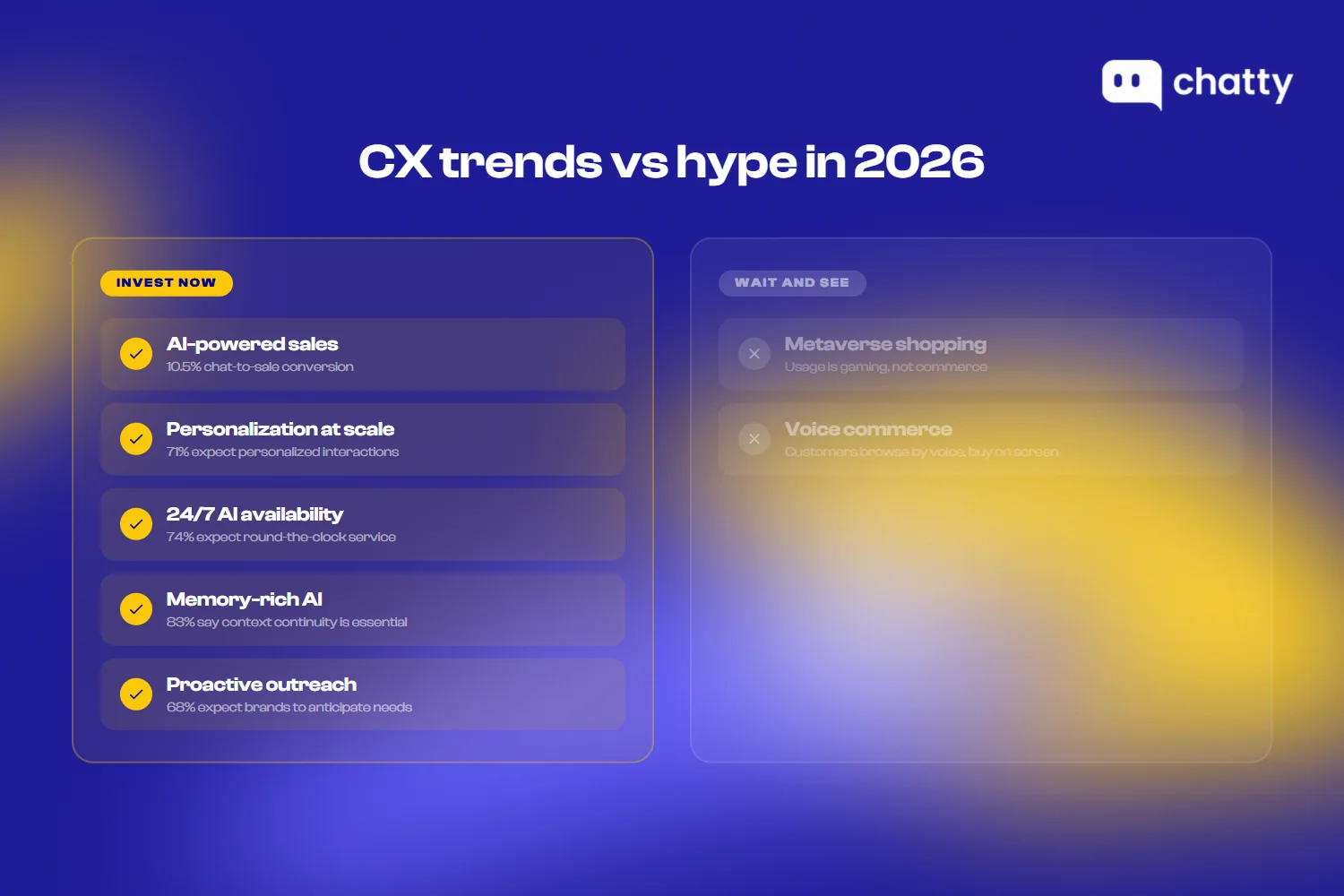
Some trends in CX reports are years from mainstream adoption. Others may stay niche forever.
Metaverse and VR shopping
The metaverse gets mentioned in nearly every CX trends report. The reality is different. While 26% of U.S. adults have used the metaverse in the past year according to YouGov surveys, that usage is overwhelmingly gaming and social, with minimal shopping activity. Virtual fitting rooms show promise for specific categories (fashion, furniture), but general metaverse shopping remains niche.
For most eCommerce businesses, metaverse investment in 2026 is premature. Watch the space, but save significant budget for when customer adoption signals a genuine shift.
Voice commerce as primary channel
Voice commerce has been "the next big thing" for a decade. Customers use voice assistants to browse and ask questions, but they convert on screens. The reason is simple: complex purchases require visual comparison, reviews, and checkout flows that voice struggles to replicate.
Voice works for simple, familiar transactions like reordering household supplies, checking order status. Screens will remain dominant for considered purchases. Build voice capabilities for convenience use cases, not as a primary commerce channel.
How to evaluate CX trends for your business
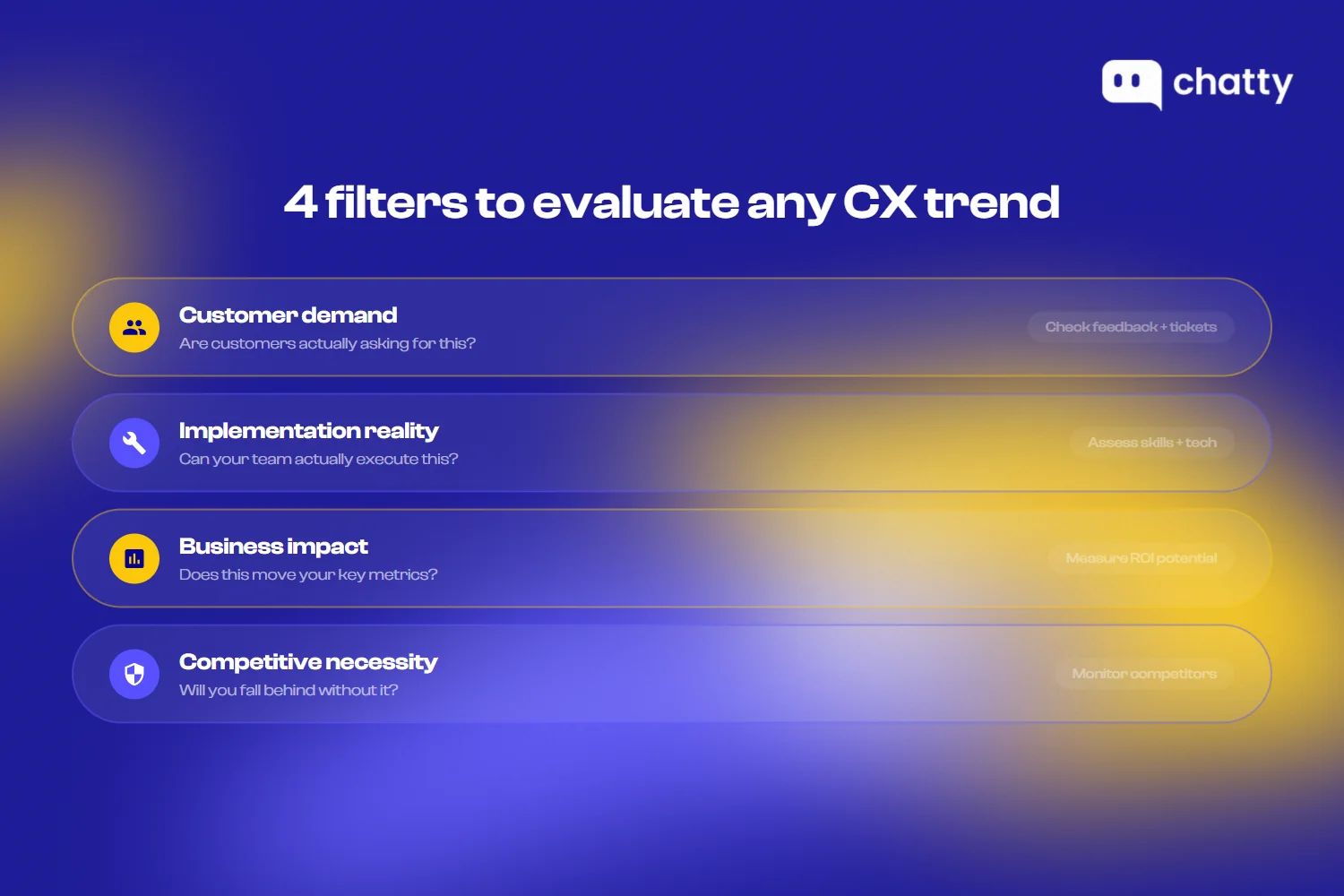
Every CX trend sounds compelling in isolation. The challenge is deciding which ones deserve your limited resources. Use this four-question filter:
Customer demand filter: Are your customers asking for this, or is it a solution looking for a problem? Check support tickets, customer feedback, and competitor reviews for signals of unmet needs.
Implementation reality filter: Can you actually execute this with your current team and technology? A trend requiring skills or infrastructure you don't have is a multi-year project, not a quick win.
Business impact filter: Does this trend move metrics you care about? A technology that improves a secondary metric while your primary metrics stagnate deserves lower priority.
Competitive necessity filter: Will you fall significantly behind competitors without this? Some trends are defensive, meaning you need them to stay competitive even if they don't provide advantage.
The trends that pass all four filters are your priorities. The ones that fail multiple filters can wait.
Preparing your customer experience for what's next
The specific trends will change. The constant is the need to evolve with customer expectations.
The businesses that thrive in shifting CX landscapes share common traits:
- They listen more than they assume, so customer feedback drives their roadmap, not industry reports.
- They build adaptable infrastructure: systems that can incorporate new capabilities without complete rebuilds.
- They experiment continuously by testing trends with small pilots before major investments.
Start with one trend at a time. Pick one that aligns with your customers' stated frustrations:
- If customers complain about slow response times, 24/7 AI-assisted support solves a real problem.
- If customers mention repeating themselves, memory-rich AI addresses genuine friction.
- If pre-purchase questions go unanswered, AI sales assistance fills the gap.
Customer expectations will keep rising. The only question is whether you'll adapt proactively or reactively.
FAQ
The most impactful CX trends in 2026 are AI moving from support to sales, memory-rich AI that maintains context across conversations, personalization becoming baseline rather than differentiator, and 24/7 instant availability. These trends have documented customer demand. In fact, 88% expect faster responses than last year, and 83% of CX leaders say memory-rich AI is essential for personalization.
Apply a four-question filter: Is there customer demand? Can you implement it? Does it impact metrics you care about? Will you fall behind competitors without it? Trends that pass all four filters deserve investment. Those that fail multiple filters can wait until customer adoption or your capabilities catch up.
AI will handle most routine interactions, but human agents become more valuable for complex situations, emotional escalations, and high-value customers. Premium brands see 3x conversion increases using AI-human hybrid models. The shift isn't replacement but rather reallocation of human agents to where they add most value.
Build adaptable infrastructure that can incorporate new capabilities without rebuilds. Listen to customer feedback to identify which expectations are rising fastest for your audience. Start with one trend that solves a real customer frustration, prove value, then expand. Continuous small experiments beat occasional large transformations.
Trends have measurable customer demand and proven business impact. Hype has industry excitement but limited adoption. Metaverse shopping and voice commerce as primary channels remain hype because customer adoption stays minimal. AI personalization and 24/7 availability are trends because customers actively expect them and penalize brands that fall short.