











Right now, most brands are feeling the pressure: ad costs keep rising, competition gets tougher, and manual decisions do not scale anymore. At the same time, it’s estimated that the market for AI-powered ecommerce tools will reach nearly $17 billion by 2030, which shows how quickly AI is becoming a must, not an option.
E-commerce limitless artificial intelligence is one way to keep up, because it lets a single AI layer learn from all your data and support every key decision. In this article, we walk through what “limitless” really means, where it already shows up in real platforms, and how you can start adopting it without losing control.
- The AI-powered e-commerce tools market is projected to reach $17 billion by 2030.
Rising ad costs and intensifying competition are accelerating adoption, making AI less of a growth experiment and more of a baseline operational requirement.
- Limitless AI in e-commerce means one intelligence layer that learns from all store data simultaneously.
Rather than isolated tools handling separate tasks, a limitless AI model applies insights from sales, support, and browsing data to improve every decision at once.
- Manual decisions cannot scale to match the personalization demands of modern shoppers.
AI replaces the bottleneck of human review cycles with real-time adaptation, allowing pricing, recommendations, and messaging to respond to live demand signals.
- Adopting limitless AI without governance creates accuracy and brand control risks.
The article advises starting with defined use cases and maintaining human oversight checkpoints so AI augments decisions rather than replacing judgment on high-stakes actions.
- E-commerce brands that move first on AI adoption set personalization benchmarks competitors must catch up to.
Early adopters accumulate training data advantages that make their AI models progressively more accurate, widening the performance gap over time.
What does “limitless artificial intelligence” really mean in e-commerce?
“E-commerce limitless artificial intelligence” means that AI stops being a single feature (like a product recommender) and becomes a decision layer across your whole stack. It learns from every visit, click, order, and support ticket, then pushes the best decision to whichever tool the shopper is using at that moment.
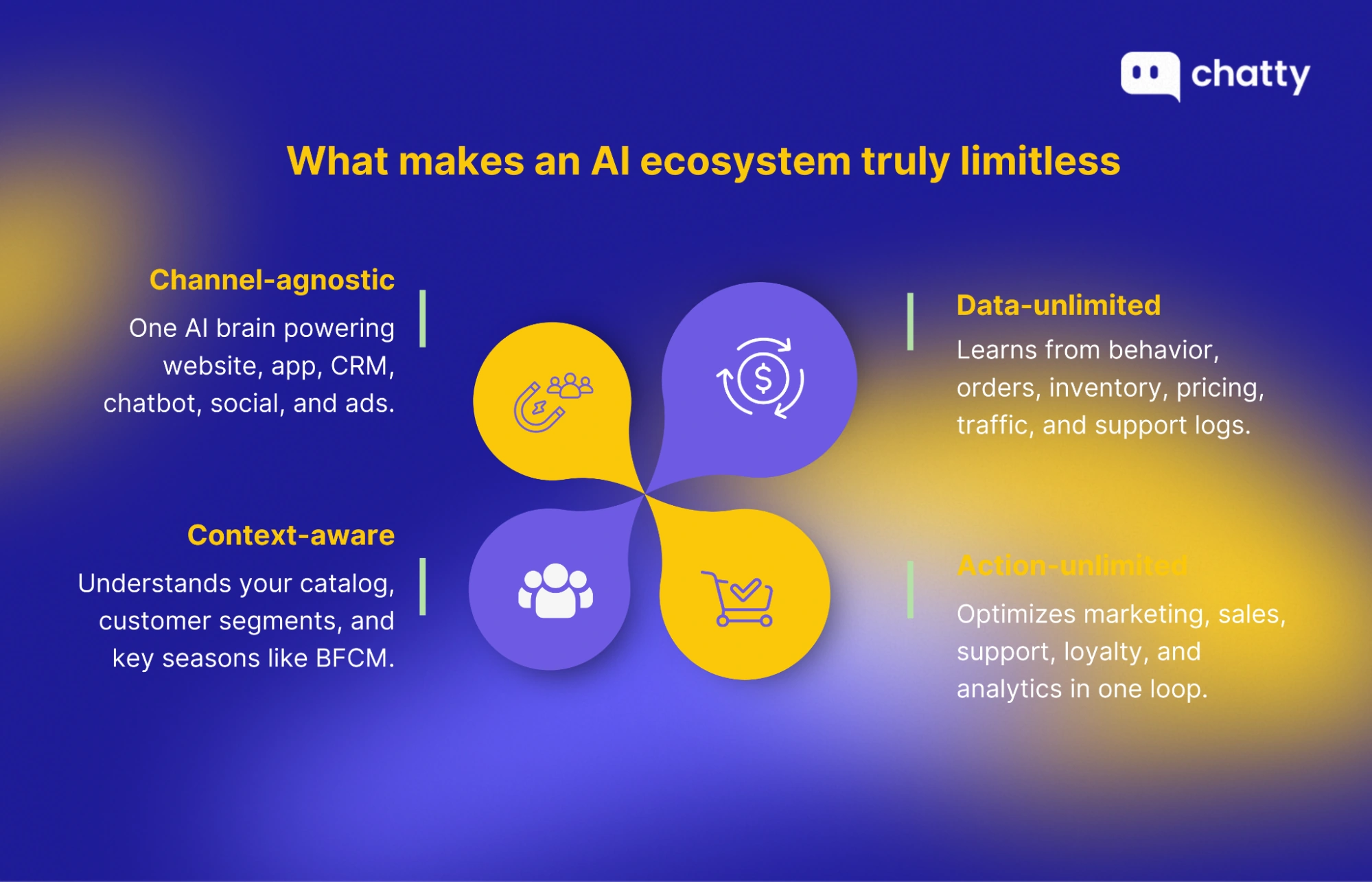
“Limitless” here refers to the scope of what AI can see and do, not to magic. What makes an AI ecosystem truly limitless:
- Channel-agnostic: one AI brain acting across website, app, inbox, CRM, chatbot, social, and ads.
- Data-unlimited: uses behavior, purchase history, inventory, pricing, traffic, creatives, UGC, and support logs as inputs.
- Context-aware: understands your catalog, vertical, customer segments, and seasonality (BFCM, holidays, back-to-school).
- Action-unlimited: drives marketing, sales, support, loyalty, and analytics so every action feeds the next optimization.
What can an “e-Commerce limitless AI” system do?
When you run an e-commerce limitless AI system, your channels, data, and teams stop working in silos and start following one shared brain. Below is how that brain can power end-to-end journeys, daily operations, sales and support, and your creative output.
Build your own end-to-end customer journey
Here, AI designs the path from first impression to repeat purchase. It reads data from your ads, analytics, ecommerce platform, recommendation engine, and marketing automation, then adjusts journeys based on real behavior instead of fixed funnels.
Let’s see the workflow:
- Connect your e-commerce platform, analytics, ad accounts, and personalization tool, so AI sees the whole path from impression to order.
- Let AI cluster visitors by source and intent, then send each group to the most relevant creatives, landing pages, and offers.
- Turn on dynamic recommendations and offers based on real behavior, then track their impact on conversion rate, AOV, and ROAS.
Most teams use this layer to:
- Suggest creative ads
- Optimize ad budgets based on ROAS
- Personalize landing pages based on visitors
- Automatically upsell/cross-sell based on real-time behavior

AI as an “operational mindset” for businesses
Limitless AI also supports the decisions that protect cash and profit. It studies historic sales, stock levels, lead times, and costs, then shows which products to reorder, which to mark down, and which channels truly make money after ad spend and logistics.
Workflow:
- Centralize sales, stock, lead time, cost, and marketing data so AI can model demand and margin.
- Set guardrails on margin, stock cover, and discounts, then let AI suggest reorders, price changes, and budget shifts.
- Review short AI summaries of profit drivers and issues instead of digging through raw reports.
On the operations side, AI often helps to:
- Forecast inventory
- Optimize prices based on time
- Allocate marketing budgets based on profits
- Automatically report performance
AI as a salesperson + 24/7 customer care
On the front line, limitless AI appears as a sales and support teammate that never sleeps. It reads your catalog, FAQs, policies, and order data, then answers questions, overcomes objections, and moves people to the right offer while knowing when to bring a human in.
Workflow:
- Train a conversational AI on your product data, help center, and policy docs, and connect it to your order system for real-time lookups.
- Define clear rules for what the bot can decide alone, such as simple pre-purchase questions or basic refunds, and when it must escalate.
- Track metrics like revenue from chat, average order value from assisted sessions, first response time, and satisfaction, then refine scripts and intents.
Common use cases:
- Sales chatbot understands products like a real person
- Cart consulting
- Handle complaints
- Follow-up abandoned carts
AI as a creative studio
Finally, an e-Commerce limitless AI system speeds up content production while keeping humans in control of brand and message. It generates variants of visuals and copy, then uses data from your site, email, and ads to keep only what converts.
Workflow:
- Define brand rules for tone, structure, layouts, and visual style, then feed these into your AI tools for text and images.
- Generate multiple options for banners, product photos, thumbnails, SEO text, emails, and ad copy for each campaign.
- Run structured A/B tests on key touchpoints, let AI read the results, and promote the best-performing variants across channels.
Typical outputs from this layer:
- Create banners, product photos, thumbnails
- Automatically optimize A/B testing
- Write SEO content + email + ads
What’s driving the buzz around e-commerce, limitless AI
The excitement around limitless AI in e-commerce comes from one thing: the pieces are finally ready. Shoppers are already using AI to find products, and the big platforms are quietly building multi-agent systems that can handle a full shopping flow rather than a single microtask.
On the customer side
AI is becoming a regular part of how people discover and choose products. Salesforce reports that 39% of consumers, and more than half of Gen Z, already use AI to find out what to buy, and many are starting to replace classic search with generative AI when they want ideas or comparisons.
During recent peak seasons, Adobe and Salesforce both saw AI-driven tools influence billions in online sales and record Black Friday revenue, helped by assistants like Amazon Rufus and Walmart Sparky on large retail sites.
On the tech side
Companies like OpenAI, Google, Meta, and large commerce platforms are investing heavily in multi-agent or agentic systems. These setups let AI search, compare, build a cart, and even complete checkout within a single continuous experience.
OpenAI’s Operator and its Agentic Commerce Protocol are early examples of systems that enable an AI agent to browse, shop, and order on behalf of the user. McKinsey estimates that generative AI could unlock $ 240 to $ 390 billion in value in retail, equal to roughly 1.2 to 1.9 margin points, mainly through better personalization, pricing, and automation.
For online sellers, limitless AI feels urgent, not theoretical. Multi-agent AI can now:
- Increase sales faster
- Reduce operating costs
- Optimize profit margins
- Automate key tasks 24/7 across channels
Example of a platform that is getting closer to “limitless AI”
If “e-commerce limitless artificial intelligence” means an AI layer that sees your whole business and acts across many tools, some platforms are already moving in that direction. Three good examples today are Shopify Sidekick, Chatty AI, and Meta’s Advantage+ ads suite.
1. Shopify sidekick
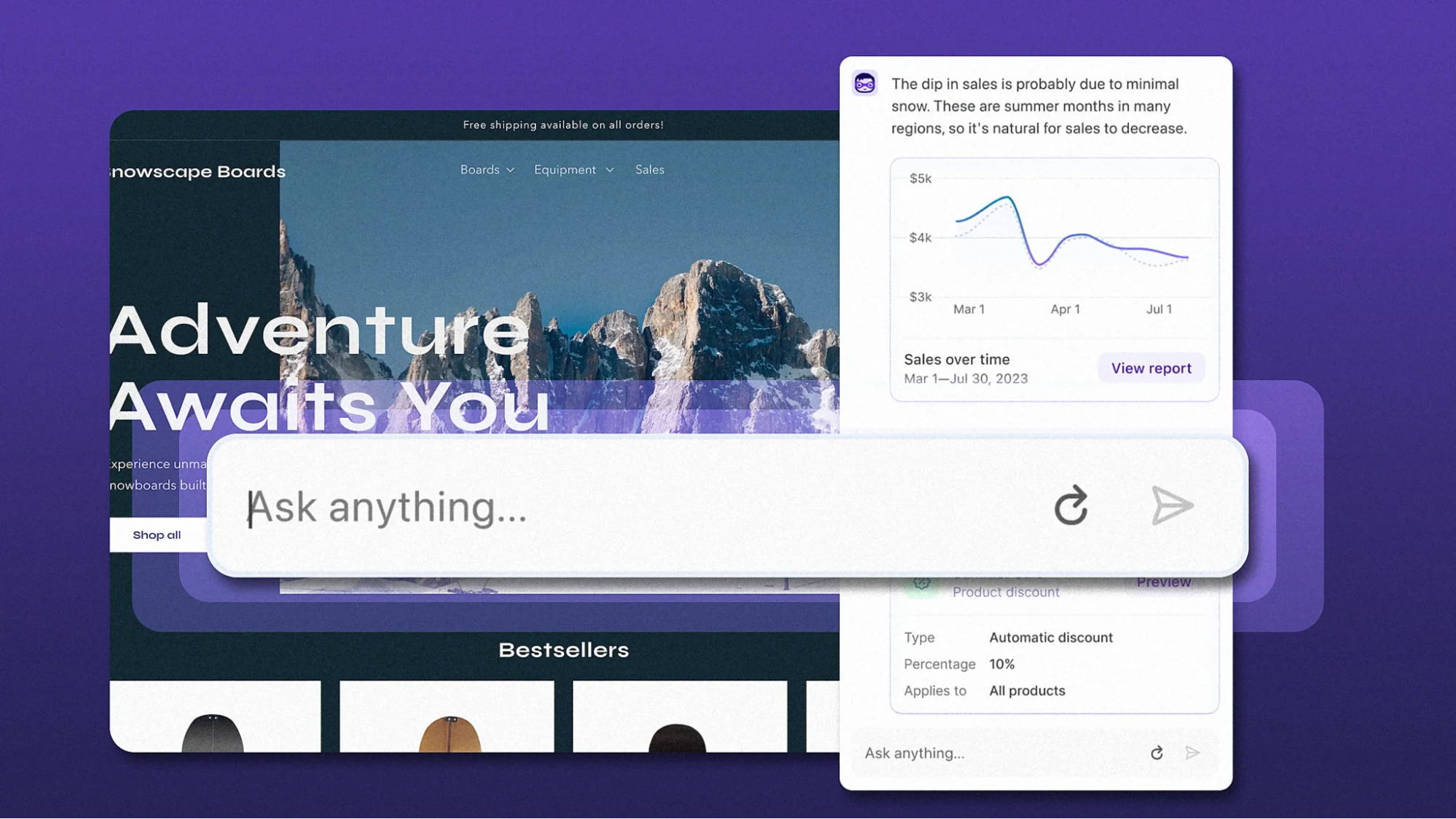
Image source: Fast Company
Sidekick is built into the Shopify admin as an AI commerce assistant that knows your products, customers, orders, and the platform itself. It can see store context, not just a text prompt, and then take multi-step actions instead of answering one-off questions.
Today, merchants can ask Sidekick to:
- Rewrite or generate product descriptions, blogs, emails, and homepage banners
- Analyze customer segments and performance reports
- Help configure shipping, legal pages, and other admin settings
- Support theme and section generation with AI-created Liquid blocks and media
The critical shift is architectural. Shopify’s engineering team describes Sidekick as an agentic platform: it plans and executes a chain of actions in a loop, pulling data, calling tools, and updating the store until a task is done.
That moves AI from “an SEO helper” or “a content writer” into a general brain layer that can touch content, UX, merchandising, analytics, and operations from the same place.
2. Chatty AI
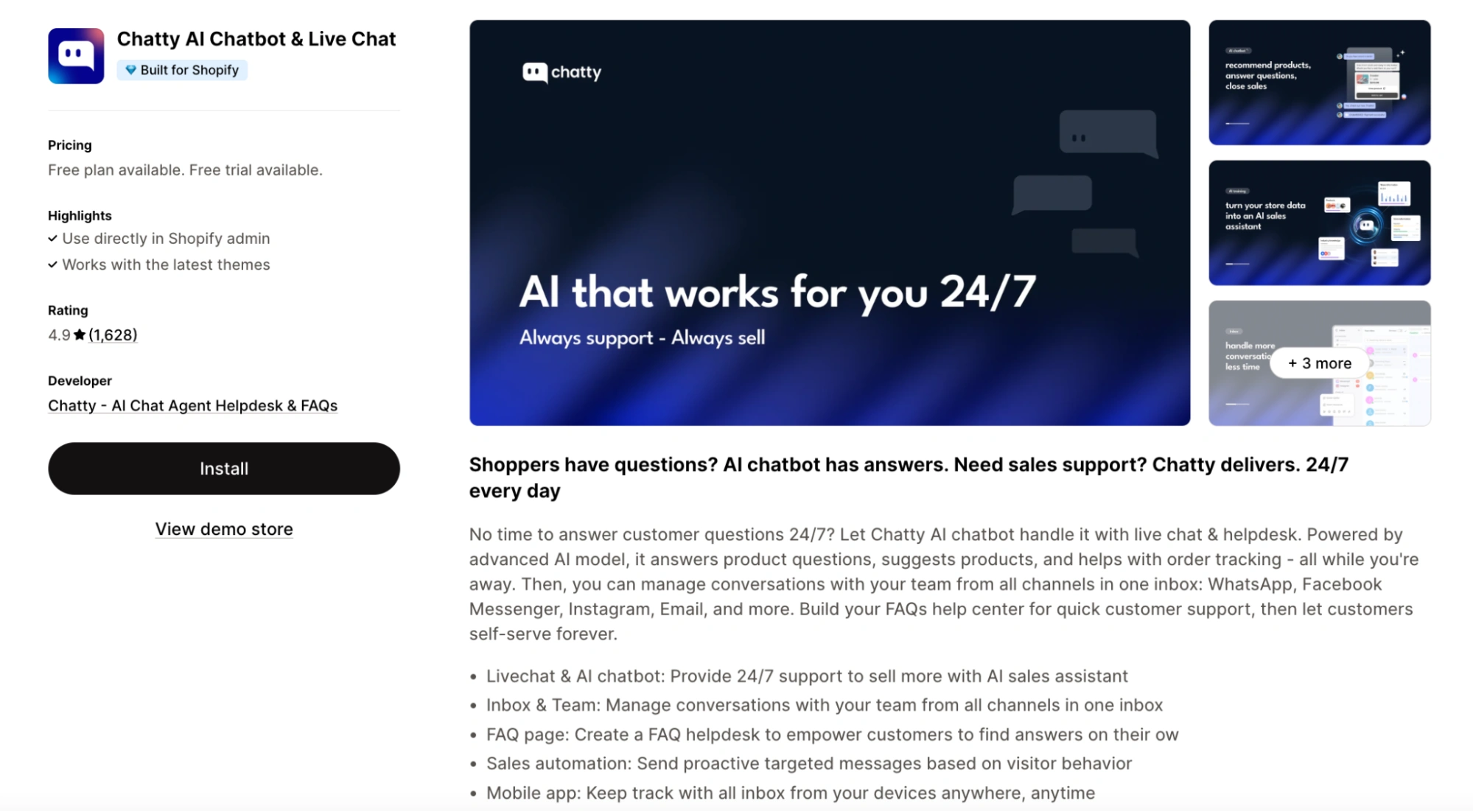
Chatty positions itself as an AI-first chat platform for e-commerce sales, not just a FAQ bot. It learns products, prices, and policies from your store in one night and then uses that knowledge in honest conversations.
Once connected, Chatty can:
- Read the full product catalog and specs like a trained sales rep
- Pull inventory, variants, and order data to give real-time advice
- Track browsing behavior and purchase history to understand intent
- Push upsell and cross-sell suggestions right inside the chat widget
Because it plugs into multiple channels (site chat, WhatsApp, Messenger, Instagram) and supports multi-agent, shared-inbox workflows, it can follow a shopper across touchpoints while keeping one brain behind the scenes.
Shopify also highlights Chatty as an out-of-the-box option that automatically syncs product info, shipping policies, and FAQs, so it can start handling real support and pre-sale questions almost immediately.
The result is an AI sales “team” that can suggest offers, rescue abandoned carts, and handle a large share of complaints or order questions before humans step in. Instead of a single bot flow, you get a continuous sales and support loop that runs 24/7 and scales with traffic.
3. Meta AI ads optimization
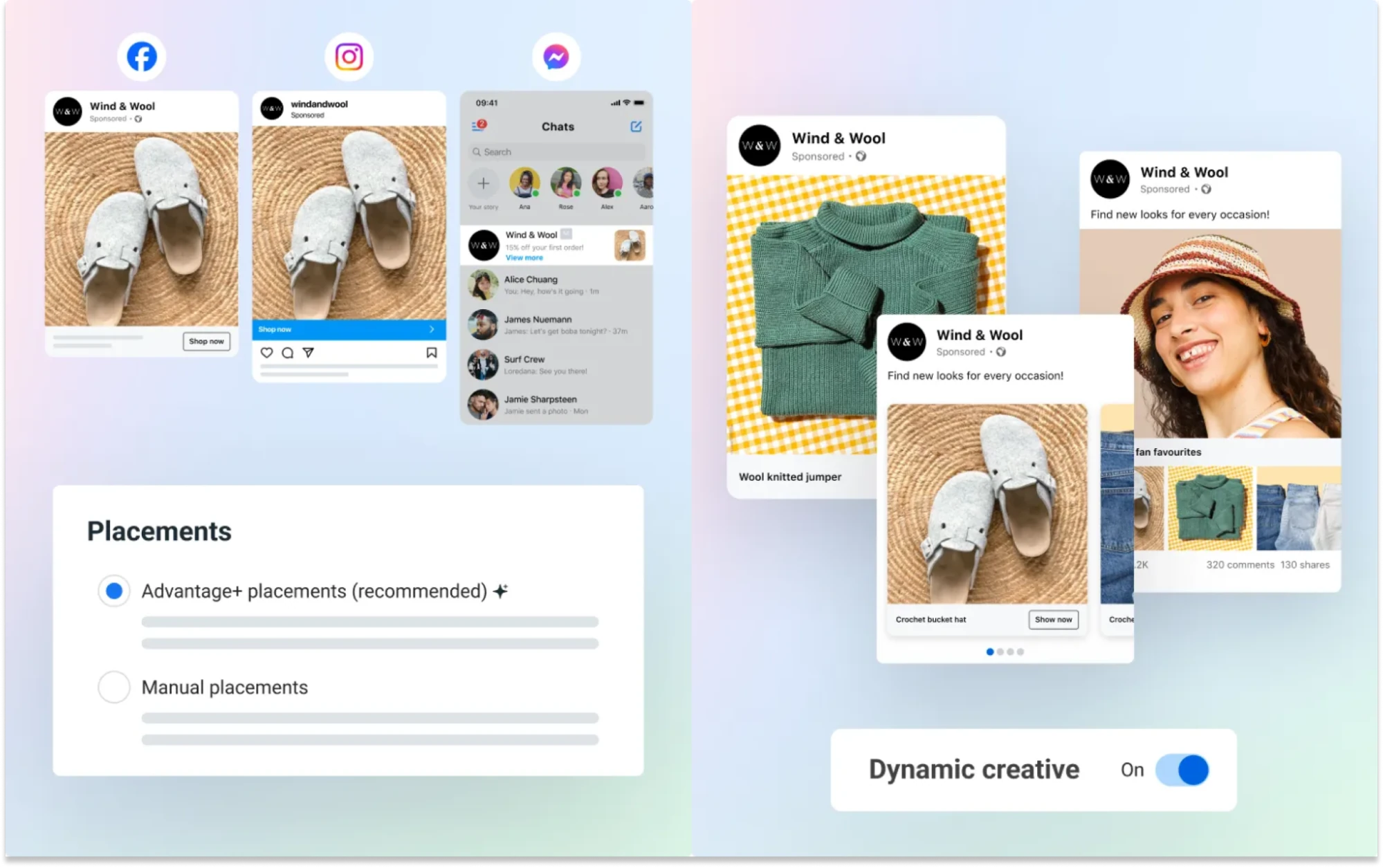
Image source: ConvertBomb
On the traffic side, Meta’s Advantage products are a clear step toward multi-agent advertising. Meta Business Suite already lets the system choose audience, placements, creative mixes, and budgets for Facebook and Instagram, while marketers focus on strategy and messaging.
Agentic-AI research describes ad platforms that use separate agents for budget, creative, and growth, each learning from real-time data and continuously adjusting campaigns. Meta’s Advantage+ campaign budget is a live example: it autonomously optimizes targeting, creative selection, placements, and budget allocation using first-party data, with far fewer manual tweaks.
This moves ads from “rule-driven” setups you tweak by hand to objective-driven systems that chase ROAS or profit every hour, at a scale humans cannot match.
Bottom line: Across Sidekick, Chatty, and Meta’s AI stack, you can see the same pattern:
- They read data in context, not as isolated fields or rules.
- They plan and execute sequences of actions without human approval for every click.
- They keep learning from behavior and performance and feed that back into the next decision.
- They span many related tasks rather than being confined to a single tiny module.
- They optimize for business goals like sales, conversion, and margin, not vanity metrics.
Step by step, these platforms are starting to feel less like single tools and more like early operating systems for commerce, with AI acting as the control layer on top.
How to adopt a limitless AI strategy?
A “limitless AI” strategy works best when rolled out in phases. You start by making your data usable, then let AI handle simple tasks, and only later trust it with decisions that touch revenue and profit. Here are more details.
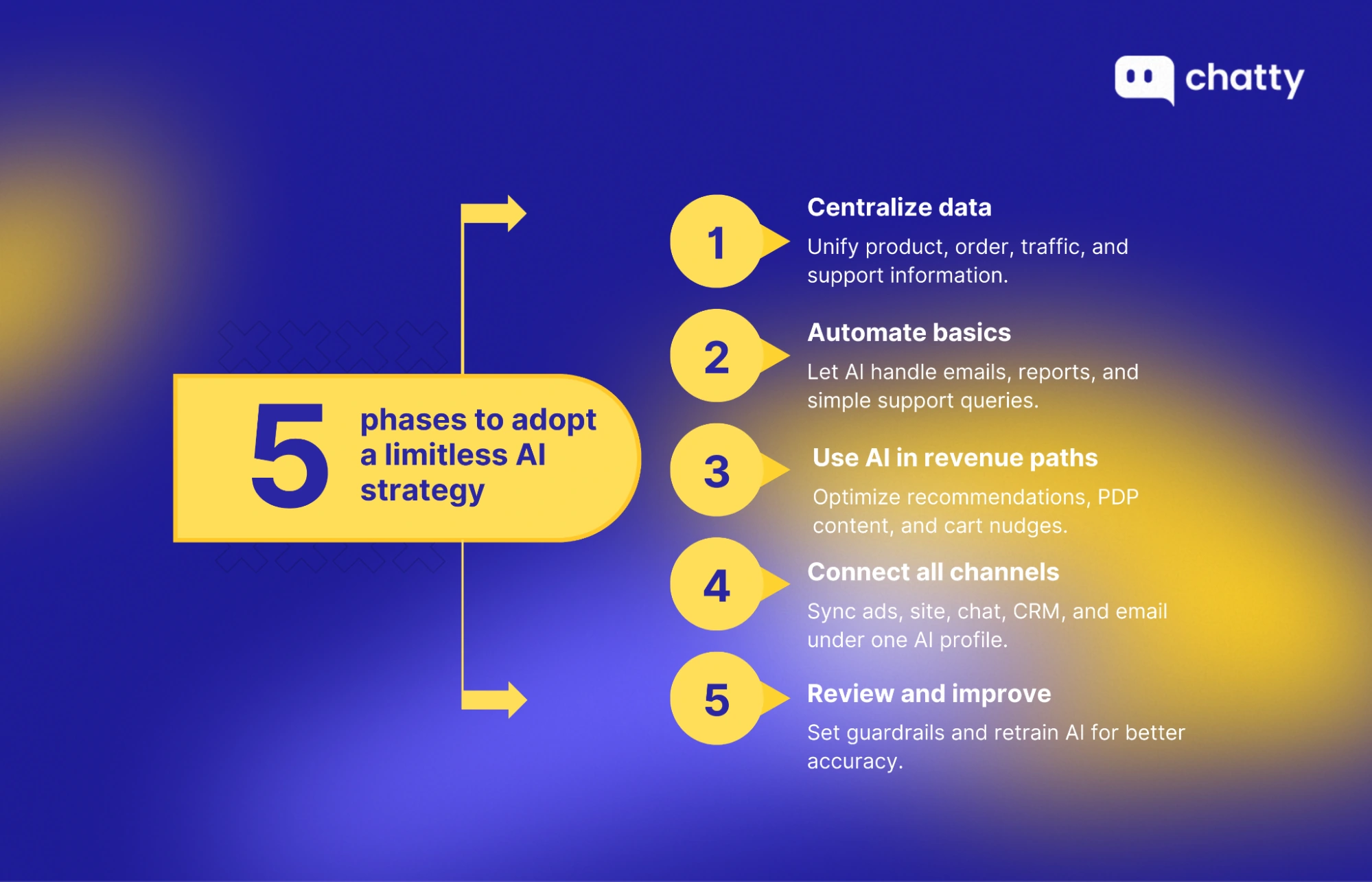
Phase 1: Centralize your data
First, give AI one clean view of your business. Choose a source of truth (GA4, a CDP like Segment/Klaviyo CDP, or a warehouse like BigQuery/Snowflake) and send all key events there. At minimum, you want:
- Product catalog and pricing
- Orders, refunds, subscriptions
- Traffic and campaign data
- Support tickets and chat logs
Use consistent IDs for customers and products, and define events like view, add to cart, purchase, cancel, and ticket resolved.
Phase 2: Automate low-risk channels
Next, let AI help where errors are easy to fix. Good starting points are:
- Email: subject lines, preheaders, text variants
- Reporting: weekly summaries, anomaly alerts
- Support: order status, FAQs, basic policy questions
Keep humans in “approve or edit” mode. Track open rate, click rate, resolution time, and CSAT so you know when quality is good enough to loosen control.
Phase 3: Deploy AI agents into revenue channels
Now move AI closer to money. Use agents for onsite recommendations, “people like you also bought” blocks, PDP microcopy, cart suggestions, and real-time sales chat. Set hard limits on discounts, free gifts, and inventory usage. Watch conversion rate, AOV, and revenue per visitor before and after each rollout so you can prove impact.
Phase 4: Let AI orchestrate the customer journey end-to-end
Once single channels work, connect them. Link ads, website personalization, chat, CRM, and email so one customer profile drives all touchpoints. You set goals such as target ROAS or profit per order. The AI decides audiences, creatives, landing pages, and next best actions in real time.
Phase 5: Govern, refine, repeat
Finally, put guardrails around everything you built:
- Define when humans must review or override
- Schedule audits of prompts, policies, and logs
- Retrain models and refresh data regularly
Treat this as a loop. Each cycle makes your “limitless” AI stack more accurate, safer, and more profitable.
Challenges & ethical considerations when applying limitless AI in e-commerce
Accuracy & decision boundaries
When AI touches pricing, policies, or product recommendations, minor errors turn into refunds, complaints, and broken trust. A limitless system can easily “hallucinate” delivery terms, suggest out-of-stock items, or approve discounts that destroy margin if it is not anchored to real store data.
How to manage it:
- Restrict AI decisions to data that can be verified against live inventory, pricing, and policy tables.
- Define clear tiers of actions (informational, low-risk, high-risk) and only auto-approve the first two.
- Set hard limits for discounts, compensation, and free items at the system level, not in prompts.
Brand voice governance
If AI writes PDPs, emails, and chat replies, tone can drift from helpful to robotic or even rude very quickly. At scale, hundreds of microcopies can silently erode your positioning if there is no shared guardrail.
How to manage it:
- Create a short brand voice playbook with approved phrases, taboo topics, and concrete examples.
- Use templates for key assets (PDPs, flows, macros) and let AI fill structured fields instead of free text.
- Review samples regularly from chatbot logs, emails, and new PDPs and retrain on “good” outputs.
Privacy & user data control
Limitless AI only works when it sees behavior, orders, and sometimes support history across channels. Without clear consent, storage rules, and user controls, this quickly becomes a privacy and compliance risk.
How to manage it:
- Collect only the events you actually use and document each purpose in your privacy policy.
- Offer a simple preference center for tracking, personalization, and marketing opt-outs.
- Anonymize data for modeling where possible and define strict retention windows.
Human override and accountability
If “the AI decided it” becomes the default answer, nobody owns mistakes. Customers need a visible way to get a human, and teams need clarity on who is responsible for outcomes.
How to manage it:
- Add a clear “talk to a human” path in chat, email, and phone workflows.
- Log important AI decisions (refund approvals, pricing changes, big offers) with timestamps and owners.
- Run regular reviews of these logs to keep leadership accountable for how AI is used.
Final thought
The rise of e-commerce and limitless artificial intelligence marks a turning point in which automation becomes a competitive edge rather than a bonus feature. With the proper guardrails, it helps brands grow faster while keeping experiences sharp and personal. From where we stand, the most brilliant move is to start the journey now and scale thoughtfully.
FAQ
Yes, it can be if you let AI generate content without rules. Overuse or poorly guided AI can dilute tone, create generic messaging, or even damage trust if it sounds off or is insensitive. The fix is clear brand guidelines, human review on high-impact content, and regular audits.
AI is used for product recommendations, personalized content, search, pricing, inventory forecasting, fraud checks, and support chatbots. Studies show personalization alone can drive up to around 30% higher order values and a big share of total revenue for many stores.
No, AI will not replace e-commerce; it is reshaping how e-commerce runs. It acts as an optimization and automation layer on top of existing stores, helping humans sell and support more efficiently instead of replacing the whole model.
You do not always need a big technical team to start. Many AI and “no-code” tools are built for non-technical users, with visual interfaces and templates, although more advanced, custom setups still benefit from data or engineering skills.