












AI, automation, and chatbots now handle a large share of customer service interactions. In fact, industry data shows that around 75-85% of customer interactions are managed by AI-enabled systems, with chatbots resolving up to 80% of routine inquiries without human involvement.
Yet when something feels confusing, risky, or emotionally charged, many still ask the same question: "Can I talk to a human?" This question isn't a rejection of AI or self-service. It's a need for reassurance, judgment, and accountability when context or uncertainty is at play.
This guide explains what human customer service really means. It shows why it still matters in an AI-driven environment. It also explains how to design AI-to-human handoffs in 2026 that protect trust while scaling efficiently.
Let's dive in!
- AI handles 80% of inquiries, but humans still own the moments that matter.
When interactions are emotionally charged or high-stakes, customers instinctively ask for a human, not faster automation.
- Asking for a human is not an AI rejection — it is a trust signal.
Customers seek human agents when they need reassurance, judgment, and accountability, not because self-service failed them entirely.
- Empathy in service is an action, not a sentiment — it changes how agents listen.
Truly empathetic agents use open-ended questions and emotional confirmation to create space for accurate, meaningful problem-solving.
- Respect shows up in timelines and tone, not just polite words.
Transparent communication, prompt responses, and clear service-level commitments signal to customers that their concern is taken seriously.
- Flexibility is what separates human service from a policy-reading machine.
Human agents add real value by overriding rigid rules, adjusting fees, and crafting resolutions that actually fit the situation.
What is human customer service?
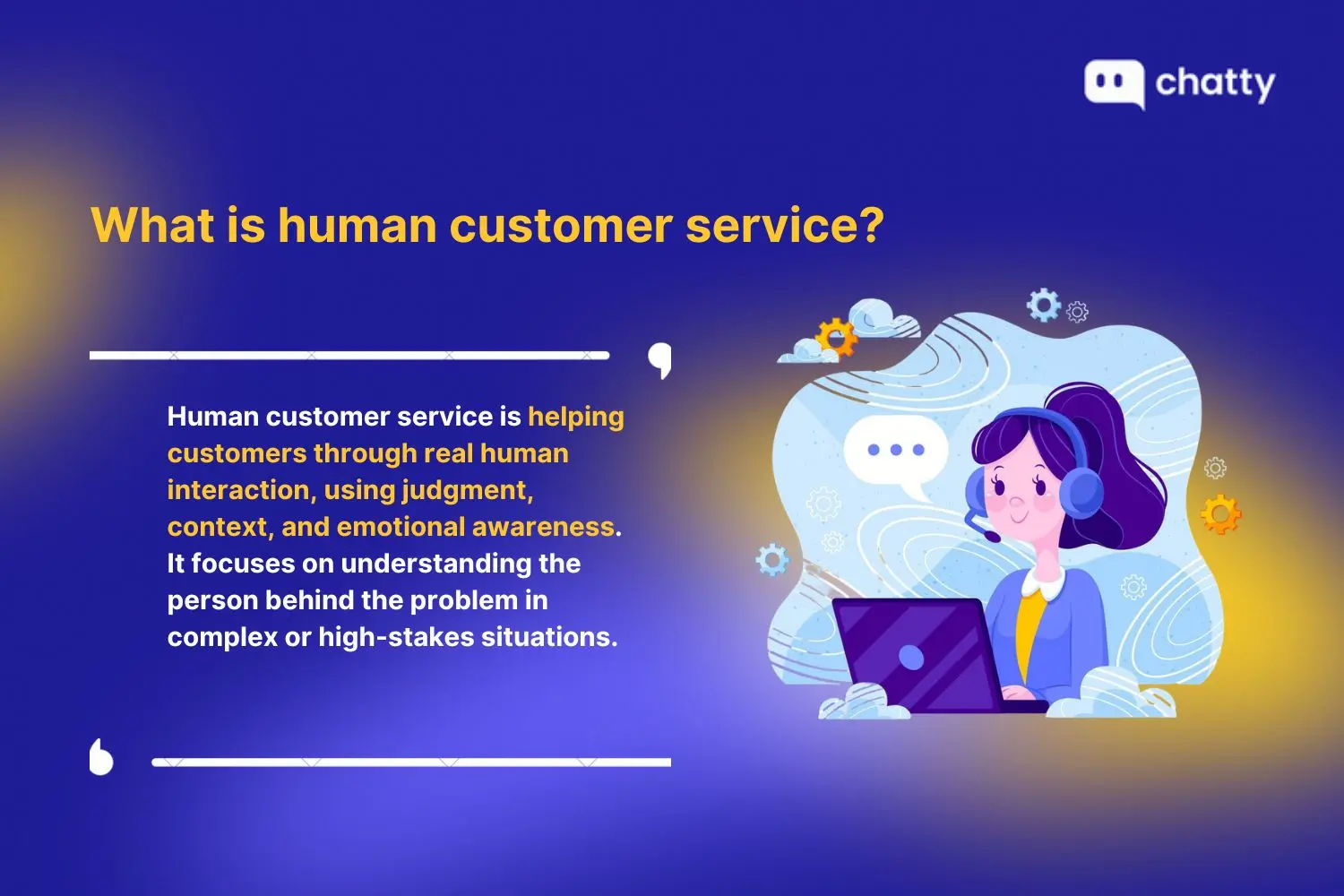
Human customer service is the act of helping customers through real human interaction that applies judgment, context, and emotional awareness. Rather than treating requests as tickets to be closed, it focuses on understanding the person behind the problem and responding appropriately when situations are complex, sensitive, or high-stakes.
This difference becomes most visible in moments where automation falls short. Imagine a customer who was mistakenly charged a large amount of money, had their account locked without warning, or is waiting for a delivery tied to a significant life event such as a wedding, birthday, or urgent medication.
An automated system may confirm that everything is "correct according to policy" and end the interaction. A human agent, however, can pause, ask clarifying questions, and recognize what is truly at risk. In these situations, the value of human customer service lies not in speed or consistency, but in thoughtful intervention when the outcome actually matters.
At its core, human customer service is built on three pillars: empathy, respect, and flexibility. What sets it apart is how these principles translate into real actions during conversations.
- Empathy: Empathy is not just about expressing understanding; it drives how agents listen and respond. Empathetic service leads to open-ended questions, careful listening, and emotional confirmation such as acknowledging stress, urgency, or disappointment. This helps customers feel understood and creates space for accurate problem-solving.
- Respect: Respect shapes the tone and structure of the interaction. It influences how clearly an agent communicates, how promptly they respond, and whether the issue is handled with appropriate priority. Respect shows up through calm language, transparent timelines, and service-level commitments that signal the customer's concern is taken seriously.
- Flexibility: Flexibility is what allows agents to act when rigid rules are not enough. It enables policy overrides, exception handling, and tailored resolutions such as adjusting fees, restoring access, or offering alternatives that better fit the situation. Flexibility demonstrates that fairness and customer outcomes matter more than strict adherence to scripts.
Together, these pillars define human customer service as an active, judgment-based practice; one that steps in when customers need more than a correct answer.
Human customer service in the age of AI
AI has transformed customer support by delivering speed, scale, and cost efficiency. It can instantly answer routine questions, operate 24/7, and resolve a large share of repetitive requests. However, efficiency alone does not create trust. While AI optimizes for accuracy and speed, good customer service still relies on human judgment, accountability, and emotional understanding.
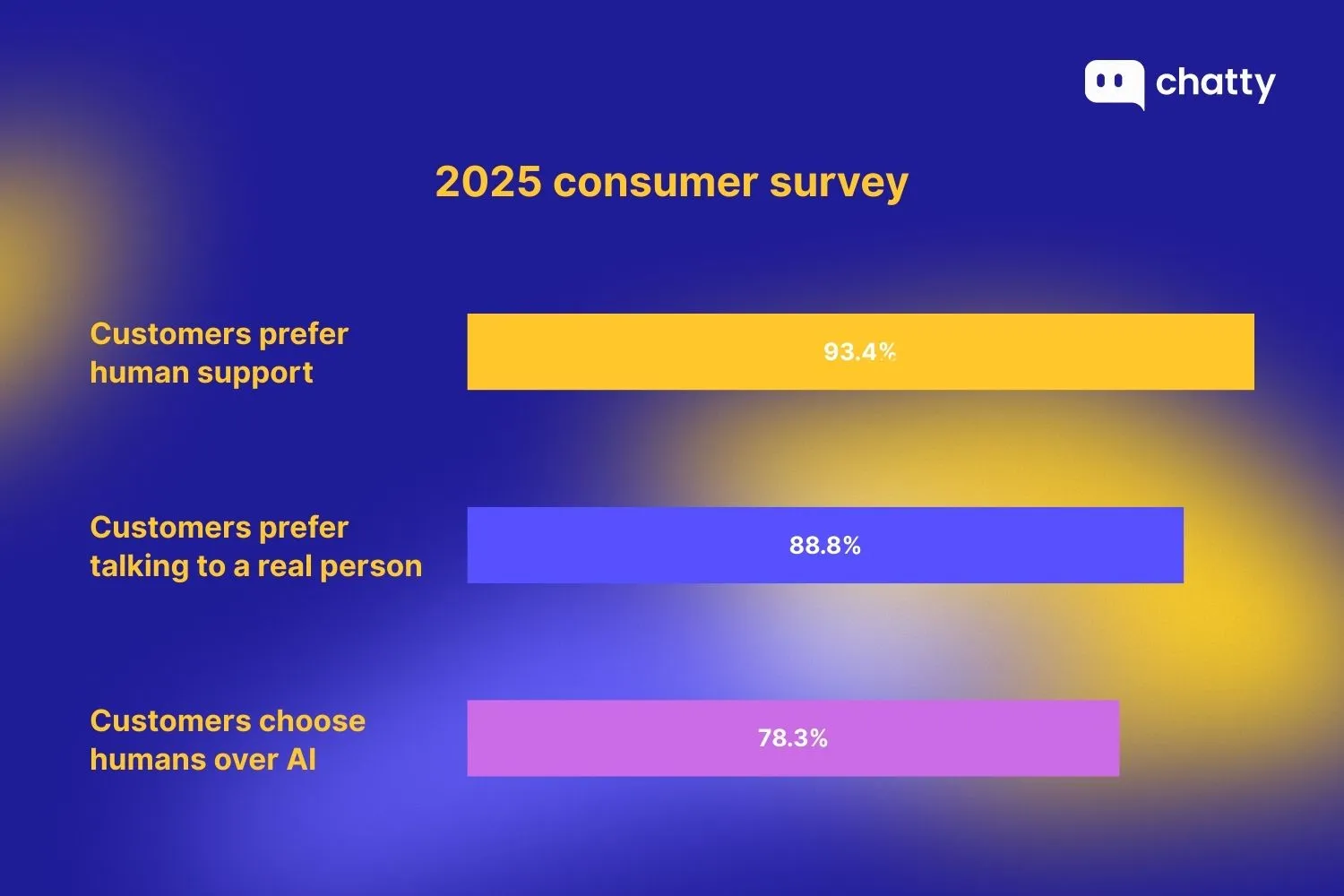
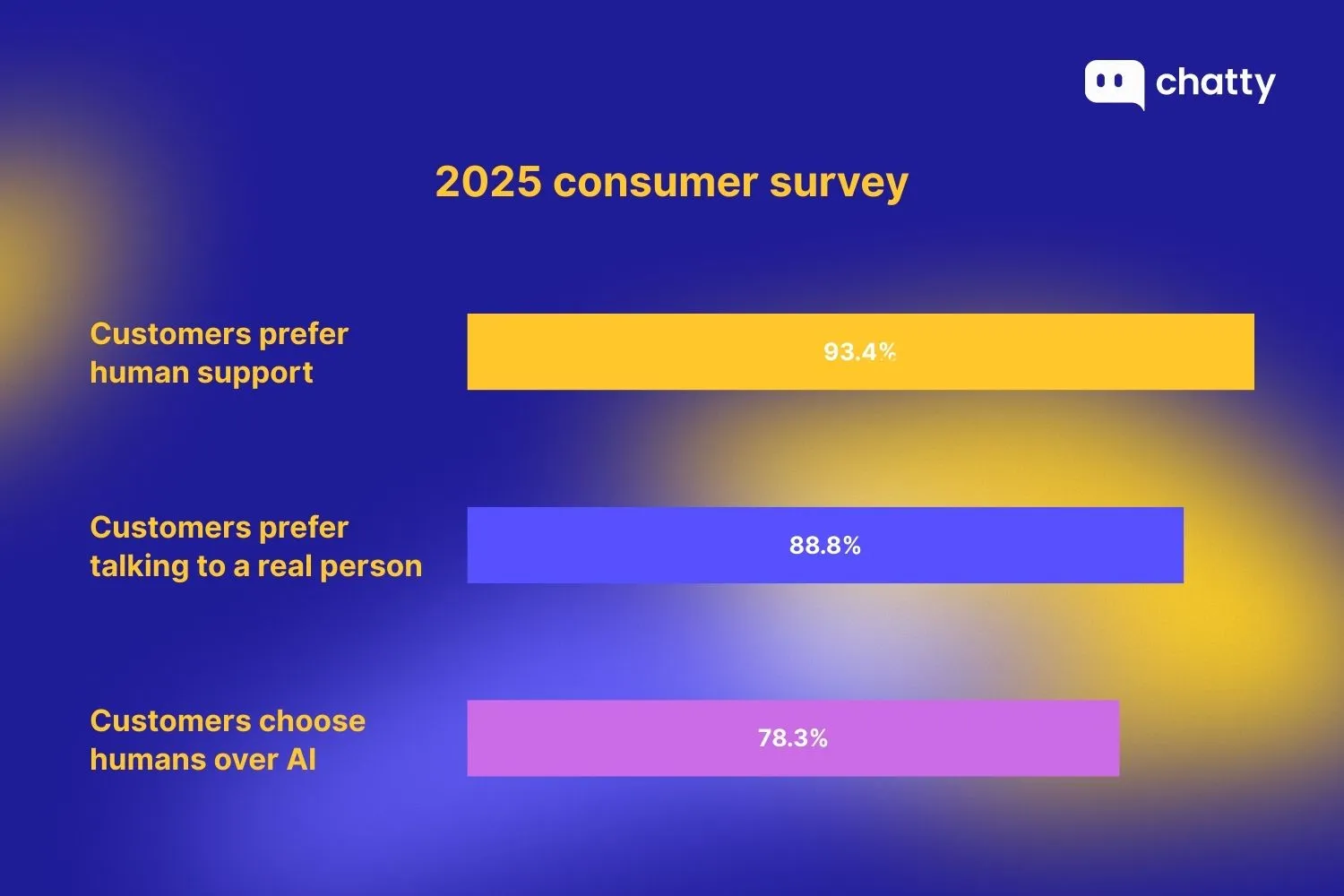
Consumer data reinforces this distinction. A 2025 consumer survey shows that 93.4% of customers prefer interacting with a human for support, and 88.8% believe companies should always offer the option to speak with a real person rather than rely solely on automation. Notably, 78.3% of respondents say humans resolve issues faster when problems are complex or emotionally charged, highlighting that speed is not just about response time, but about effective resolution.
At the same time, customers clearly value automation for simple, low-risk tasks. Actions such as order status checks, delivery updates, or password resets are ideal for AI-driven support. In these cases, automation can handle up to 80% of routine queries instantly, reducing wait times and operational costs while improving convenience. This is where AI performs best: predictable questions with clear inputs and outcomes.
Human agents become essential when situations involve emotion, risk, or uncertainty.
- High emotion: When customers are frustrated or stressed, human empathy and reassurance matter. Research shows that 73% of customers consider empathy critical in service experiences, and many actively avoid brands that fail to show it.
- High risk: Issues involving payments, personal data, or important decisions require accountability and clear explanation, areas where customers overwhelmingly prefer human support.
- High uncertainty: Unique or ambiguous problems demand judgment, follow-up questions, and flexibility that AI systems still struggle to provide.
Rather than competing, AI and human agents play complementary roles. AI delivers efficiency at scale, while humans provide the understanding and adaptability that build confidence. In the age of AI, the most friendly customer service strategies don't replace people, they use technology to support them where it works best.
Implementing AI-enhanced human agents in 2026
Acknowledging the continued importance of human services raises a pressing question: how should businesses design AI systems that strengthen, rather than replace, human agents in 2026? The sections below break down the key implementation principles.
Define clear roles for AI and human agents
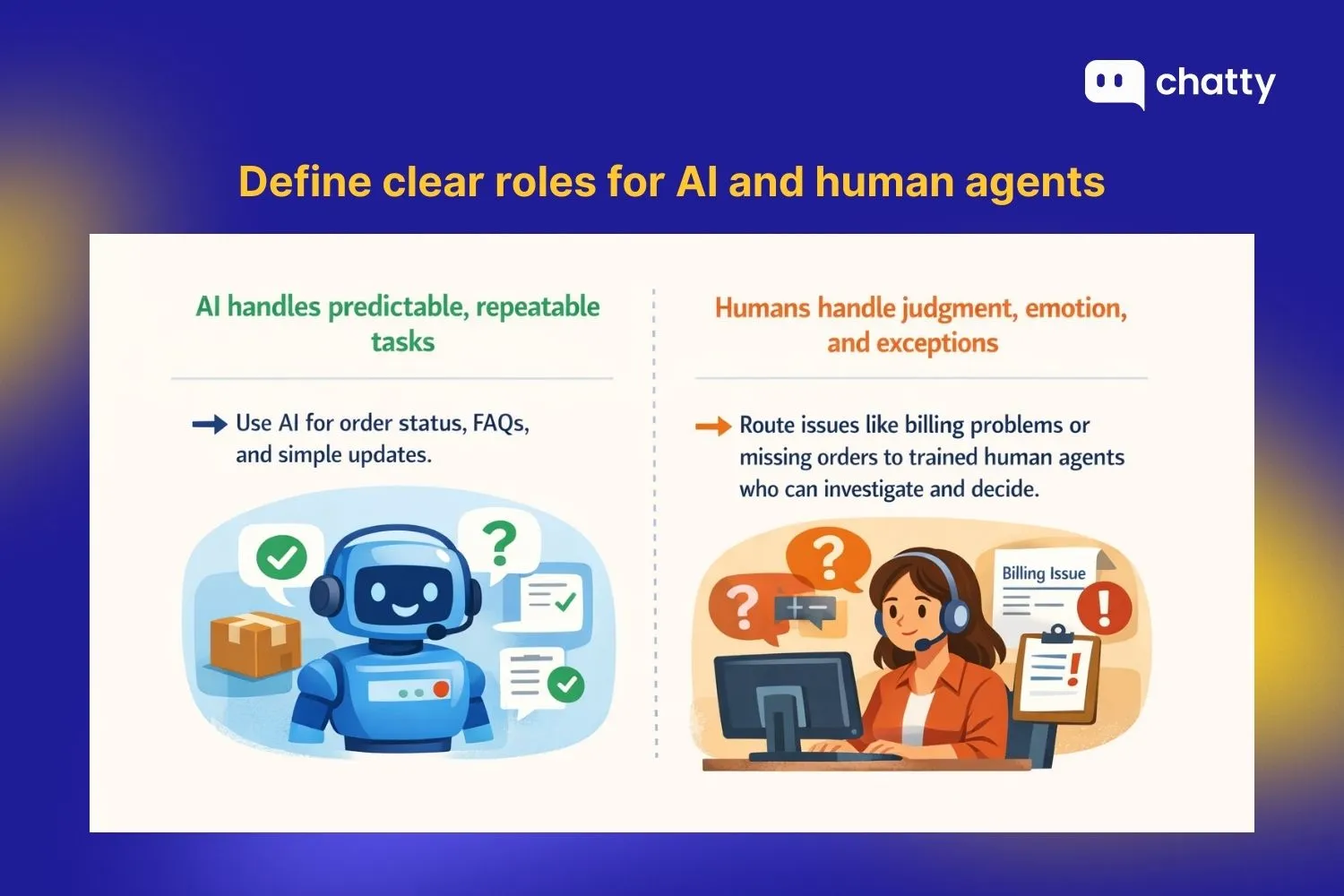
Clear roles mean AI and humans are not doing the same work. AI should focus on predictable, repeatable tasks, while humans handle judgment, emotion, and exceptions. This separation prevents confusion, reduces response time, and ensures customers always reach the right level of support.
To apply this, map common support requests and label which ones AI can fully resolve and which require a human. For example, AI manages order status, address changes, and FAQs through customer experience automation. When a customer reports a missing order or billing issue, the system routes the case to a human agent trained to investigate and make decisions.
Decide when AI should escalate to a human
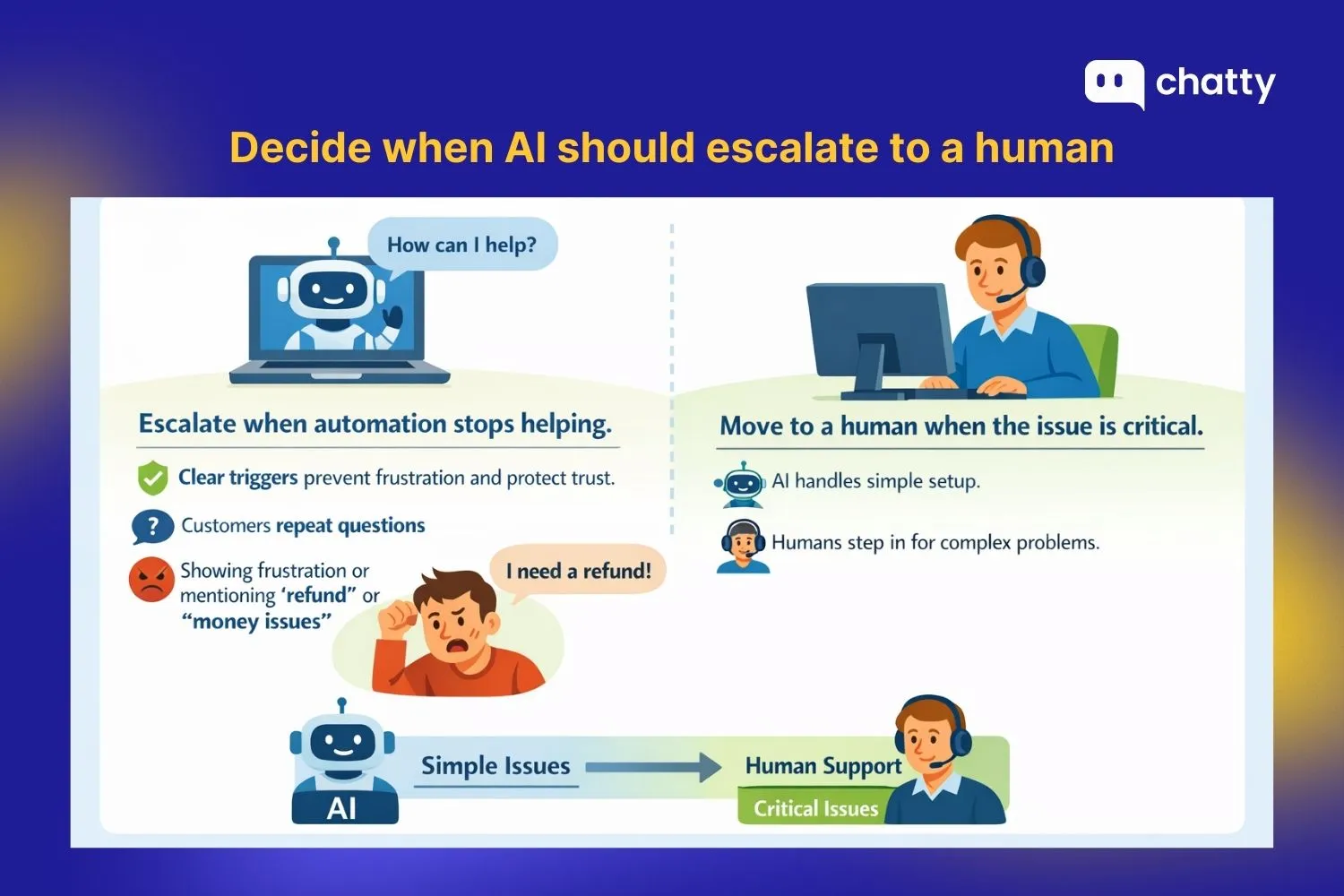
Escalation defines the moment automation stops being helpful. Without clear rules, AI can frustrate customers by repeating answers or missing emotional signals. Good escalation protects trust and prevents small issues from becoming major complaints.
Set escalation triggers based on intent and sentiment. If a customer repeats a question, expresses frustration, mentions refunds, or refers to financial loss, the system should escalate immediately. For instance, an AI may handle setup questions, but when a user says "this is blocking our team," the conversation is handed to a human without delay.
Use AI to prepare a full customer context for agents
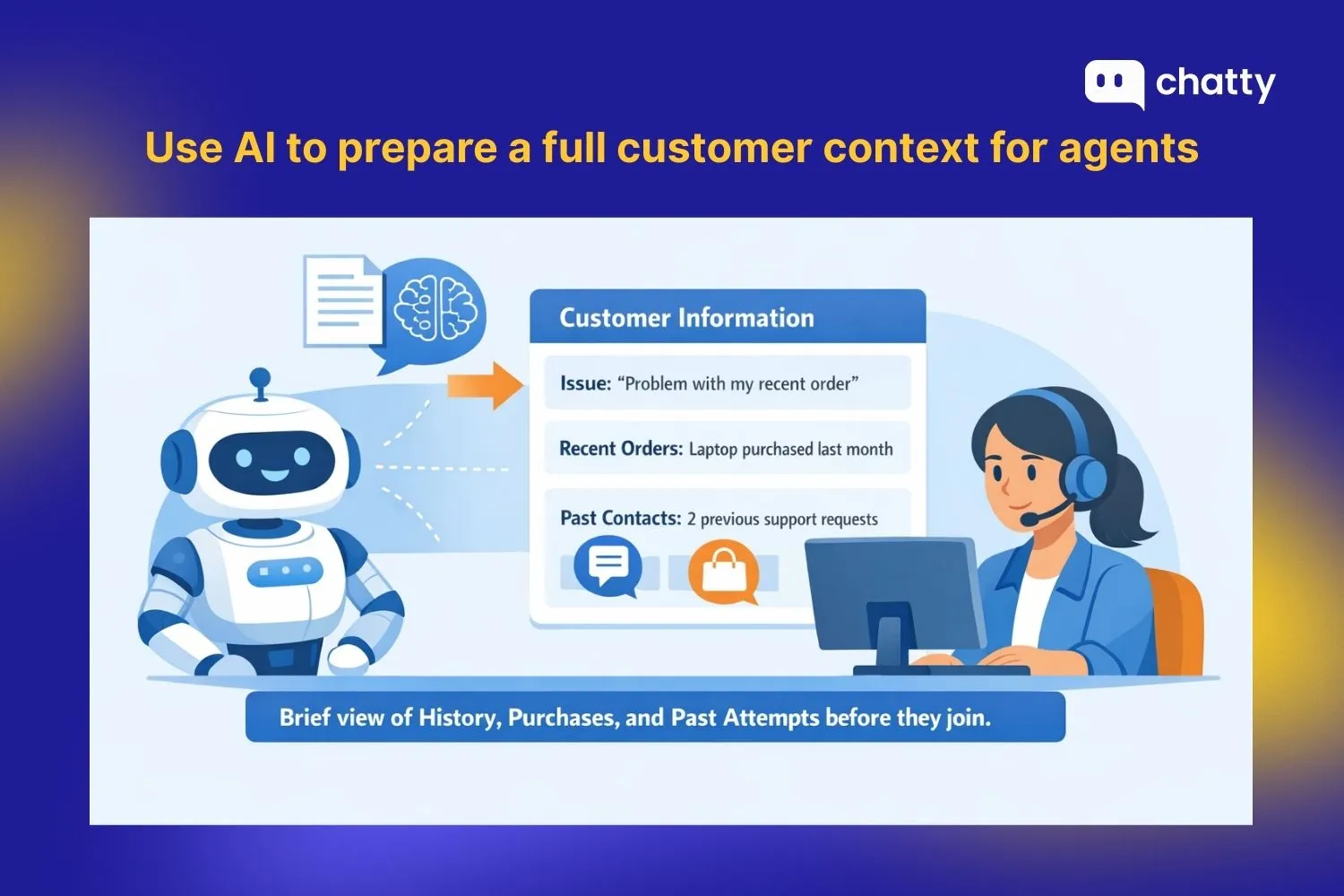
A prepared context allows agents to solve problems instead of collecting information. When AI summarizes the situation, agents can start with clarity and confidence, which customers perceive as competence and care.
Connect AI to your CRM, order data, and past conversations so it creates a short briefing before the agent joins. For example, the agent sees the customer's plan, recent purchases, prior complaints, and what the AI has already attempted. This eliminates repeated questions and speeds up resolution.
Design a clean AI-to-human handoff experience
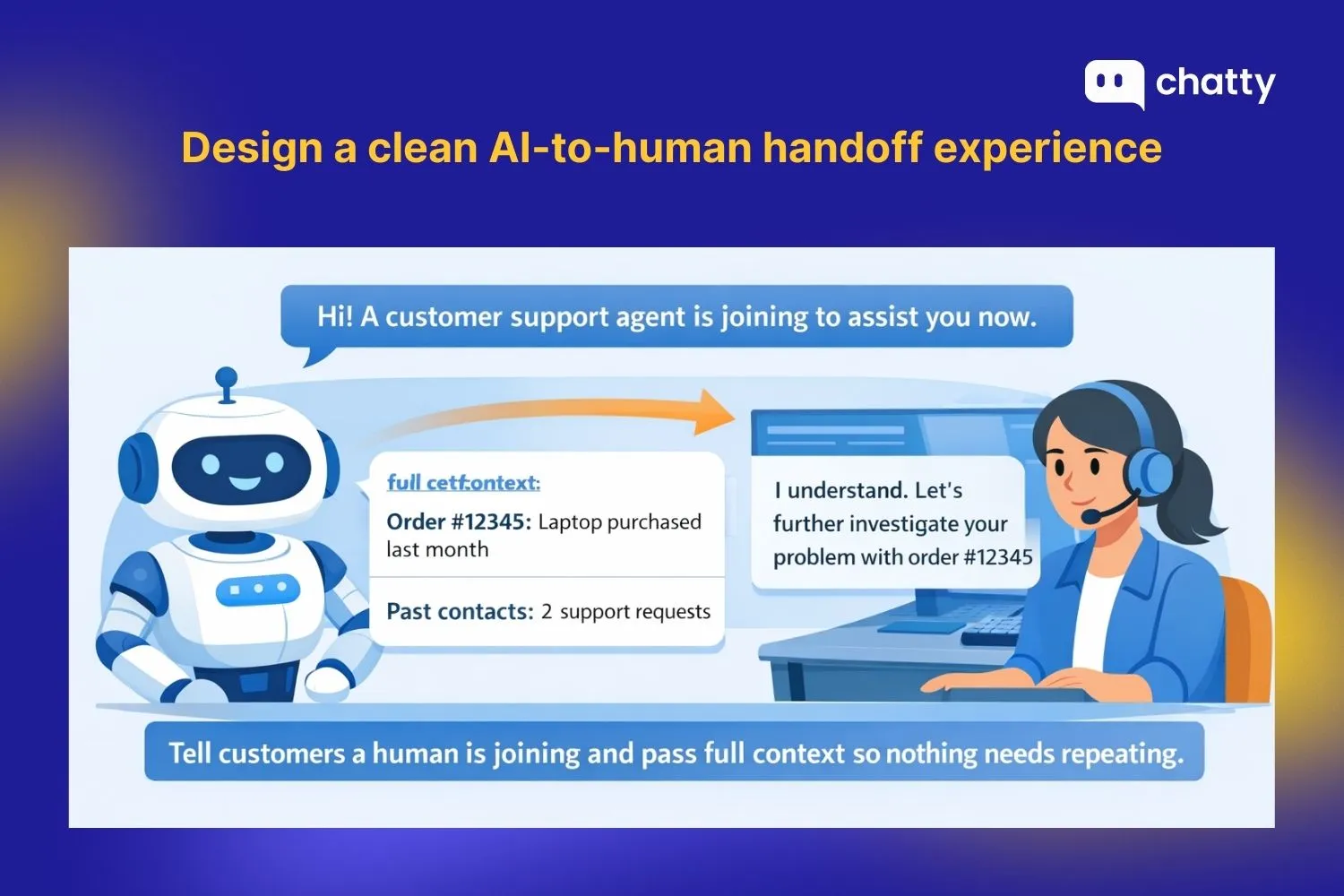
A clean handoff prevents customers from feeling dropped or restarted. The transition should feel like a continuation of the same conversation, not a system switch. Clarity and continuity are critical here.
Inform the customer clearly that a human is joining and pass the full conversation history to the agent. Avoid asking the customer to repeat information. For example, automated customer service may say, "I'm connecting you to a specialist," and the agent opens by referencing the exact issue already discussed, creating a seamless experience.
Support human agents with AI during resolution
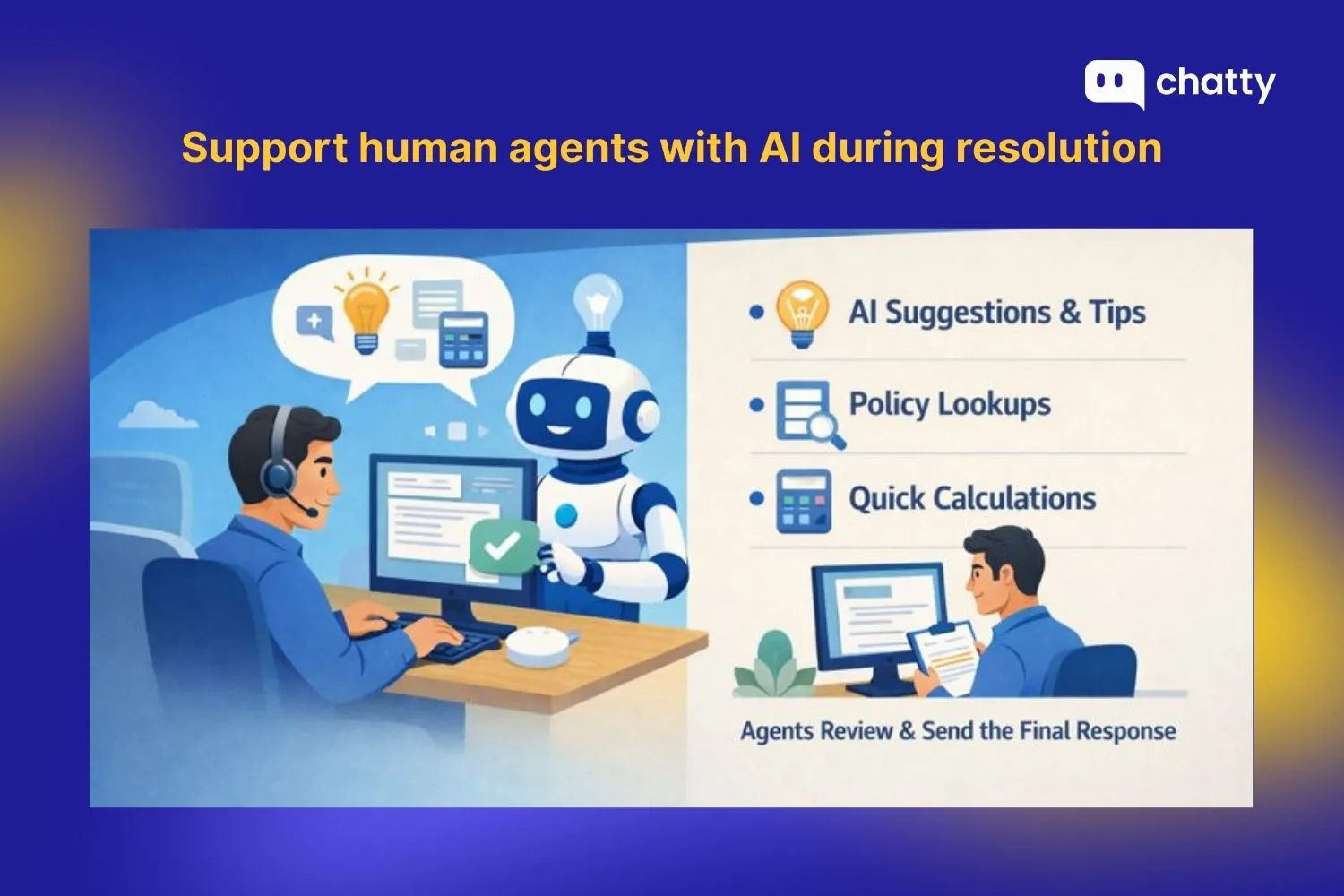
AI should assist agents quietly while they work. The goal is to increase speed and accuracy without removing human judgment or tone from the conversation.
Provide real-time support such as suggested replies, policy references, and calculations. For example, AI can surface refund guidelines, highlight risks, or draft a response. The agent edits and sends the final message. This support reduces errors, shortens training time, and allows agents to focus on problem-solving rather than searching for information.
Keep accountability and final decisions human-led
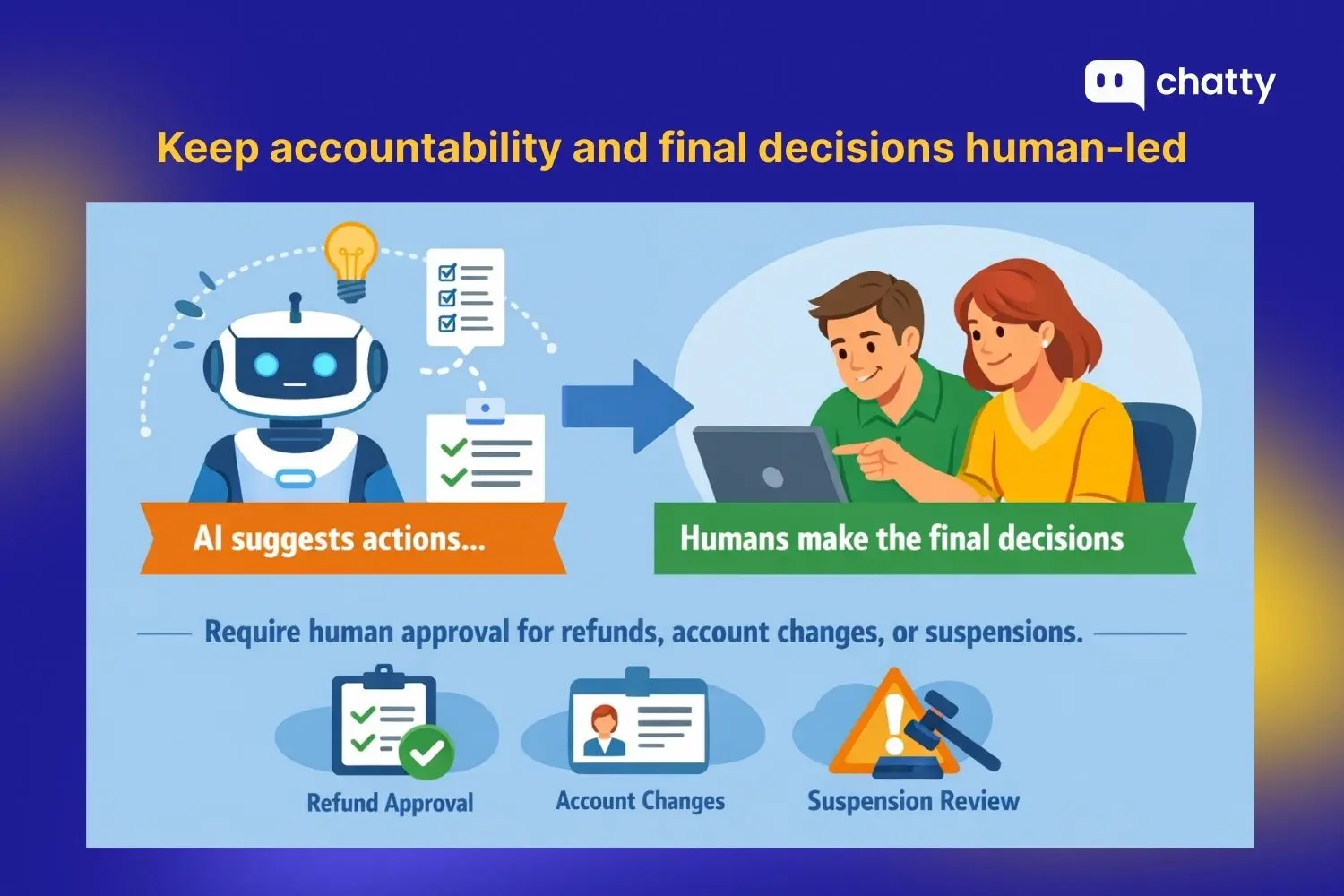
Human-led accountability ensures trust and fairness in sensitive situations. AI can recommend actions, but it should not make final decisions that affect finances, access, or long-term relationships.
Define decision thresholds that require human approval, such as large refunds, account suspensions, or contract changes. For example, AI may suggest compensation options based on policy and history, but the agent chooses the outcome and records the decision. This keeps responsibility clear and protects both customers and the business.
Improve the system continuously using human-led outcomes
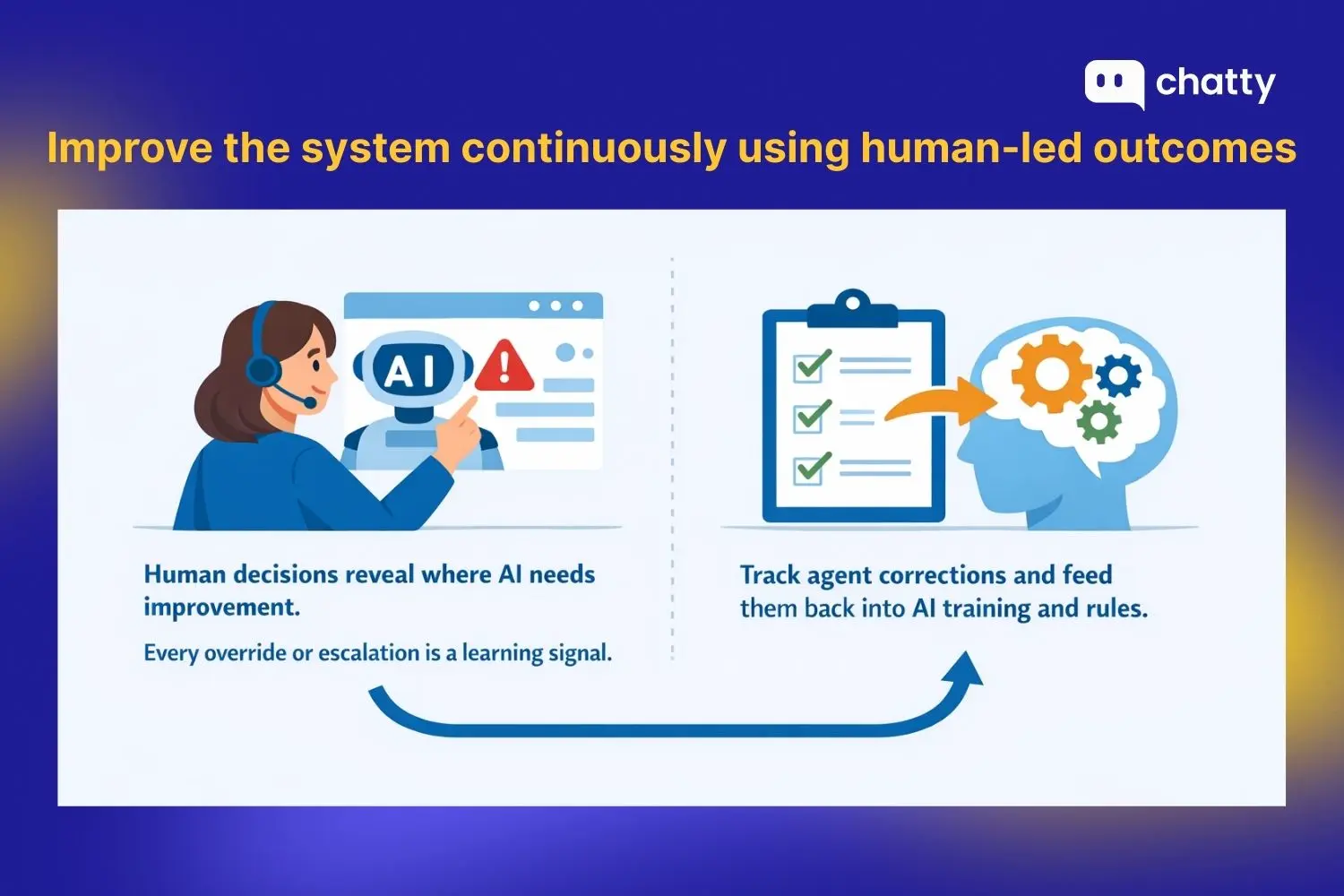
Human decisions provide the best signal for improving AI performance. Each override or escalation highlights where automation needs adjustment. Continuous improvement depends on learning from these moments.
Track where agents correct AI, approve exceptions, or resolve repeat issues. Review these outcomes regularly and feed them back into training and rules. For example, if agents often adjust return eligibility, update the logic accordingly. Over time, the system becomes more accurate, efficient, and aligned with real-world judgment.
How to measure human customer service
Measuring human customer service requires more than a single satisfaction score. CSAT captures how a customer feels at the end of an interaction, but it often misses what actually mattered during the conversation. Two customers may give the same rating even though one feels reassured and confident, while the other simply wants the issue to stop. This makes CSAT alone an incomplete signal of real human impact.
You must measure human customer service by going beyond satisfaction scores and tracking how customers experience the interaction, not just how they rate it.
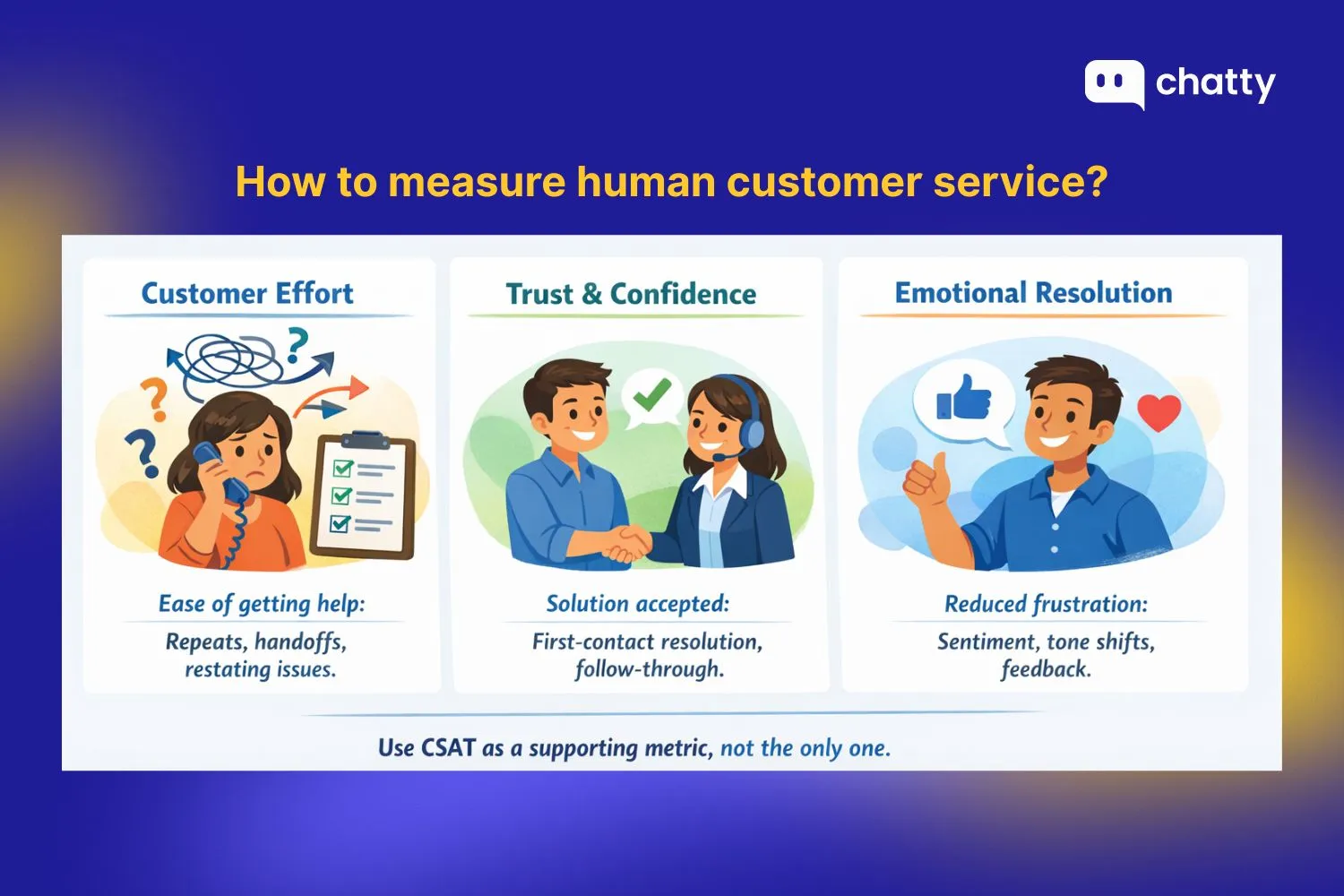
In practice, this means focusing on three measurable areas:
- Customer effort: Track how easy it was to get help. Look at repeat contacts, handoffs between agents or channels, and whether customers had to restate their issue. Low effort usually signals effective human support.
- Trust and confidence: Measure whether customers accept solutions and guidance. Indicators include first-contact resolution, follow-through on recommendations, and reduced need for reassurance in future interactions.
- Emotional resolution: Assess whether negative emotions were eased. This can be measured through post-chat sentiment analysis, short qualitative feedback, or changes in tone during the conversation.
CSAT can still be used, but only as a supporting signal. When combined with these experience-focused indicators and broader customer service metrics, teams gain a clearer, more accurate view of how well human agents create understanding, reassurance, and lasting confidence.
Final thought
Human customer service is not about choosing people over technology. It is about placing human judgment where automation reaches its limits. AI can resolve routine issues quickly and consistently, but trust is built when customers feel understood and supported through complexity. That trust depends on clear escalation paths, well-prepared agents, and handoffs that preserve context instead of forcing customers to start over.
In 2026, strong customer service teams will be defined less by how much they automate and more by how deliberately they design human involvement. The most effective handoffs are not interruptions to the system. They are the moments where the system proves it was designed for people.
FAQs
No. Live agent support refers to who handles the interaction. Human customer service describes how the experience feels. A live agent can still deliver a rigid or scripted experience. Human customer service requires empathy, respect, and flexibility. It shows up when agents adapt to context, take ownership, and apply judgment instead of following automation or scripts blindly.
Customers should be routed to a human when emotion, risk, or uncertainty increases. This includes billing disputes, account access issues, complaints, or repeated failed self-service attempts. Escalation is also critical when decisions have a lasting impact. Routing early prevents frustration, reduces effort, and protects trust before problems escalate further.
AI can support human customer service, but it cannot fully deliver it on its own. AI handles speed, consistency, and information retrieval well. However, it lacks accountability and emotional judgment. Human customer service depends on understanding nuance, weighing trade-offs, and making responsibility-driven decisions, which still require human involvement.
AI will not replace human customer service agents, but it will change their role. Routine tasks will continue to be automated. Human agents will focus more on complex, sensitive, and high-impact situations. Their value will come from judgment, problem-solving, and trust-building, not volume handling or scripted responses.