












Chatbots have evolved quickly over the past decade. Early chatbots relied on fixed rules and scripts. Modern AI chatbots can understand natural language and user intent. Each approach has clear strengths, but also clear limits.
This is why many businesses now choose hybrid chatbots. Hybrid chatbots combine rule-based automation, AI-driven conversations, and human support. They handle simple requests instantly and pass complex issues to agents when needed. The result is faster service without losing the human touch.
In 2026, hybrid chatbots are becoming the standard for customer engagement. This article explores 10 real-world hybrid chatbot examples from leading global brands. It also explains how they work, when humans step in, and what results businesses can expect.
- Hybrid chatbots are no longer experimental — they are the 2026 standard. Leading global brands now combine rule-based logic, AI, and human agents to meet modern customer expectations.
- Pure AI and rule-only bots both fail in ways hybrid chatbots are designed to fix. Rule-only bots break on unexpected questions, while pure AI struggles with edge cases and sensitive situations.
- The real power of hybrid chatbots is knowing exactly when to hand off to a human. When confusion or sensitive topics are detected, context is passed seamlessly to a live agent without friction.
- Businesses get 24/7 coverage and lower costs without sacrificing the human touch. Automation handles repetitive volume at scale while human judgment is reserved for moments that genuinely require it.
- Hybrid chatbots do not replace agents — they make every agent interaction more valuable. By resolving routine requests automatically, human agents spend their time only on complex, high-stakes conversations.
What is a hybrid chatbot?
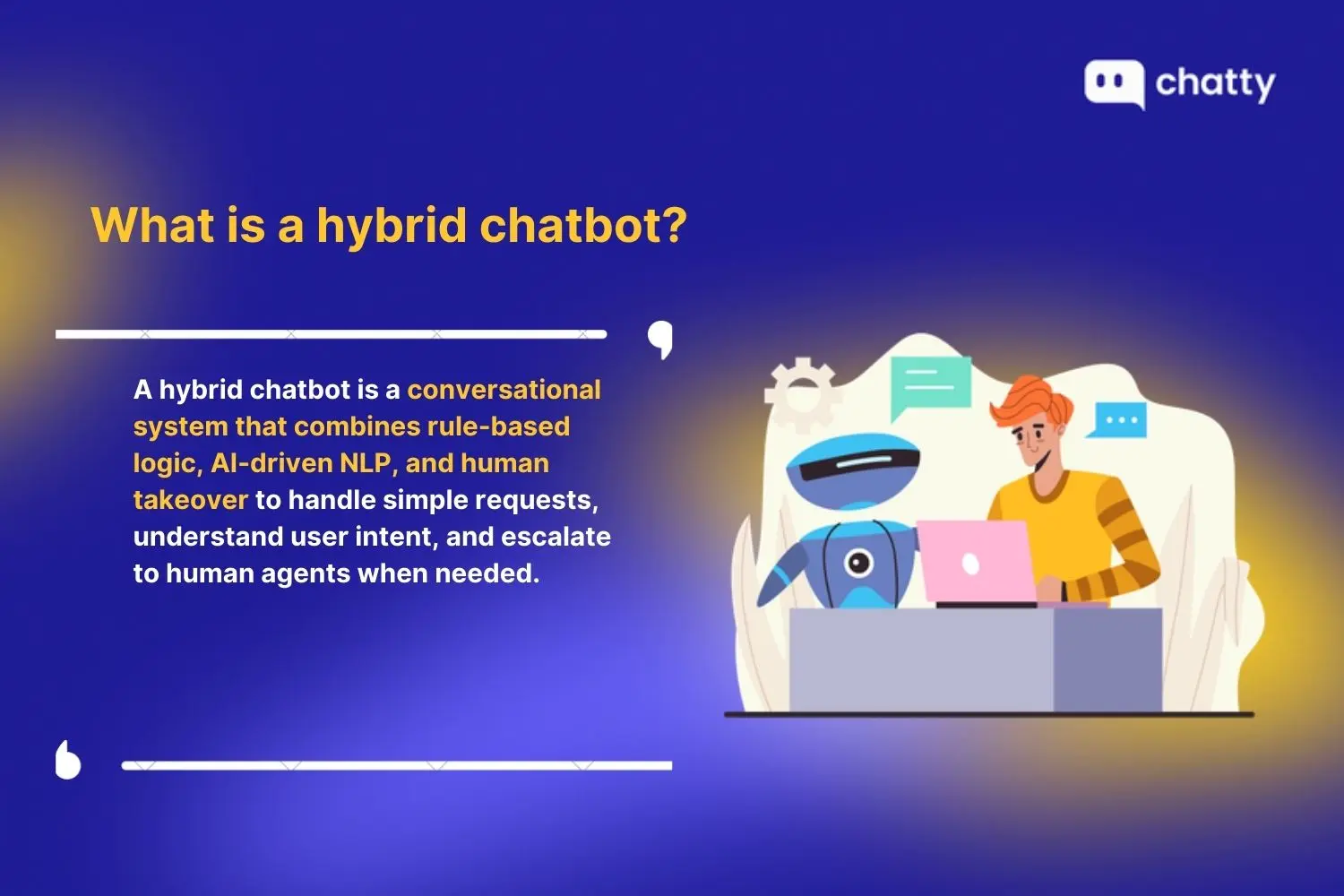
A hybrid chatbot is a conversational system that combines rule-based logic, AI-powered natural language processing (NLP), and human takeover. In practice, it handles simple and repetitive requests through predefined rules, uses AI to understand intent and context in more open-ended questions, and escalates conversations to human agents when needed. This ensures users always receive accurate and relevant support.
Compared to standard chatbots, which rely only on rules or only on AI, hybrid chatbots are more flexible and dependable. Rule-only bots often break when users ask unexpected questions, while pure AI bots may struggle with edge cases or sensitive situations. Hybrid models balance both, using automation where it works best and human judgment where it matters most.
For businesses, the results are clear but practical: round-the-clock availability, lower operational costs through automation, and a smoother customer experience driven by faster responses and seamless handovers.
How do hybrid chatbots work?
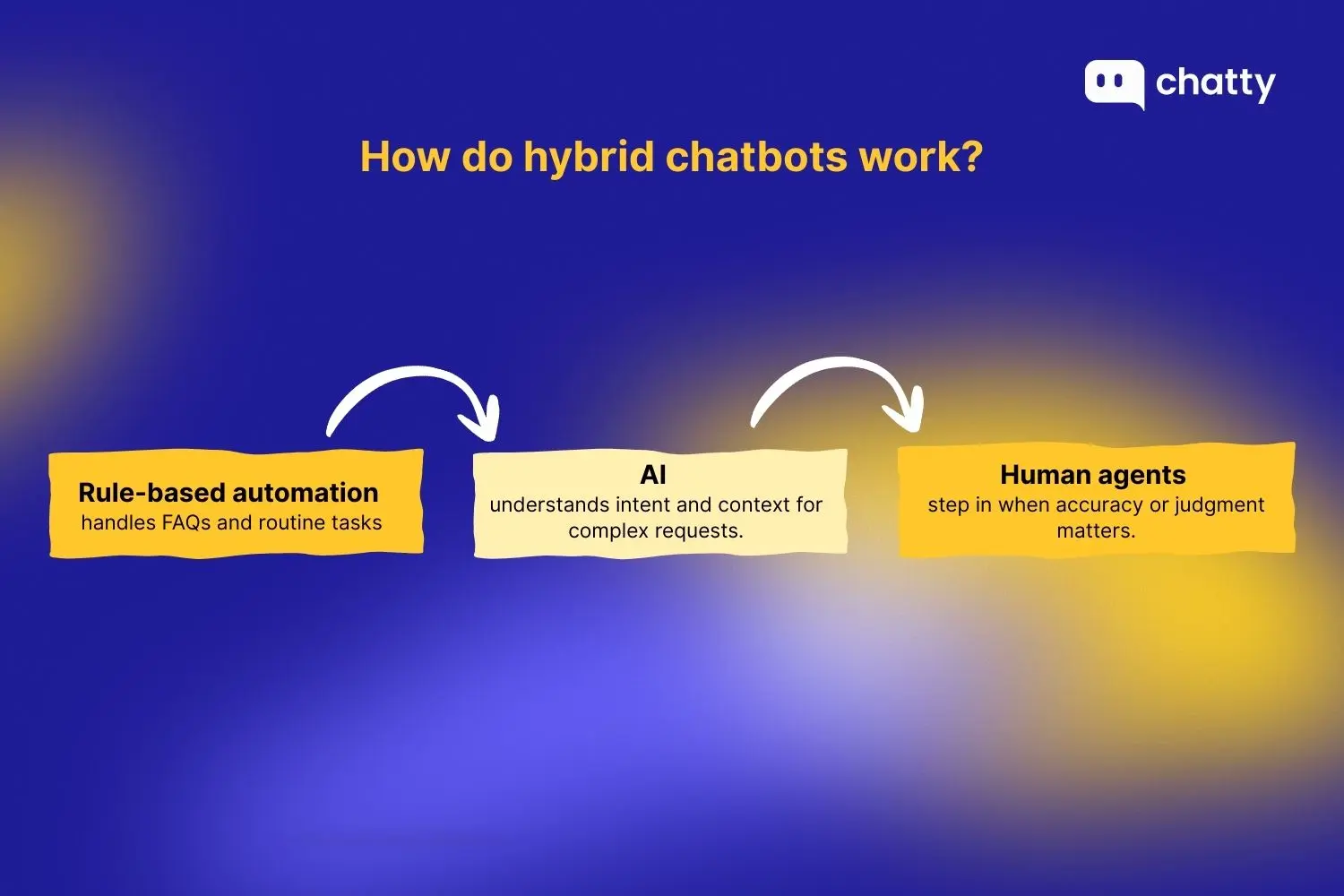
How does chatbot work? Hybrid chatbots combine rule-based automation with AI-powered language understanding. When a user starts a conversation, the chatbot analyzes the message to identify intent, context, and urgency.
For simple and predictable requests such as FAQs, order tracking, or basic account updates, the rule-based system responds instantly using predefined workflows. This ensures fast, accurate, and consistent answers. When questions become more complex or open-ended, the AI component takes over to understand natural language, manage follow-up questions, and generate more flexible responses.
If the chatbot detects confusion, sensitive topics, or situations that require human judgment, it can smoothly transfer the conversation to a human agent while sharing the full context. This approach keeps interactions efficient while maintaining a natural user experience.
Benefits of hybrid chatbots
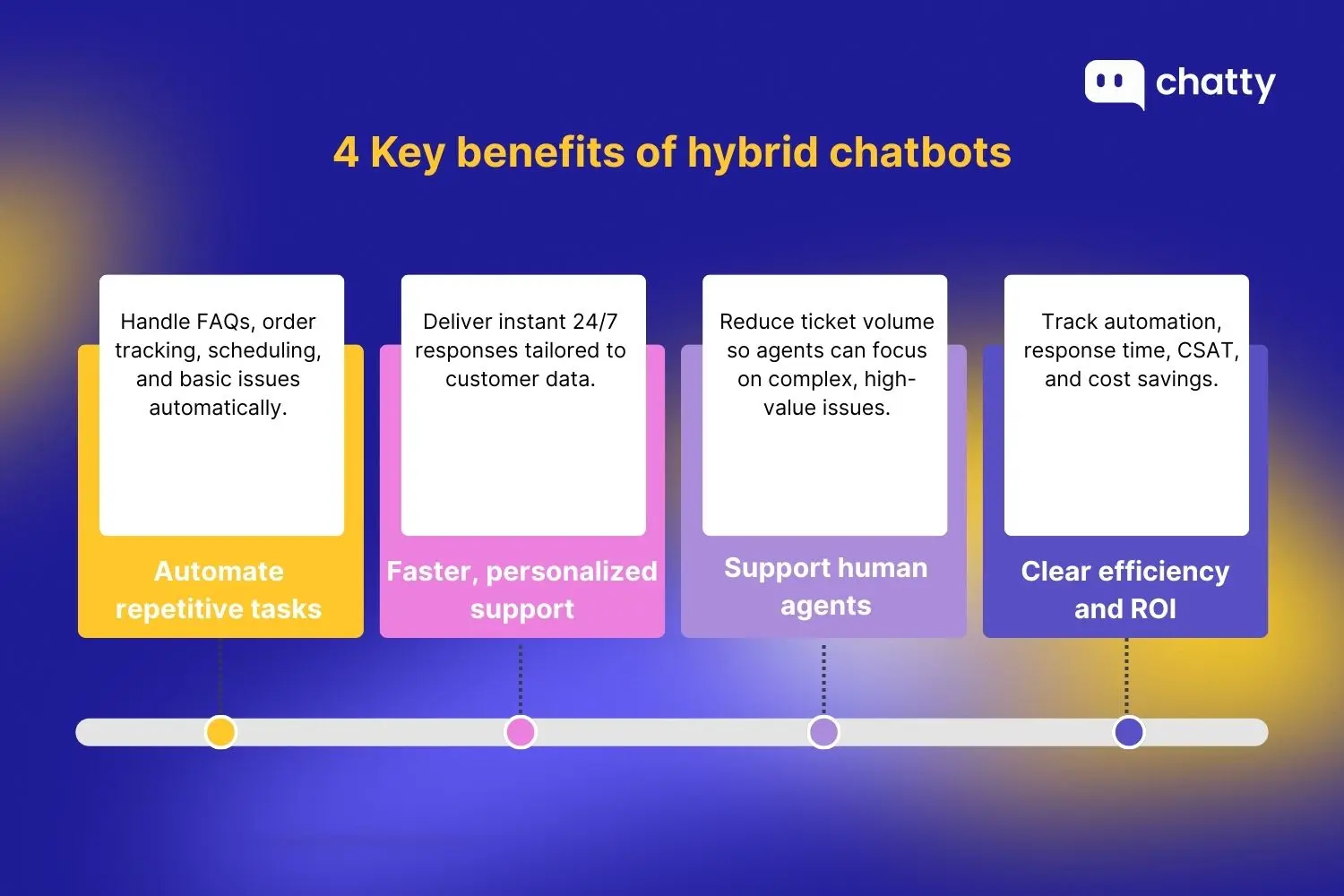
Hybrid chatbots deliver practical, measurable value by combining automation with human support. Below are the key benefits, explained with real use cases and data-driven context.
Automate repetitive tasks at scale
Hybrid chatbots are highly effective at handling routine inquiries such as FAQs, order status checks, appointment scheduling, and basic troubleshooting without human involvement. Studies show that well-designed chatbots can automatically resolve up to 70% of common customer questions. This significantly reduces pressure on support teams and shortens response times.
AI-powered chatbots typically respond within seconds, compared to minutes or even hours through traditional channels. By automating predictable requests, businesses can scale support efficiently while keeping human agents available for exceptions and complex cases.
Enhance customer experience with speed and relevance
Response speed plays a major role in customer satisfaction and brand perception. Research indicates that around half of customers expect a reply within five minutes when they contact support. Hybrid chatbots meet these expectations by offering instant, 24/7 responses and friendly customer service.
In addition, they can personalize interactions using customer data such as previous purchases, conversation history, or preferences. Personalization has been shown to increase engagement and conversion rates by up to 25%. When issues become complex or emotionally sensitive, the chatbot seamlessly transfers the conversation to a human agent with full context, reducing frustration and repetition.
Support human agents more effectively
Hybrid chatbots are designed to support, not replace, human agents. By resolving simple and repetitive requests, they reduce ticket volume and allow agents to focus on tasks that require empathy, problem-solving, and decision-making. This leads to better service quality and helps reduce agent burnout, improving overall team satisfaction and retention.
Measure efficiency and ROI clearly
The benefits of hybrid chatbots are measurable. Many organizations report operational cost reductions of up to 30%, along with faster response and resolution times. Tracking metrics such as automation rate, first response time, and customer satisfaction score helps teams evaluate ROI and continuously improve performance.
Key features of successful hybrid chatbots
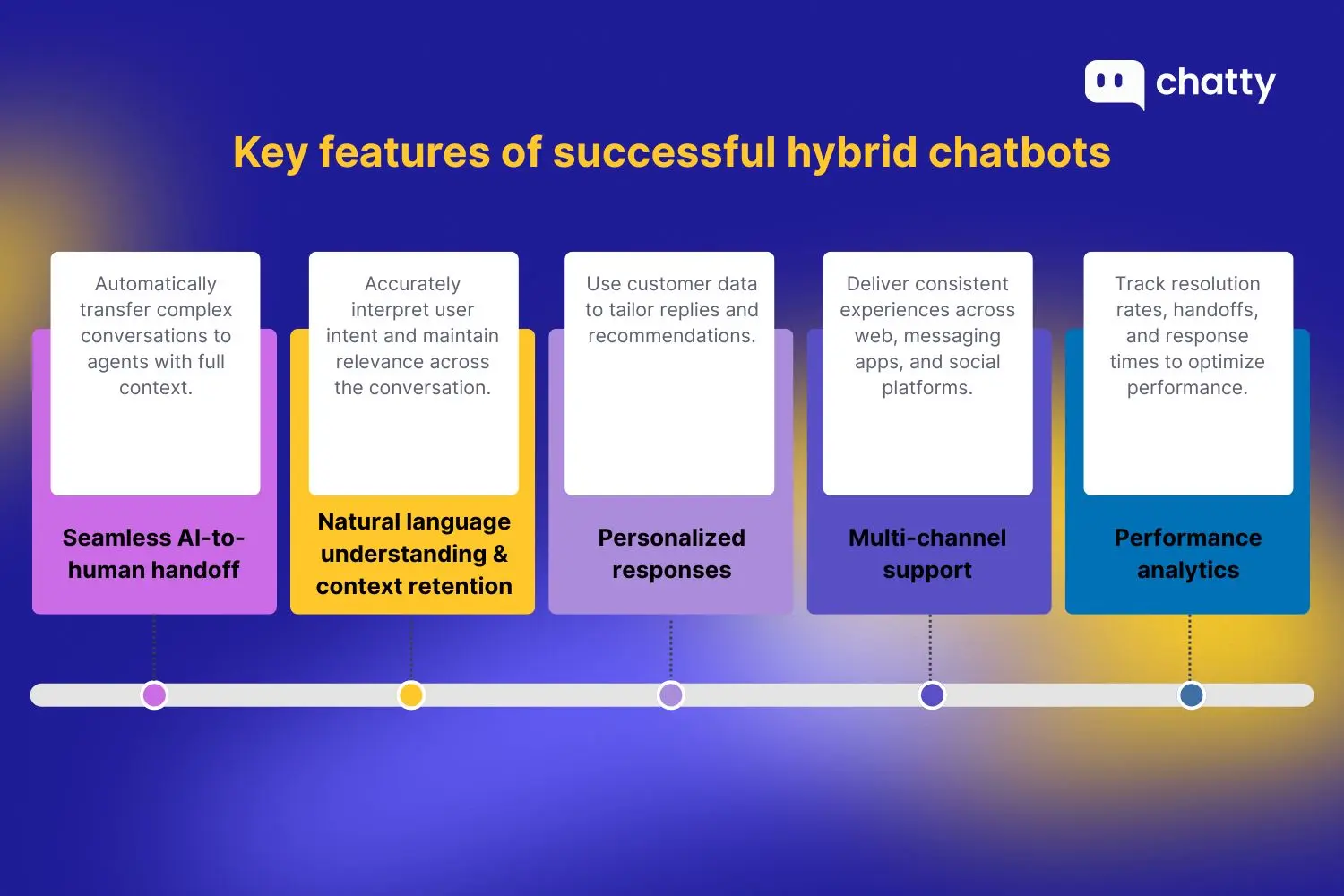
The following features highlight what separates effective hybrid chatbots from basic automation, showing how AI and human support can work together to deliver reliable, high-quality customer experiences.
- Seamless AI-to-human handoff: A successful hybrid chatbot recognizes when a conversation requires human intervention and transfers it smoothly to a live agent. All relevant context, including conversation history and user intent, is shared automatically, so customers do not need to repeat themselves.
- Natural language understanding and context retention: Strong language understanding enables the chatbot to accurately interpret user intent, even when questions are phrased differently or asked in follow-ups. Context retention ensures responses remain relevant throughout the entire conversation.
- Personalized responses based on user data: By leveraging customer data such as past interactions or account status, hybrid chatbots can tailor responses and recommendations. This improves efficiency and creates a more relevant and engaging user experience.
- Multi-channel support: Effective hybrid chatbots deliver a consistent experience across websites, messaging apps, and social platforms. Users can move between channels without losing context or service continuity.
- Analytics dashboard for performance monitoring: An analytics dashboard provides visibility into key metrics such as resolution rates, handoff frequency, and response times. These insights help teams refine chatbot performance and improve overall support outcomes.
Top 9 hybrid chatbot examples across industries
The examples below highlight how hybrid chatbots are implemented across different industries.
Decathlon — AI Product Expert Chatbot (E-commerce / Sports Retail)
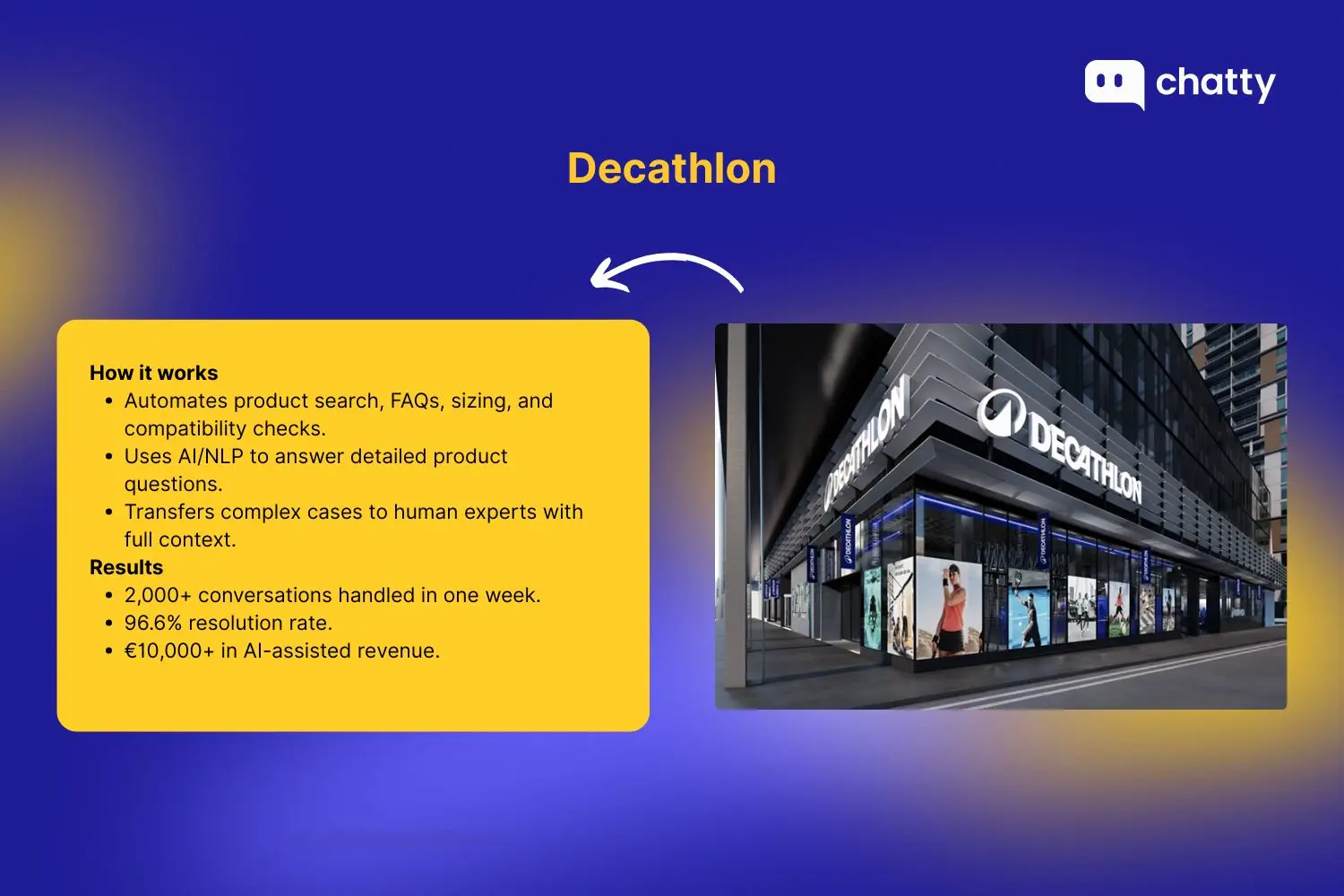
Decathlon implemented a hybrid chatbot powered by Chatty to deliver expert-level product guidance across its 10,000+ item catalog while reducing pressure on customer support teams. The chatbot’s purpose is to ensure shoppers receive accurate, technical advice at any time, preventing cart abandonment and helping them make confident purchase decisions.
Chatty automates rule-based tasks such as product search, FAQs, sizing charts, and compatibility checks, while its AI and NLP capabilities understand detailed, conversational questions about fit, performance, and use cases. When customers require personalized fittings or expert consultations, it seamlessly hands the conversation to human specialists with full context.
This hybrid setup enables instant responses at scale while preserving human expertise for high-value interactions. As a result, Decathlon handled over 2,000 conversations in one week, achieved a 96.6% resolution rate, and generated more than €10,000 in AI-assisted revenue.
Bank of America — Erica (Banking & Finance)
Erica was created to serve as a central digital assistant that helps customers manage their finances easily while scaling support across millions of users. The goal is to simplify everyday banking and deepen customer relationships without increasing operational costs.
Erica handles structured tasks such as balance checks, transaction history, bill reminders, and appointment scheduling through predefined workflows. AI and NLP power personalized insights, spending analysis, investment guidance, and proactive alerts based on customer behavior. When conversations require deeper financial advice, Erica connects users to human financial specialists.
This hybrid model reduces call center volume while maintaining high-quality service for complex financial needs. Erica has supported nearly 50 million users, delivered over 3 billion interactions, and achieved satisfaction rates above 98%, allowing human advisors to focus on higher-value conversations.
KLM Royal Dutch Airlines — BlueBot (Airlines / Travel)
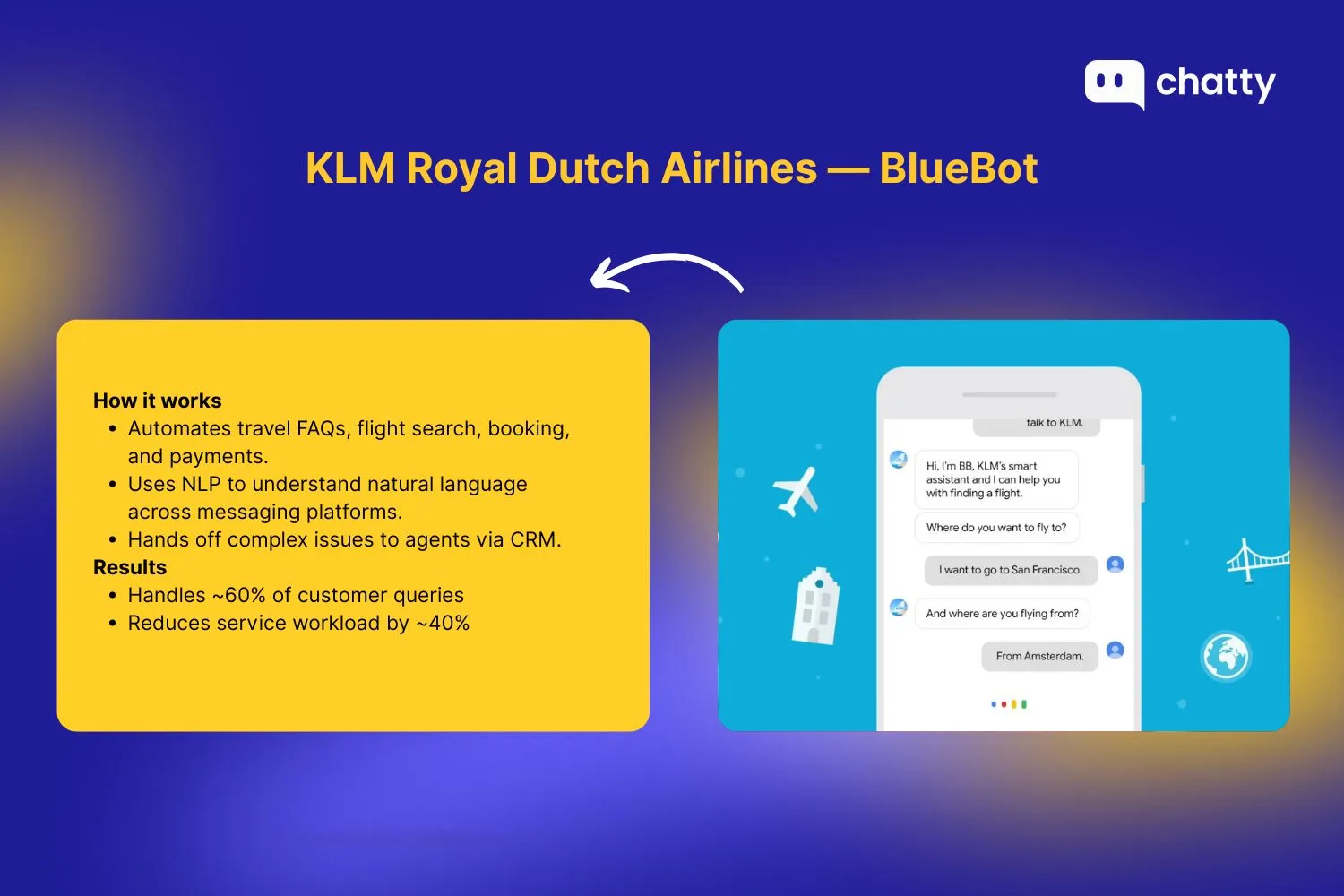
BlueBot was designed to provide fast, conversational customer service across social messaging platforms while preserving KLM’s reputation for personal support. Its purpose is to handle growing customer volumes without sacrificing response speed or service quality.
The chatbot automates tasks such as answering travel questions, searching flights, booking tickets, and processing payments using predefined flows. AI enables it to understand natural language, learn from past interactions, and improve response accuracy over time. When issues become complex, BlueBot hands conversations to human agents through CRM integration.
This hybrid setup allows KLM to scale efficiently while keeping human agents focused on sensitive or complex cases. BlueBot now handles around 60% of customer queries and has reduced customer service workload by approximately 40%.
Sephora Virtual Artist / Chatbot (Retail / Beauty)
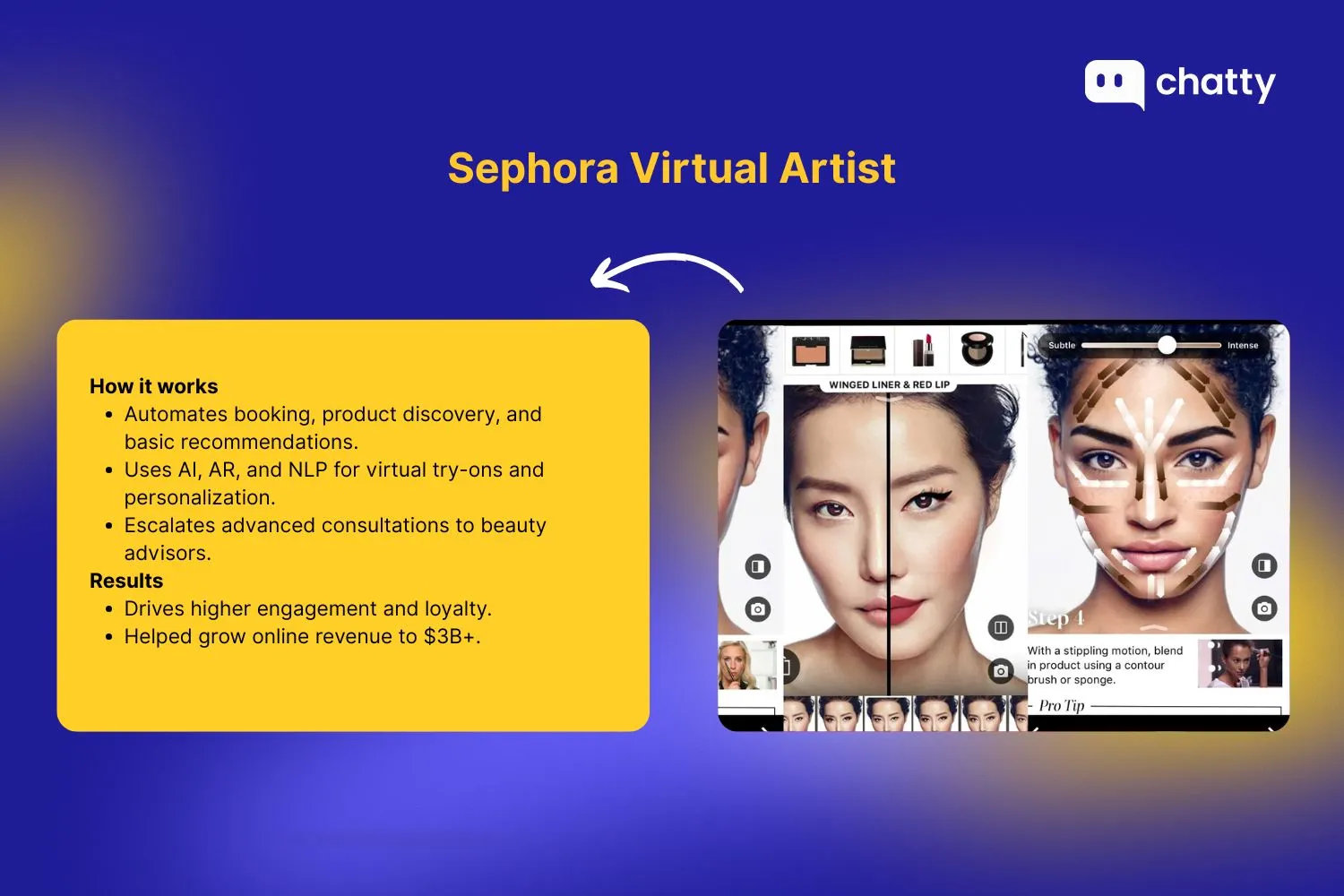
Sephora‘s chatbot ecosystem aims to create highly personalized beauty shopping experiences while bridging online and in-store interactions. The goal is to help customers confidently choose products and increase engagement across digital channels.
Rule-based automation supports appointment booking, product discovery, and basic recommendations. AI-driven tools use computer vision, AR, and NLP to analyze facial features, skin tone, preferences, and past behavior, enabling virtual try-ons and tailored suggestions. Human beauty advisors step in for advanced consultations or in-store assistance.
This hybrid strategy combines convenience with trust and expertise, driving stronger customer loyalty. It played a key role in Sephora’s digital growth, helping online revenue increase from $580 million in 2016 to over $3 billion by 2022.
H&M Online Chatbot (Fashion / Retail)
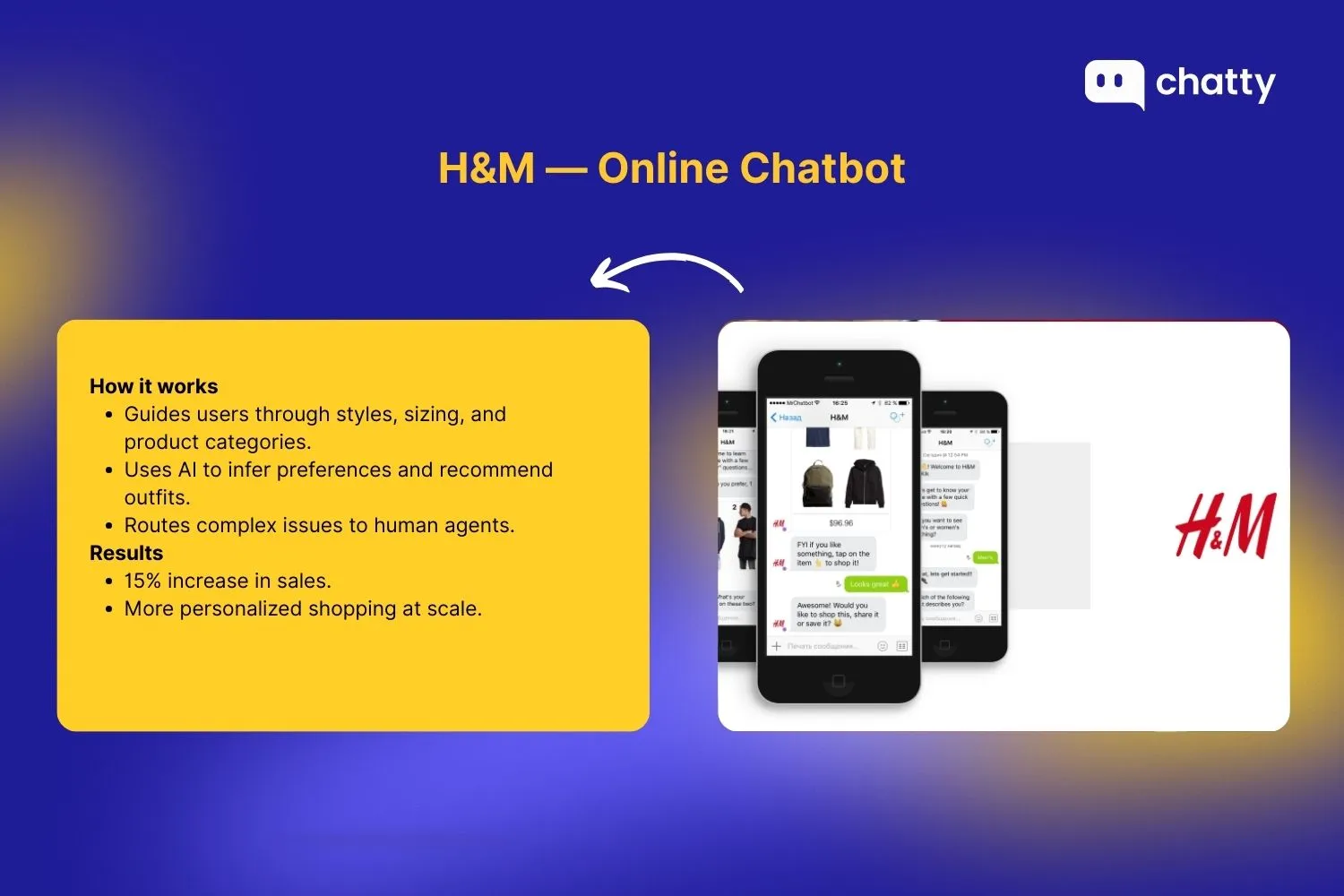
H&M introduced its chatbot to improve the online shopping experience by making product discovery faster and more personalized. The main objective was to increase conversion rates while engaging younger, messaging-first audiences.
The chatbot uses rule-based logic to guide users through style questions, product categories, sizing information, and purchase steps. AI analyzes customer responses to infer preferences such as color, occasion, and fashion style, then recommends relevant outfits. Human agents handle post-purchase issues or complex support cases.
This hybrid model delivers personalized shopping at scale while maintaining service quality. H&M achieved a 15% increase in sales after implementing its chatbot solution.
Verizon Virtual Assistant (Telecom)
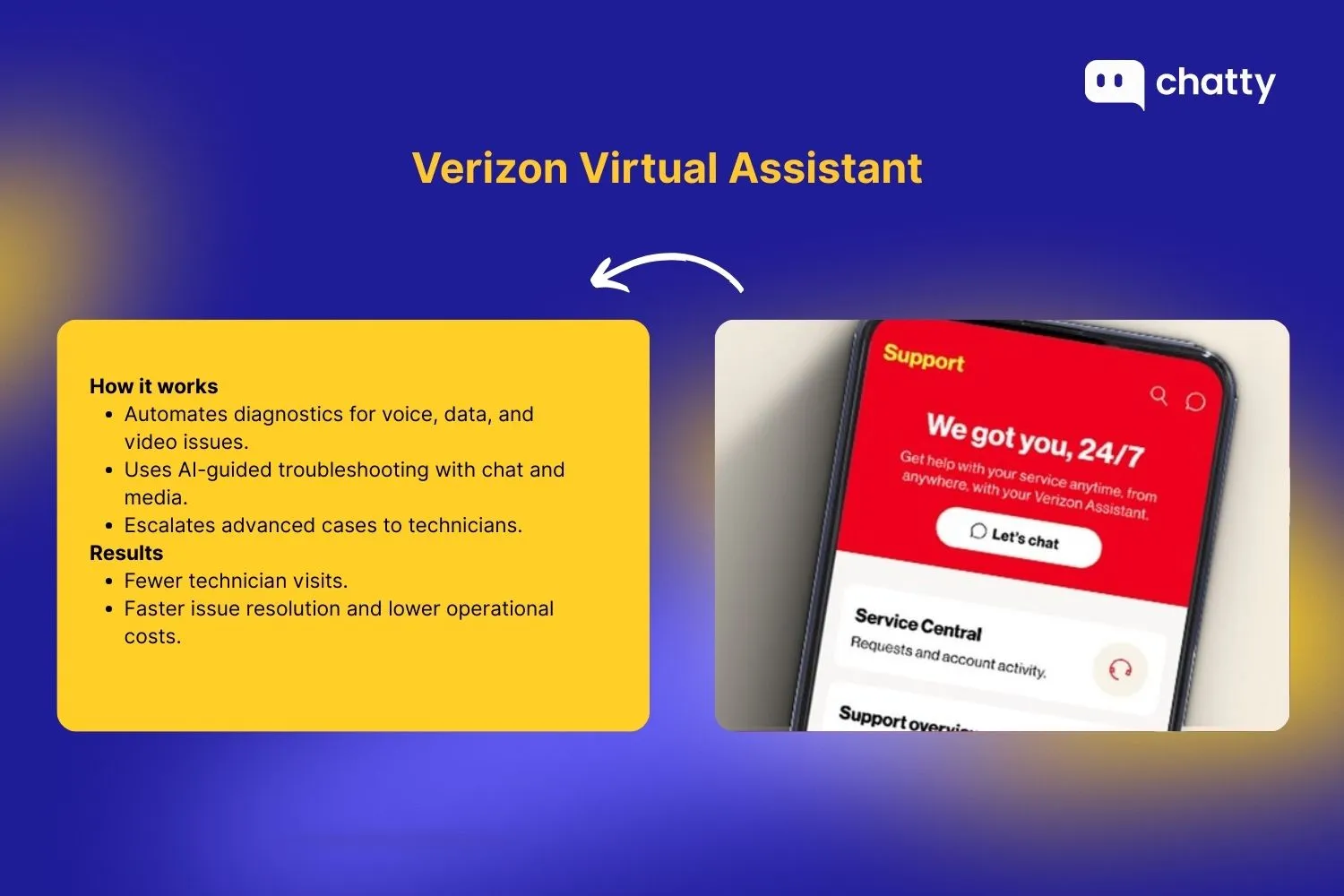
Verizon’s Virtual Assistant was created to maintain reliable telecom services while reducing the need for in-person technician visits. Its purpose is to resolve common technical issues quickly and safely, especially during periods of high demand.
The assistant automates diagnostics for voice, data, and video problems using guided troubleshooting steps, chat, images, and video links. AI helps interpret customer input and identify common faults, while human technicians intervene remotely or on-site when advanced repairs are required.
This hybrid approach reduces travel time, operational costs, and service delays. It allows technicians to focus on complex infrastructure work while routine issues are resolved remotely, improving efficiency and customer satisfaction.
Delta Airlines AI Assistant (Airlines / Travel)
Delta Concierge was built to provide SkyMiles members with real-time, personalized travel assistance throughout their journey. Its goal is to reduce travel-related friction while enhancing the premium customer experience.
The assistant automates tasks such as flight details, gate and seat information, baggage tracking, and eCredit lookup using predefined data flows. AI personalizes responses based on travel history and preferences and supports voice interaction. When needed, it seamlessly hands customers over to Delta’s customer care teams.
This hybrid design improves efficiency while preserving human support for complex situations. As it rolls out in phases, Delta Concierge continues to learn from real interactions to deliver increasingly personalized and connected travel experiences.
Netflix Support Bot (Streaming / Entertainment)
Netflix’s chatbot focuses on helping users find content more easily by reducing decision fatigue. Its purpose is to make browsing intuitive and aligned with users’ moods and preferences.
The system automates discovery using preset prompts and structured recommendation logic. AI and NLP interpret nuanced conversational queries such as tone, emotional intensity, and genre preferences, generating tailored suggestions with contextual explanations. Traditional human support remains available for account or technical issues.
This hybrid approach enhances engagement by making discovery faster and more enjoyable. By combining conversational AI with existing recommendation systems, Netflix improves user satisfaction and keeps viewers spending more time watching rather than searching.
Shopify Inbox and Sidekick — Shopify Magic (E‑commerce Platform / Retail)
Shopify’s hybrid chatbot ecosystem is designed to support both merchants and customers across the ecommerce lifecycle. Its purpose is to save time, improve decision-making, and increase conversions without adding operational complexity.
Shopify Inbox automates customer conversations by answering FAQs, recommending products, and generating contextual replies using conversational AI. Sidekick supports merchants through a chat interface by providing reports, shipping insights, and setup guidance. Humans remain in control for nuanced decisions and sensitive interactions.
This hybrid model balances automation with human oversight, improving efficiency while maintaining quality. Merchants benefit from faster customer responses, better operational insights, and scalable growth without sacrificing the personal touch.
Hybrid chatbot implementation guide
The guide below walks through a practical, step-by-step approach to planning, deploying, and improving a hybrid chatbot that fits real operational needs.
Step 1: Evaluate business needs
Start by analyzing real conversation data from chat logs, tickets, and emails. Identify repetitive, high-volume questions such as order status, account updates, or basic product details that can be automated safely.
Measure current agent workload, peak hours, and response times to understand where automation will have the biggest impact. At the same time, list the systems the chatbot must access, including CRM tools, helpdesk platforms, and internal databases. This ensures the solution is grounded in actual operational needs.
Step 2: Select the right platform
Choose a chatbot platform that supports human takeover, multi-channel deployment, and API integration. Human takeover allows agents to join conversations instantly with full context, preventing users from repeating information.
Multi-channel support ensures consistent experiences across websites, messaging apps, and social channels. API integration enables the chatbot to fetch accurate, real-time data. Also, look for platforms with built-in analytics to simplify performance tracking.
Step 3: Set up workflows and responsibilities
Clearly define what the chatbot handles and what requires human involvement. The chatbot should manage structured, predictable requests, while agents focus on complex or sensitive issues. Establish practical handover triggers such as low confidence responses, repeated failed attempts, negative sentiment, or direct requests for an agent. Document these workflows so teams can operate consistently and efficiently.
Step 4: Testing and iteration
Test the chatbot using common scenarios and edge cases based on historical data. Involve support and sales teams to simulate real conversations and identify gaps in understanding or tone. Use feedback to refine intents, update training examples, and adjust escalation rules. Continuous testing helps prevent issues before they affect customers.
Step 5: Launch and optimize
Once live, treat optimization as an ongoing task. Regularly update the knowledge base to reflect new products or policies. Track KPIs such as resolution rate, escalation frequency, response time, and customer satisfaction. Use these insights to expand automation where it performs well and rely on human agents where judgment and empathy remain essential.
Tips to optimize hybrid chatbots
Here are practical tips you can apply to optimize your hybrid chatbot and improve both automated and human-led conversations.
- Make the first interaction simple and guided: Use a clear avatar, a short teaser that explains what the chatbot can help with, and buttons for top use cases such as order tracking, pricing, or support. Limit choices to five or fewer buttons to avoid overwhelming users. Regularly review which buttons are clicked most and reorder them so the most-used options appear first.
- Use context to reduce repeated questions: Capture basic context early, such as language, customer type, or intent, and reuse it throughout the conversation. For example, store order IDs, email addresses, or selected topics so users do not need to re-enter them when the chat is handed over to a human agent. This makes escalation feel seamless rather than frustrating.
- Set clear and smart handover rules: Define when the chatbot should transfer the conversation to a human, such as after two failed answers, negative sentiment, or high-value requests. Always show a short message explaining the handover so users know what to expect. Route chats to the right agent team based on topic and priority to reduce resolution time.
- Monitor performance weekly, not occasionally: Review practical metrics like handover rate, average response time, and user satisfaction scores on a regular schedule. Compare failed chatbot conversations with successful ones to spot gaps in content or logic. Small, frequent adjustments are more effective than large, infrequent changes.
- Improve using real user conversations: Analyze chat transcripts to find common questions the chatbot fails to answer. Turn those questions into new intents, FAQs, or buttons. Test changes in live traffic and measure impact before rolling them out fully. Continuous learning from real interactions keeps the hybrid chatbot relevant and effective.
Looking for a hybrid chatbot built for e-commerce? Meet Chatty!
If your goal is to apply hybrid chatbot strategies specifically to e-commerce, Chatty is built with that exact use case in mind. Designed as an AI-first sales and support assistant for online stores, Chatty combines automated workflows, AI-driven conversations, and live chat in a single platform.
Chatty handles common retail questions such as order tracking, shipping updates, product details, and FAQs through automated and self-serve flows. Its AI chatbot is trained on store and product data to understand customer intent, answer questions naturally, and guide shoppers toward purchase decisions. When a conversation requires human judgment or sales support, Chatty enables instant live chat takeover with full context preserved.
Available on the Shopify App Store and easy to set up, Chatty integrates seamlessly with storefronts and marketing tools. For e-commerce teams, it turns customer conversations into faster resolutions, better shopping experiences, and measurable revenue impact, while keeping human agents focused where they add the most value.
Conclusion
Hybrid chatbots combine the efficiency of automation with the value of human support to create a stronger customer experience. The real-world examples covered in this article show how organizations across industries use hybrid chatbots to lower costs, shorten response times, and increase customer satisfaction.
Success depends on selecting the right chatbot platform, defining clear AI and human workflows, and continuously measuring performance. When implemented strategically, hybrid chatbots become more than a customer support tool. They serve as a long-term advantage for delivering scalable, friendly, and automated customer service in 2026 and beyond.