











E-commerce today feels like running a marathon with shoppers who sprint. They expect instant answers, perfect product matches, and zero friction. The moment something feels slow or generic, it vanishes without a trace. Merchants aren’t losing customers because their products are bad, but because every tiny delay becomes a deal-breaker.
That’s why AI e-commerce platforms are rewriting the rules. They rescue the moments where human teams can’t react fast enough. Search becomes intuitive, content writes itself, and support responds before frustration sets in.
This article breaks down the backbone of modern AI e-commerce platforms and shows why brands can’t scale without them.
- 70–77% of buyers expect personalized experiences, and brands that deliver spend 37% more per customer. AI e-commerce platforms make personalization operational at scale, turning a known preference into a measurable revenue multiplier across the entire customer base.
- AI e-commerce platforms are not add-on chatbots but foundational infrastructure powering search, content, and decisions. Built on machine learning and generative models, these platforms interpret shopper intent and adapt dynamically across every touchpoint from discovery to post-purchase.
- Rising digital ad costs make AI-driven on-site conversion the highest-ROI lever available to e-commerce brands. As the IAB confirmed record digital ad revenue in 2024, brands that cannot convert expensive clicks with personalized experiences are paying more per order every quarter.
- AI platforms complete the commerce loop by triggering pricing adjustments, cart recovery, and promotions automatically. Decision execution and workflow automation mean the system not only understands shopper intent but acts on it without waiting for a human to review data and approve a response.
- Generative AI inside e-commerce platforms can automatically create and optimize product descriptions and landing pages. This eliminates a major content production bottleneck, allowing catalogs of thousands of SKUs to have personalized, SEO-optimized descriptions without a large copywriting team.
What is an AI e-commerce platform?
Clear definition
An AI e‑commerce platform is a digital retail infrastructure that embeds artificial intelligence at its core. Not just as add-on chatbots or simple recommendation widgets, but it is built on a fundamental layer that powers search, personalization, content, and decision-making across the shopping journey.

Through machine learning, natural language understanding, and generative models, these platforms interpret shopper intent, predict behavior, and adapt dynamically to customer needs.
How does an AI e-commerce platform actually work?
An AI e-commerce platform operates as a continuous, intelligent cycle that guides shoppers from the first interaction to the final purchase and even post-purchase engagement.
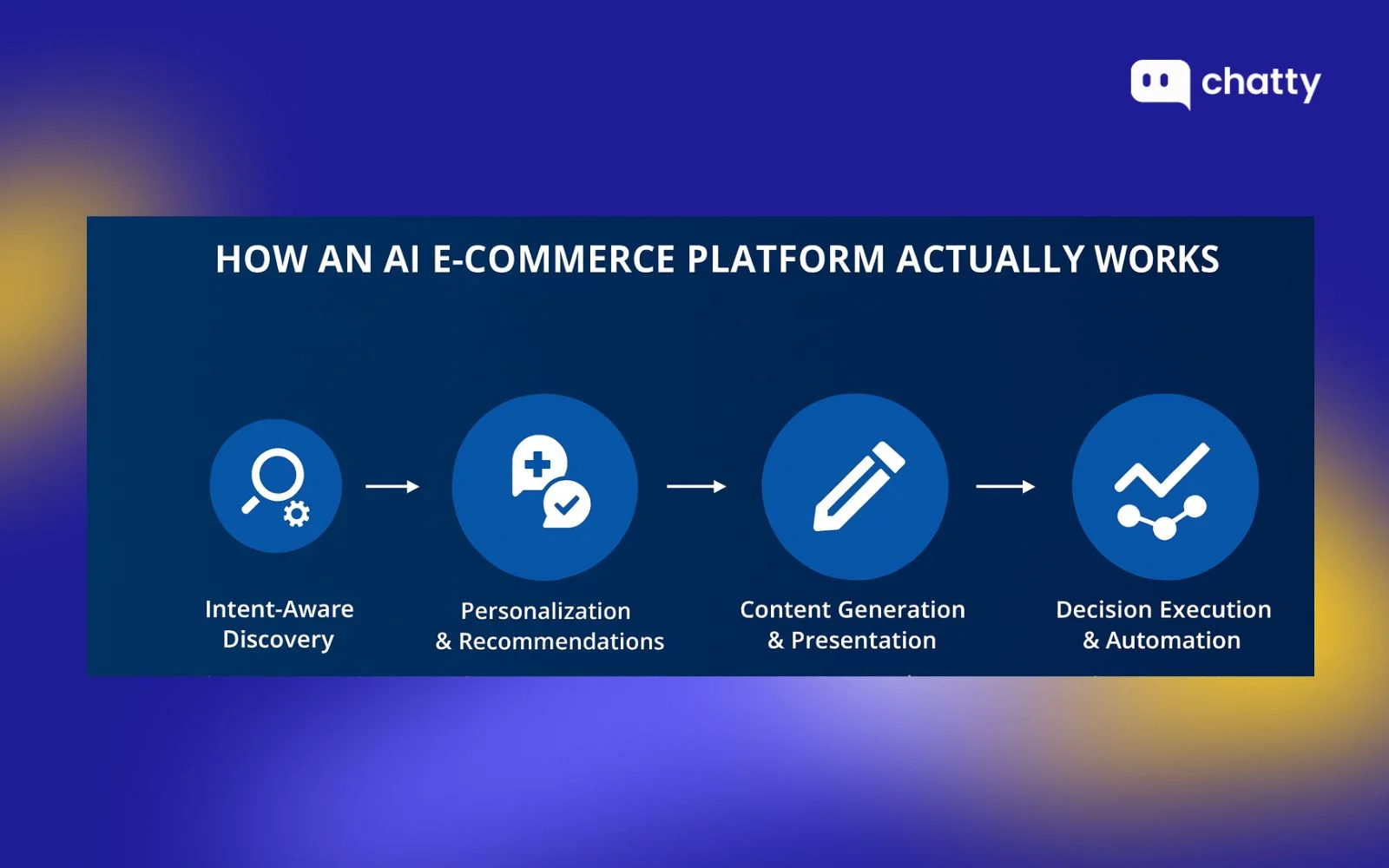
- It begins with intent-aware discovery: the system interprets what a customer is looking for, not just through literal keywords of search, but by analyzing the context of browsing, past behavior, and implicit preferences.
- Once the platform understands the shopper’s intent, it activates personalization and recommendations. By synthesizing historical data, browsing patterns, and session context, the AI generates product suggestions tailored to each individual. These recommendations are dynamic, updating in real-time as the shopper navigates the site, reducing friction that often leads to cart abandonment.
- Next, the platform supports content generation and presentation. Using generative AI, it can automatically create or optimize product descriptions, landing pages, and marketing messages, ensuring that the content aligns with shopper intent and drives engagement without requiring manual effort.
- Finally, AI completes the loop with decision execution and workflow automation. It can adjust pricing, check inventory availability, initiate promotions, recover abandoned carts, or even trigger specific actions within integrated systems like Shopify or other e-commerce backends.
Through translating insights into automated actions, the platform ensures that the shopper’s journey flows smoothly from discovery to purchase.
AI ecommerce platform comparison: how 6 leading options stack up
Choosing an AI ecommerce platform depends on store size, tech stack, and which workflows you want AI to own. The table below compares six widely adopted options across the dimensions that matter most in evaluation.
| Platform | Best for | Core AI capability | Shopify native | Starting price |
|---|---|---|---|---|
| Chatty | Shopify merchants scaling support + sales | Conversational AI agent with product-level context, omnichannel inbox | Yes | Free plan; paid from $19.99/mo |
| Shopify Magic / Sidekick | Shopify merchants wanting baseline AI | Product description generation, admin copilot, basic recommendations | Yes (built-in) | Included with Shopify plans |
| Gorgias AI | Brands prioritizing support deflection | Support ticket automation, macros, order lookup | Yes | From $10/mo (Starter) |
| Klaviyo AI | Email and SMS personalization at scale | Send-time optimization, predictive analytics, audience segmentation | Yes | From $45/mo for 1K contacts |
| Nosto | Enterprise personalization and recommendations | On-site personalization, dynamic bundles, search merchandising | Yes | Custom pricing (enterprise) |
| Salesforce Commerce Cloud AI (Einstein) | Enterprise retailers on Salesforce stack | Predictive sort, commerce insights, Einstein recommendations | No (Salesforce-native) | Custom pricing (enterprise) |
The shortlist narrows fast when you filter by size tier: early-stage Shopify merchants usually pair Chatty + Shopify Magic for chat and catalog, growing DTC brands add Klaviyo AI and Gorgias AI as volume scales, and enterprise retailers consolidate on Nosto or Salesforce Einstein.
How to evaluate an AI ecommerce platform: 7 criteria
AI platform demos are deliberately impressive. These seven criteria help you see past the polish and judge whether a platform will actually lift revenue in your store.
- Catalog depth, not chat polish. Does the platform ingest your full product catalog with variants, pricing rules, and inventory states? An AI that sounds smart but cannot reason about SKU-level inventory will fail in production.
- Integration breadth. Native connectors to your CMS (Shopify, BigCommerce, WooCommerce), your CX stack (Gorgias, Zendesk), and your marketing stack (Klaviyo, Mailchimp). Each custom integration you need to build is a six-month delay.
- Data governance and training boundaries. Where is customer data stored? Is it used to train shared models? What is the deletion policy? Review the DPA before you see a demo.
- Evaluation and observability tooling. Can you see what the AI answered, why it chose that answer, and which data source it used? If the answer is “trust us,” you cannot tune or debug the system.
- Handoff to humans. How does the AI escalate to a human agent, and does it pass full context? Test this in the demo — most platforms lose context at handoff, which is where customer trust breaks.
- Pricing model and overage behavior. Flat rate, per-conversation, per-message, or per-resolved-ticket? Ask what happens on a Black Friday spike. Surprise overages are a common killer of AI ROI.
- Time to first value. How long from signup to the first useful AI response in production? If onboarding takes more than two weeks for a Shopify store, the platform is carrying too much setup overhead.
For specific capability deep-dives, see how AI product recommendations work under the hood, and how conversational AI shapes the ecommerce buyer journey. For real brands running these stacks, browse 40+ AI ecommerce examples.
Why do modern brands need an AI e-commerce platform?
Customer behavior has changed
Today’s shoppers expect clarity, speed, and guidance at every micro-moment. A large share of consumers demand personalized experiences. Surveys show roughly 70–77% of buyers expect personalization and tailored interactions from brands. When sites fail to deliver relevance or quick answers, frustration increases and conversion drops.
In fact, brands that consistently deliver superior commerce experiences see materially higher spending: customers spend up to 37% more with them.
Traffic is more expensive
As global digital-ad inventory grows, competition for attention has intensified, so every click now costs more. According to the IAB 2024 report, total digital ad revenue reached its highest level in recent years. That growth reflects heavier spending across channels, which are all bidding for the same finite pool of consumer attention.
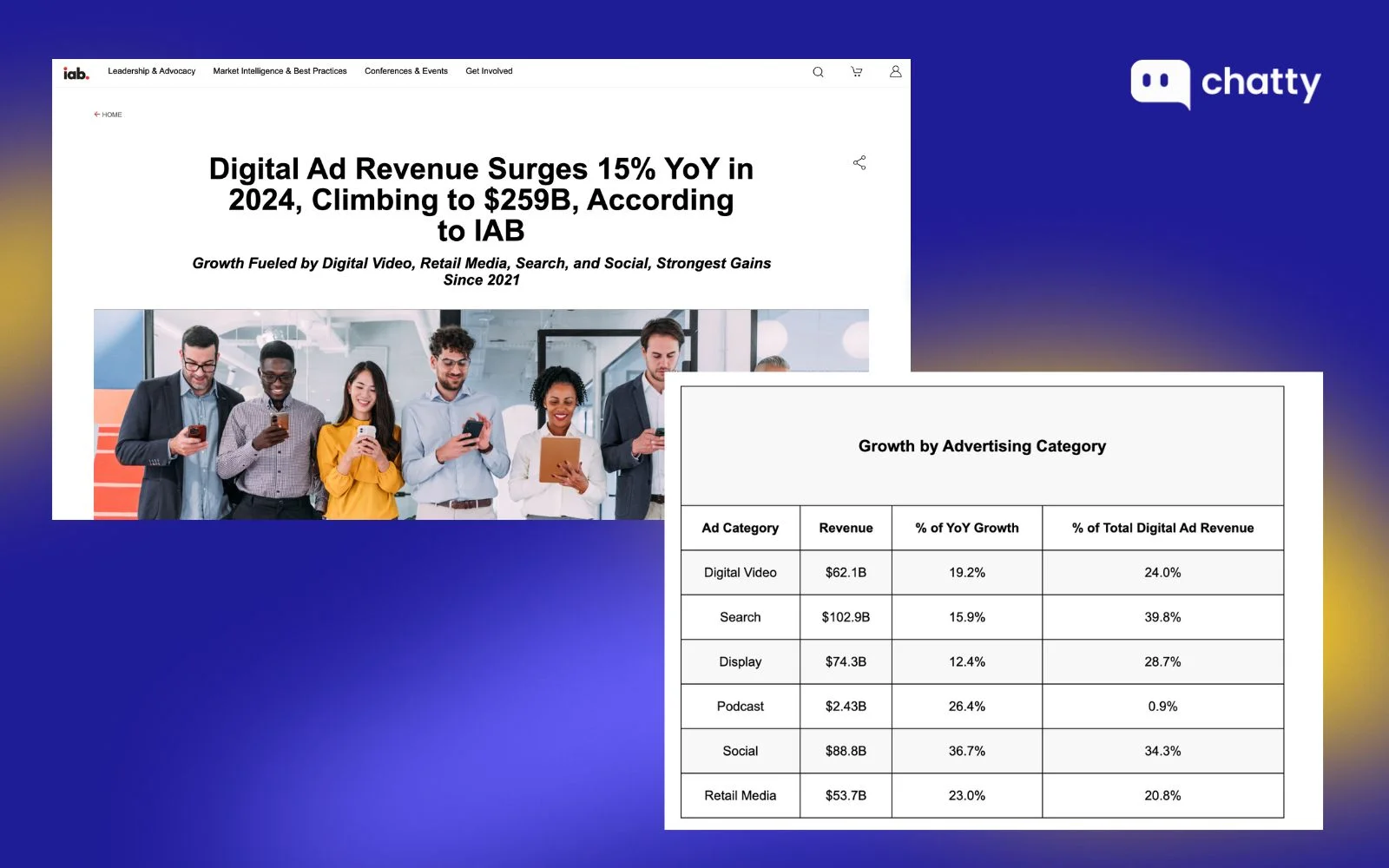
As ad spend rises, the cost to acquire each customer goes up. Which means a high click-through rate alone is no longer enough. If your product pages, landing experiences, or discovery flows don’t match the expectations of incoming traffic, that expensive click ends in a bounce and wasted budget.
Because attention has become scarce and costly, brands can no longer treat traffic as disposable. In that context, an AI-powered platform can detect intent, surface relevant products quickly, and personalize experiences on the fly.
Teams are leaner than ever
At the same time that acquisition costs rise, many brands face pressure to grow revenue without proportionally expanding their teams. Customers expect near-instant support responses, highly curated product experiences, and seamless service, but support and merchandising teams often lack the bandwidth to deliver that manually.
According to a 2025 customer-experience trends report, automation, including AI and machine-learning tools, has become central to scaling service without scaling headcount.
Everyday tasks like answering repetitive customer queries, rewriting content for hundreds or thousands of SKUs, or managing inventory logic consume time that could go to strategic improvements. AI-driven automation picks up that load, enabling small teams to deliver faster, more consistent, and more personalized service.
Chatty: The AI ecommerce platform built to solve today’s selling challenges
All the pressures facing modern brands point to one need: intelligence that can step in where humans can’t. That’s where Chatty comes in.
Chatty positions itself as an AI-first layer that sits on top of Shopify with a simple premise of intelligence and action. That is what separates a chat tool from a commerce platform.
What is Chatty?
Chatty is an AI-native commerce assistant built for Shopify merchants that combines conversational interfaces, a shared inbox, and automated workflows into a single platform.
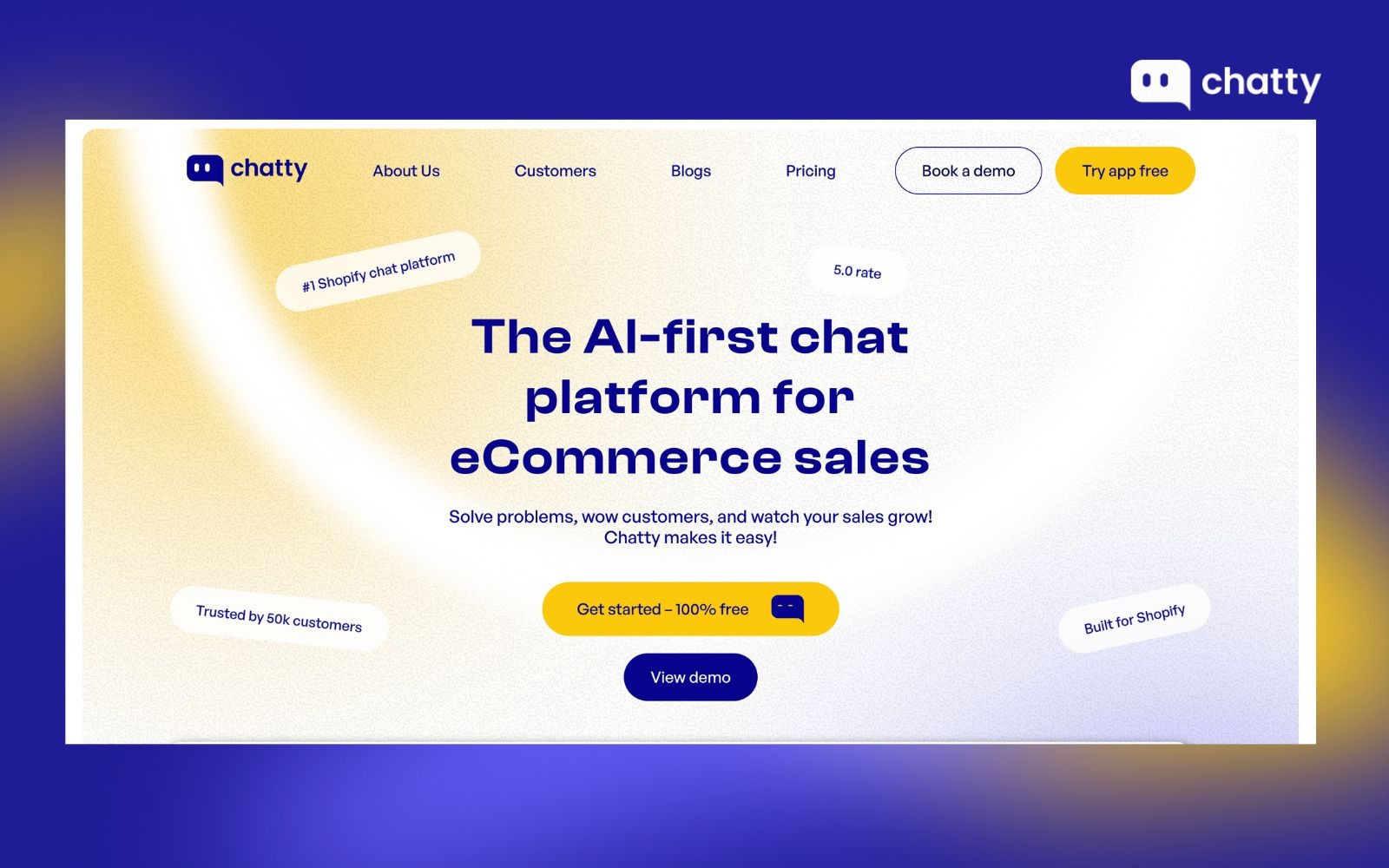
Install it, and the system automatically syncs with your store, digests product specs and policies overnight, and begins answering questions, suggesting products, and assisting checkout, often producing measurable sales within 24 hours, according to merchant reports.
The AI capabilities that make Chatty a true e-commerce platform
Chatty is best understood as an integrated AI capability block and an execution layer that converts insights into action. Each block maps to concrete features you can see and measure.
- AI reasoning for product discovery. Chatty doesn’t rely on canned responses. It parses product descriptions, technical specs, compatibility tables, and browsing context to answer complex pre-purchase questions (e.g., “Will these wheels fit my frame?”). The platform claims it can learn catalogs of 10,000+ items overnight and reason about relationships between items, which allows it to handle nuanced queries that would otherwise require human expertise.
That reasoning layer is what turns chat from a support channel into a discovery surface.
- AI-driven personalization and intent detection. Beyond raw product knowledge, Chatty ingests session signals and historical purchase data to infer intent: whether a visitor is browsing, comparing, or ready to buy.
This enables real-time personalization in chat and proactive outreach (targeted messages or upsell prompts) that match the shopper’s current mindset. It delivers fewer aimless clicks and more guided paths toward the right product.
- AI decision-making for recommendations. Chatty applies learned rules and predictive models to select and prioritize product suggestions during conversations. It surfaces complementary items, configures bundles, and spots upsell opportunities while factoring in inventory and compatibility.
This decisioning layer reduces friction at the point of choice and increases average order value by recommending the correct SKU at the right moment.
- AI execution layer (Shopify actions). Crucially, Chatty moves from insight to outcome via tight Shopify integration: it can display product cards, generate checkout links, pull order status, and trigger workflows in your store admin.
That execution layer, the ability to take action on Shopify rather than merely suggest, is what lets Chatty close the loop: a confident answer becomes an add-to-cart, and a suggestion can become revenue. The app’s Shopify listing and help docs emphasize quick setup and deep Shopify hooks.
See how real brands apply Chatty’s AI capabilities in practice?
Real-world merchants show how an AI commerce platform like Chatty doesn’t just sound good on paper; it can fundamentally change how you turn traffic into revenue.
Here are three concrete cases spanning very different product categories in which Chatty’s AI capabilities proved decisive.
Yoeleo Bike: mastering complex product support for high-spec gear
Yoeleo Bike, known for its high-performance wheels, frames, and brake systems, sells gear where tiny compatibility details like rotor standards, bearing sizes, frame geometry, etc., make or break the purchase.
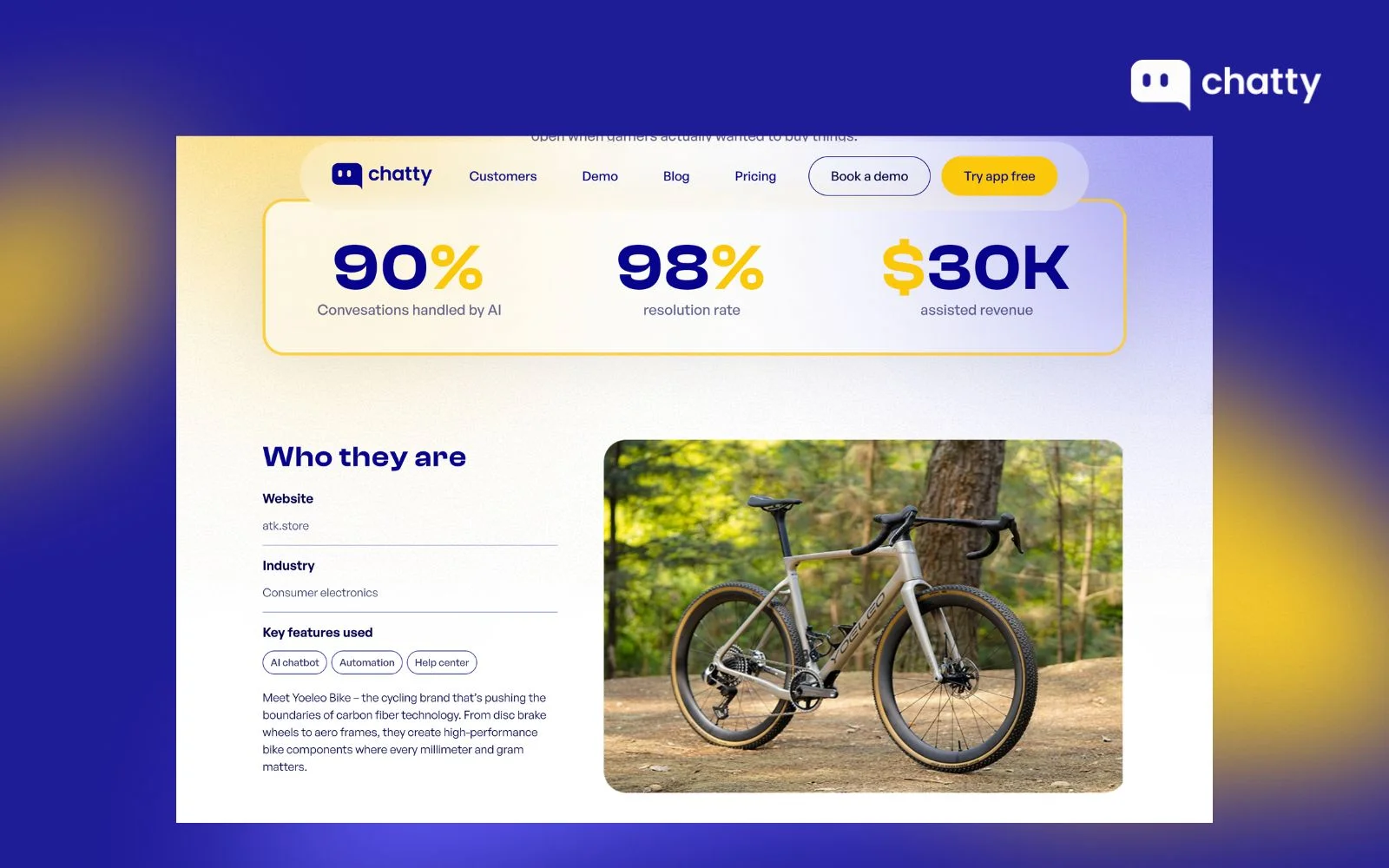
Their challenge was clear: customers needed expert-level answers instantly, but the team couldn’t be on call 24/7. After implementing Chatty, that bottleneck disappeared. Chatty learned Yoeleo’s product specs in depth and began delivering precise compatibility guidance in real time, giving shoppers confidence to make the right choices.
The impact was dramatic:
- Nearly 90% of conversations were entirely handled by AI, with a 98% resolution rate.
- About US$30,000 in assisted revenue is directly tied to Chatty-guided sales.
For Yoeleo, fewer abandoned carts and returns became the new norm, proving that strong AI reasoning and product knowledge can turn a complex catalog into a sales advantage.
Decathlon: scaling customer support for tens of thousands of SKUs
With an online catalog exceeding 10,000 products, from trekking tents to snow boots, Decathlon faced a volume problem, not a quality one. Their team was overwhelmed by repetitive questions about sizing, fit, and technical suitability.

Chatty solved this by syncing Decathlon’s entire catalog and instantly becoming a 24/7 advisor that could interpret intent, recommend the right gear, and cross-suggest complementary items. It scales expertise across thousands of SKUs without increasing headcount.
Within a single week, Chatty handled over 2,000 conversations, achieving a 96.6% resolution rate and generating €10,964.39 in attributed revenue.
This case shows the power of personalization, AI-driven decision-making, and execution layers when managing massive, diverse inventories.
ATK Gear: capturing sales at odd hours with round-the-clock AI assistance
ATK Gear, a premium tech gear retailer, caters to shoppers who browse late at night, the exact hours when human support is offline. They were losing high-intent customers simply because no one was available to answer questions or recommend the right product.

Chatty changed that overnight. Acting as a 24/7 sales assistant with deep technical knowledge training, it responded instantly, offered personalized product suggestions, and guided shoppers to checkout at any hour.
Ultimately, ATK Gear has achieved:
- 400% spike in late-night traffic successfully handled with instant AI support
- Major drop in cart abandonment as Chatty solved 60% of technical compatibility questions
- 24/7 global coverage, enabling sales from Asia-Pacific without adding staff
- AI-powered “gaming intelligence” recommending complete setups
- New esports endorsement opportunities as players received real-time gear guidance during tournament weekends
- No more missed sales during off-hours, eliminating the old choice between lost revenue or midnight support shifts
ATK Gear’s experience highlights the strength of Chatty’s automation and execution layer: when customers show up at 2 AM with buying intent, Chatty is there to assist, engage, and convert, ensuring the store is effectively “open” 24/7.
Is Chatty for you?
Despite its powerful capabilities, Chatty’s fit depends less on industry and more on operational reality: how you sell, what customers ask, and where your growth bottlenecks appear.
Chatty is a strong fit if your brand:
- Runs on Shopify and wants an AI-first layer, not one more app to manage: Chatty deeply integrates with Shopify’s data model: products, variants, collections, customer history, and orders. So its intelligence grows with your store instead of sitting beside it.
- Has a growing catalog or sells technically complex products: The more specifications, sizing rules, compatibility constraints, and decision friction your catalog has, the more Chatty’s reasoning engine shines. AI can guide shoppers through what normally requires a trained salesperson.
- Receives many repetitive or high-volume questions: Chatty handles FAQs, product comparisons, compatibility checks, policy clarifications, and order lookups autonomously. This frees your team from daily triage and ensures customers never wait for basic answers.
- Wants to reduce operational load without shrinking customer experience: Instead of expanding headcount to keep up with traffic, Chatty absorbs routine conversations and executes actions on your storefront: checking stock, creating carts, applying discounts, and more.
- Needs guided selling to increase conversion: Chatty doesn’t only respond, but it also identifies intent, recommends products, bundles accessories, upsells intelligently, and prevents cart abandonment with contextual prompts.
- Values AI that can take real storefront actions, not just talk: Through Shopify Actions, Chatty can do what human agents do: build carts, edit orders, check statuses, suggest variants, and drive customers to purchase with accuracy and speed.
Chatty may not be the right fit if:
- You don’t use Shopify: Chatty is engineered specifically for the Shopify ecosystem, taking advantage of its data structure and automation hooks.
- Your store has very few SKUs and receives minimal customer inquiries: If shoppers rarely have questions and buying decisions require little guidance, an AI commerce layer may not produce significant lift.
- You prefer human-led support for every interaction: Some brands prioritize full manual control, even if it limits scale. If automation is not part of your operational philosophy, Chatty may offer more capability than you need.
Final thought: The future stack
The future of e-commerce is intelligent. AI platforms like Chatty are showing that the next generation of stores will combine reasoning, personalization, and execution to turn every interaction into an opportunity, while freeing teams to focus on strategy, creativity, and growth.
Don’t treat AI as optional. Use it as a core operational layer to capture lost revenue, reduce operational strain, and stay ahead in a market where speed, personalization, and conversion define success.
FAQ
Implementation guide: 6-week rollout plan
Most AI ecommerce platforms fail in production not because of the model, but because of rushed rollout. Use this six-week plan to de-risk the launch.
Week 1: Data and scope
- Audit your product catalog for missing attributes, inconsistent naming, and stock feed accuracy.
- Pick one primary use case (support deflection, product recommendations, or abandoned cart recovery). Do not launch three at once.
- Define success metrics up front: tickets deflected, AOV lift, recovered revenue. Pick one north-star metric.
Week 2: Integration and training
- Connect the platform to your Shopify store, CRM, and support inbox.
- Upload FAQs, policy documents, and any internal knowledge base articles.
- Configure escalation rules: when does the AI hand off to a human?
Week 3: Internal testing
- Run 50–100 test conversations across your most common scenarios (order status, returns, sizing, product comparison).
- Log every wrong or awkward answer. Fix the underlying data source, not the prompt.
- Get support and sales teams to red-team the assistant before customers see it.
Week 4: Soft launch
- Enable the AI for 10–20% of traffic. A/B test against your current flow.
- Review all escalated conversations daily. Patch knowledge gaps within 24 hours.
- Watch for hallucinations about pricing, inventory, or shipping. These are trust killers.
Week 5: Scale up
- Expand to 100% of traffic once the deflection or CVR metric beats baseline.
- Turn on secondary use cases (upsell prompts, post-purchase follow-up).
- Brief customer service on the new volume mix: AI handles routine, humans get complex cases.
Week 6: Review and optimize
- Report actual lift against the north-star metric. Share with leadership.
- Identify the top 10 unresolved question patterns and add them to the knowledge base.
- Decide the next use case to layer on. Rinse and repeat each quarter.
This pacing trades launch speed for measurable, defensible ROI. Teams that collapse this timeline into two weeks almost always roll back within the quarter.
- Generate product descriptions, headlines, and content automatically, saving hours of copywriting.
- Design layouts and suggest UX improvements based on best practices and user behavior data.
- Personalize product recommendations and navigation in real time to match visitor intent.
- Automate repetitive tasks like inventory tagging, image resizing, or FAQ generation.
- Personalization: Recommending products based on browsing behavior, purchase history, or inferred intent.
- Guided selling: Assisting shoppers with complex choices, bundles, or upsells.
- Customer support: Handling FAQs, order queries, and product guidance 24/7.
- Marketing optimization: Targeting ads, emails, and promotions to the right customers.