










Right now, someone is asking ChatGPT: "best creatine supplement for beginners." ChatGPT recommends your product. The shopper clicks through. They land on your store.
And then nothing happens. Nobody answers "what's the right dosage for a 70kg male?" Nobody suggests the bundle with the shaker bottle. Nobody confirms whether express shipping makes it there by Friday.
The shopper leaves. You never know they visited.
This scenario is already playing out across millions of Shopify stores. Since March 2026, Shopify has activated Agentic Storefronts by default, putting your products in front of ChatGPT's 880 million monthly users, plus Google AI Mode, Microsoft Copilot, and Perplexity. The discovery problem is solved.
The selling problem is wide open.
Every guide on the internet tells you to optimize product data so AI agents can find you. Necessary. But it's only half the job. This article covers agentic commerce from both sides: how to get found, and the part almost nobody talks about, how to close the sale when AI sends buyers to your door.
- Shopify activated Agentic Storefronts by default. Your products are already discoverable on ChatGPT, Copilot, Google AI Mode, and Perplexity. If you haven't checked, you're behind.
- Shopify Q1 2026: AI-driven orders grew 13x year over year, traffic 8x, and average order value on agent-driven orders is up 30%. Still under 0.2% of total sessions, but trajectory and order quality are what matter. Setup cost is near zero.
- OpenAI tried letting shoppers buy inside ChatGPT and failed. Only about 30 merchants went live. Walmart saw 3x worse conversion rates. Checkout belongs on your store, not inside an AI chat.
- 42% of shoppers abandon purchases due to insufficient product information on the store itself. Agentic Storefronts solve discovery. Nobody solves conversion.
- The seller-side gap is the real opportunity. Buyers have ChatGPT, Perplexity, and Copilot shopping for them. Most merchants still rely on a static FAQ page and 24-hour email replies. AI that sells for merchants is the missing piece.
What agentic commerce actually means for your revenue
Agentic commerce is the shift from "shoppers browse your store" to "AI agents find your store for shoppers." Instead of clicking through Google ads, shoppers describe what they want to an AI, and the AI decides which stores and products to recommend.
The difference from everything that came before is who controls discovery. In SEO, Google's algorithm decides. In social commerce, influencers decide. In agentic commerce, AI agents decide, based almost entirely on your product data quality.
Here's how a real agentic commerce interaction works today:
- A shopper asks Perplexity: "best cycling sunglasses for narrow face under $200"
- Perplexity scans product feeds from hundreds of stores, compares specs, reads reviews
- It recommends three products, including yours
- The shopper clicks through to your store
- They want to know: "does this fit an Asian nose bridge?"
Steps 1 through 4 are already handled. Shopify built Agentic Storefronts. Google and OpenAI built the AI shopping agents. Your products get surfaced automatically.
Step 5 is where revenue happens or doesn't. And right now, most stores have nobody there to answer.
That distinction, discovery versus closing, is the lens you need for everything that follows. Agentic commerce has two jobs. The industry is obsessed with job one. Job two is where the money is.
Twelve months that rewired ecommerce, and one spectacular failure
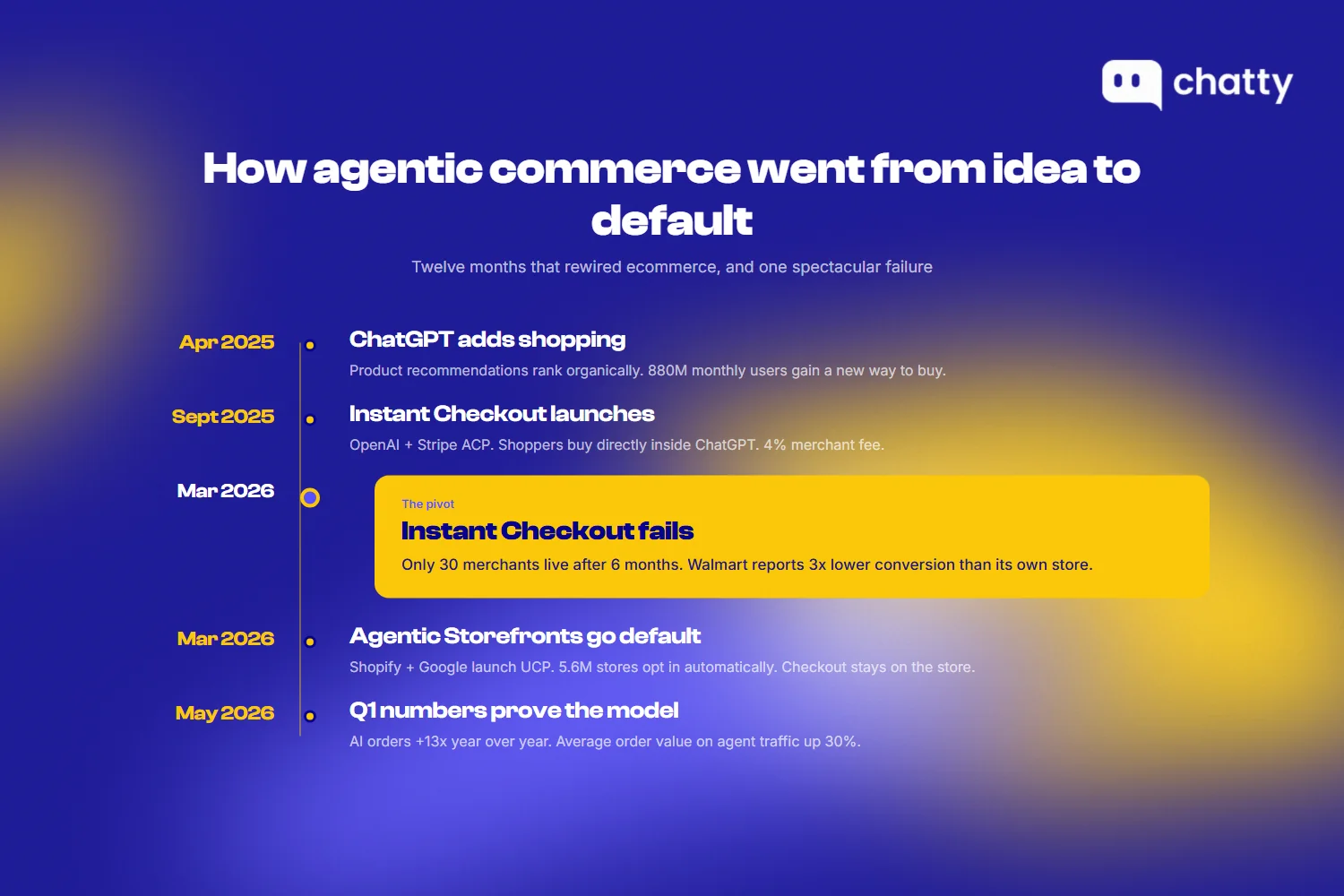
The speed of agentic commerce caught most merchants off guard. Here's what happened in chronological order, and what each event actually means.
April 2025: ChatGPT adds shopping
OpenAI added product recommendations to ChatGPT search. Images, pricing, reviews, and direct purchase links, all ranked organically. No advertising, no bidding. Products with good structured data appeared for free.
The signal was clear: product data quality became a ranking factor in a channel with 880 million monthly users.
September 2025: OpenAI tries to own checkout
OpenAI launched Instant Checkout, letting shoppers buy directly inside ChatGPT. The Agentic Commerce Protocol (ACP), co-developed with Stripe, powered the transaction. Merchants paid a 4% fee on top of standard processing. Launch partners included Walmart, Etsy, and Shopify brands like Glossier and SKIMS.
The failure that changed everything
By March 2026, OpenAI killed Instant Checkout. The numbers were brutal. Only about 30 merchants had gone live after six months. Walmart publicly reported that conversion rates for products sold inside ChatGPT were 3x lower than products where shoppers clicked through to walmart.com.
This failure is the most important data point in the entire agentic commerce timeline. It proved something fundamental: AI agents are excellent at discovery but structurally bad at closing. Shoppers want brand experience, familiar payment methods, and trust signals that only exist on the merchant's own store.
ChatGPT is becoming the next Google, a discovery engine that drives traffic, not a checkout destination that replaces your store.
March 2026: The model that works
Two things happened in the same week. Shopify activated Agentic Storefronts by default for all eligible merchants. And Shopify announced that products would be discoverable and purchasable inside ChatGPT, but through an in-app browser that loads the merchant's own checkout. No extra transaction fees.
Simultaneously, Shopify and Google launched the Universal Commerce Protocol (UCP), an open standard endorsed by 20-plus partners including Walmart, Target, Visa, Mastercard, and Stripe. Native shopping began rolling out in Google AI Mode and the Gemini app.
Where we are now: May 2026
The numbers tell a clear story of momentum:
- Shopify's Q1 2026 numbers: AI-driven traffic +8x year over year, AI orders +13x, AOV on agent-driven orders +30%. Agentic Storefronts are now live by default on roughly 5.6 million stores
- AI traffic to US retail sites increased 4,700% year over year according to Adobe
- One in six Black Friday 2025 purchases were AI-assisted
- Roughly 50 million shoppers now use ChatGPT for product queries every day
But here's the honest context: AI traffic still represents less than 0.2% of total ecommerce sessions. The absolute volume is small. The trajectory is what matters.
Four AI platforms are already sending buyers to Shopify stores
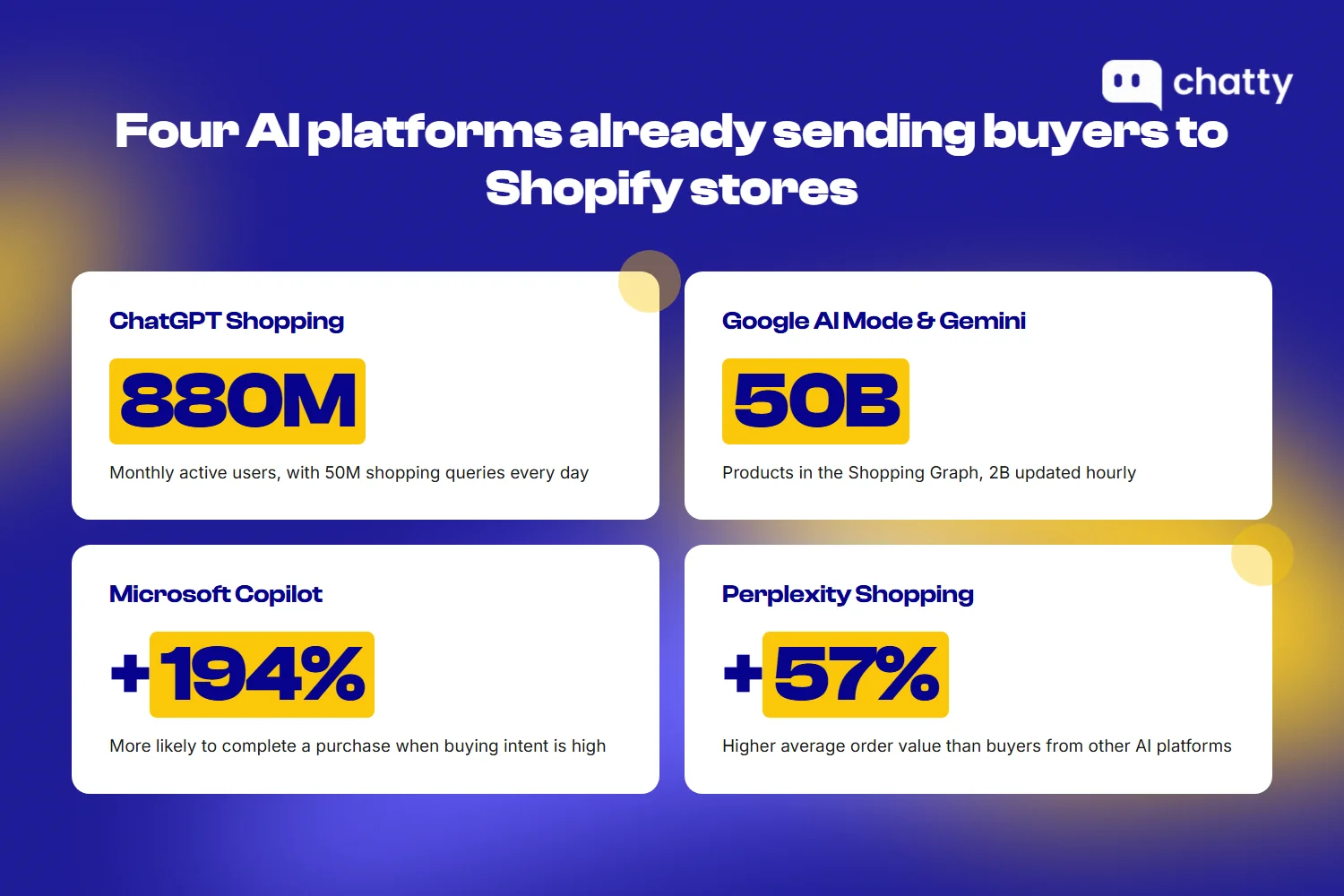
Understanding where agentic traffic comes from helps you prioritize. Here are the four active platforms, ranked by current impact.
ChatGPT Shopping
The largest. 880 million monthly active users, with shopping queries making up roughly 10% of total searches and growing. ChatGPT recommends products using structured feeds, schema markup, and Shopify Catalog data. Ranking is entirely organic, based on relevance, availability, pricing, and review quality.
A notable data point: 83% of ChatGPT's product recommendations match Google Shopping's top 40 organic listings. If you rank well on Google Shopping, you likely rank well on ChatGPT.
On mobile, shoppers complete purchases in an in-app browser that loads your store. On desktop, a new tab opens. Either way, they're buying on your store, not inside ChatGPT.
Google AI Mode and Gemini
Google's Shopping Graph covers 50 billion products with 2 billion updated hourly. Native shopping is rolling out in Google Search AI Mode and the Gemini app via UCP. The ability to check inventory, monitor prices, and authorize purchases directly in the AI interface is coming.
Microsoft Copilot
Already live with embedded checkout and Shop Pay integration. The conversion signal is strong: shoppers using Copilot are 194% more likely to complete a purchase when they have buying intent. Thousands of Shopify merchants are already selling through Copilot.
Perplexity Shopping
Unbiased, unsponsored product recommendations with PayPal-powered checkout. Perplexity's "no sponsored results" positioning gives it higher consumer trust than platforms where shoppers suspect paid placements. Integrated with Shopify Catalog.
In May 2026, Perplexity also rolled out virtual try-on for apparel, letting shoppers preview outfits on a generated avatar before buying. Shopify's data shows Perplexity shoppers carry an average order value 57% higher than buyers arriving from other AI platforms, the strongest per-visitor signal in agentic commerce today.
Two protocols you should know about but don't need to worry about
Two competing standards power this ecosystem. UCP (Shopify plus Google) is the broader protocol, backed by 20-plus global partners. ACP (OpenAI plus Stripe) primarily powers ChatGPT.
Merchants don't need to choose sides. Shopify handles both protocols through Agentic Storefronts. One setup, all platforms. Focus on product data and store readiness, not protocol specifications.
How to set up Agentic Storefronts (the part Shopify already did for you)
Good news: if you're on Shopify, Agentic Storefronts activated by default on March 24, 2026. Your products may already be appearing on ChatGPT and Copilot without you doing anything.
Verify your setup: Go to Settings, then Sales channels, then Agentic Storefronts. Confirm the toggle is on.
Four requirements must be met:
- Store policies completed. Shipping, returns, privacy, and terms of service, all filled in under Settings then Policies
- US customers supported. Your store can be based anywhere, but must sell to US customers
- Guest checkout enabled. Under Settings, then Checkout, then Customer accounts
- Supplemental Terms of Service agreed to
When a shopper clicks your product in ChatGPT, the checkout loads your store in an in-app browser on mobile or a new tab on desktop. Your brand experience, payment methods, and checkout customizations carry over. Orders appear in Shopify Admin with channel attribution, so you know exactly which AI platform sent the buyer.
Early adopters already selling through agentic channels include Fenty Beauty, Gymshark, Everlane, Monos, Keen, and Pura Vida.
The opt-out option exists. You can disable it under Settings. But turning off a free channel that sends high-intent traffic is a hard case to make.
The gap nobody talks about: "discoverable" doesn't mean "sellable"
Search "agentic commerce guide" on Google. Read the top ten results, from Shopify's official blog to dozens of agency guides and expert roundups. Count how many discuss what happens after AI-referred traffic lands on your store.
The answer is close to zero. Every guide focuses on the same thing: optimize product data so AI agents can find you. Necessary, yes. But it's only half the equation.
The data that proves the gap exists
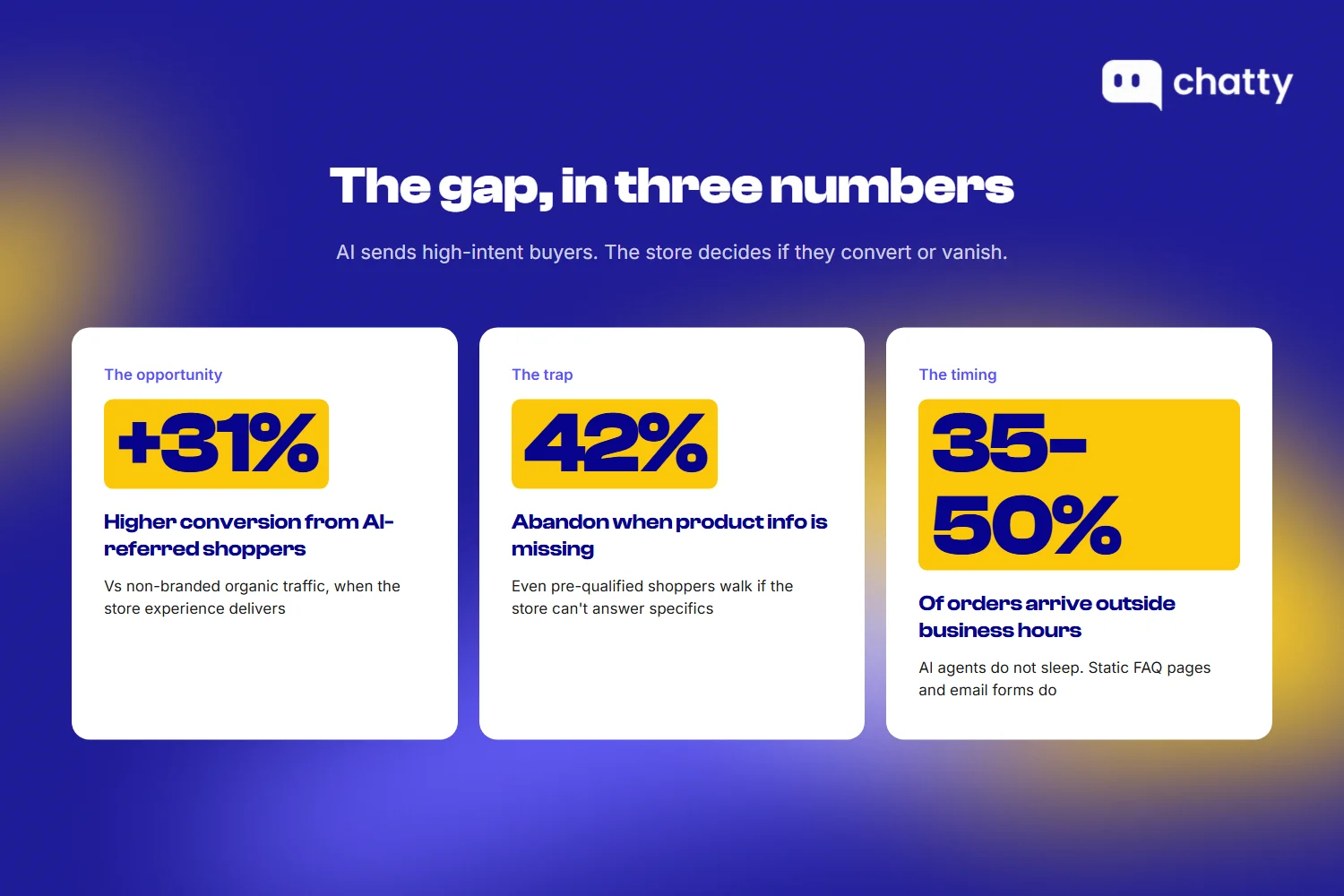
AI-referred shoppers arrive with higher intent than almost any other traffic source. They've already been filtered by an AI that researched, compared, and selected your product specifically. Adobe's holiday 2025 data shows these visitors convert 31% higher than non-branded organic.
But that conversion advantage only materializes when the store experience delivers. When it doesn't, the numbers flip:
- 42% of shoppers abandon purchases because of insufficient product information on the store
- ChatGPT can answer general questions, but not store-specific ones: real-time inventory, exact sizing for a specific body type, shipping cutoff dates, compatibility with products the shopper already owns
The AI agent that sent the shopper did its job. It found the right product, at the right price, for the right person. Then the shopper landed on a store with a static FAQ page and a "we'll get back to you in 24 hours" contact form.
What the data actually says about closing
The numbers make the gap hard to ignore.
Stores with an on-site AI Sales Agent convert chat interactions into purchases at 10.5%, which is 3.5 times the standard ecommerce conversion rate of 2 to 3%. Each conversation generates $8.40 to $14.59 in revenue for stores with $80-plus average order value. That data comes from Chatty's analysis across 4 industries and 15,600-plus conversations.
Meanwhile, AI chat increases conversion 4x compared to unassisted shopping: 12.3% versus 3.1%. Microsoft reported that shoppers using Copilot are 194% more likely to complete a purchase.
Now combine that with the traffic pattern. 35 to 50% of ecommerce orders arrive outside business hours. AI agents like ChatGPT don't sleep, so neither does the traffic they send. But most stores still rely on a contact form that promises a reply within 24 hours.
An AI agent sends a high-intent shopper to your store at 11 PM. The shopper wants to know if the supplement is safe with her existing medication, whether express shipping arrives by Friday, or which size fits her body type. Nobody answers. She leaves. You never know she visited.
That's not a hypothetical. That's the default experience on the vast majority of Shopify stores right now.
The asymmetry in plain terms
Agentic Storefronts are marketing infrastructure. They get your products in front of AI agents. That's job one: discovery.
Job two is conversion, the moment a high-intent shopper lands on your store and needs a reason to buy. That job requires an AI Sales Agent on your store, one that knows your products, answers specific questions, recommends alternatives, adds items to cart, and sends checkout links. Available at 2 AM on a Sunday. In any language.
The discovery side is built. The seller side is the gap. And it's the side you actually control.
The agentic commerce revenue checklist
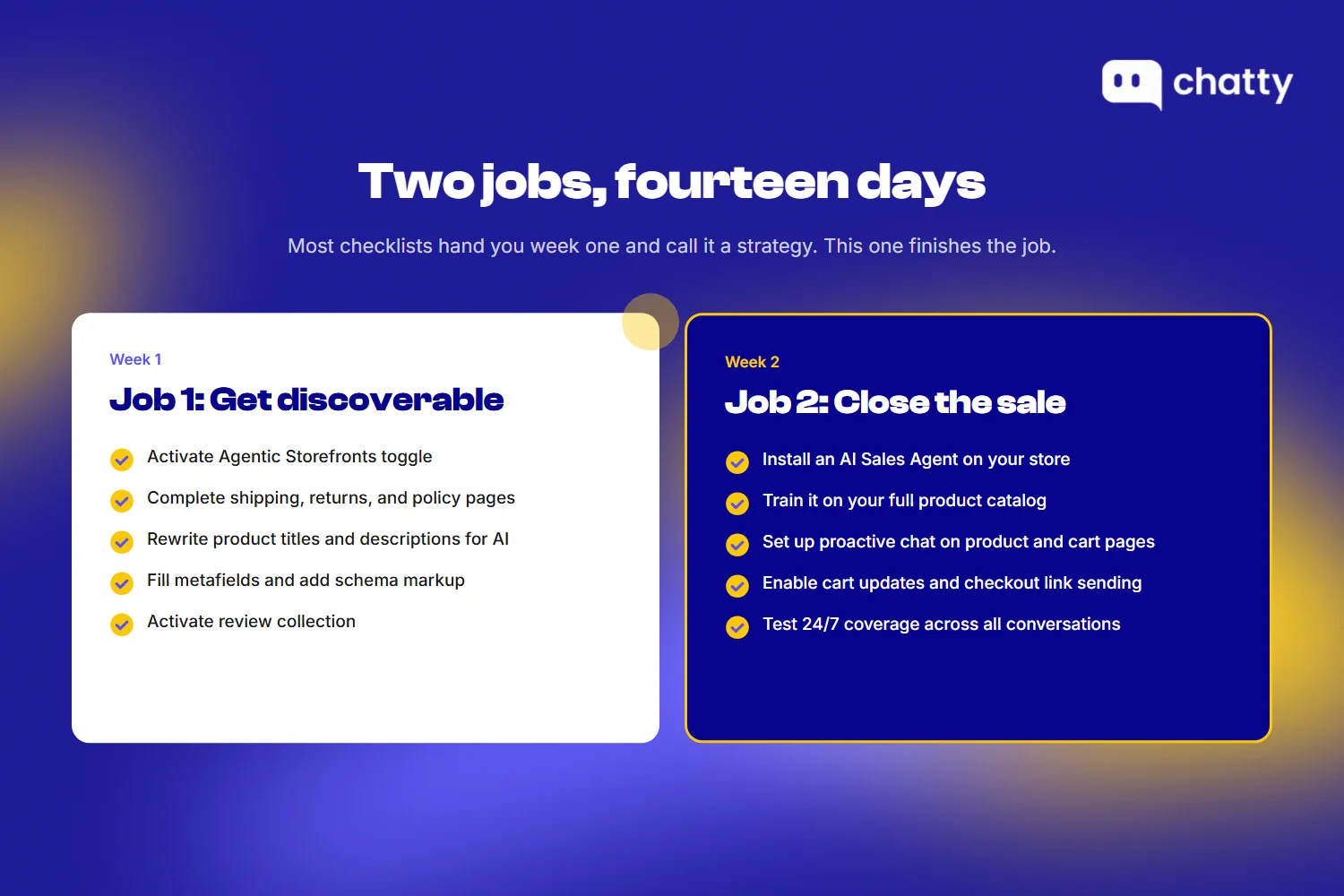
Most agentic commerce checklists hand you week one and call it a strategy. This one finishes the job: getting found, then closing the sale.
Job 1: Get discoverable (week one)
Store foundation (day one to two):
- Confirm Agentic Storefronts toggle is on: Settings, Sales channels, Agentic Storefronts
- Complete all four policies: shipping, returns, privacy, terms of service
- Enable guest checkout: Settings, Checkout, Customer accounts
- Verify your store sells to US customers
Product data (day three to seven):
- Rewrite product titles to be descriptive and natural. "Lightweight Trail Running Shoes, Waterproof, Wide Fit, Cushioned Sole" ranks. "Running Shoes 2026 New" does not.
- Lead product descriptions with facts using consistent labels: Materials, Dimensions, What's Included, Best For, Compatibility
- Fill metafields for your top 20 products: Products, select product, Metafields. Add capacity, material, care instructions, waterproof rating, compatibility
- Add schema markup (JSON-LD) to product pages: Product schema, Review schema, FAQ schema
- Ensure each variant has its own URL, price, and inventory count
- Activate review collection. Volume and quality directly influence AI ranking
Job 2: Close the sale (week two)
AI Sales Agent setup (day eight to twelve):
- Install an AI Sales Agent on your store that answers product questions 24/7
- Train it on your full product catalog: specs, variants, compatibility, sizing
- Configure product recommendations: bestsellers, new arrivals, cross-sell opportunities
- Set up proactive chat on high-intent pages: product detail pages and cart pages
- Enable cart updates so the AI can add products and send checkout links
- Test it yourself: ask the 10 questions your customers ask most. Verify the answers are accurate
Expand and refine (day thirteen onward):
- Enable multi-language support if you sell internationally
- Extend AI to email, Facebook Messenger, and Instagram DM
- Set transfer rules so conversations that need human judgment get routed with full context
- Review AI conversations weekly. Fix gaps in training data for questions the AI couldn't answer
Verify (weekly, ongoing)
- Search your top five products on ChatGPT, Perplexity, and Copilot. Are they appearing? Is the information accurate?
- Check Shopify Admin for AI channel attribution data
- Monitor revenue per conversation and chat-to-sale conversion rate
- Compare AOV from agentic channels against your site average to see if AI traffic skews higher-value
- Track the percentage of AI-driven conversations that end with a checkout link sent, your true closing rate on AI-referred shoppers
Once the checklist is running, the next question becomes: how big is this bet really worth?
The honest math on agentic commerce
The projections are massive. McKinsey estimates agentic commerce could represent $3 to $5 trillion globally by 2030. Morgan Stanley predicts nearly half of online shoppers will use AI shopping agents by 2030, accounting for 25% of their spending.
But the counterweights are real. Gartner warns that over 40% of agentic AI projects will be canceled by end of 2027 due to escalating costs and unclear ROI. AI traffic still makes up less than 0.2% of total ecommerce sessions. Of thousands of vendors claiming agentic solutions, Gartner found only about 130 actually have genuine capabilities.
Neither side is wrong. The volume is small. The trajectory is exponential.
What makes this different from most "invest now" arguments is the cost structure. Setting up the discovery side costs nothing. Your product data should be complete regardless of agentic commerce. An AI Sales Agent runs $69 per month. The entire investment to be fully agentic-commerce-ready is under $100 per month.
The potential upside is a free, high-intent traffic channel growing exponentially. The downside is $69 per month if it doesn't pan out.
That's an asymmetric bet. Small downside, large upside, and the work you do to prepare, better product data, stronger on-site experience, pays off even if agentic commerce grows slower than predicted.
Merchants who set up now will have optimized product listings, trained AI Sales Agents, and baseline data when the volume hits critical mass. That head start can't be purchased later.
Build both sides of agentic commerce, not just one
Agentic commerce isn't a single task. It's two jobs running in parallel.
Job one, discovery, is mostly solved. Shopify built Agentic Storefronts. Google and OpenAI built the AI shopping agents. Your products get surfaced to hundreds of millions of users automatically.
Job two, conversion, is wide open. When AI sends a high-intent shopper to your store, someone needs to answer the questions a static product page can't.
The entire industry is building AI that shops for customers. The merchants who win will be the ones who also build AI that sells for them.
Chatty is an AI Sales Agent built for Shopify. It answers product questions, recommends products, updates carts, and sends checkout links, 24/7, in 95-plus languages. If you're ready to build the seller side of agentic commerce, start with a free trial.