












Waiting on hold, repeating the same issue, or digging through outdated help pages quickly kills customer trust. At the same time, support teams are overwhelmed by repetitive tickets that add little value. Customers now expect answers instantly, on any channel, at any time.
AI self-service meets that expectation by turning support into a fast, intuitive experience, making it a core part of modern AI customer service. It understands intent, delivers accurate answers, and completes tasks without human intervention.
In this guide, you'll learn what AI self-service really is, how it works behind the scenes, the most impactful use cases, and practical strategies to overcome common implementation challenges and deliver scalable, always-on support.
- AI self-service takes action, not just answers, resetting passwords, tracking orders, and updating accounts autonomously.
This difference from traditional FAQ pages is fundamental: AI self-service completes the task the customer came to accomplish rather than pointing them to information and making them act on it themselves.
- Traditional self-service expects users to know how to phrase their question; AI self-service understands natural, imprecise language.
NLP-powered systems interpret intent even when requests are vague or informal, removing the friction that causes customers to abandon self-service and call a human agent instead.
- AI agents maintain context across multi-step tasks in ways basic chatbots cannot, enabling complex journey support.
Where chatbots follow predefined scripts and fail when conversations deviate, AI agents learn from outcomes over time and handle the full arc of a customer's self-service journey.
- AI self-service knows when to escalate and transfers full conversation context to human agents seamlessly.
This graceful handoff prevents the most common self-service failure mode: customers reaching a dead end and having to repeat their entire issue from the beginning to a live agent.
- Waiting on hold and repeating the same issue to multiple agents are the two experiences that most reliably destroy customer trust.
AI self-service eliminates both: instant resolution removes wait times, while context preservation across the entire journey means customers never have to explain the same problem twice.
What does AI self-service mean?
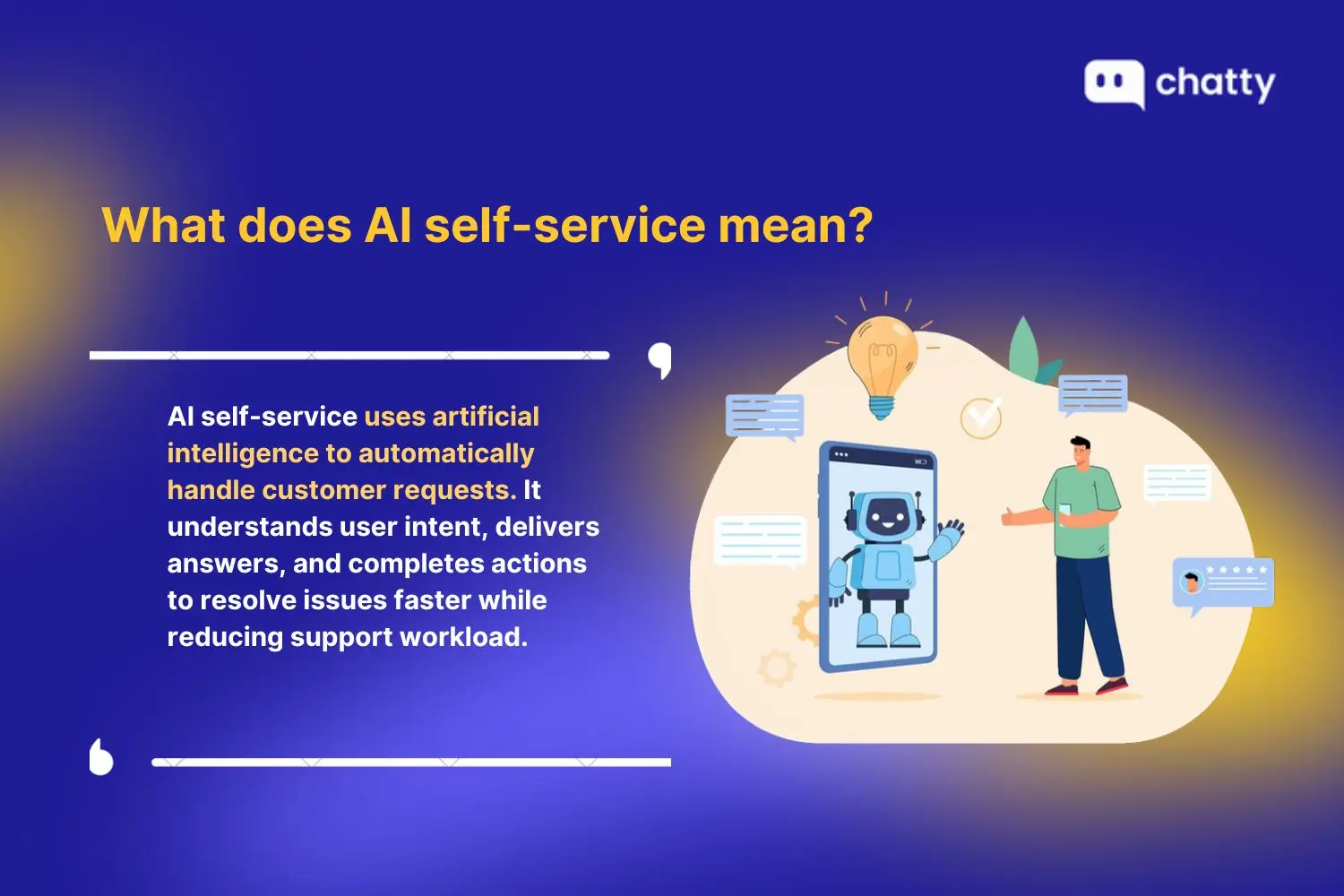
To begin, we will clarify the meaning of AI self-service and outline how it differs from traditional support experiences.
The simple definition
At its core, AI self-service uses AI to automatically handle customer requests. These tools understand what users are asking, deliver relevant answers, and often complete actions on their behalf. Common examples include chatbots, virtual assistants, intelligent knowledge bases, and automated workflows. Together, they help customers resolve issues faster while reducing pressure on support teams.
AI self-service vs. traditional self-service
Traditional self-service relies on static resources. This usually means FAQs, help articles, or basic keyword search. While useful, these tools expect users to know what to look for and how to phrase it. They do not adapt when questions change.
AI-powered self-service works differently. It understands natural language, even when questions are vague or informal. It learns from past interactions, improves responses over time, and personalizes answers based on user context. Most importantly, it can take action, such as resetting a password, tracking an order, or updating account details.
AI agents vs. chatbots: what's the difference?
Within AI self-service, chatbots and AI agents play different roles. Chatbots are often rule-based and follow predefined scripts, making them suitable for simple and repetitive questions.
AI agents build on this foundation. They maintain context across conversations, handle multi-step tasks, and learn from outcomes over time. This allows them to support more complex journeys and deliver a more seamless self-service experience from start to finish.
How does AI self-service work?
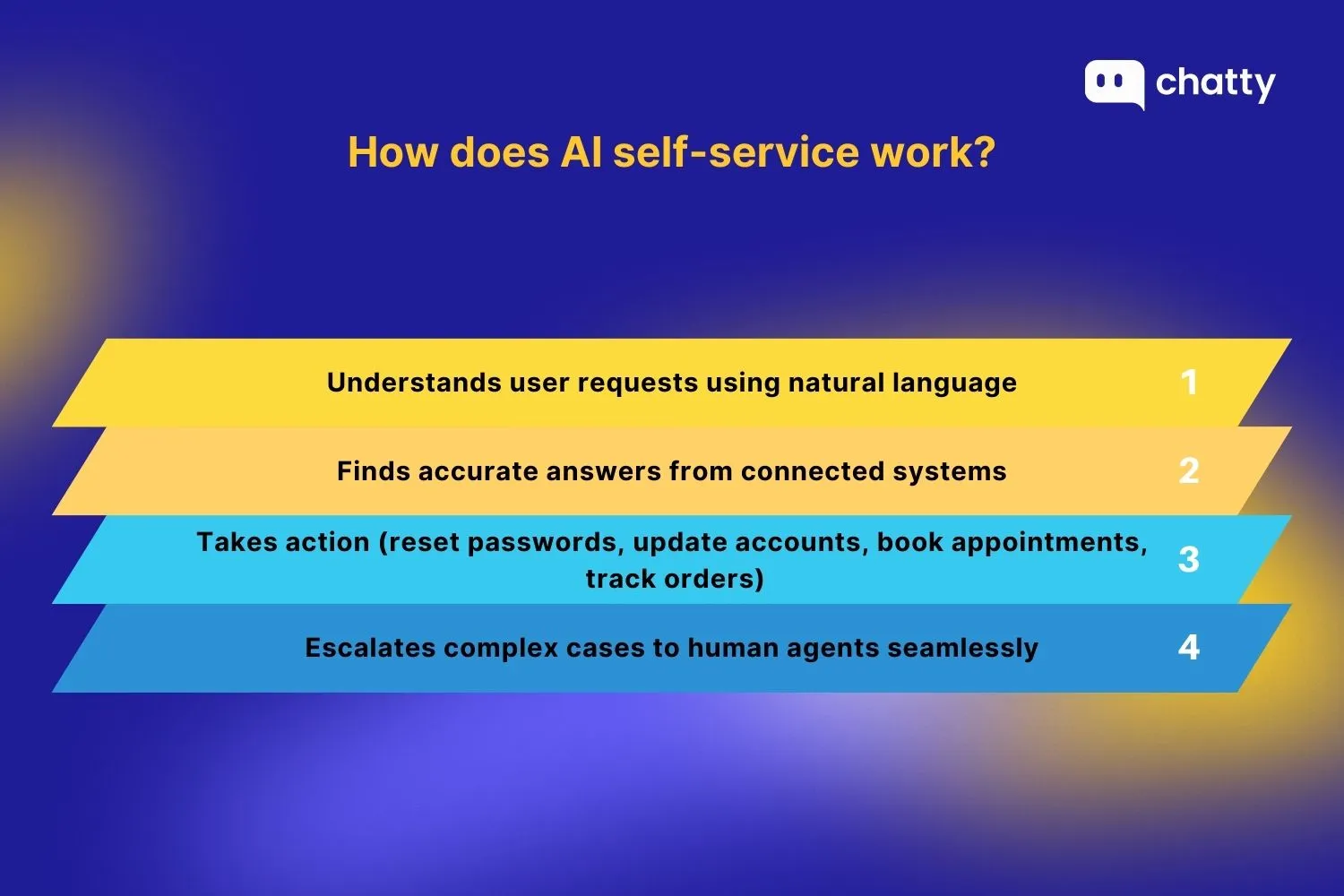
AI self-service works by handling user requests from start to finish in a smooth, connected flow. It begins by understanding the request. Using natural language processing, the system interprets what the user is asking, even if the wording is informal or incomplete. This reduces friction and avoids forcing users to follow rigid scripts.
Once the intent is clear, the system finds the right information. It searches across connected knowledge bases, FAQs, policies, or backend systems to retrieve the most relevant and up-to-date answer. The focus is accuracy and speed, not generic responses.
Next, AI self-service takes action immediately. Instead of stopping at an answer, it can complete tasks such as resetting passwords, updating account details, booking appointments, or tracking orders. This shortens resolution time and removes the need for manual follow-ups.
Finally, the system knows when to escalate. If a request is too complex, sensitive, or unclear, it seamlessly hands the conversation to a human agent with full context. This ensures users get help without having to repeat themselves.
Common types of AI self-service
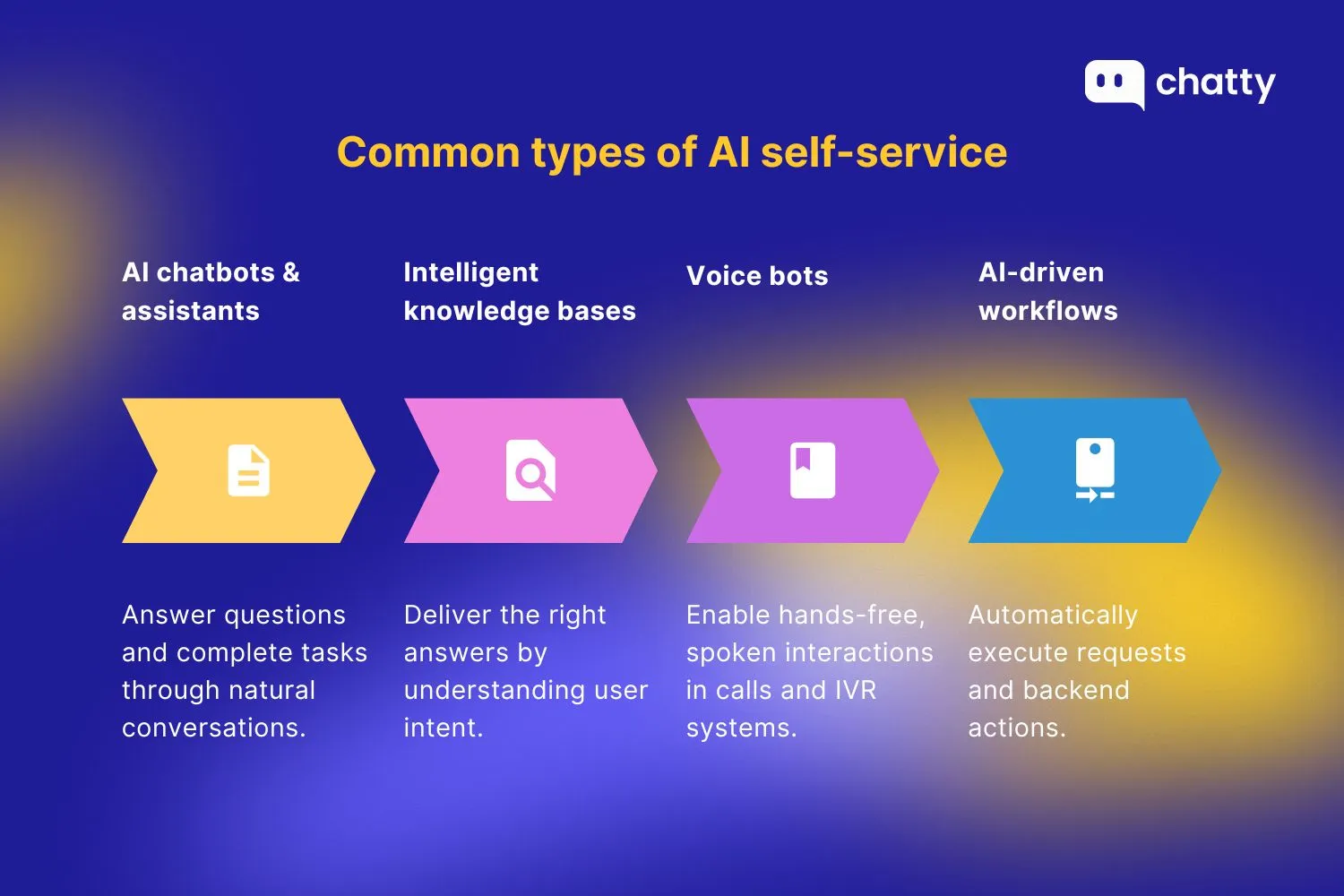
AI self-service comes in several forms, but all share the same goal: helping users solve problems quickly without human assistance. These tools often work together as part of one connected experience rather than as isolated systems.
- AI chatbots and virtual assistants are the most visible type. They interact with users through chat or messaging interfaces and handle common questions, requests, and tasks. Unlike rule-based bots, AI-powered versions understand intent, ask follow-up questions, and adapt responses based on context. This makes conversations feel more natural and efficient.
- Intelligent knowledge bases are a key component of modern customer self-service portals, delivering accurate information at the right moment. AI improves traditional search by understanding user intent rather than relying solely on keywords. It surfaces relevant articles, guides, or answers even when users do not know the exact terms to use. Over time, it also learns which content solves issues best.
- Voice bots and speech-enabled self-service allow users to interact through spoken language. These systems convert speech to text, understand intent, and respond in real time. They are commonly used in call centers, IVR systems, and hands-free environments where typing is not practical.
- AI-driven workflows move beyond answering questions to executing actions. They automate tasks such as account updates, approvals, or service requests by connecting directly to backend systems. This turns self-service into a complete resolution channel, not just a support tool.
4 essential AI self-service use cases
The following use cases demonstrate how organizations can leverage AI to reduce effort, accelerate resolution, and improve the user experience across customer-facing and internal workflows.
Customer support
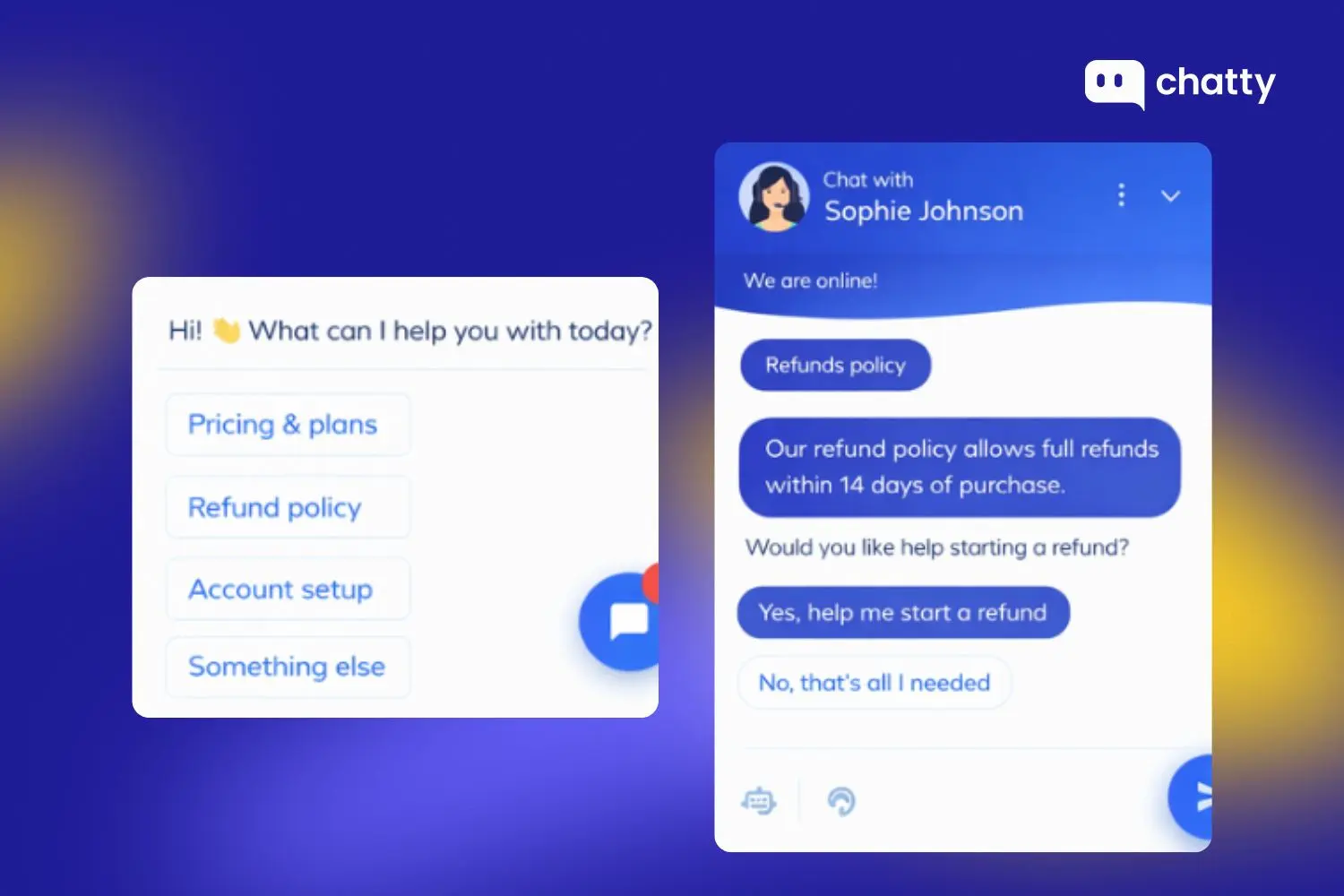
Customer support is the most widely adopted AI self-service use case because many customer questions are repetitive and time-sensitive. AI can deliver instant answers to FAQs on pricing, shipping times, and return policies at any time. For example, when a customer asks, "Where is my order?", the system can pull live order data and provide order tracking or return options without involving an agent.
AI also handles password resets and account questions by guiding users through secure verification steps. In practice, solutions like Chatty enable customers to move from a simple question to a completed task in a single conversation, reducing wait times and support tickets.
E-commerce & sales support
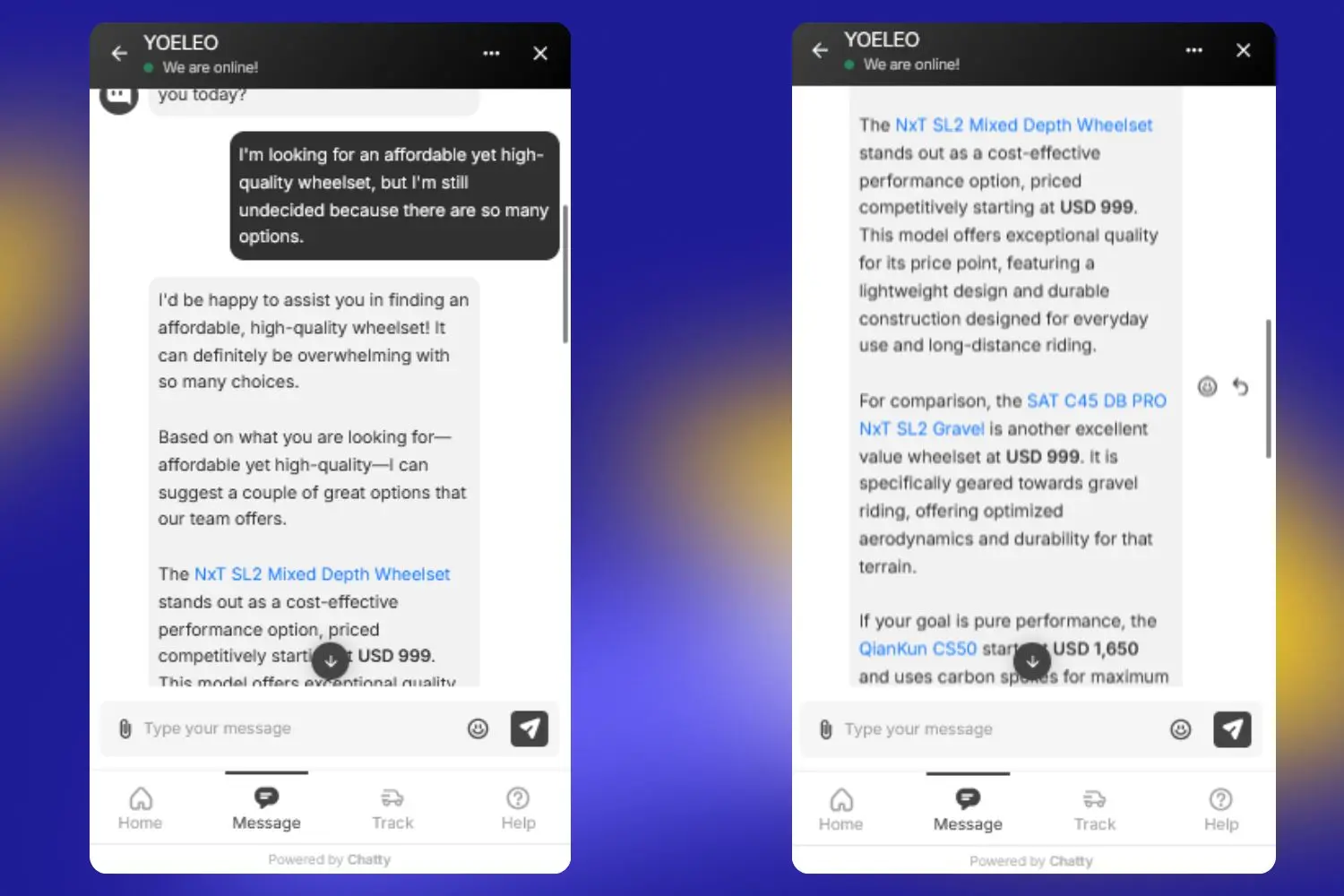
In e-commerce, AI self-service supports customers throughout the buying journey. Through product recommendations and guided help, AI asks a few clarifying questions about needs, budget, or use case, then suggests suitable products. For example, a shopper looking for a laptop may receive recommendations based on performance needs and price range.
AI can also answer pre-purchase questions such as availability, compatibility, or delivery options in real time. This reduces decision friction and helps customers feel confident before checkout.
Business operations
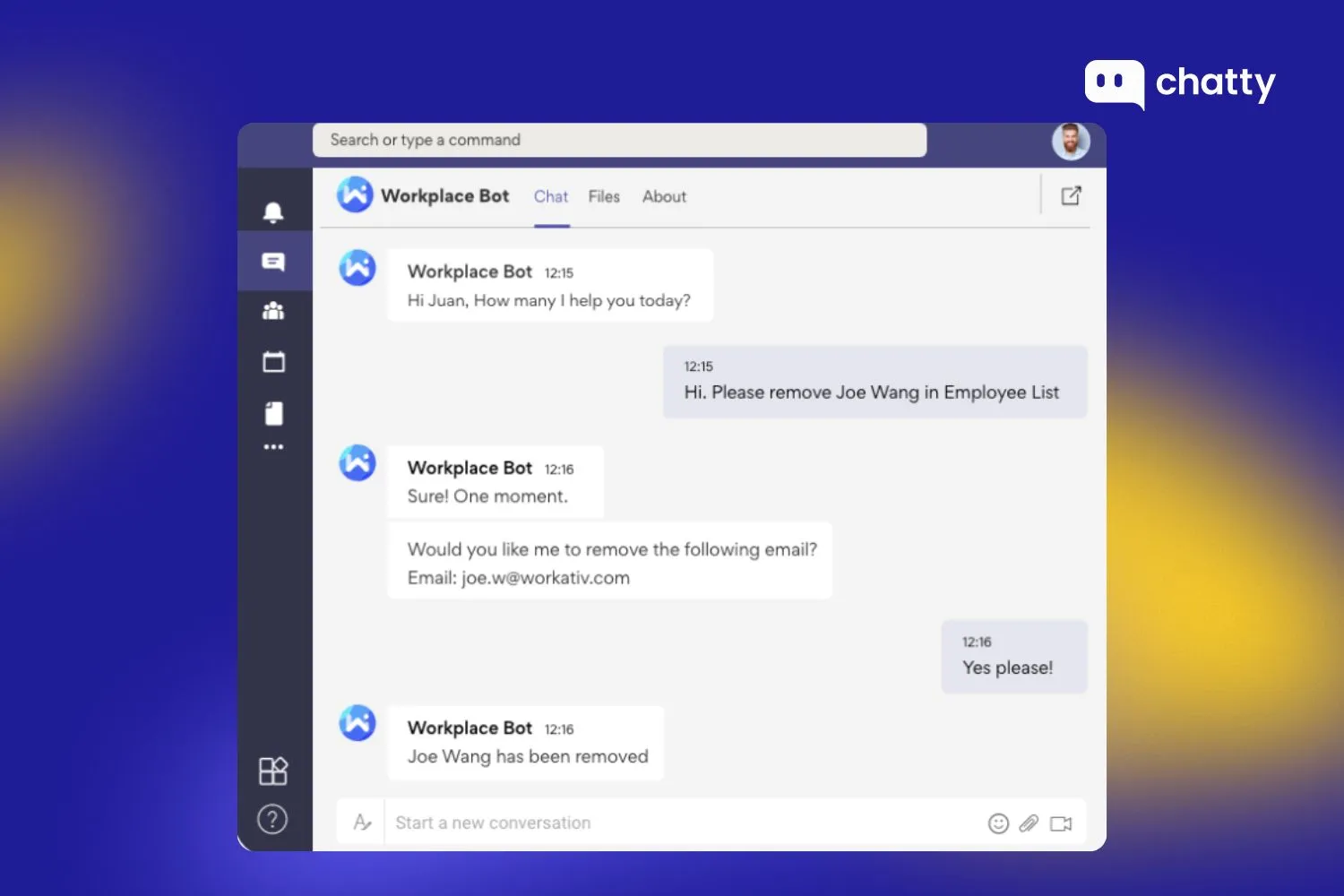
AI self-service also improves internal efficiency. In many organizations, especially SaaS and enterprise companies, AI-powered tools form the foundation of an effective B2B self-service portal. Internal employee self-service enables staff to find HR information, submit leave requests, or check company policies without contacting HR teams. At the same time, IT support automation resolves common technical issues such as software access, device setup, or basic troubleshooting. For example, an employee can request system access or reset a work password through AI, avoiding delays and manual tickets.
Omni-channel support
Modern users interact across multiple touchpoints. By integrating web, mobile, messaging, and voice AI self-service, organizations ensure a consistent experience across channels. A conversation that starts on a website can continue in a messaging app or voice system without losing context, leading to faster resolution and higher user satisfaction.
Key benefits of AI self-service
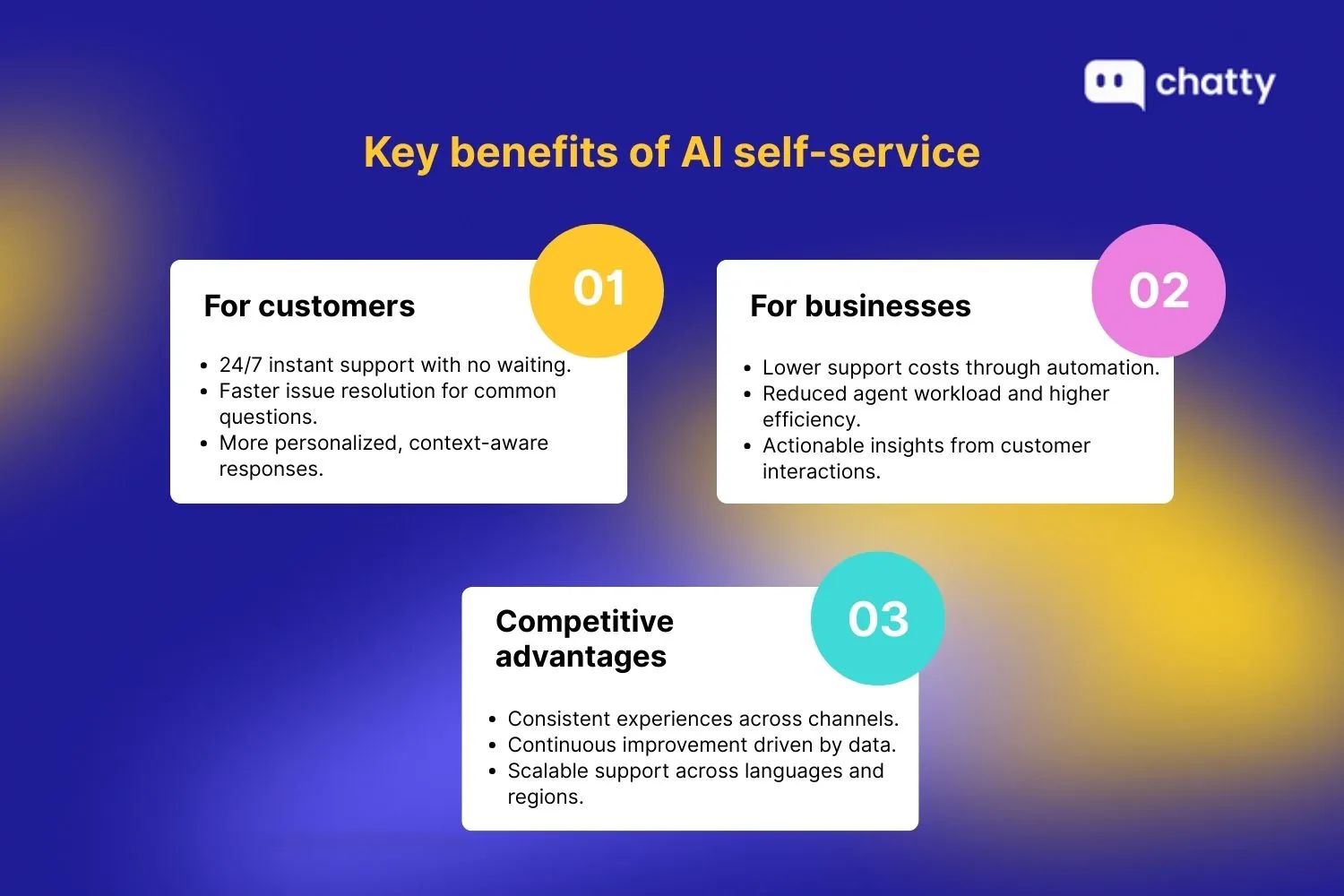
AI self-service delivers value on both sides of the interaction. When well-designed, it improves users' everyday experiences while helping organizations operate more efficiently and competitively.
For customers
For customers, the most obvious benefit is 24/7 instant access to support. Around 50% of companies report that AI provides always-on support without extra staffing costs. Many customers receive responses in seconds rather than hours compared with traditional queues. Studies show that AI tools handle up to 80% of routine customer queries without human intervention, and 80% of customers who have used AI for support report positive experiences.
By reducing wait times and resolving common issues quickly, AI lowers frustration and increases the likelihood of repeat use. AI also supports personalized interactions by tailoring responses based on context, history, or preferences, which feels more helpful than generic replies.
For businesses
For businesses, AI self-service reduces costs while improving efficiency. Research shows companies can lower support costs by 20 – 30% or more through automation. Many organizations report that up to 80% of routine inquiries are resolved automatically, allowing agents to focus on complex or sensitive cases. This reduces contact center workload and supports growth without adding staff. AI also provides insights from interaction analytics. Teams can identify common issues and content gaps, then improve products, knowledge bases, and workflows over time.
Competitive advantages
Beyond efficiency, AI self-service creates clear competitive advantages. It ensures a consistent experience across channels and touchpoints, reducing confusion and brand inconsistency. Through data-driven optimization, organizations can continuously refine responses, workflows, and journeys based on real user behavior. Finally, AI self-service supports global audiences by handling multiple languages and time zones, helping businesses serve customers worldwide without building large regional support teams.
Measuring success in AI self-service
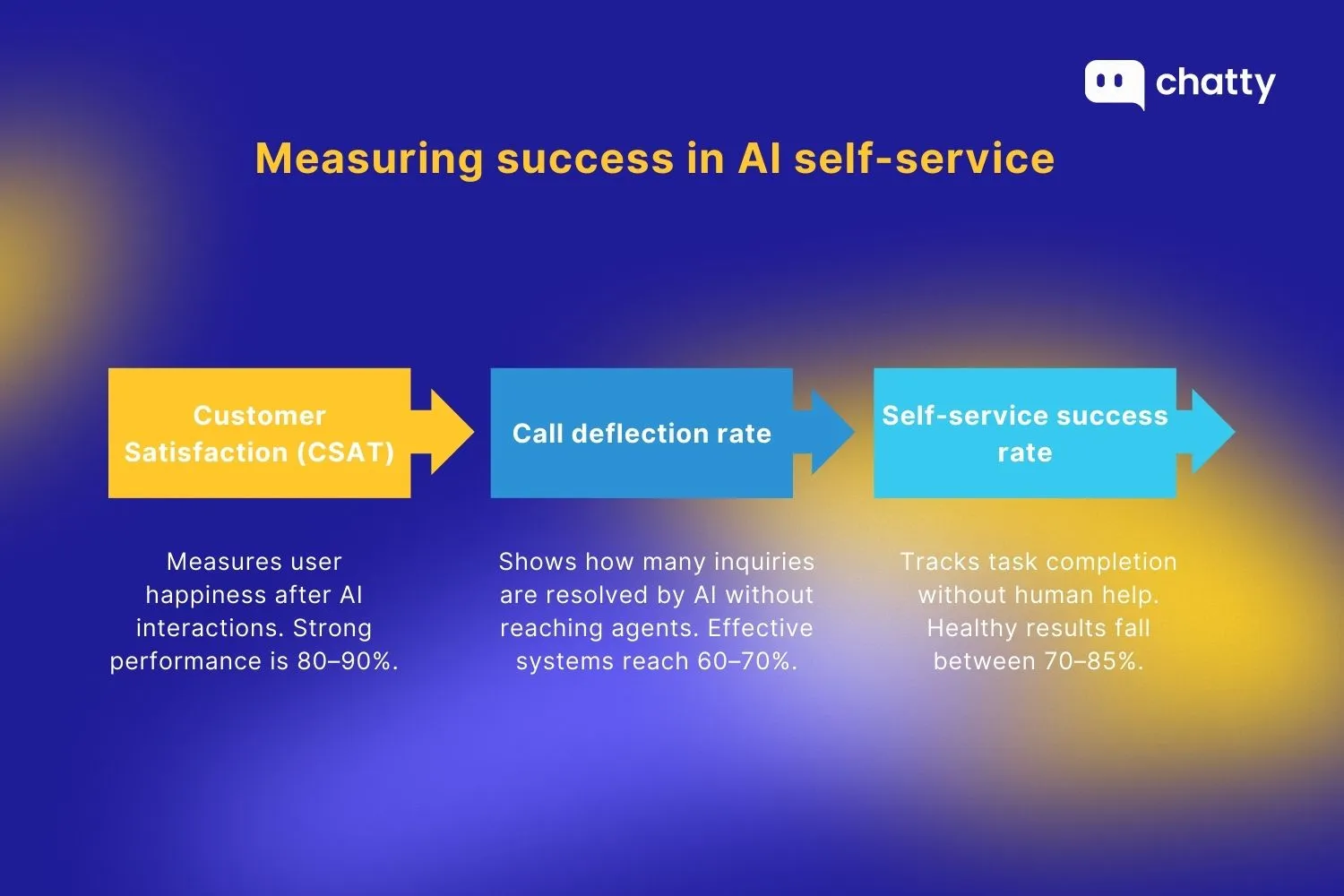
Measuring success in AI self-service helps you understand whether your chatbot or virtual assistant is truly improving the customer experience and reducing support workload. Instead of relying on guesswork, you can track a few clear metrics that show how well your system performs in real situations. The goal is to ensure customers can quickly solve their problems without frustration while keeping operations efficient.
Three key metrics are especially useful for evaluating AI self-service performance:
- Customer Satisfaction (CSAT): This measures how happy users are after interacting with your AI. Scores are usually collected on a 1–5 scale or converted into percentages. 80–90% is considered strong for AI self-service. Anything below 70% suggests friction, unclear responses, or incomplete solutions.
- Call Deflection Rate: This shows how many customer inquiries are handled by AI rather than being passed to human agents. A higher deflection rate (60–70%) means your self-service tools are effectively answering common questions and reducing support costs.
- Self-Service Success Rate: This tracks how often users complete their tasks without needing human help. A strong success rate (70–85%) indicates that customers can easily navigate the system and find what they need. Rates below 65% often mean users struggle with navigation, wording, or missing information.
Beyond tracking numbers, it's important to analyze patterns and continuously improve performance. Segmenting data by customer type or issue category helps reveal common pain points. A/B testing different chatbot flows can uncover which approaches work best. Integrating AI data with your CRM system provides a complete view of customer interactions.
Use insights to optimize your AI system through regular content updates, personalized responses, and ongoing training. This ensures your AI self-service remains accurate, relevant, and easy to use, leading to better customer experiences and higher overall efficiency.
How to build your AI self-service strategy?
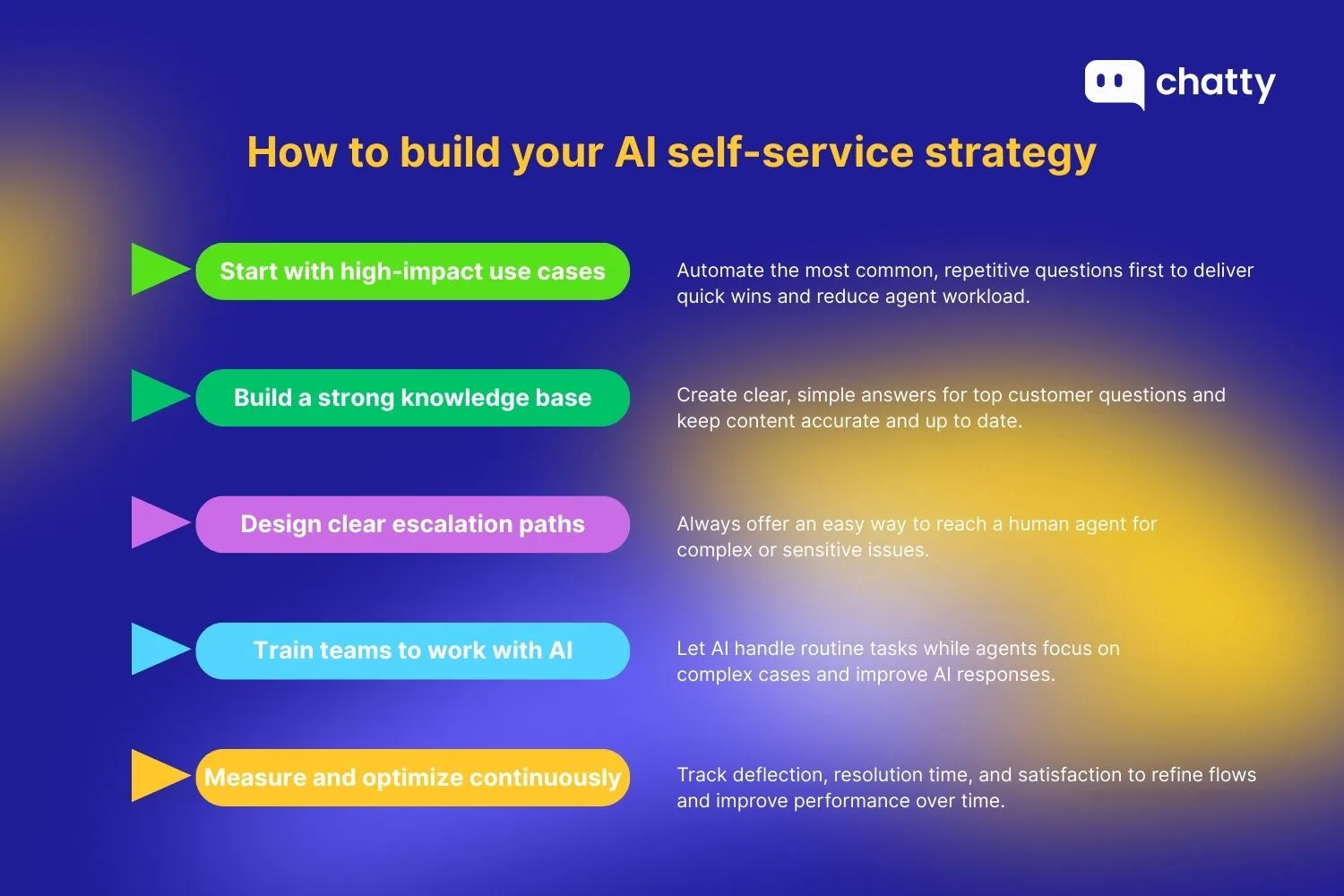
To turn this strategy into real results, follow the practical steps below to build an AI self-service system that works for both your customers and your team.
Start with your highest-impact use cases
Start by identifying two or three repetitive tasks that consume the most of the agent's time. Review support tickets, chat logs, and call transcripts to find frequent, predictable questions. Typical examples include order tracking, password resets, account updates, shipping questions, and basic product or pricing information. These use cases are ideal because they are simple, common, and easy to automate.
Automate only these first to launch quickly, reduce risk, and test performance. Early success delivers instant support, frees agents, and builds confidence for future growth.
Build a strong knowledge base
AI can only provide accurate answers if the information it relies on is clear and reliable. Start by listing your top 50–100 customer questions. Write short, direct answers using simple language. Avoid long explanations, technical terms, and internal jargon.
Best practices:
- Use short sentences and step-by-step instructions
- Add screenshots or examples when helpful
- Update content whenever policies, pricing, or processes change
- Assign ownership so someone is responsible for keeping information accurate
Design clear escalation paths
Not every customer issue should be handled by AI, so always offer a clear option to reach a human agent. This is critical for urgent, complex, or emotional cases such as payment failures, refunds, complaints, technical issues, or account security concerns. Easy access to human support builds trust and reduces frustration.
Ensure smooth handoffs by passing along chat history, customer details, and prior actions to agents, so issues are understood quickly, resolved faster, and customer satisfaction improves for both customers and support teams.
Train your team to work alongside AI
AI works best when your team knows how to use it effectively. Train agents to handle complex, sensitive situations while AI manages repetitive tasks. Teach agents to review and edit AI-suggested replies, correct wrong answers, and flag gaps in knowledge. Encourage feedback on unclear customer questions. When agents notice frequent gaps, they should report them so the knowledge base is updated. This creates a feedback loop where humans continuously improve AI performance.
Measure, learn, and optimize continuously
Tracking the right metrics helps you understand whether your AI is delivering real value. Focus on three main areas: deflection rate, resolution time, and customer satisfaction.
- If deflection is low, improve training data and add missing answers.
- If resolution time is high, simplify workflows and escalation rules.
- If satisfaction is low, review conversations to fix unclear or incorrect replies.
Use this data to find gaps, update content, and refine AI behavior. Regular improvements ensure your AI self-service system becomes smarter and more helpful over time.
Common challenges when implementing and how to overcome them
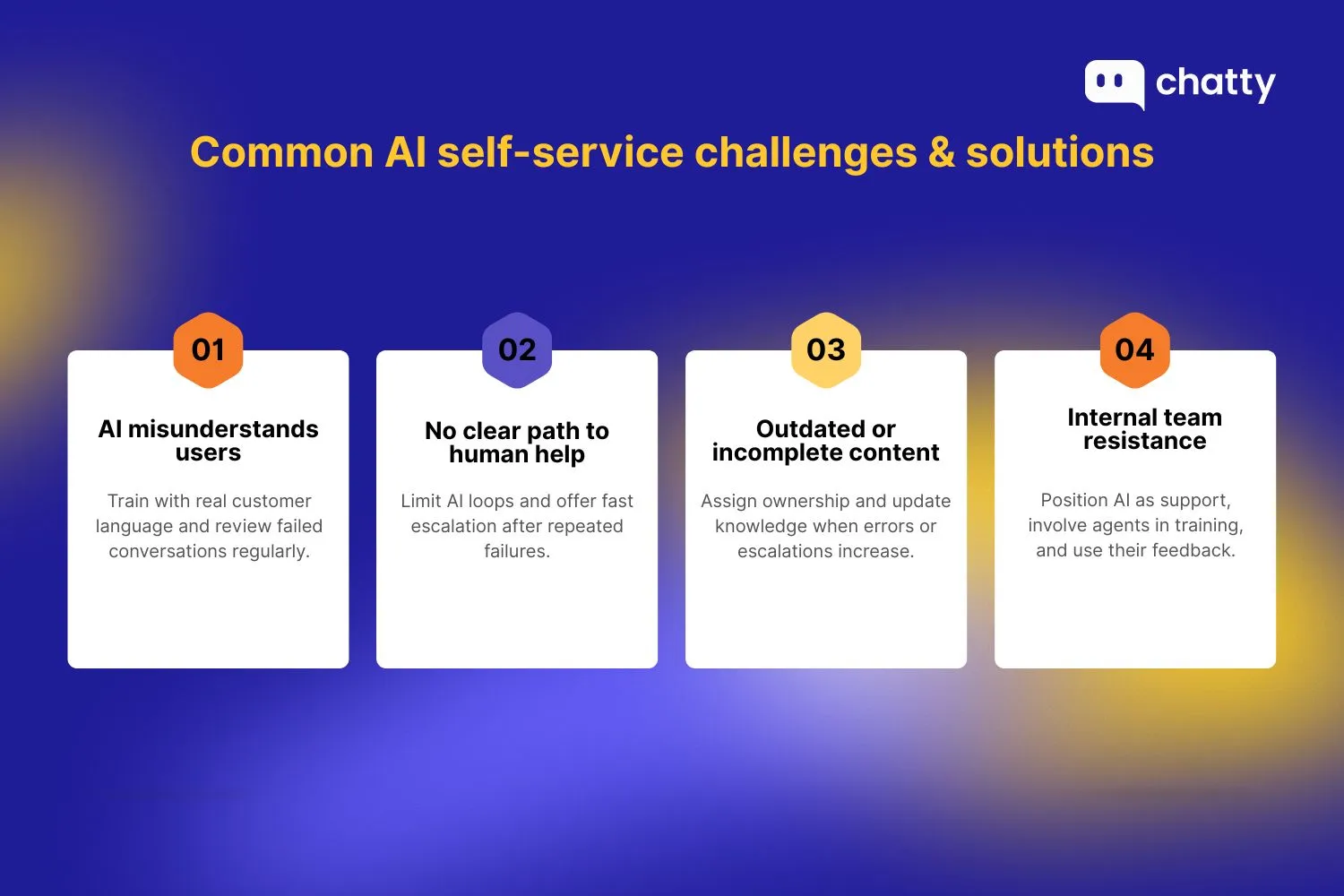
While AI self-service offers many benefits, teams often face common challenges. Addressing them early helps improve performance and customer experience.
AI that doesn't understand customers
One common problem is that AI misunderstands customer questions. This often happens when the system is trained using formal or internal language that does not match how customers actually speak. To fix this, train AI using real customer conversations, chat logs, and support tickets. This helps it recognize natural phrases, slang, and incomplete questions.
Regularly review failed conversations to identify patterns. If users frequently rephrase the same question, your intent recognition needs improvement. Add new examples and refine the training data weekly or monthly to continuously improve accuracy and reduce confusion.
Frustrating loops with no human option
Customers quickly lose trust when they get stuck in repetitive loops without a way to reach a human. Always provide a clear option to speak with an agent, especially after two or three failed attempts.
Limit how many times the AI can ask for clarification. If the system still cannot understand the request, automatically trigger escalation. This prevents frustration, reduces churn, and shows customers that support is always available when they need it.
Outdated or incomplete knowledge
AI can only perform well if its information is accurate and up to date. Outdated content leads to wrong answers, poor experiences, and increased complaints. Assign clear ownership for maintaining knowledge articles, policies, and product updates.
Set up alerts when AI frequently fails or escalates on the same topic. This is a strong signal that content needs improvement. Regular updates ensure your AI stays relevant, accurate, and trustworthy.
Internal resistance from support teams
Some agents may fear that AI will replace their jobs. To overcome this, position AI as a support tool that reduces repetitive work, not as a replacement. Show how AI helps them focus on complex cases, improve productivity, and reduce stress.
Involve agents in training, testing, and feedback. Their frontline experience helps improve AI accuracy and builds a sense of ownership. When teams see AI making their work easier, adoption increases, and resistance decreases.
Future trends in AI self-service
AI self-service is evolving quickly, driven by advances in generative AI and automation. In the coming years, businesses can expect smarter systems that deliver faster, more natural, and more personalized customer support.
- More human-like interactions: Advances in generative AI are making conversations feel more natural, accurate, and helpful. AI can better understand context, tone, and intent, enabling customers to communicate in their own words rather than using fixed commands. This reduces misunderstandings, shortens conversations, and improves overall satisfaction.
- Complex task automation: AI is expanding beyond simple question answering to handle multi-step tasks such as refunds, booking changes, troubleshooting, and guided problem resolution. This reduces manual effort, speeds up issue resolution, and ensures consistent service quality across support channels, even during peak demand.
- Multimodal and cross-channel support: Future AI systems will support text, voice, and visual input across chat, phone, apps, and websites. Customers can upload images, speak naturally, or switch between channels without losing context. This flexibility improves accessibility and creates smoother, more convenient support experiences.
- Predictive and proactive support: AI will increasingly predict customer needs before problems occur by analyzing usage patterns and behavior. It can send reminders, alerts, and helpful tips to prevent issues, reduce support volume, and improve satisfaction. Proactive support helps businesses shift from reactive problem-solving to preventive measures, creating stronger customer relationships and long-term loyalty.
Final thought
AI self-service is reshaping how businesses deliver support at scale. When done right, it removes friction for customers while freeing teams to focus on complex, high-value interactions. The real impact comes from choosing the right use cases, keeping knowledge up to date, and ensuring seamless handoffs to human agents.
While challenges like poor understanding or outdated content can slow adoption, they are manageable with the right approach. As AI capabilities continue to advance, companies that invest in thoughtful, customer-centric self-service today will gain a lasting advantage tomorrow.
FAQ
AI self-service platforms use conversational AI, natural language processing, and machine learning to understand user intent. When a customer asks a question or requests an action, the system identifies the intent, retrieves the right information from backend systems via APIs, and responds or completes the task in real time.
Yes. AI self-service portals use encryption, secure authentication, and access controls to protect sensitive data. They are regularly tested and designed to comply with industry standards and regulations such as GDPR, ensuring customer information is handled safely and responsibly at all times.
AI-powered self-service can manage complex, multi-step conversations using advanced NLP and machine learning. It can access multiple systems and databases when needed. For highly specialized or sensitive issues, the AI seamlessly escalates the conversation to a human agent with full context.