












By 2030, AI is expected to handle up to 80% of customer interactions – a staggering figure that signals a significant upcoming shift. This means the customer experience will be shaped predominantly by intelligent systems. The role of AI in sales is no longer just about back-end support; it’s becoming the face of your brand. Let’s explore how to prepare for the future, starting now.
This article takes the strategic lens: how AI is redefining the sales function, team structure, and workflow. If you want the tactical companion with concrete use cases and ROI metrics for each, read proven AI use cases in sales that boost AOV, CVR, and LTV.
- By 2030, AI will handle up to 80% of all customer interactions. This means intelligent systems, not human reps, will increasingly define how buyers experience your brand.
- 61% of B2B buyers now prefer a sales experience with no rep involved. Self-directed buyer journeys are shrinking traditional sales influence, forcing teams to adapt or lose relevance entirely.
- Sales reps spend only 28% of their week actually selling anything. The remaining time disappears into CRM updates, data entry, and follow-ups that AI can automate instantly.
- Nearly a quarter of CRM managers say most of their data is simply wrong. Inaccurate data makes pipeline forecasts unreliable and causes high-value opportunities to go unnoticed or unprioritized.
- Sales teams using AI report revenue growth at a dramatically higher rate. Salesforce found 83% of AI-powered teams saw revenue gains, compared to just 66% of teams without AI tools.
The old sales model is breaking down
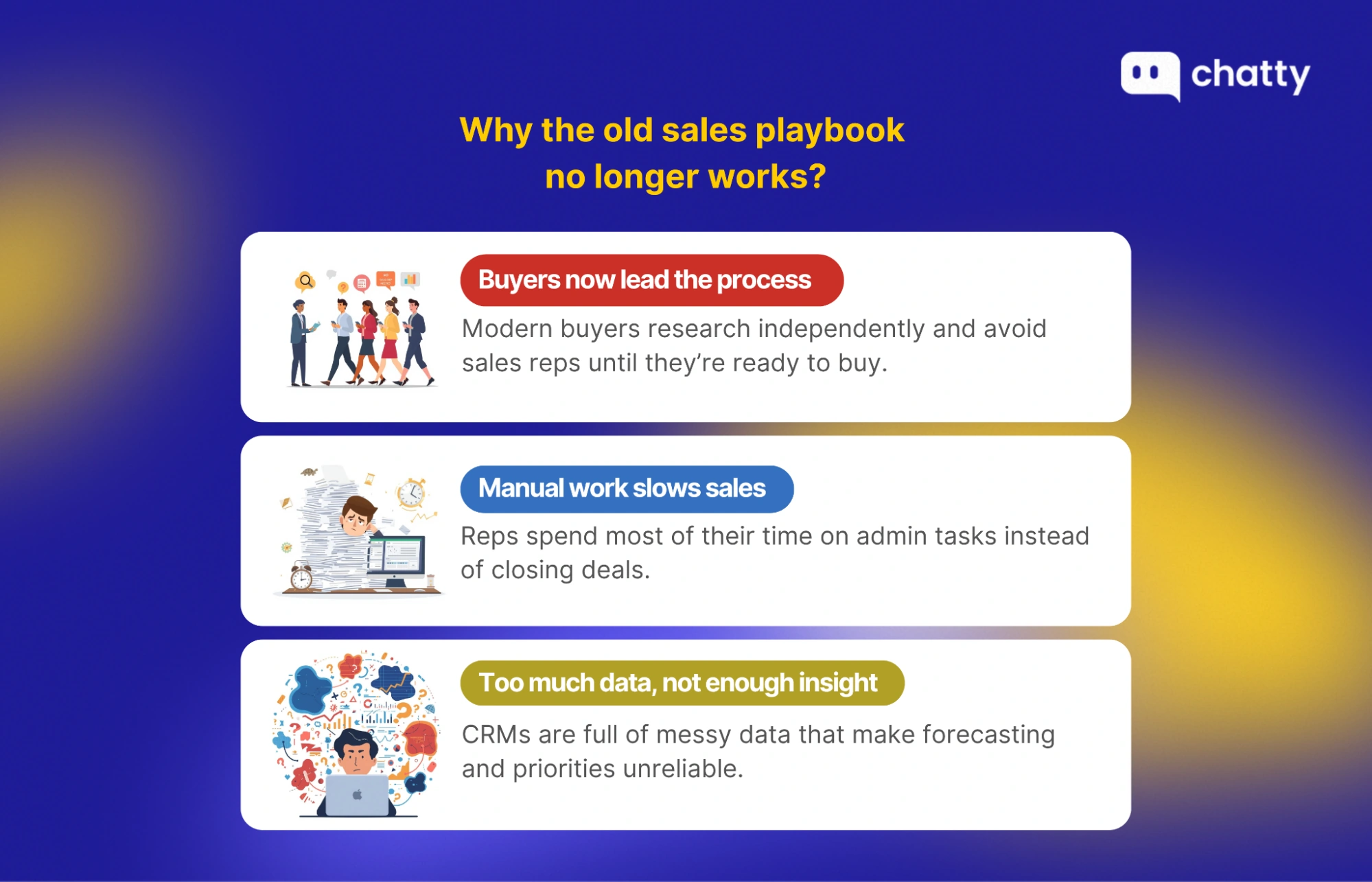
1. Buyers now lead the process.
In the past, sales reps guided customers through every step. Today, buyers research independently, compare options online, and often avoid talking to sales until they are ready to decide.
A 2024 Gartner survey showed that 61% of B2B buyers prefer a rep-free experience. This shift means sales teams have less influence and must adapt to faster, self-directed buyer journeys.
2. Manual work holds sales back.
Reps are still buried in admin tasks. According to HubSpot’s 2024 Sales Report, they spend only 28% of their week actually selling, while the rest goes to updating CRMs, sending follow-ups, or entering data. Manual work slows everything down and increases mistakes, especially when hundreds of leads move through the pipeline each month.
3. Too much data, not enough insight.
CRMs collect massive amounts of data, but much of it is incomplete or unreliable. Around 24% of CRM managers say less than half of their data is accurate, which makes forecasts uncertain and opportunities hard to prioritize.
As we see, the traditional model built on intuition, manual tracking, and static data no longer fits today’s complex buying environment. Sales teams need intelligent systems that process data, predict intent, and guide action in real time. That is why AI is becoming essential, not optional.
The rise of intelligent selling
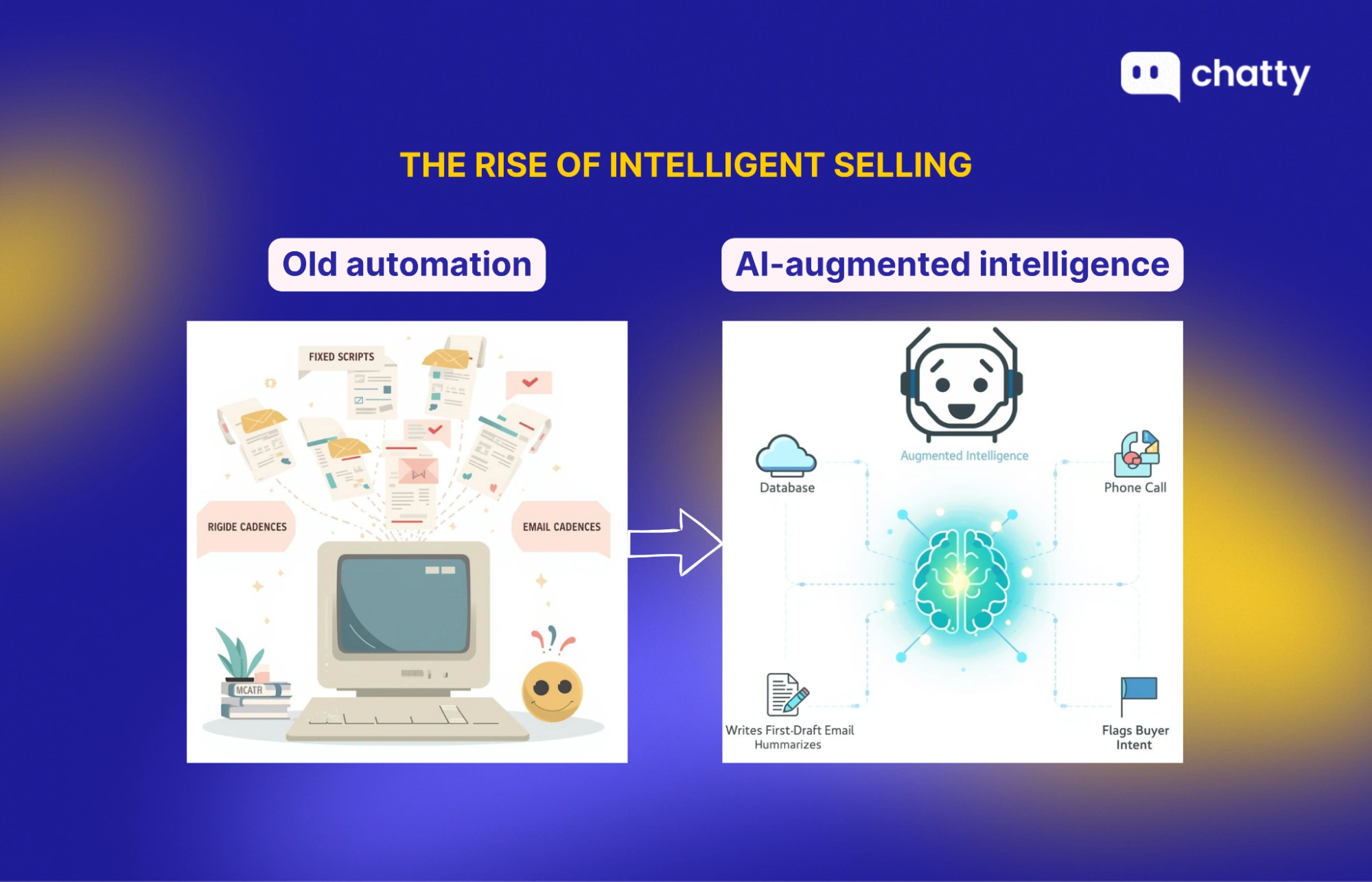
Sales is moving from fixed automation to real intelligence. Old tools sent the same scripts and rigid email cadences. New systems read context from CRM, calls, and product usage, then predict who is ready, what to say, and when to engage. This shift is already visible. In 2024, 65% of companies reported regular use of generative AI in at least one function, and sales is one of the top adopters.
AI-augmented sales teams mix human empathy with machine precision. Reps stay focused on discovery, trust, and negotiation while AI handles the heavy lifting in the background. Teams using AI report real gains. Salesforce found that 81% of sales teams are experimenting with or have implemented AI tools, and 83% of teams using AI saw revenue growth compared with 66% of teams without AI.
Generative AI now writes first-draft emails, summarizes calls, and flags buyer intent across channels. These AI sales assistants save time that reps can reinvest in live conversations. HubSpot reports that sales pros using AI for admin work save about 2 hours per day, which directly increases selling time and follow-up speed.
Put simply, intelligent selling upgrades every step of the cycle. Data becomes guidance, activity becomes timing, and conversations feel personal at scale. The result is a team that moves faster, wastes fewer touches, and shows up with the right message at the right moment. For the full list of tactical applications that drive these gains, see our guide to AI use cases in sales.
AI in sales: market landscape and adoption trends
Understanding where AI stands across the sales function today helps frame how fast teams must move. The following trends outline the macro picture, who is adopting what, and which capabilities are moving from experimental to standard.
Adoption is no longer optional
AI has crossed the chasm from early adopters to the mainstream sales function. Gartner forecasts that by 2028, 60% of B2B sales organizations will shift from intuition-based to data-driven selling, unifying sales processes, data, and analytics under AI. Among enterprise sales leaders, Salesforce reports 83% of AI-powered teams grew revenue in 2024, compared with just 66% of non-AI teams — a gap that is compounding quarter over quarter.
Where the investment is flowing
AI budgets in sales are concentrating around three capabilities, in this order of maturity:
- Conversational AI and assistants: the most deployed category, with buyer comfort now mainstream — AI-powered chat influenced $229 billion of global online sales in the 2024 holiday season alone.
- Pipeline and forecast intelligence: the fastest-growing category, driven by CRO demand for deal-level risk scoring rather than quarter-end guesses.
- Agentic selling (autonomous AI reps): still early but accelerating — vendors like Salesforce Agentforce, HubSpot Breeze, and Microsoft Copilot are shipping autonomous agents that qualify leads, book meetings, and draft proposals without human intervention.
The talent and org-design shift
AI adoption is reshaping sales team structure, not just tooling. Three patterns are emerging across high-performing B2B orgs:
- Flatter teams, deeper specialization: Companies are retiring pure SDR roles where AI can qualify inbound, while investing in senior sellers who handle complex negotiation and multi-threaded accounts.
- Rise of the RevOps + AI role: A new function pairs RevOps leaders with AI engineers to own data quality, model tuning, and workflow orchestration across CRM, marketing automation, and CS systems.
- Sales managers as AI conductors: Instead of inspecting every deal, managers curate the signals AI watches, set guardrails, and coach on the exceptions the system flags.
What is coming next: 3 predictions for 2026 and beyond
- Autonomous SDRs will become the default for inbound qualification. By the end of 2026, most mid-market B2B companies will route inbound leads to AI agents by default, with human SDRs reserved for enterprise tiers and strategic outreach.
- Forecasting accuracy becomes a board-level KPI. CFOs will push CROs to report forecast accuracy delta (AI vs manager commit) each quarter, with ±5% accuracy becoming table stakes for public SaaS companies.
- Buyer-side AI will change rep workflows. As enterprise buyers deploy their own AI agents to evaluate vendors, sellers will need to produce machine-readable product specs, ROI calculators, and compliance documentation — not just human-readable pitch decks.
The takeaway: the strategic question for sales leaders is no longer whether to adopt AI, but which capabilities to sequence, how to restructure teams around them, and how to stay ahead of the buyer-side AI wave reshaping the other end of the funnel. For the tactical playbook of specific AI use cases and the revenue metrics they move, see our guide to AI use cases in sales.
Different forms of AI used in sales operations
There are 3 main types of AI that help sales teams work smarter:
1) Natural language processing (NLP)
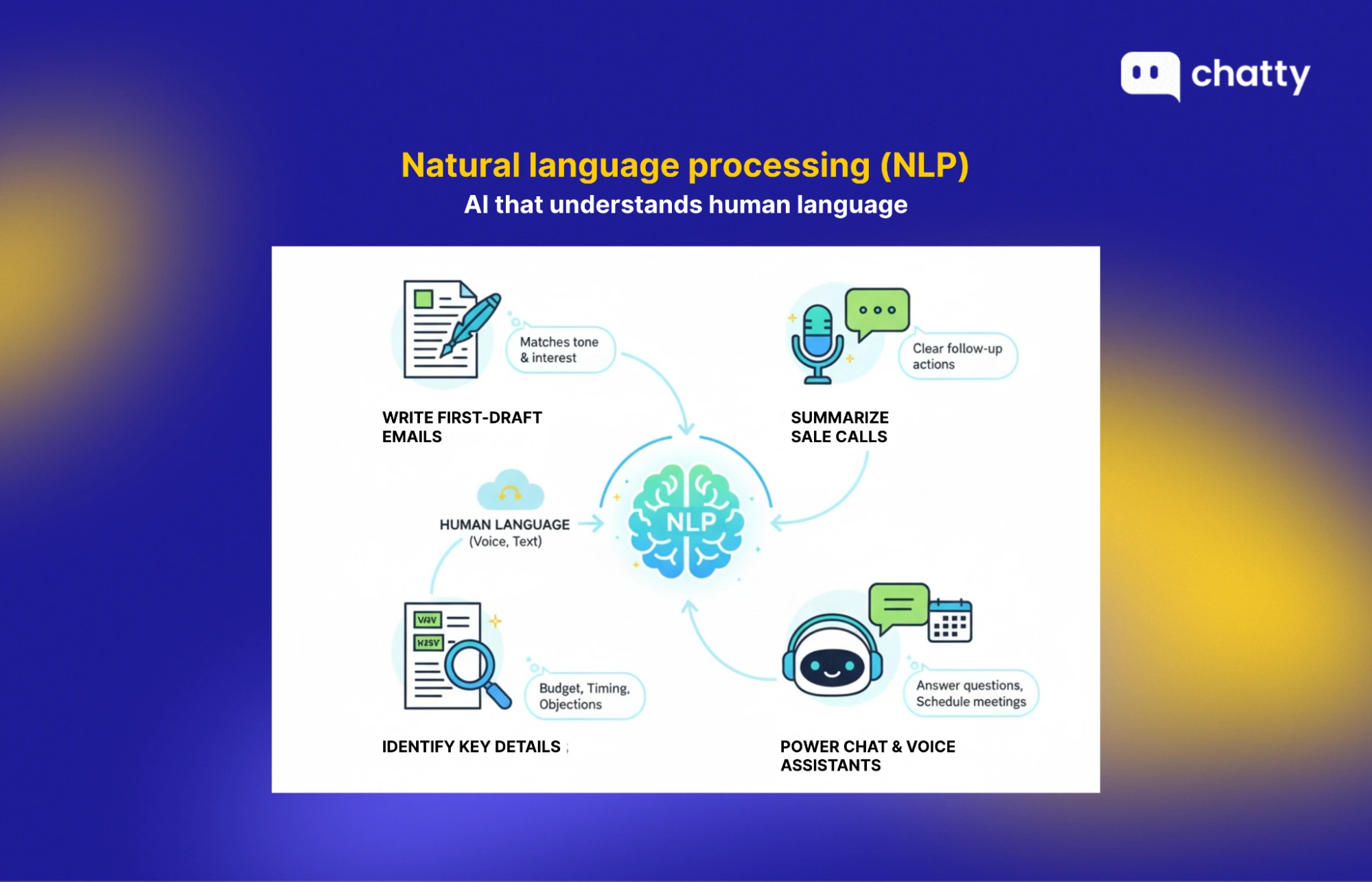
Natural language processing (NLP) allows software to understand and use human language. It helps sales teams save time and capture key insights without manual note-taking. For example, NLP can:
- Write first-draft emails that match each buyer’s tone and interest
- Summarize sales calls into clear follow-up actions
- Identify useful details such as budget, timing, and objections from meeting transcripts
It also powers chat and voice assistants that answer questions or schedule meetings automatically.
2) AI analytics
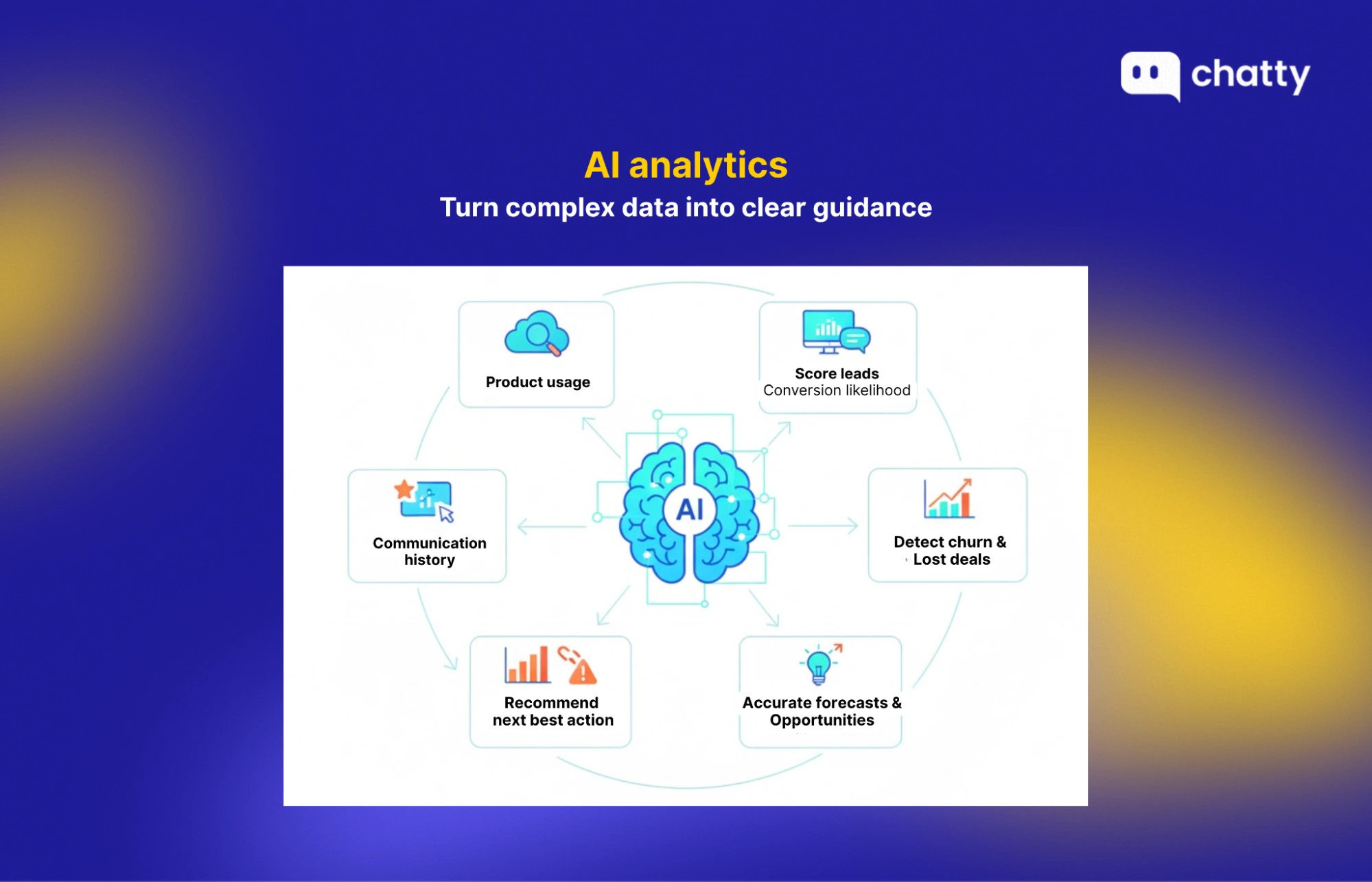
AI analytics focuses on turning complex data into clear guidance. Instead of manually checking dozens of reports, sales teams can rely on predictive models that:
- Score leads based on conversion likelihood
- Detect early signs of churn or lost deals
- Recommend the next best action for each account
When product usage, website activity, and communication history are combined, AI analytics reveals patterns that help teams forecast more accurately and focus on the right opportunities.
3) Smart process automation
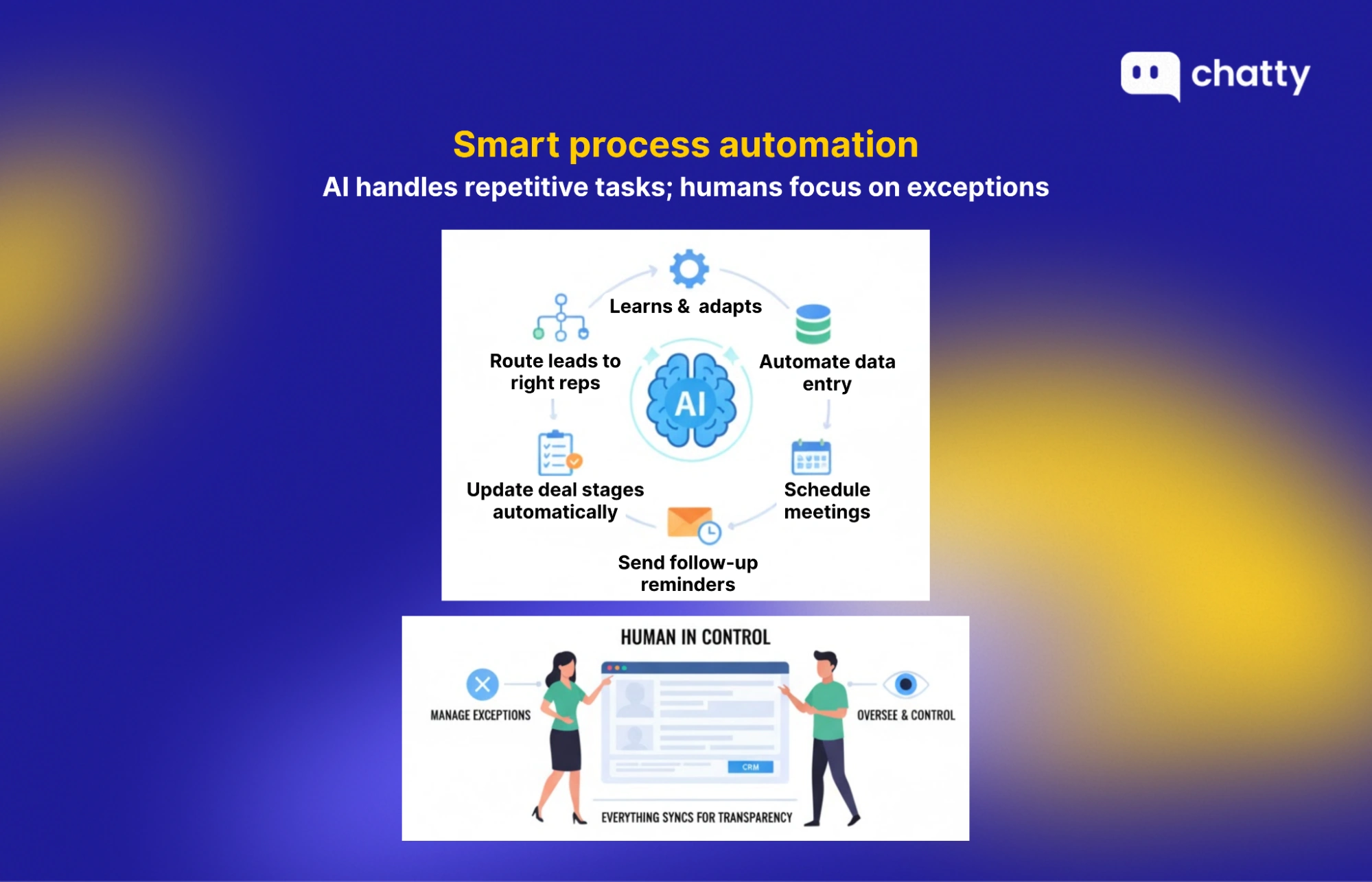
Smart automation takes care of repetitive tasks that consume time and cause errors. It can route leads to the right reps, update deal stages after meetings, or send follow-up reminders at the right moment. Over time, these systems learn from outcomes and adjust automatically.
Start by automating the tasks that slow your team down most, such as data entry or meeting scheduling. Keep humans in control of exceptions and make sure every update syncs with your CRM. This balance keeps the process efficient and transparent.
Core applications of AI in modern sales
Below are five places where AI already creates real gains. For each one, you will see what it does and how to apply it right away.
Lead scoring and prioritization
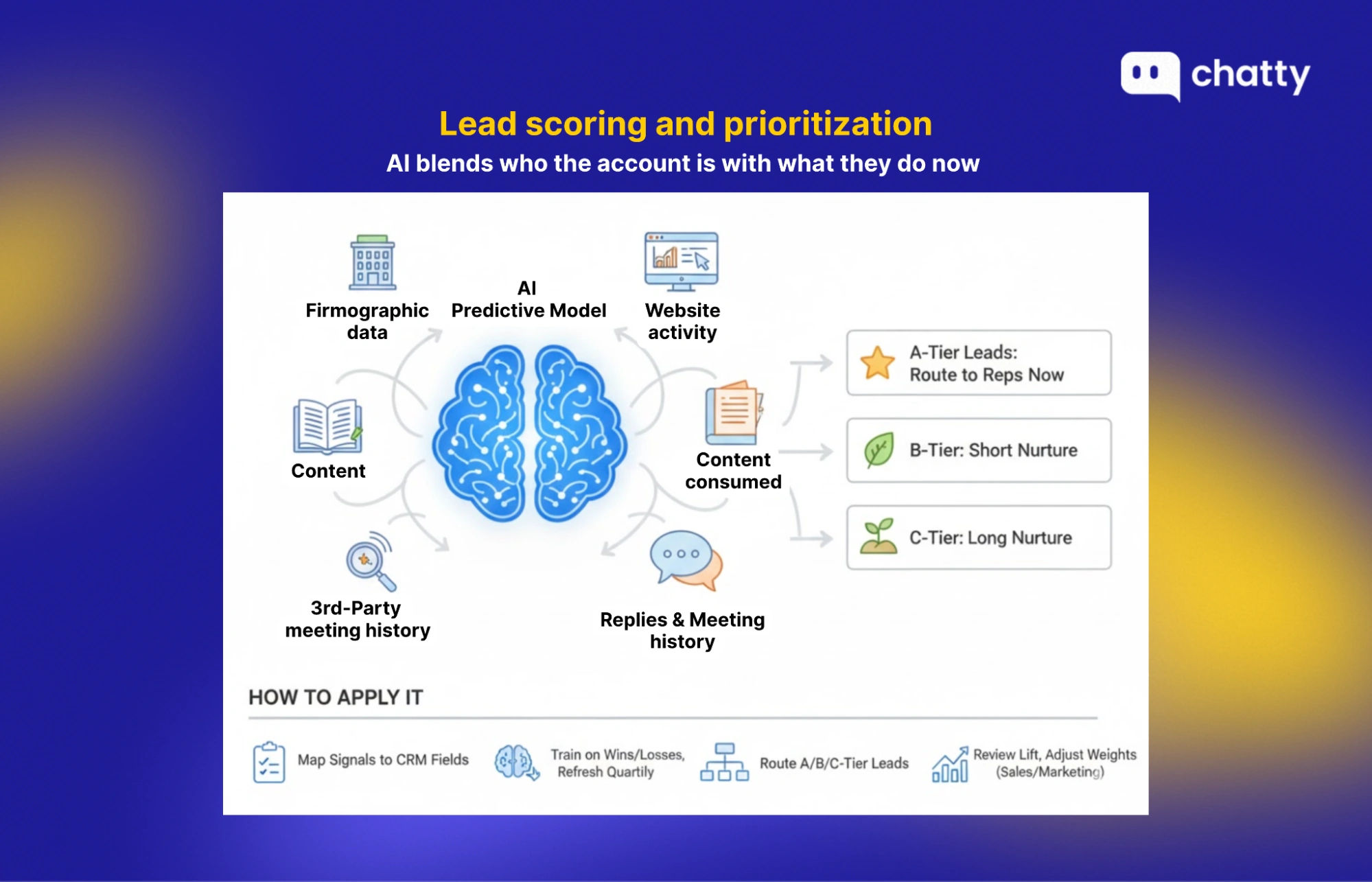
Predictive scoring blends who the account is with what the account is doing right now. It looks at firmographic fit, visits to key pages, content consumed, replies, meeting history, and buyer-intent signals from third parties. Teams that layer prediction on top of this behavior see warmer pipelines and fewer wasted touches.
For example, account-based programs powered by predictive data report very large gains in revenue effectiveness, with 6sense publishing benchmarks that show up to 120% improvement when teams focus on in-market accounts rather than broad lists.
A ZoomInfo case with G2 Buyer Intent also reported a 17% lift in conversion and lower cost per lead after adding intent signals to scoring.
How to apply it:
- Map positive and negative signals to CRM fields.
- Train on recent wins and losses and refresh each quarter.
- Route A-tier leads to reps now, B to short nurture, C to long nurture.
- Review weekly lift and adjust weights together with sales and marketing.
Personalized outreach at scale
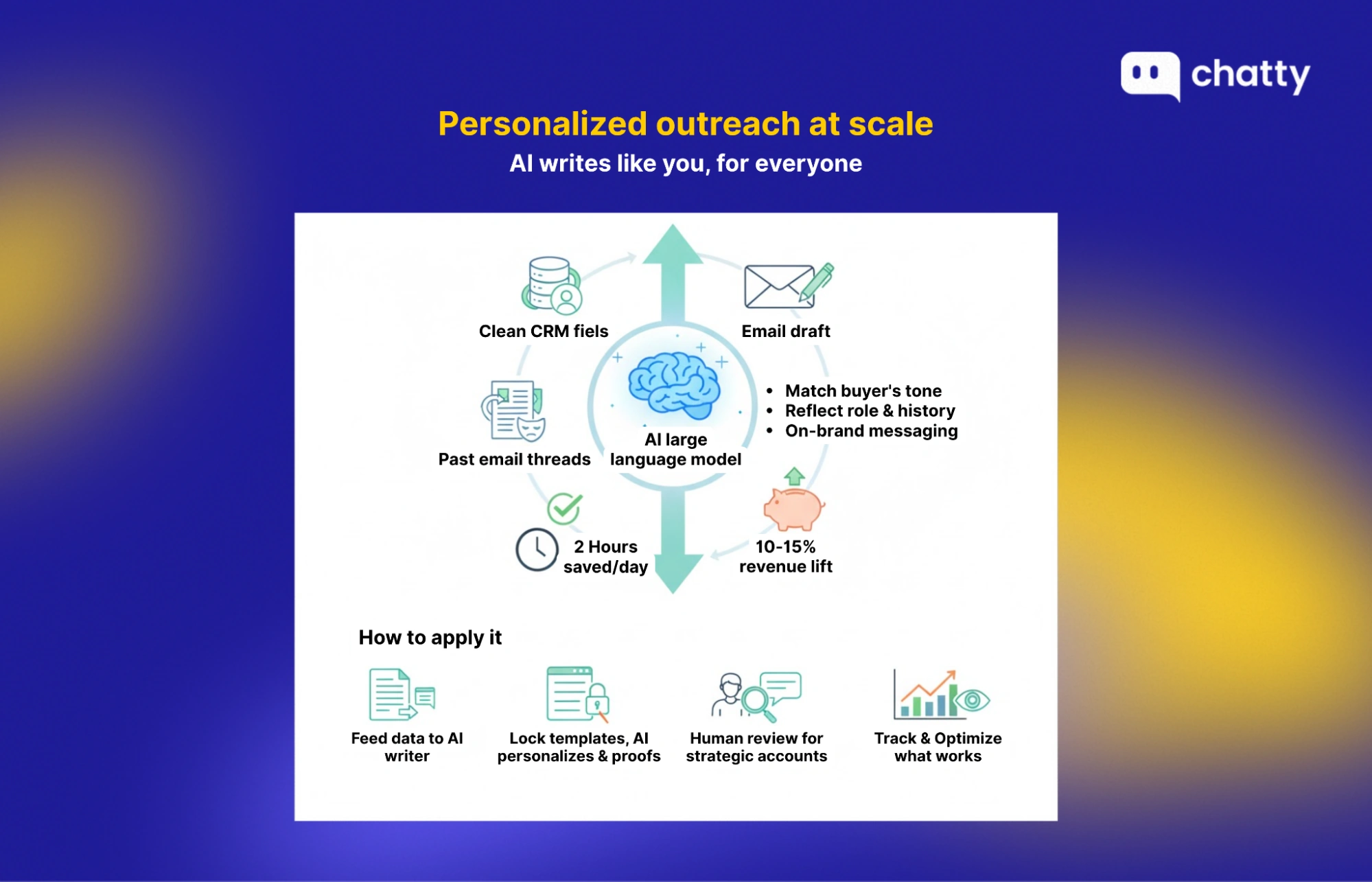
Large-language models now write first drafts that sound like your brand and reflect each buyer’s role, industry, and history with you. The goal is not volume for its own sake but consistent relevance.
Teams that adopt AI for routine writing are freeing real selling time; HubSpot reports roughly two hours saved per rep each day when AI handles admin and first-pass writing, which directly improves follow-up speed.
Personalization itself is tied to revenue lift, with McKinsey showing gains of 10-15% when companies use data to tailor messages and offers
How to apply it:
- Feed clean CRM fields, past email threads, and persona notes to your writer.
- Lock tone, disclaimers, and approvals in templates, let the model personalize openings and proof.
- Keep human review for strategic accounts and sensitive messages.
- Track replies, meetings, and sourced pipeline by segment and keep what works.
Sales forecasting and pipeline intelligence
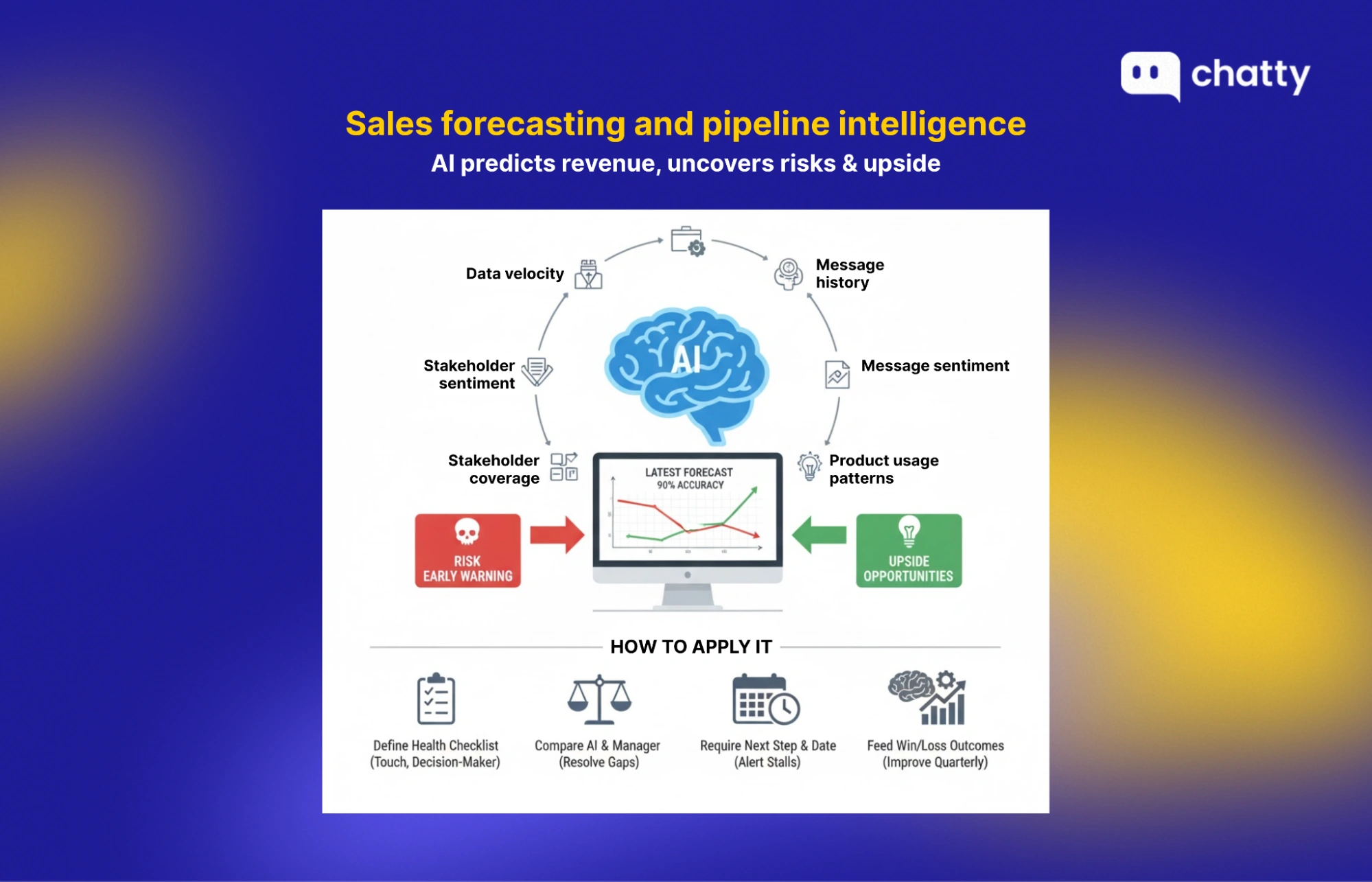
Modern forecasting tools watch deal velocity, stakeholder coverage, message sentiment, and product usage patterns. Instead of end-of-quarter guesswork, leaders see risk early, get upside estimates, and watch the forecast update as buyers act.
Companies that implement pipeline intelligence report tighter precision, and industry research continues to urge B2B leaders to put AI across the seller journey to improve revenue and productivity.
How to apply it:
- Define a short health checklist for every deal, such as the last meaningful touch and the decision-maker engaged.
- Compare AI projections with manager commits in a weekly review and resolve gaps case by case.
- Require a next step and date on every open deal and alert owners when momentum stalls.
- Feed the win and loss outcomes back so accuracy improves each quarter.
Conversational AI and virtual assistants
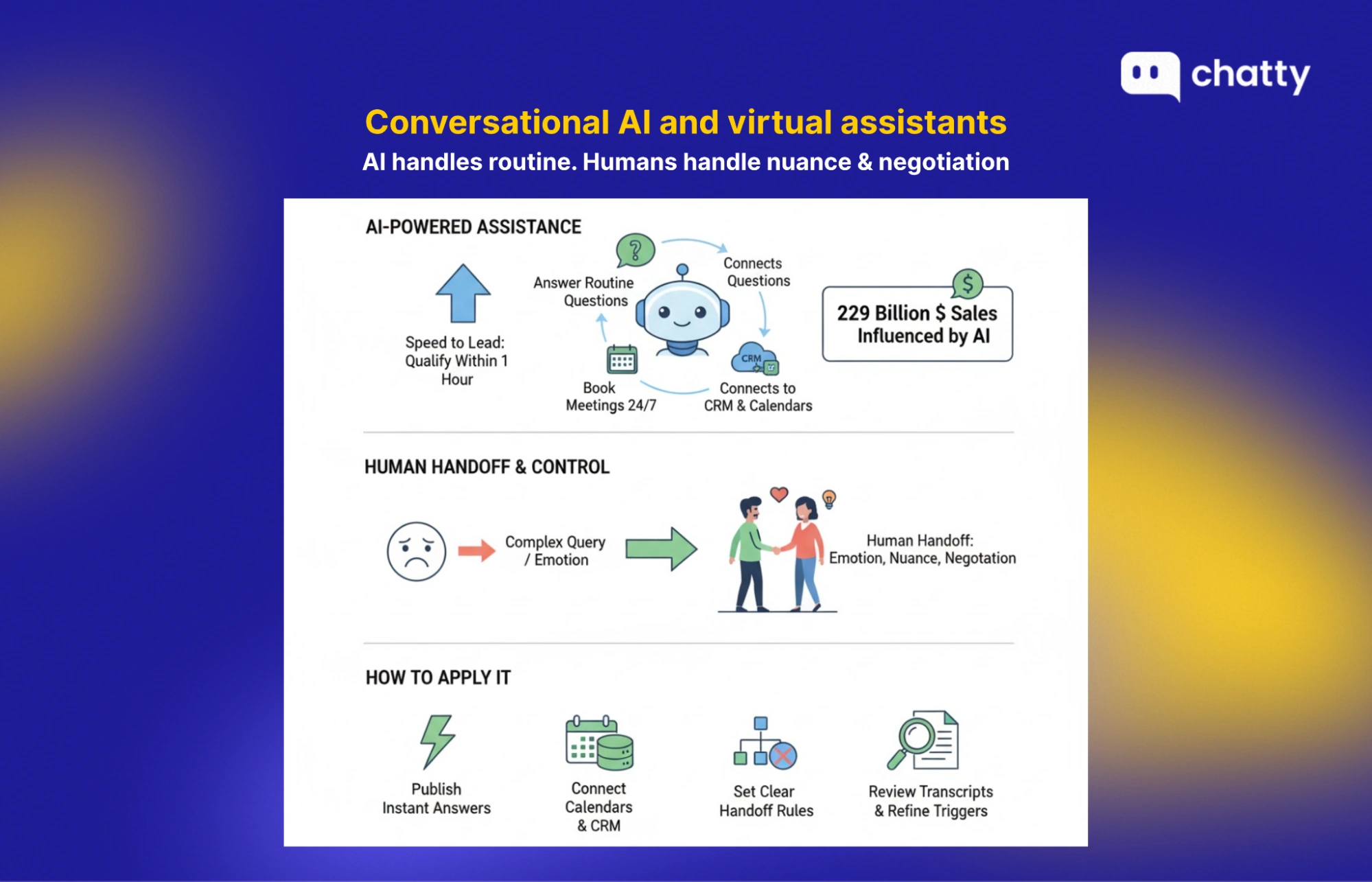
Chatbots and voice agents qualify leads, answer routine questions, and book meetings at any hour, then hand off to a human when emotion, nuance, or negotiation appears. Buyer behavior shows growing comfort with this help.
During the 2024 holiday season, shoppers used AI and agent-powered chat 42% more than the year before, and 229 billion dollars of global online sales were influenced by AI, a sign that real-time assistance is now part of the journey.
Platforms like Chatty keep one thread across web chat, Instagram, WhatsApp, and email so context never resets. Classic research on speed to lead still applies: contacting a new inquiry within an hour makes qualification far more likely than waiting.
How to apply it:
- Publish instant answers for pricing, availability, demo requests, and basic support.
- Connect calendars and CRM so the assistant can book time and write transcripts to records.
- Set clear handoff rules for high deal value or signs of confusion or frustration.
- Review transcripts weekly, add missing answers, and refine triggers for meeting booking.
Call analysis and coaching
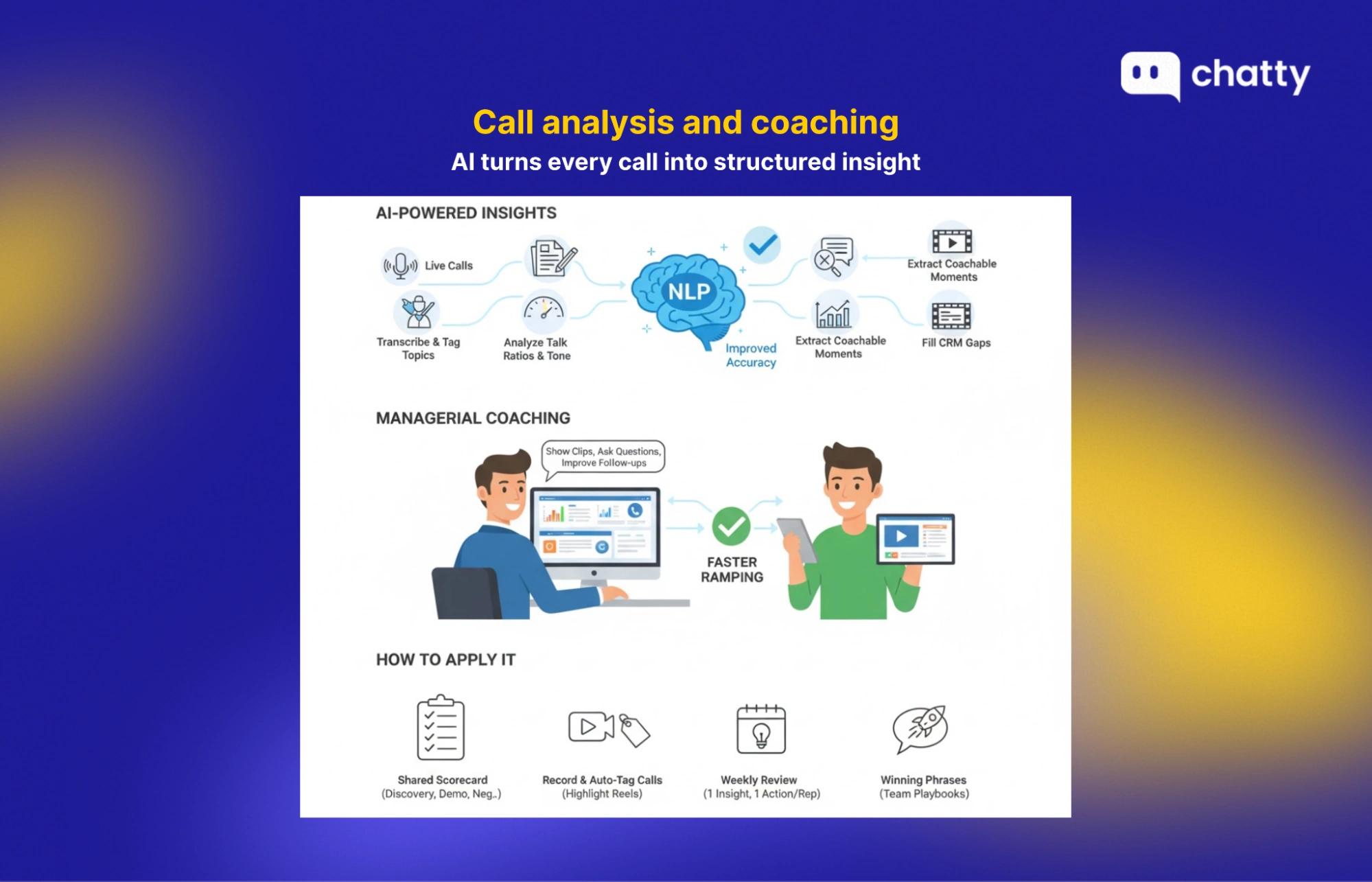
NLP now turns every call into structured insight. It transcribes, tags topics and objections, measures talk ratios and tone, and surfaces moments worth coaching. Managers no longer rely only on memory or notes; they can show clips, call out strong questions, and fix weak follow-ups.
Vendors report that capturing and analyzing nearly all customer interactions fills the gaps most CRMs miss, which makes coaching more specific and ramps new reps faster.
How to apply it:
- Use a shared scorecard for discovery, demo, and negotiation, and apply it to every call.
- Record and auto-tag calls, then share short highlight reels for quick learning.
- Run a short weekly review and turn one insight into one action per rep.
- Fold winning phrases into playbooks so improvements spread across the team.
How AI transforms the sales workflow
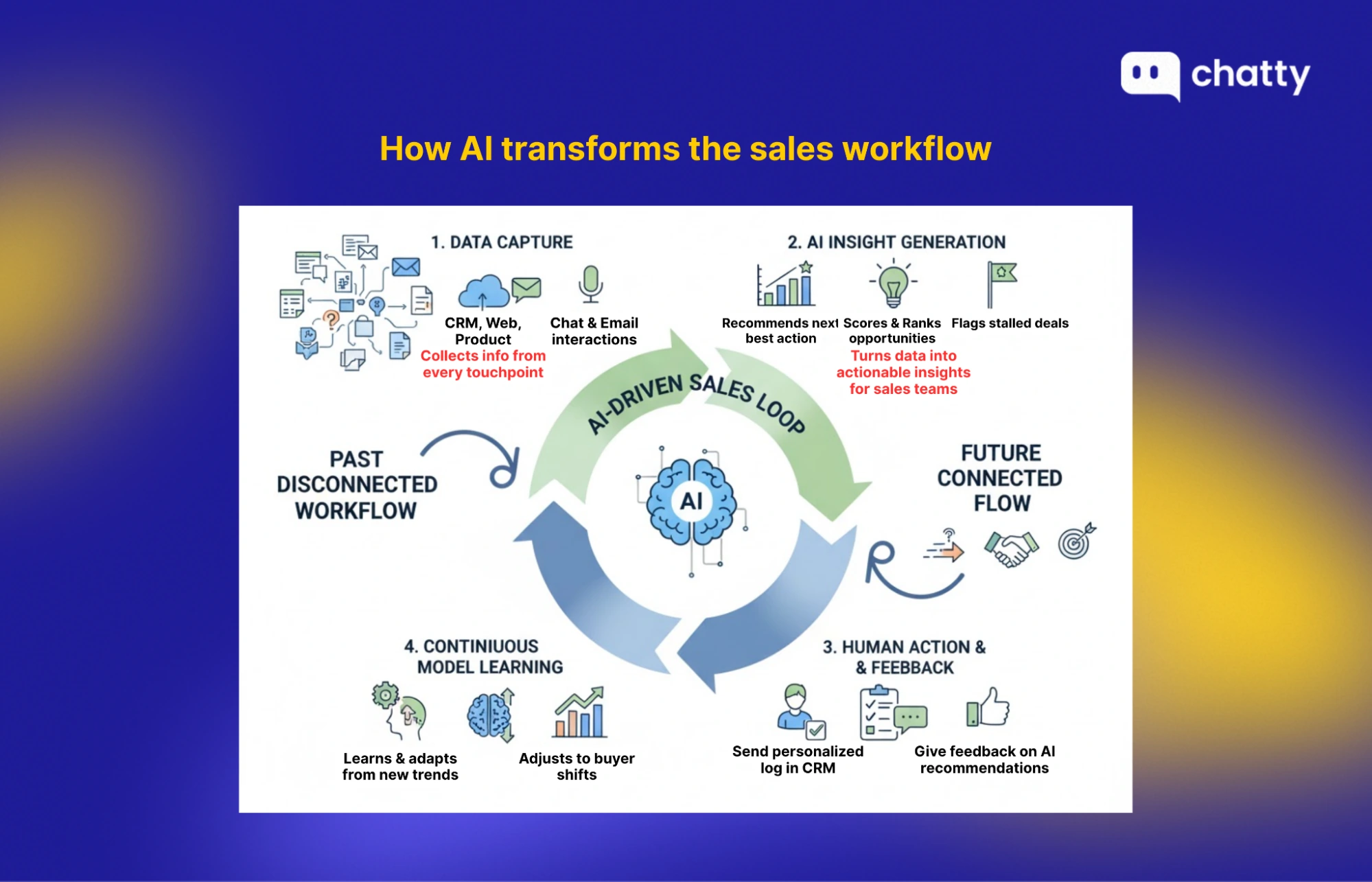
In the past, sales operations often felt disconnected. Data lived in different systems, from CRMs and inboxes to spreadsheets, which made it hard to see the full picture. Follow-ups depended on memory, so timing was inconsistent, and many opportunities slipped away. Teams made decisions reactively, only fixing problems after they appeared.
Now, AI unifies all of that into one connected flow. It collects data, interprets patterns, and gives clear next steps. Sales teams no longer wait for reports. They act early, guided by insights that show where to focus and how to engage each customer. The result is a faster, more coordinated, and more predictable sales process.
This continuous cycle is called the AI-driven sales loop, and it keeps improving every day as new data comes in.
1. Data capture
AI automatically gathers information from every touchpoint:
- CRM records, web visits, product usage, and meeting notes
- Chat and email interactions with intent and sentiment tags
- Call transcripts and customer responses linked to the right deal
2. AI insight generation
Once data is collected, AI turns it into useful guidance:
- Scores and ranks are based on behavior and interest
- Recommends the next best action for each account
- Flags stalled deals or weak engagement before they drop
3. Human action and feedback
Reps use these insights to move quickly and respond with purpose:
- Send personalized messages or schedule follow-ups at the right moment
- Confirm next steps and log outcomes clearly in the CRM
- Give feedback on AI recommendations to improve accuracy
4. Continuous model learning
The loop keeps learning and adapting over time:
- Updates predictions as new wins and losses are logged
- Adjusts scoring and timing when buyer behavior shifts
- Surfaces fresh trends for training, coaching, and strategy
In this way, AI acts like the nervous system of modern sales. The tools (CRM, chat, email, and calls) are the senses that collect signals from every interaction. AI connects those signals, interprets them, and sends clear guidance to the right person at the right moment. The team stays alert, coordinated, and always ready to respond.
Chatty: Your AI sales assistant that actually closes deals
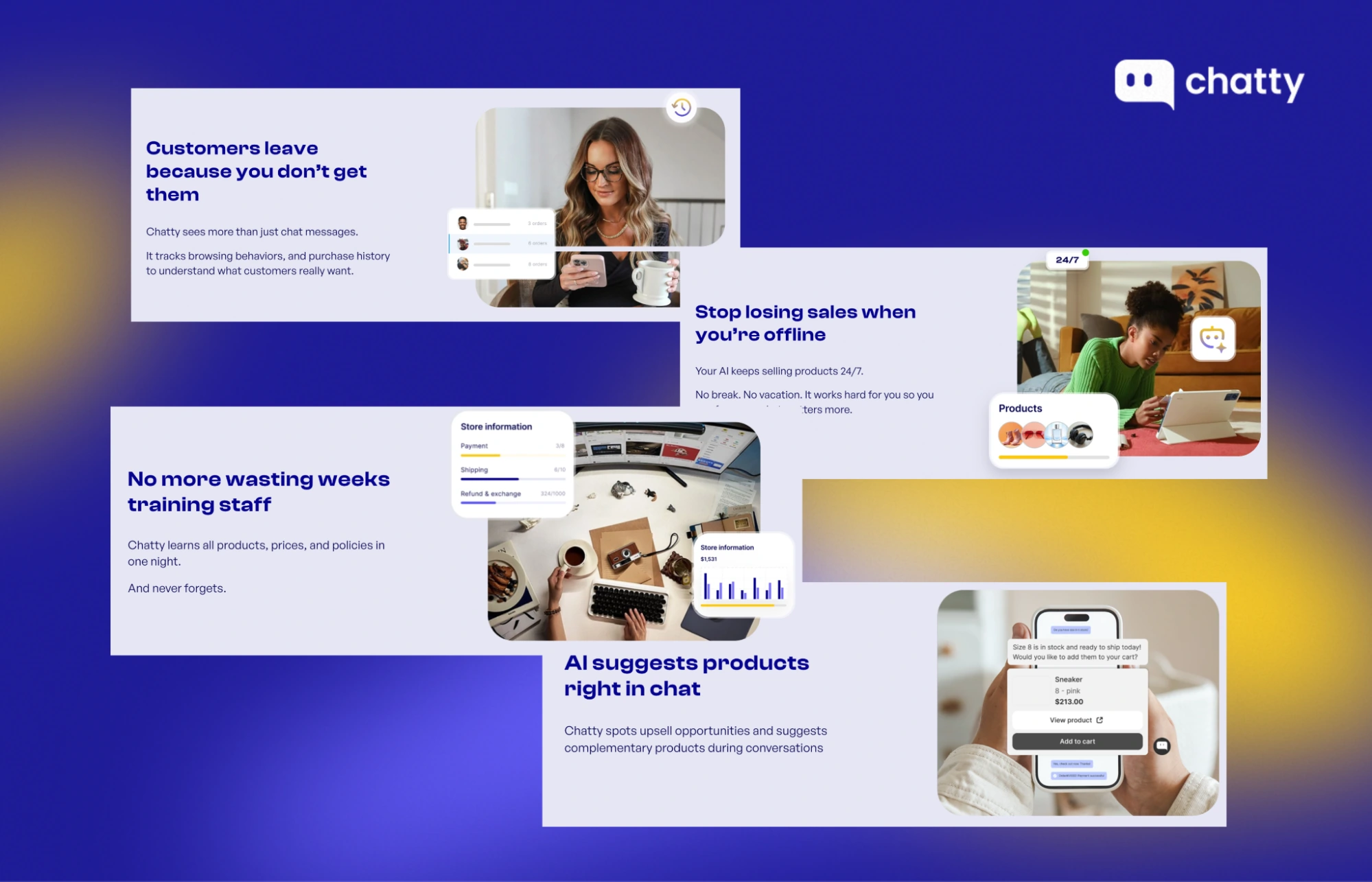
Chatty is built for Shopify and true omnichannel commerce. It answers questions, recommends products, tracks orders, and books meetings around the clock, while you manage everything from one inbox that connects website chat, WhatsApp, Instagram, Messenger, email, and more. Your brand voice stays consistent in every reply, even at 3 a.m.
Setup is simple. Chatty auto syncs your store so the assistant learns your products, prices, and policies, then you add extra data sources like FAQs and custom answers to sharpen its knowledge. You can fine-tune tone, length, and style, set the bot name and avatar, and define when a human should take over.
When a conversation is transferred, Chatty posts a clean summary with language detection, key issues, and suggested next steps so your team jumps in with full context.
You stay in control while it learns. Test the assistant in a safe zone before going live, see the exact sources used for each answer, and turn unresolved questions into new FAQs with a few clicks. This feedback loop makes the bot sharper every week without guesswork or mystery.
Costs are clear and predictable. Every AI message counts as one reply, and each plan comes with a monthly quota:
- Free plan: 100 AI replies per month
- Basic plan ($19.99): 1,000 AI replies
- Pro plan ($49.99): 5,000 AI replies
- Plus plan ($199): 10,000 AI replies
If you go over your limit:
- Extra replies are billed at a simple per-reply rate (from $0.025 to $0.04 each)
- You can set a spending cap to control costs and prevent surprises
- Usage resets automatically at the start of each billing cycle
- Chatty sends an email alert when you reach 80% and 100% of your quota
In short, Chatty behaves like a calm closer who never sleeps. Your channels act like the senses that collect signals, while Chatty connects those signals, understands intent, and nudges every shopper toward the right product and the right outcome. That means faster answers, fewer tickets, and more sales without adding headcount.
Human + AI: The new hybrid sales team
Modern selling needs two strengths working together. AI keeps the engine running quietly in the background, while people bring context, empathy, and trust in the moments that matter. Here is how the partnership looks when it works well.
- Sales stays human at the core
AI does not replace judgment or rapport. It removes the busywork that blurs focus. Let it handle summaries, CRM updates, lead ranking, and scheduling so reps have time to listen, read signals, and make clear promises they can keep. The result is fewer rushed touches and more meaningful conversations.
- Reps move from transactional to strategic
Instead of pushing the same offers, reps start with a short, data-informed plan that shows who is ready, why they are ready, and which value to lead with. AI highlights intent, risk, and timing; the rep chooses the angle, asks stronger questions, and maps solutions to goals. Follow-up turns into forward motion, and close rates rise without extra pressure.
- Managers act as AI conductors
Great managers set the rhythm. They select a small set of signals to watch, such as response time, multithreading, deal velocity, and product usage. They turn insights into simple rules for routing, handoffs, and next steps, and they protect brand voice and compliance. In weekly reviews, they compare AI guidance with human judgment, capture what worked, and update the playbook so improvements spread.
Final thought: The sales rep of tomorrow
The conversation around AI often focuses on automation, but we think that’s only half the story. The transformative role of AI in sales lies in its ability to generate deep insights that guide human action and build a continuously learning system. It’s this combination of machine precision and human empathy that will define the next generation of top-performing teams.