












Businesses now face scaling customer support demands. Traditional ticketing systems and rule-based automation can struggle to keep up, leading to slower responses, misrouted tickets, and frustrated customers. That’s where AI ticketing systems step in.
They use artificial intelligence to analyze, categorize, and route support requests. Some can even provide instant solutions or suggest replies for agents. AI ticketing improves speed, accuracy, and consistency while reducing costs. It also provides actionable insights from every interaction.
In this guide, we explain how AI ticketing works, its key benefits, and top industry-specific use cases for eCommerce, SaaS, ITSM, and global support teams.
- AI ticketing systems understand customer intent and urgency from natural language, not just keywords. Using NLP to interpret tone, context, and meaning, AI-powered systems route and resolve tickets more accurately than rule-based automation that breaks when phrasing varies.
- Traditional automation handles predictable tickets well but fails when customer needs become complex or varied. AI ticketing systems are specifically designed for this gap: they adapt to different situations rather than failing when a request doesn't match a predefined script exactly.
- Every ticket interaction trains the AI system to improve future resolution speed and classification accuracy. Unlike static rule sets that stay fixed until manually updated, AI ticketing continuously refines its understanding from outcomes and feedback, getting smarter with each resolved case.
- AI ticketing handles the full workflow: intake, classification, routing, response generation, and continuous learning in sequence. This end-to-end automation means agents only receive tickets that genuinely require human judgment, while routine requests resolve themselves without entering the manual queue.
- AI ticketing systems are better suited than rule-based chatbots for businesses with diverse or unpredictable customer needs. Where scripted bots break on unexpected phrasing or multi-part requests, AI ticketing understands context across a full conversation and adjusts its routing and response accordingly.
What is an AI ticketing system?
The basics explained simply
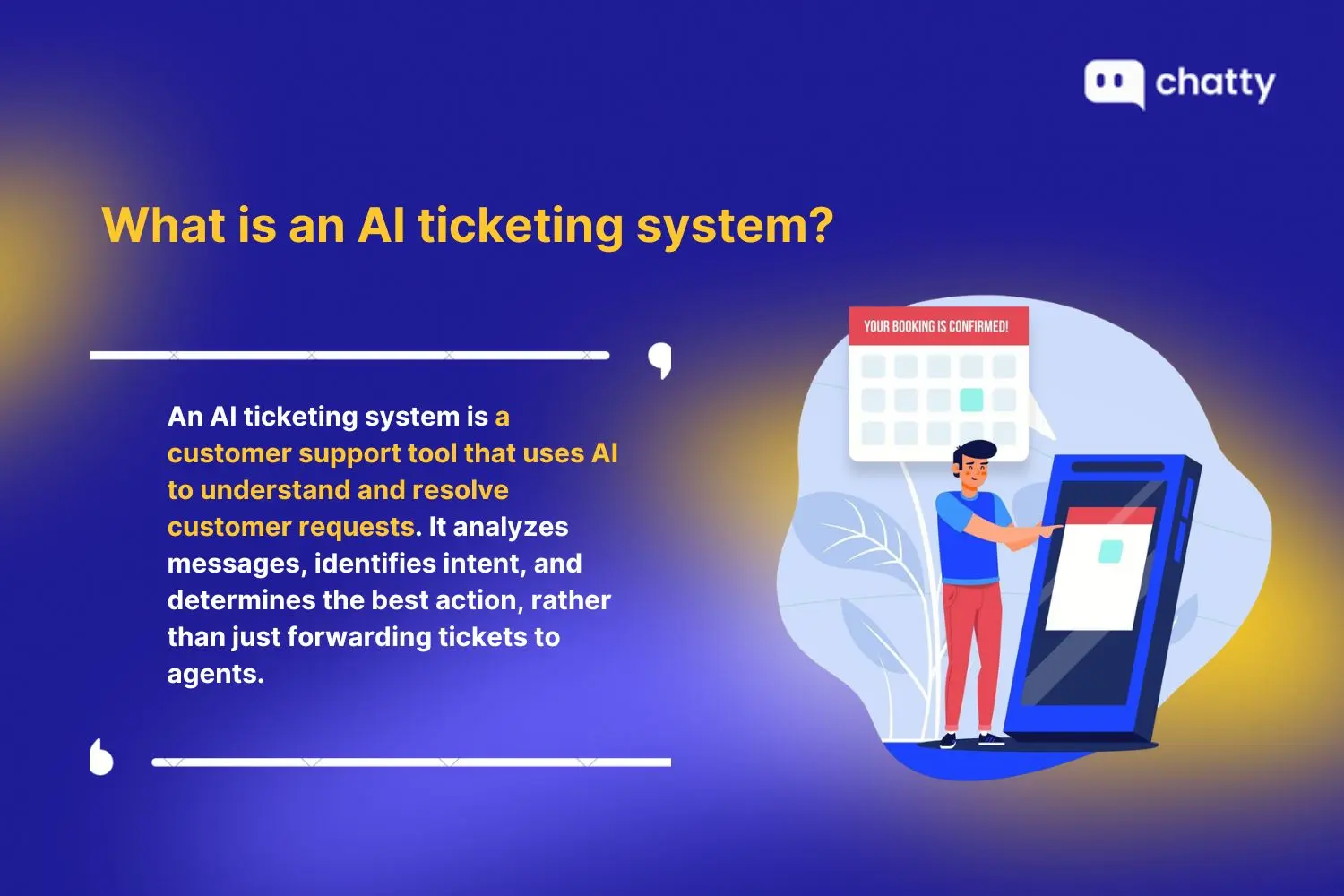
An AI ticketing system is a customer support tool that uses artificial intelligence to understand, manage, and resolve customer requests. Instead of simply collecting tickets and forwarding them to agents, it analyzes each message, identifies customer intent, and determines the best action.
Compared to traditional ticketing systems, AI-based solutions provide a deeper understanding and smarter handling. Traditional systems mainly focus on logging, tracking, and routing tickets through predefined workflows. This often requires heavy manual input and leads to slower response times. AI ticketing systems improve this process by:
- Understanding the meaning and urgency of customer messages.
- Automatically categorizing and prioritizing requests.
- Reducing manual sorting and repetitive tasks.
AI ticketing systems also differ from rule-based chatbots. Traditional chatbots rely on scripted flows and keyword detection, which limits flexibility. If a user phrases a request differently, the chatbot may fail. AI-powered systems use natural language processing (NLP) to understand context, tone, and intent, allowing them to handle more natural and varied conversations.
AI ticketing vs traditional automation: what’s different
Traditional automation relies on fixed rules and workflows, making it effective for simple and predictable tasks. However, it struggles with complex or varied requests. AI ticketing systems adapt to different situations, understand language in context, and continuously improve. This makes them better suited for businesses that handle diverse customer needs and aim to deliver fast, accurate, and scalable support.
How AI ticketing actually works
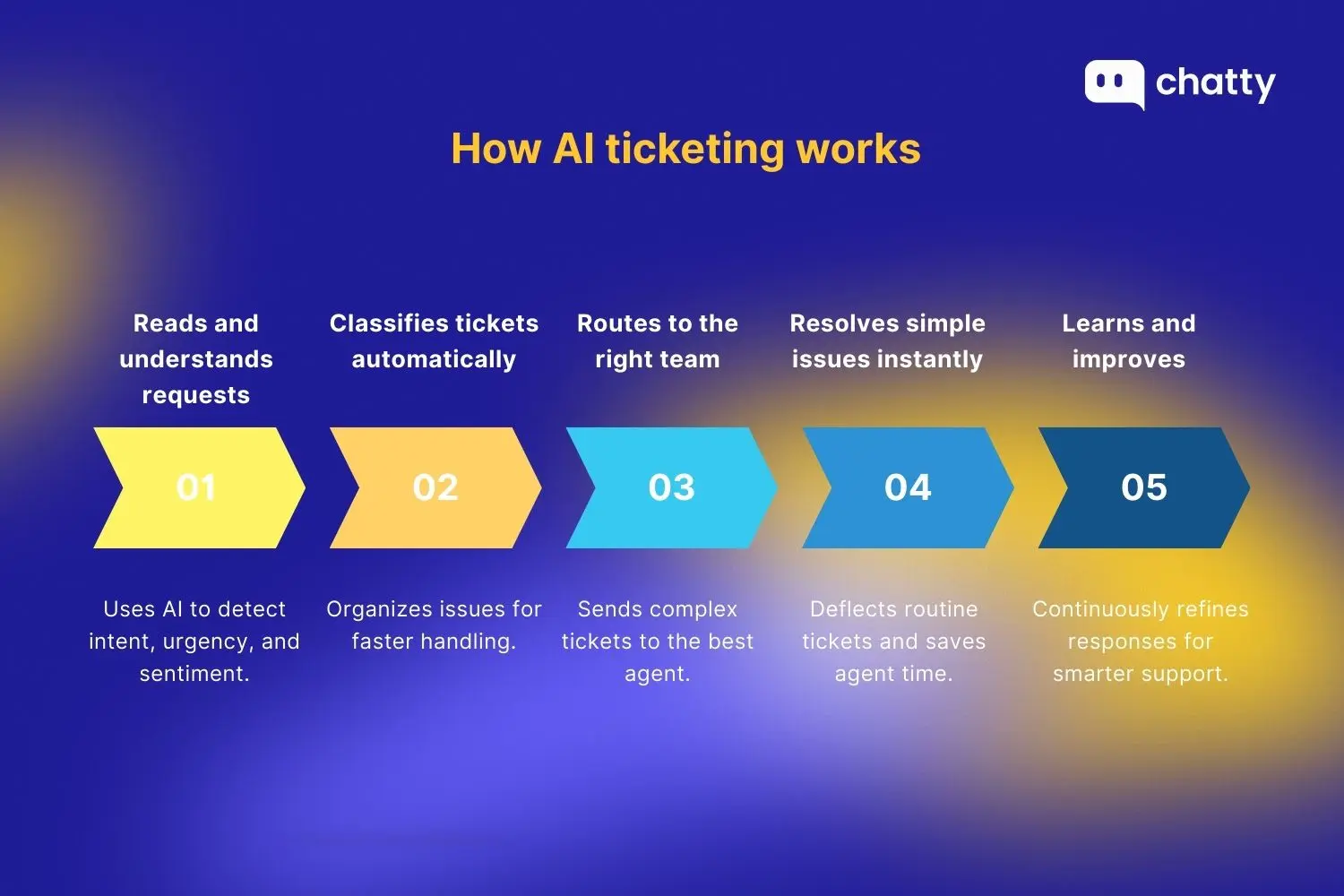
AI ticketing systems streamline customer support by automating key parts of the workflow, ensuring faster and more accurate resolutions.
- Intake and analysis: When a customer submits a ticket, AI reads the message using natural language processing (NLP). It interprets the customer’s intent, urgency, and sentiment, allowing the system to understand the request just like a human agent would.
- Classification and tagging: The system then categorizes tickets automatically. Common categories include billing, technical support, account issues, or product inquiries. This organization ensures that each ticket is handled efficiently and reaches the right team.
- Routing or resolution: For simple or routine requests, AI can resolve tickets instantly, helping achieve ticket deflection and freeing agents for more complex issues. More complex problems are intelligently routed to the most suitable human agent, saving time and preventing unnecessary delays.
- Response generation: AI ticketing provides suggested replies for agents or sends automated responses when appropriate. This reduces repetitive work while maintaining consistency in communication.
- Learning and improvement: Every ticket interaction helps the AI system improve. By analyzing outcomes and feedback, it continuously refines its understanding, enhancing accuracy, speeding up future resolutions, and delivering smarter support over time.
Overall, AI ticketing combines automation and intelligence to handle customer issues efficiently. By understanding messages, categorizing them, routing effectively, and learning continuously, these systems help businesses provide faster, more accurate, and reliable customer support while reducing the workload for human agents.
The core technologies of AI ticketing systems
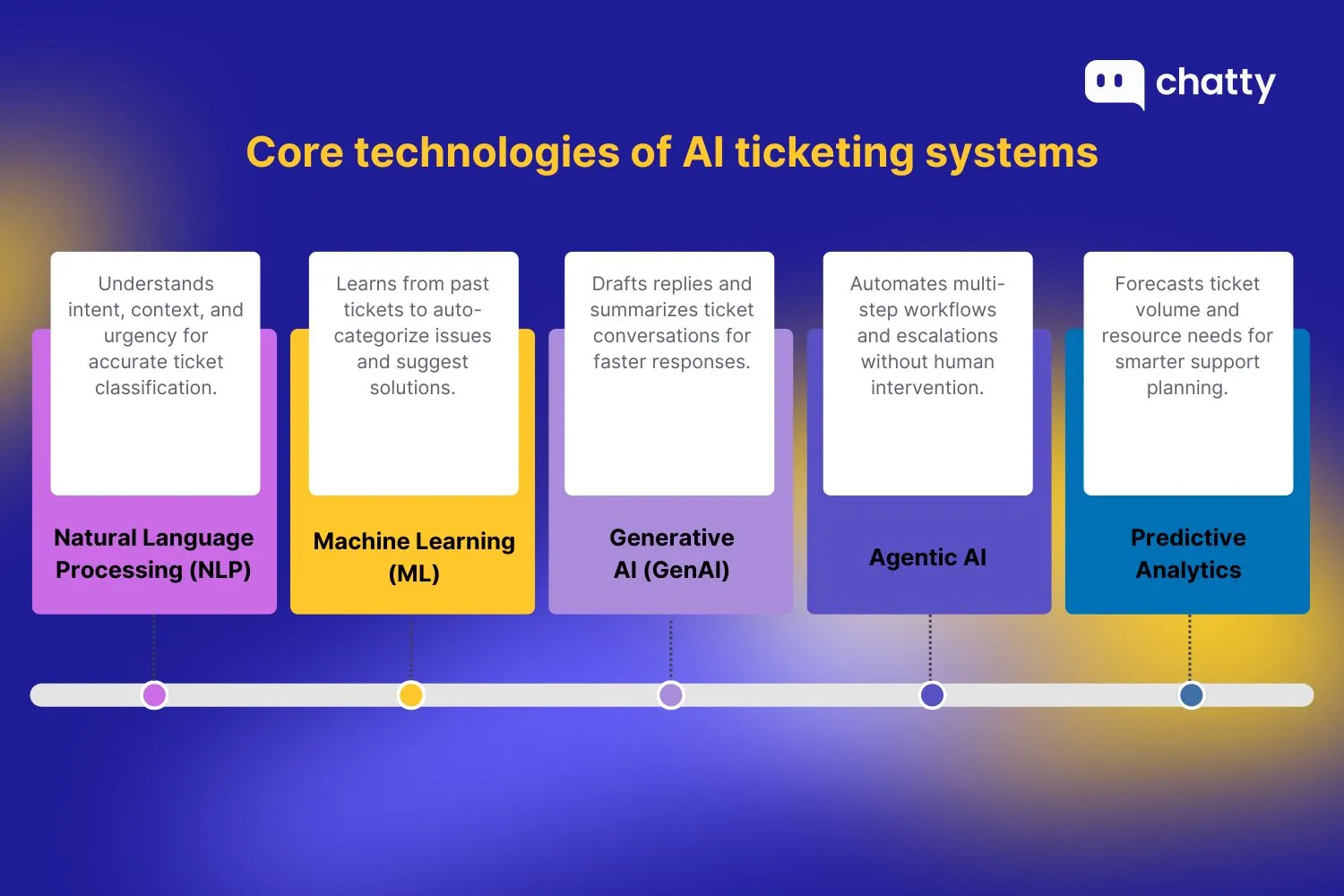
AI ticketing systems use advanced technologies to automate, prioritize, and improve customer support.
- Natural Language Processing (NLP): Understanding Intent: NLP enables AI ticketing to “read” and interpret human language, extracting intent, context, and sentiment. This helps classify tickets accurately, detect urgency, and tailor responses. For example, a ticket saying, “My account is locked, and I need urgent access for a presentation in 30 minutes” can be prioritized immediately, routed to the right team, and flagged as high urgency.
- Machine Learning (ML): Intelligent Routing & Prediction: ML allows systems to learn from historical tickets and improve decision-making over time. By analyzing patterns, it can automatically categorize recurring issues and suggest proven solutions. For instance, if VPN connectivity tickets are frequent, ML can preemptively classify new tickets and recommend fixes, reducing agent workload and resolution times.
- Generative AI (GenAI): Drafting and Summarization: Generative AI helps agents respond faster by drafting context-aware replies and summarizing ticket conversations. For example, a complex billing inquiry can be condensed into a clear overview, highlighting key issues and providing actionable resolution suggestions while maintaining the company’s tone.
- Agentic AI: Autonomous Workflow Orchestration: Agentic AI manages complex, multi-step tasks without human intervention. For example, if a high-severity IT outage ticket is created, Agentic AI can escalate the issue, notify stakeholders, reroute workloads, and trigger remediation workflows, allowing teams to focus on strategy rather than repetitive tasks.
- Predictive Analytics and Other AI Capabilities: Predictive analytics forecasts ticket volume, staffing needs, and service trends, helping organizations allocate resources efficiently. Combined with intelligent routing, triage, and automation, these technologies make AI ticketing systems faster, smarter, and more reliable than traditional support tools.
What are the key benefits of an AI ticketing system?
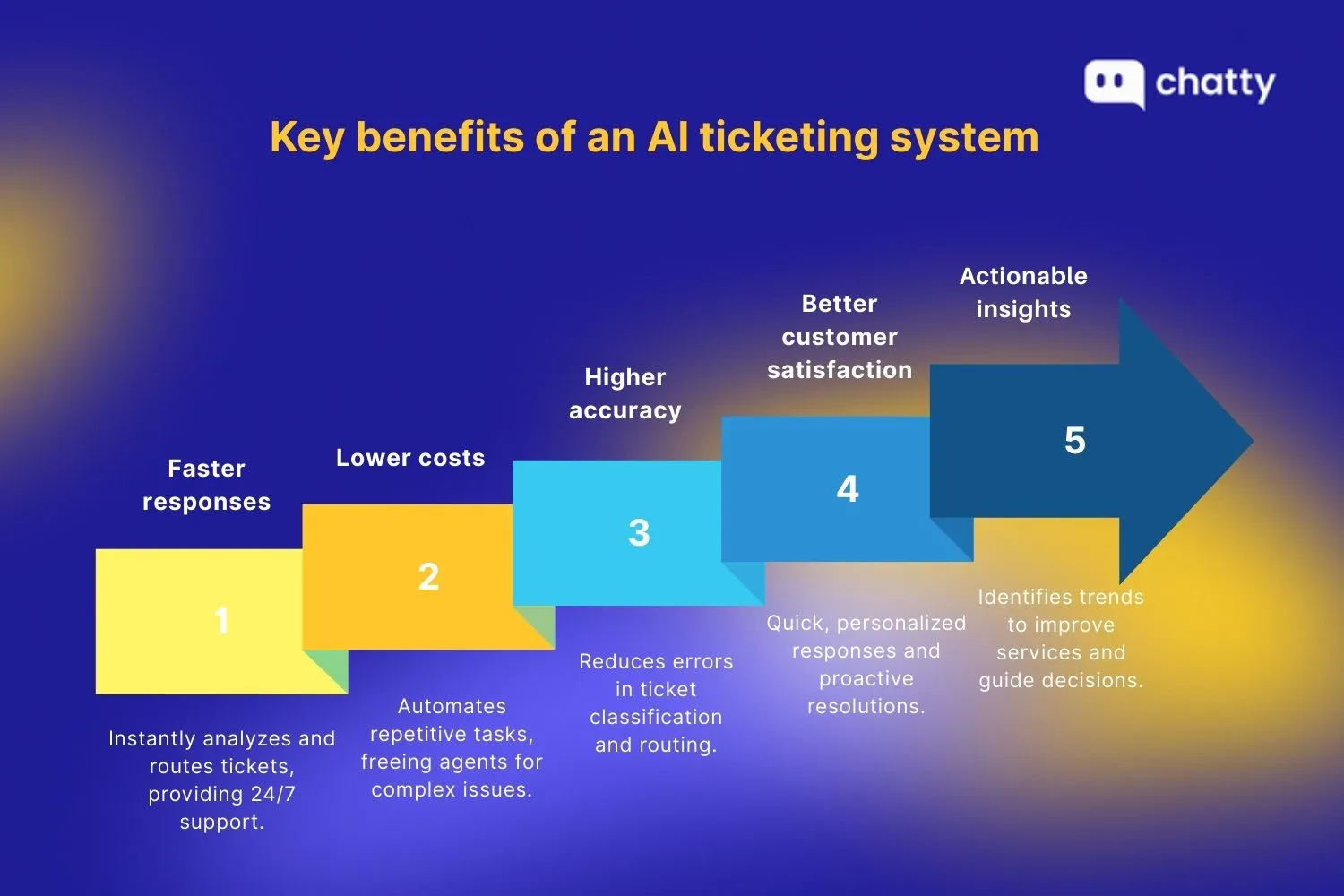
AI ticketing systems are transforming how businesses manage customer support. By automating repetitive tasks, they help teams respond faster, reduce costs, and improve overall customer experience. Here are the main benefits:
Faster response times
AI ticketing systems eliminate delays from manual sorting by instantly analyzing and routing tickets to the correct department. This speeds up response times and reduces customer waiting. Additionally, AI works 24/7 without extra staffing, automatically receiving, classifying, and responding to tickets so customers get timely acknowledgments at any time of day or night.
Real-world data shows strong results. According to Freshworks’ 2025 AI ROI report, AI-powered tools drive a 55% reduction in average first response time for CX teams — with some retail deployments cutting FRT from 12 minutes to 12 seconds.
Lower operational costs
AI reduces the need for large customer support teams by automatically handling repetitive, simple requests. This allows human agents to focus on complex cases while lowering overall staffing costs.
AI also handles sudden spikes in ticket volume without requiring temporary hires. This flexibility helps businesses manage seasonal demand without increasing payroll expenses. According to AllAboutAI, companies using AI in customer service report up to 68% lower operational costs, reducing cost per interaction from $4.60 to $1.45.
Better accuracy and consistency
AI reduces human error in ticket classification and routing. By analyzing keywords, intent, and historical data, AI ensures that tickets are consistently sent to the correct team. This lowers delays and reduces escalations caused by misrouted requests.
Salesforce reports that large deployments of Einstein Case Classification have saved customers up to 34,000 support hours in four months, with one shipping company saving €1 million in operational costs during the same period — a direct result of AI consistently routing tickets to the correct team.
Improved customer satisfaction
Faster responses and quicker resolutions directly lead to happier customers. AI also enables personalized replies by analyzing user data and past interactions, making support feel more tailored.
Additionally, AI can detect recurring issues early and trigger proactive solutions, preventing problems before they affect more users.
Actionable insights from ticket data
AI analyzes ticket data to identify trends and common problems. This helps businesses uncover product issues, collect useful feedback, and improve services. Over time, these insights support better decision-making and continuous improvement.
Industry-specific AI ticketing use cases
Instead of offering one-size-fits-all automation, modern AI ticketing platforms tailor responses, routing logic, and predictive capabilities to match real-world use cases. Below are key examples of how AI ticketing is transforming operations across major industries.
E-Commerce: Automated order tracking & returns
In e-commerce, most tickets involve order tracking, delivery updates, returns, and product questions. AI ticketing systems automate these interactions by pulling real-time order data, instantly responding to common requests, and escalating only complex cases to human agents.

Fashion accessories brand Montana West faced a sharp surge in customer inquiries during peak season, with conversation volume rising by 83%. After deploying Chatty’s AI ticketing solution, over 80% of tickets were handled automatically, allowing agents to focus on detailed style consultations. The AI learned the brand’s 400+ product catalog, provided personalized recommendations, and suggested matching accessories.
As a result, Montana West achieved a 32% increase in chat-to-sales conversion and 171% revenue growth, generating over $41,000 in AI-attributed sales while significantly reducing support workload.
IT tech support: Predictive issue resolution
In IT environments, AI ticketing systems analyze historical tickets, system logs, and incident patterns to predict recurring technical problems. When early warning signs appear, the system automatically creates preventive tickets, suggests fixes, and routes them to the correct IT teams. This often resolves issues before employees experience downtime.
IBM uses AI-powered ticket intelligence within its internal IT service management system to detect patterns in recurring incidents. By analyzing historical tickets and system alerts, the AI predicts upcoming failures, automatically opens preventive tickets, and recommends remediation steps. This approach helped IBM reduce incident resolution time and cut system downtime significantly.
Healthcare: Appointment scheduling & patient inquiries
In healthcare, AI ticketing automates appointment scheduling, rescheduling, test result inquiries, and billing questions. Tickets are classified instantly, doctor availability is checked automatically, and confirmations are sent without staff involvement, reducing administrative workload and improving patient experience.

Northwell Health, one of the largest healthcare providers in the U.S., uses AI-driven patient service automation to manage appointment requests and patient inquiries. Their AI system automatically processes scheduling tickets and responds to routine questions.
Finance: Fraud detection & dispute resolution
In financial services, AI ticketing automates the intake, classification, prioritization, and routing of fraud and dispute tickets. When customers report suspicious transactions, AI analyzes transaction history, behavioral patterns, and risk indicators to assess potential fraud. It then assigns urgency levels and escalates high-risk cases to specialized fraud teams, improving ticket escalation efficiency.
PayPal uses AI to analyze over 500 data points per transaction. When fraud-related tickets are submitted, AI instantly assesses risk, prioritizes cases, and routes them for rapid investigation. This system blocks up to $500 million in fraud per quarter, reduces dispute volumes, and accelerates resolution times.
Travel & hospitality: Flight & hotel booking modifications
In travel and hospitality, AI ticketing systems automatically handle booking changes, cancellations, compensation claims, and refund requests. The system accesses reservation data, applies airline or hotel policies, and resolves most cases without human agents.
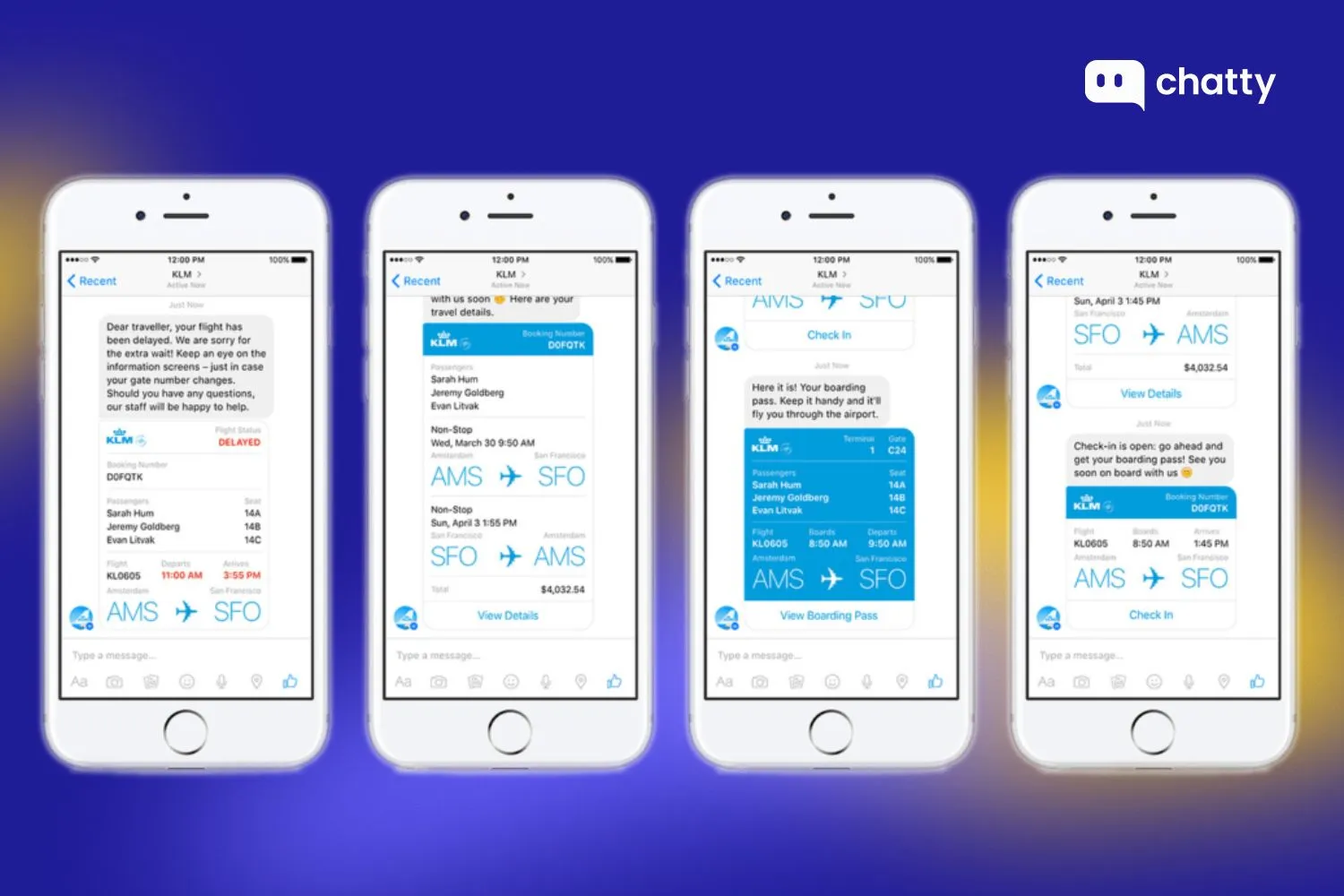
KLM Royal Dutch Airlines uses AI-powered service automation to process flight disruption tickets. When flights are canceled or delayed, the AI automatically opens service tickets, offers rebooking options, processes refunds, and sends notifications to passengers. This reduced manual handling time by over 60% and significantly improved customer satisfaction scores.
How to choose the right AI ticketing system
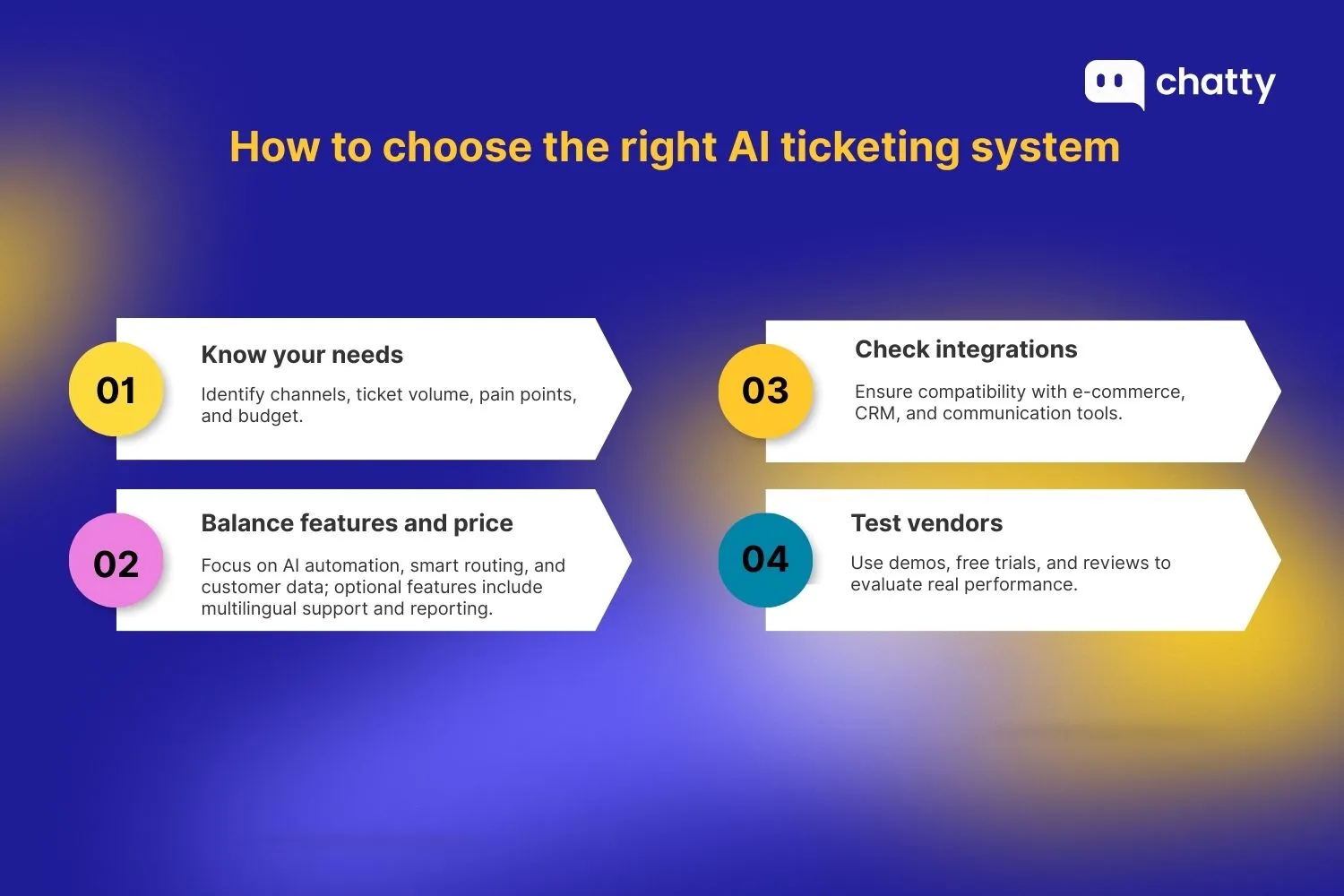
Choosing an AI ticketing system is easier when you follow a clear process. Start by understanding your needs, then match them to the right features, integrations, and vendors.
Questions to ask before you start
Before comparing tools, clarify your requirements:
- What channels do your customers use? Email, live chat, social media, and messaging apps should be supported in one unified system.
- What is your current ticket volume? Consider both current demand and expected growth to avoid outgrowing the platform.
- What are your biggest pain points? Common issues include slow response times, repetitive queries, lack of automation, or poor reporting.
- What is your budget? Factor in setup costs, monthly fees, and potential add-ons to avoid hidden expenses.
Answering these questions helps narrow your options and prevents overpaying for features you do not need.
Features vs. Price: Finding the Balance
Prioritize features that improve efficiency and customer satisfaction.
Must-have features for e-commerce:
- AI-powered automated replies
- Smart ticket routing
- Access to order and customer data
- Automation for returns, refunds, and shipping updates
Nice-to-have features:
- Multilingual support
- Sentiment analysis
- Advanced reporting
Premium features are worth the investment only when they deliver measurable value, such as reducing ticket volume, speeding up resolutions, or improving customer experience.
Integration checklist
Ensure the system integrates smoothly with your e-commerce platform so agents can access order history, payments, refunds, and shipping details in one dashboard. Check compatibility with your existing tools, including CRM, marketing platforms, analytics tools, and communication apps. Also consider future needs. A flexible system with strong integration options will support growth and reduce the need for platform changes later.
Evaluating vendors
Take advantage of free trials and demos to test real support scenarios, not just surface-level features. Review customer feedback and case studies, focusing on companies similar in size and industry. Finally, assess onboarding and ongoing support quality. Clear documentation, responsive support, and structured onboarding help ensure faster adoption and long-term success.
By following these steps, you can select an AI ticketing system that supports current operations while scaling effectively as your business grows.
The future of AI ticketing
The future of AI ticketing is moving beyond faster responses and simple automation. It is evolving into smarter systems that reduce customer effort, prevent problems, and streamline support operations.
- Ticketless support: Instead of submitting tickets, customers will see issues resolved automatically in the background. For example, if a delivery is delayed, the system can notify the customer, share a new delivery date, and offer compensation without any action required. This reduces friction and improves satisfaction.
- Proactive issue resolution: AI will identify potential problems before customers notice them by analyzing order data, delivery trends, and user behavior. When risks appear, the system can trigger alerts, provide updates, or apply fixes automatically. This helps prevent complaints, protect brand trust, and reduce incoming tickets.
- Autonomous agents: AI agents will handle complete support workflows, from understanding the issue to delivering the solution and updating internal systems. Human agents can then focus on complex cases, relationship building, and service quality, leading to faster resolutions and better customer experiences.
- AI as the control plane of CX operations: Instead of managing separate tools for chat, email, CRM, and analytics, teams will rely on AI to coordinate workflows, prioritize tasks, and optimize performance across all channels. This creates a more unified and efficient support operation.
To prepare, businesses should invest in flexible platforms, clean data systems, and clear automation strategies. These steps make it easier to adopt advanced AI capabilities and stay competitive as customer expectations continue to rise.
Looking for an AI-powered ticketing system for your eCommerce store? Meet Chatty
If you want a simple way to improve customer support for your eCommerce store, Chatty is an AI-powered ticketing system built for online businesses. It helps teams reply faster, handle more requests, and deliver better customer experiences without adding extra workload.
Chatty uses AI to analyze incoming tickets, understand intent, and route requests automatically. Common questions about orders, shipping, refunds, and returns can be resolved instantly, while complex issues are escalated with full context. This shortens response times, prevents misrouting, and keeps support workflows efficient during peak demand.
Chatty integrates seamlessly with leading platforms such as Zendesk, Klaviyo, and Salesforce, enabling smooth data sync across support, marketing, and sales. These integrations ensure customer context is always available, conversations stay connected, and every interaction drives measurable business value.
For growing and established eCommerce brands alike, Chatty makes it easier to scale customer support while maintaining high service quality, operational efficiency, and long-term customer trust.