













Customer service is one of the few business functions everyone values, yet few can define with absolute clarity. As markets saturate and products grow interchangeable, the real differentiator is no longer what a company sells. It’s the way the brand supports, guides, and reassures its customers. In today’s experience-driven environment, customer service has moved from a backstage task to a core driver of loyalty, trust, and long-term revenue.
In this guide, you’ll learn:
- How customer service has evolved into an experience-led function
- Why strong service now drives retention and trust
- What distinguishes today’s top-performing service teams
- Customer service has evolved from a back-office function to a primary revenue driver.
In saturated markets where products are interchangeable, the quality of post-sale support has become the deciding factor in retention and word-of-mouth growth.
- A clear service definition now encompasses pre-sale guidance, not just post-sale support.
Modern customer service teams influence the buying decision by answering questions, building confidence, and removing purchase barriers before a transaction occurs.
- Experience-led organizations outperform peers by treating every interaction as a brand moment.
Each support exchange is an opportunity to reinforce trust, and top-performing teams are measured on loyalty and CLV metrics alongside resolution speed.
- Strong service teams share three distinguishing traits: empathy, speed, and ownership.
Agents who take personal accountability for resolution, respond without delay, and communicate with genuine empathy consistently produce higher satisfaction scores.
- Trust built through service is harder for competitors to replicate than any product feature.
A customer who has been supported well during a difficult moment forms an emotional attachment to the brand that pricing and promotions alone cannot displace.
What is customer service?
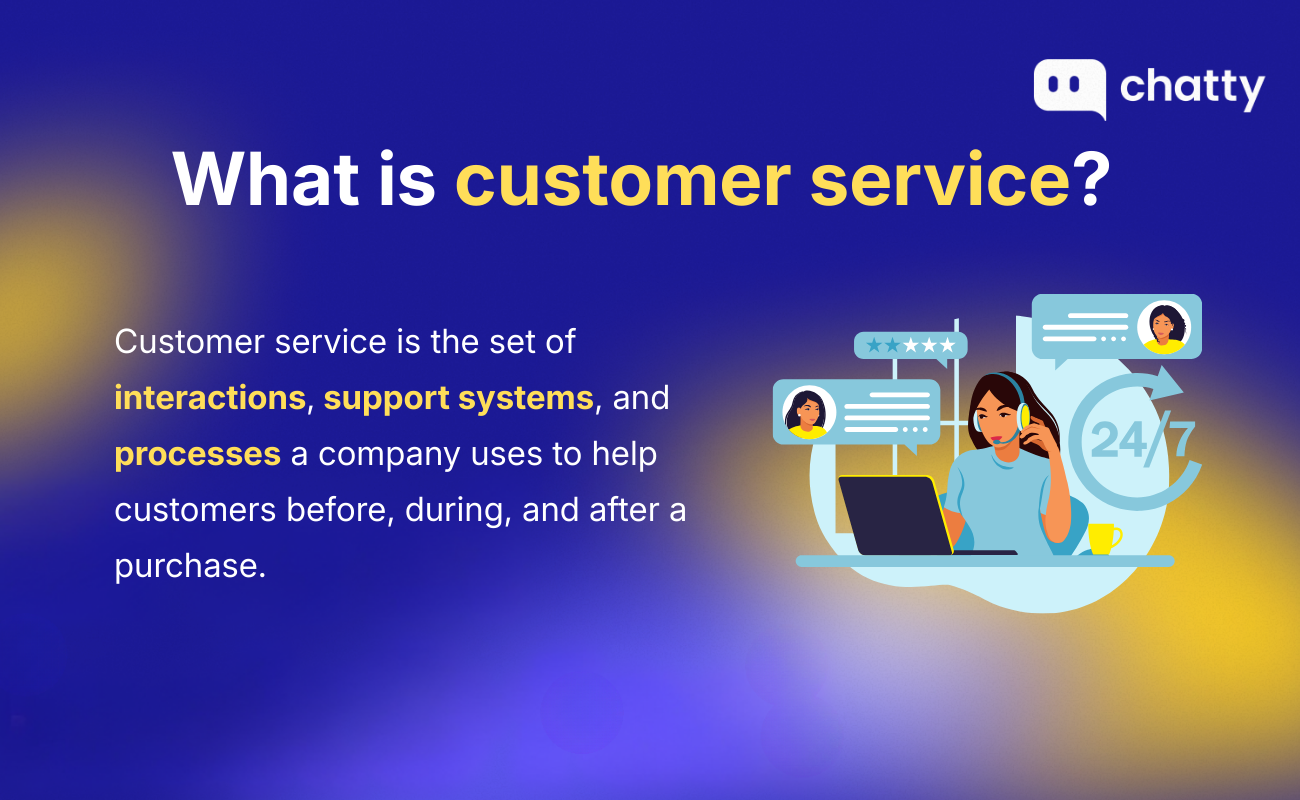
Customer service is the set of interactions, support systems, and processes a company uses to help customers before, during, and after a purchase. It ensures customers can find answers, overcome obstacles, and navigate their journey with clarity and confidence. At its core, customer service protects customer satisfaction and maintains a steady relationship between customers and the brand.
To understand the definition more precisely, it helps to separate the traditional view from the modern one.
Traditional customer service focused on reactive support.
- Customers reached out only when they had a problem
- Teams worked to answer questions and fix issues
- The main goal was resolution, not experience
Service was treated as a functional task rather than a value-creating part of the business. Meanwhile, modern customer service takes an experience-first approach.
- Support appears across many touchpoints, not just a help line
- Help includes guidance, clarity, and reassurance, not only problem-solving
- The aim is to shape perception and strengthen loyalty
Instead of seeing service as a cost, modern companies view it as a lever for trust and long-term value.
How customer service has evolved (history → present)
Customer service has never had a fixed meaning. As technology advanced and customer expectations rose, the very definition of service changed with each decade.
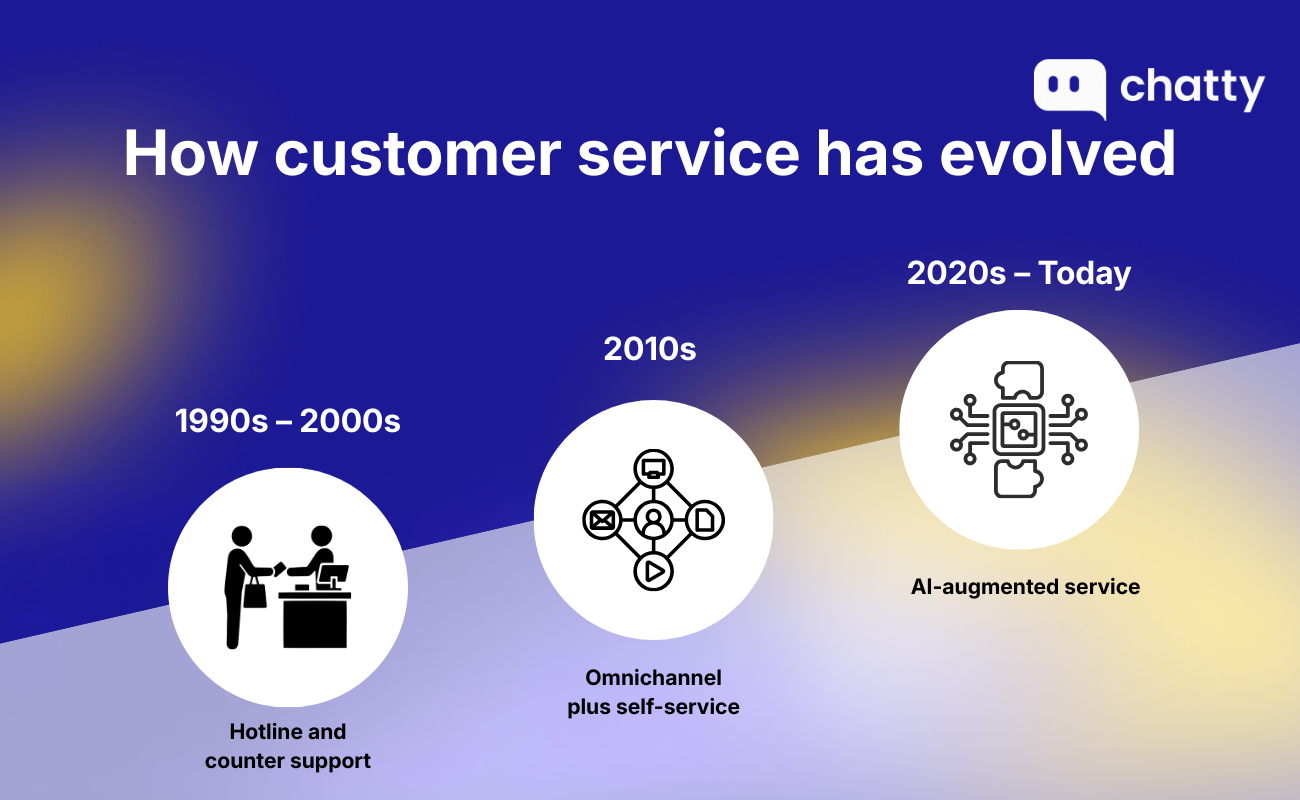
Phase 1: Hotline and counter support (1990s–2000s)
This era defined service as direct human assistance. Customers called a hotline or visited a counter, then waited for an agent to walk them through the issue. The job of service teams was simple: pick up the call, fix the problem, close the case.
The definition here was reactive help delivered by a person, usually on a single channel.
Phase 2: Omnichannel plus self-service (2010s)
As email, live chat, mobile apps, and social media became mainstream, customer service expanded to cover every digital touchpoint. Contact centers became “contact hubs” that handled messages across many channels. At the same time, FAQs, online help centers, and self-service portals let customers solve simpler tasks on their own.
Service started to mean availability wherever the customer chose to reach out, not just on a phone line.
Phase 3: AI-augmented service (2020s–today)
Today, AI assistants, more intelligent routing, and predictive insights sit atop those channels. Bots answer routine questions, summarize conversations, and surface context for human agents. Modern service tries to predict intent, shorten effort, and keep the experience consistent across every step of the journey.
Across these phases, one factor drives every transformation: customer expectations rise faster than service models can keep up. As those expectations change, the meaning of customer service is rewritten: moving from reactive help to omnichannel availability to predictive, AI-supported experiences.
Customer service vs. customer support vs. customer experience
These three concepts often appear interchangeable, yet each represents a different layer of customer interaction with a brand. Understanding the distinction helps refine what customer service truly means today.
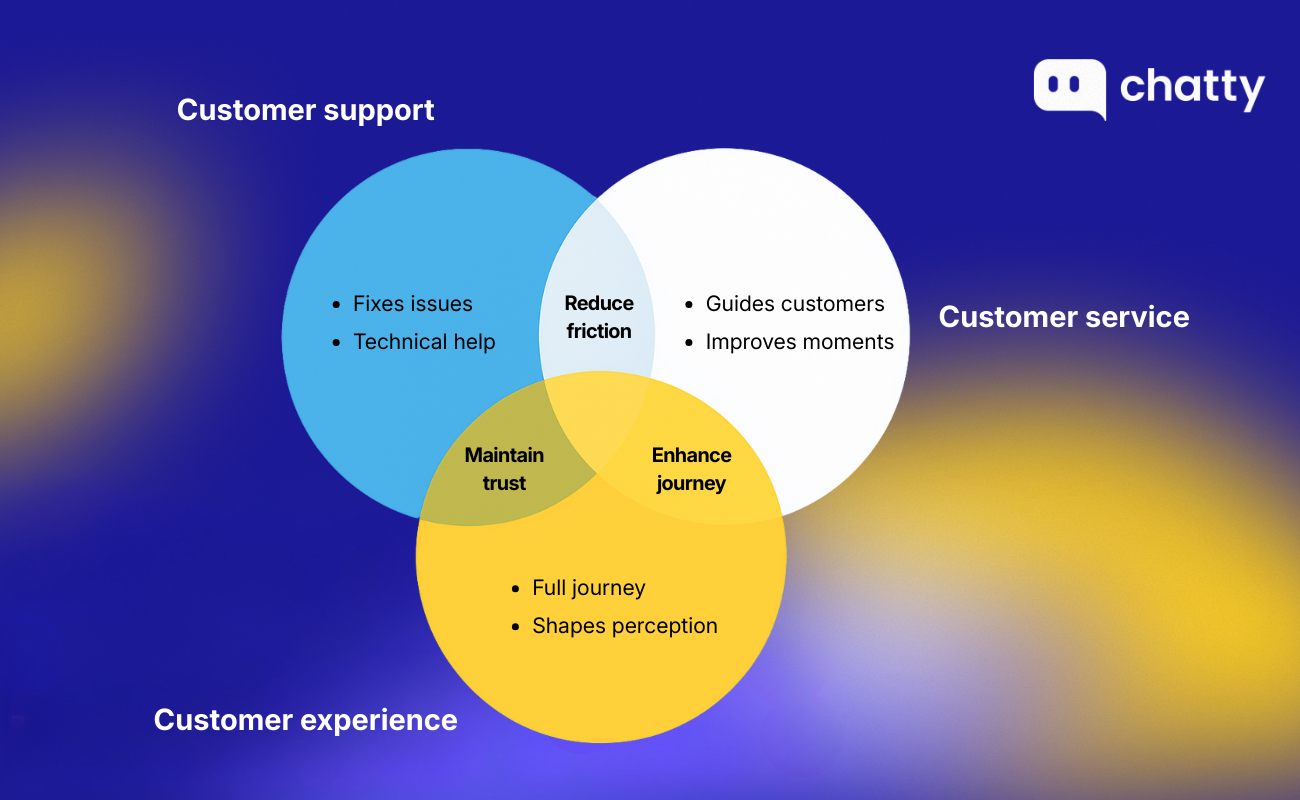
| Concept | What it means | Core focus | Scope |
| Customer support | Help for product or technical issues | Fixing problems | Narrow, issue-driven |
| Customer service | Guidance and care across the buying process | Smoothing key moments | Broader, journey-based |
| Customer experience (CX) | The full set of interactions with a brand | Shaping perception and loyalty | Wide, end-to-end |
Verdict: Which one matters most?
Customer experience sits at the top because it covers every moment that shapes how customers feel about a brand. Customer service strengthens that experience by guiding customers through crucial steps. Customer support protects it by removing obstacles when something goes wrong.
In simple terms:
- Support solves issues.
- Service supports decisions.
- Experience builds loyalty.
Why does customer service matter more than ever?
Customer service sits at the center of business performance today for three reasons: expectations have risen, competition has tightened, and service quality now shapes core financial outcomes.
- Customer expectations have shifted. Buyers want support that feels immediate and effortless. More than 50% of consumers expect a reply within an hour, and 43% now file complaints when service disappoints, up from 35% in 2015. They also expect smooth handoffs between channels, and help that reflects their history with the brand. When the experience feels slow or generic, trust drops quickly.
- Products can be copied; services cannot. Rivals can match design, pricing, or functionality, but they cannot replicate how a brand listens, responds, or recovers from mistakes. This is why nearly half of customers consider switching after one poor interaction. Service becomes the intangible differentiator that competitors cannot reverse-engineer.
- Service quality directly affects every retention and revenue lever.
- Customer retention: Good service prevents churn at the exact moments customers are most vulnerable.
- CLV: Loyal customers buy more often and spend more over time.
- Brand trust: When service feels dismissive, 47% of consumers feel less valued, which erodes credibility.
- Word-of-mouth: Positive interactions fuel advocacy; negative ones spread quickly.
- Revenue consistency: Predictable, repeat customers stabilize growth more effectively than acquisition alone.
Taken together, these forces explain why customer service matters more than ever: it meets rising expectations, builds a moat competitors cannot duplicate, and drives the metrics that determine long-term success.
Delivery models of customer service (how it actually operates)
Modern customer service is built on four core delivery models. Each model solves a different part of the customer journey, and most companies use a mix of them to meet rising expectations for speed, clarity, and support.
Human-led service

Primary channels: phone support, live chat with human agents, and in-store assistance.
Human-led service remains the foundation of high-touch support. It works when customers face unclear or emotionally charged situations. A skilled agent can read tone, adjust the conversation, and guide the customer through options that are not always obvious. This ability to adapt in real time creates confidence and often determines whether a difficult moment becomes resolved.
- Works best for: complex cases, sensitive conversations, high-stakes decisions
- Core value: judgment + empathy + adaptability
Automation-led service
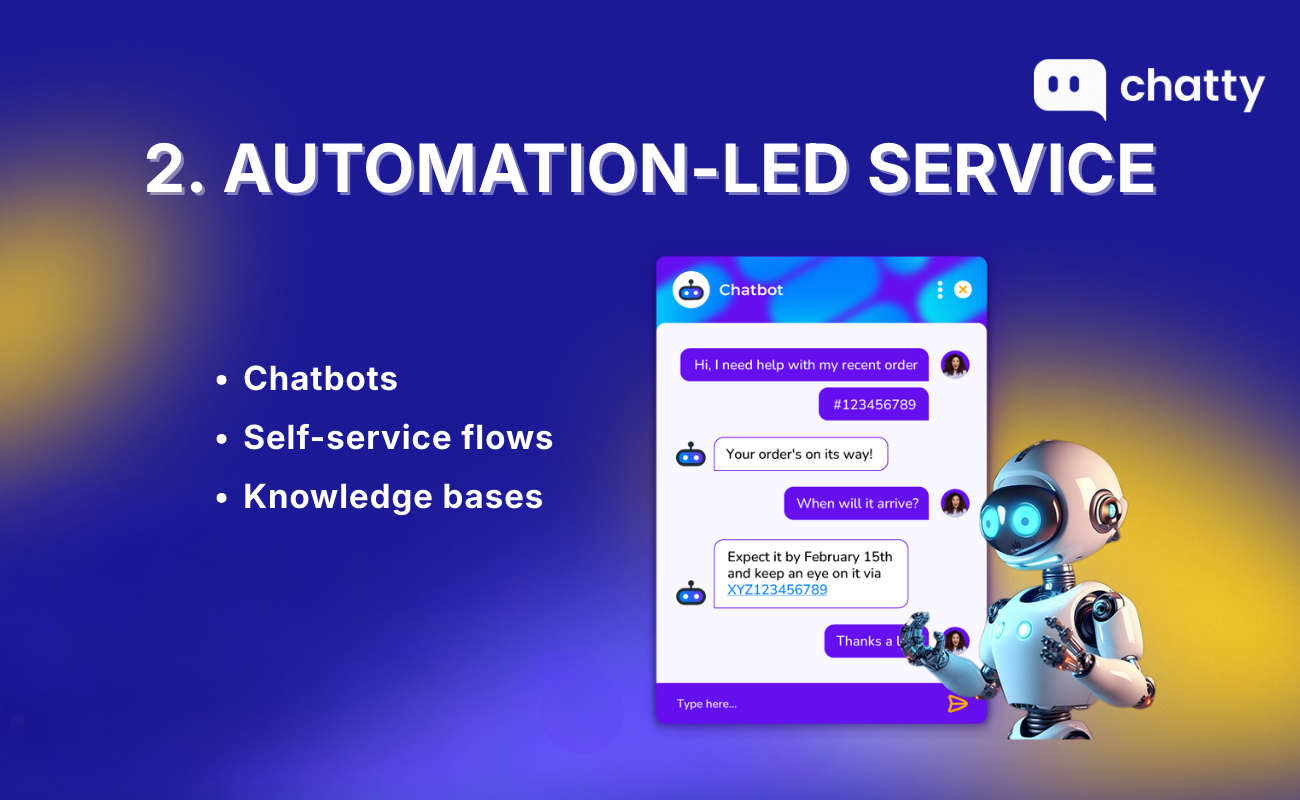
Primary channels: chatbots, structured self-service flows, searchable knowledge bases.
Automation-led service is designed for efficiency. It covers the high-volume, repetitive tasks customers want solved immediately. Instead of waiting for an agent, customers follow clear steps or ask a bot for direct answers. This reduces effort on both sides: customers move faster, and service teams avoid spending time on issues that do not require human input.
- Works best for: repetitive inquiries, simple resolutions, after-hours support
- Core value: instant answers + zero friction
Hybrid service

Primary workflow: AI handles the intake; humans handle the depth.
Hybrid service integrates automation at the front and human expertise when context becomes complex. AI identifies intent, gathers background information, and resolves straightforward tasks. If the issue requires nuance, the transition to a human agent feels smooth because the agent already has the essential context. This model reduces overall resolution time while preserving the quality of human interaction where it matters.
- Works best for: mixed scenarios with simple and complex steps
- Core value: front-loaded speed + human intelligence when needed
Community-driven service

Primary formats: user forums, product communities, peer-to-peer groups.
Community-driven service uses the collective experience of real customers. Users share tips, troubleshoot together, and highlight edge cases that formal documentation often misses. This creates a space where learning happens faster because solutions come from practical, lived experience. For the business, these communities reduce support load and reveal patterns that help improve the product.
- Works best for: advanced use cases, niche questions, enthusiastic user bases
- Core value: real-world experience + shared learning
The core pillars of modern customer service
Modern customer service rests on a few core pillars that shape how customers judge every interaction. These pillars influence whether support feels effortless or frustrating.
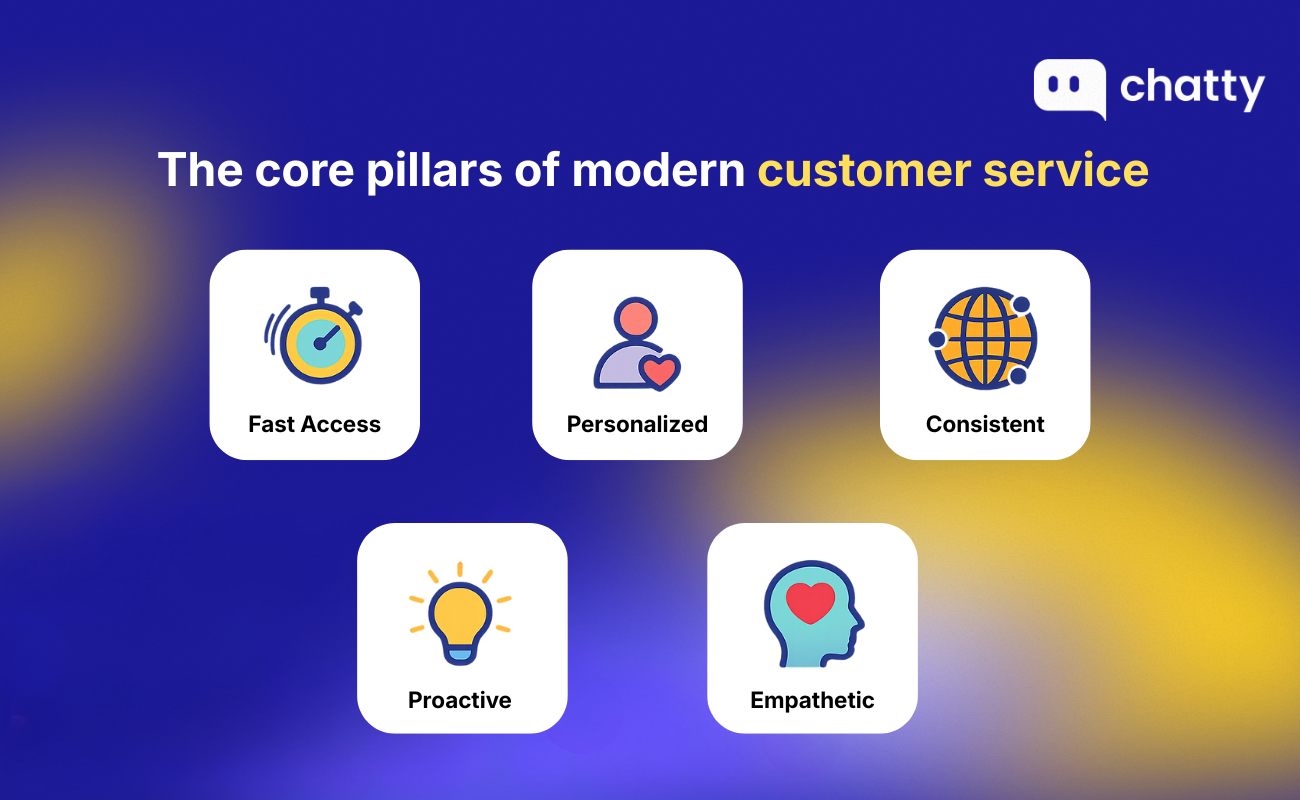
Accessibility and speed
Customers want help the moment they reach out. They switch between chat, email, social platforms, and mobile with zero patience for delays.
To meet this expectation, teams must keep support easy to reach and quick to respond.
- Fast first replies prevent frustration
- Clear routing avoids repeated explanations
- Short queues signal operational readiness
When access feels smooth, customers stay engaged. When it doesn’t, they leave.
Personalization and contextual understanding
Personalized support signals that the brand recognizes the customer, not just the ticket. Effective service uses basic context: recent activity, past purchases, or behavior signals to tailor responses rather than repeat generic scripts.
This context shortens the path to resolution and builds confidence. When help feels specific to the customer’s situation, conversion rates rise, and loyalty strengthens.
Consistency across channels
Customers expect the same quality of support wherever they reach out on chat, email, or social platforms. A smooth chat experience loses its value if email feels slow or social replies sound disconnected. This is the core of the omnichannel expectation: one brand, one standard.
Brands often fail when each channel operates in its own silo. Information gets repeated, context gets lost, and customers feel they are starting over every time. A consistent system keeps history, tone, and decisions aligned, creating a coherent journey no matter where the conversation begins.
Proactivity and customer education
Modern customer service is defined as much by what happens before the ticket as what happens after. Customers prefer brands that offer early guidance, not only responses.
Proactive efforts can take many forms:
- Timely alerts that prevent avoidable issues
- Short guidance messages that clarify next steps
- Educational content that reduces confusion and support load

Where this becomes truly effective is when AI can detect patterns humans miss. Chatty, for example, uses behavior signals and product context to surface helpful prompts (sizing tips, delivery information) at the exact moment a shopper might need them. This well-timed guidance shifts service from reactive problem-solving to early problem-prevention, lowering ticket volume and strengthening trust throughout the journey.
Empathy and emotional intelligence
Even in automated environments, empathy remains the anchor of service quality. Customers respond to tone, patience, and clarity because these cues show respect, not script-following. Emotional intelligence turns a basic answer into reassurance during stressful moments.
Human-centered handling matters most when the situation involves uncertainty or disappointment. When customers feel understood, they recover trust faster, and that trust often lasts longer than the resolution itself.
Best tips to improve your customer service
Great service doesn’t happen by accident; it’s built on deliberate habits. The practices below address the core levers that consistently improve clarity, speed, and overall customer confidence.
Tip 1: Diagnose your real friction points
Teams should examine ticket categories, chat logs, and on-site behavior signals to identify where customers hesitate or abandon tasks. Patterns in repeated questions or recurring complaints reveal systemic gaps that require structural fixes. When teams solve the root cause rather than the symptom, customer frustration drops quickly.
Tip 2: Clarify responsibilities across your service ecosystem
Each component of the ecosystem, like agents, automation, AI tools, and the knowledge base, must have defined responsibilities. Clear ownership prevents duplicated actions and ensures that no request falls between teams. When responsibilities are aligned, handoffs feel intentional rather than chaotic.
Tip 3: Make response time predictable, not just fast
Customers value certainty, and even accept waiting when expectations are clear. Predictable timelines reduce anxiety and prevent follow-up messages that add pressure to the queue.
Teams should maintain a predictable pace through:
- SLAs that set transparent response windows
- Auto-responses that confirm receipt and timeline
- Monitoring tools that keep actual performance aligned with promises
Predictability builds more trust than sporadic bursts of speed.
Tip 4: Build a useful, not decorative, knowledge base
A knowledge base should function as a self-service engine, not a repository of generic articles. It must include:
- Troubleshooting steps
- How-to guides
- Contextual FAQs based on real ticket data.
Monthly updates ensure the content reflects product changes and emerging questions. When customers find accurate answers independently, satisfaction rises, and ticket volume drops.
Tip 5: Use personalization in small but effective ways
Personalization works best when it feels natural, not intrusive. Teams should address customers by name and acknowledge relevant context, such as past orders or recent activity. These small signals show that support understands the customer’s situation without asking them to repeat details. Scripts should reinforce this awareness through clear, empathetic phrasing that adapts to the customer’s tone and intent.
Tip 6: Blend automation and human touch
Automation creates speed, but human judgment creates confidence. AI can handle routine questions and gather essential context before an agent steps in.
Use cases include:
- Routing inquiries based on intent
- Answering predictable questions instantly
- Preparing conversation summaries for agents
Platforms like Chatty support this model by accelerating replies while escalating complex issues to human teams with full context. When the handoff feels seamless, customers experience both efficiency and care.
Tip 7: Train agents on tone, not just process
Process knowledge keeps operations consistent, but tone keeps customers comfortable. Training should include examples of strong phrasing, tone guidelines, and real interactions that demonstrate how clarity and empathy diffuse tension. A unified voice reduces confusion and reinforces brand reliability across every channel.
Tip 8: Close the loop with post-resolution follow-ups
Follow-ups signal that the relationship continues after the issue closes. Teams can maintain this habit through:
- Short satisfaction surveys
- “Was this helpful?” prompts
- 24-hour check-in messages
These small gestures turn resolved cases into renewed trust and long-term loyalty.
What are the challenges in customer service?
Customer service teams operate under pressure from rising expectations, higher volumes, and more complex issues. The challenges below are the most common disruptors of quality and consistency.
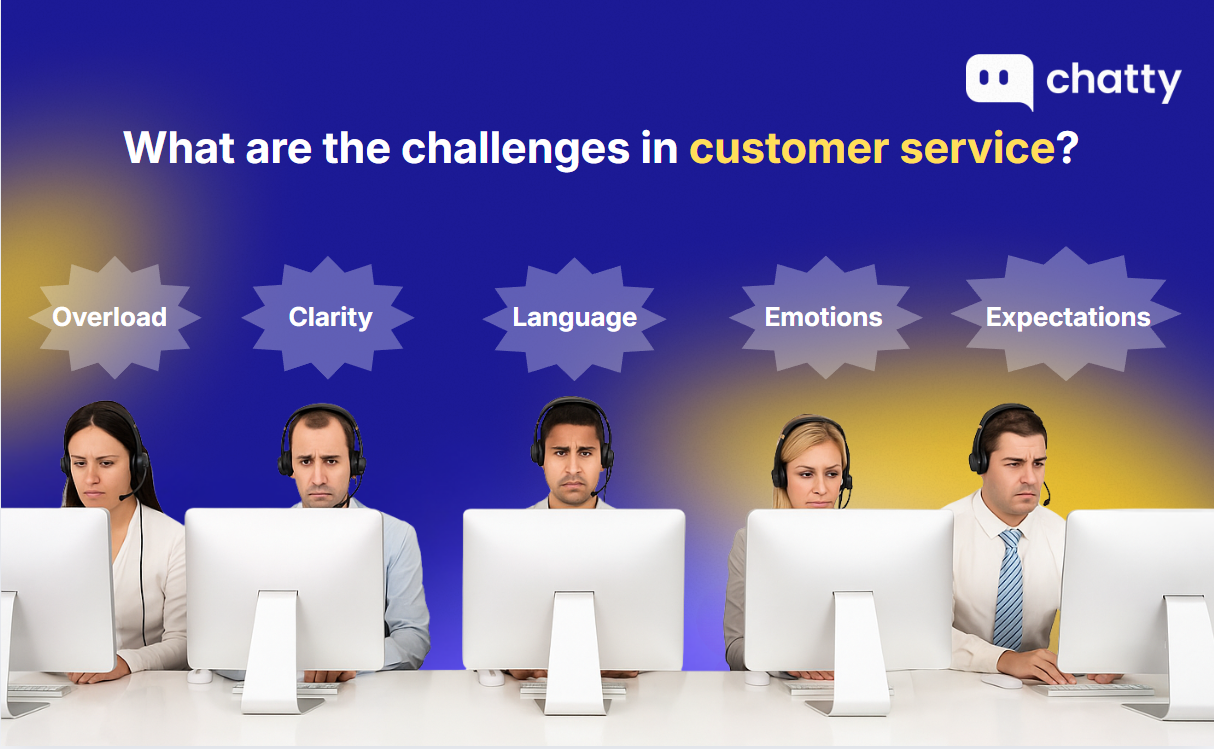
Handling multiple customers at once
Volume spikes disrupt even well-structured teams. When calls spike or chat queues expand, agents struggle to deliver personalized attention. The risk is rushed conversations and incomplete resolutions. Brands need clear queue management, load balancing, and routing systems so agents can maintain quality even during peak times.
Clarifying vague or incomplete issues
Customers often describe symptoms, not causes. This creates confusion on both sides and slows down resolution. Skilled teams rely on patient questioning, active listening, and structured discovery to uncover the real problem. Clarity up front lowers repeat tickets and improves satisfaction.
Navigating language and cultural differences
For global businesses, linguistic gaps create friction. Literal translations miss nuance, and cultural norms influence how customers express urgency or dissatisfaction. Multilingual support, culturally aware training, and selective use of translation tools help teams serve diverse audiences with accuracy and respect.
Managing emotional or upset customers
Angry customers test both patience and professionalism. The challenge lies in de-escalating emotions without dismissing the customer’s experience. Calm tone, clear acknowledgement, and empathy help rebuild trust. In some cases, escalation or a goodwill gesture brings closure.
Keeping pace with shifting expectations
Expectations evolve faster than internal processes. Customers now expect immediate responses, 24/7 availability, and frictionless transitions across channels.
Organizations must adapt through omnichannel systems, AI-enabled support, and continuous training. Without this evolution, even strong teams fall behind.
Examples of brands with great customer service
Abstract principles are useful, but real brands show what “great customer service” looks like in practice. Below are three examples that turn the pillars we discussed into concrete results.
Zappos: Service as the product
Zappos built its entire model on eliminating friction from buying shoes online. Its approach prioritizes risk-free shopping and human-first support:
- 365-day return policy with free two-way shipping
- 24/7 customer support over phone and digital channels
- A culture that encourages long, unhurried calls if that is what the customer needs
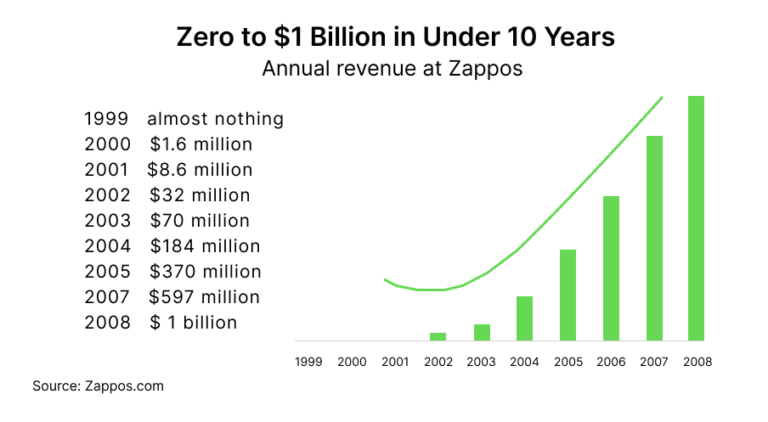
By treating convenience and reassurance as core features, Zappos turned service into a competitive advantage. Customers trust the brand because the experience is predictable, generous, and genuinely helpful.
Yoeleo Bike: Mastering complex questions with AI
Yoeleo Bike sells performance components where technical precision truly matters. A cyclist considering a $999 wheelset often needs exact compatibility guidance before committing. A single wrong answer can create an expensive return and damage trust.
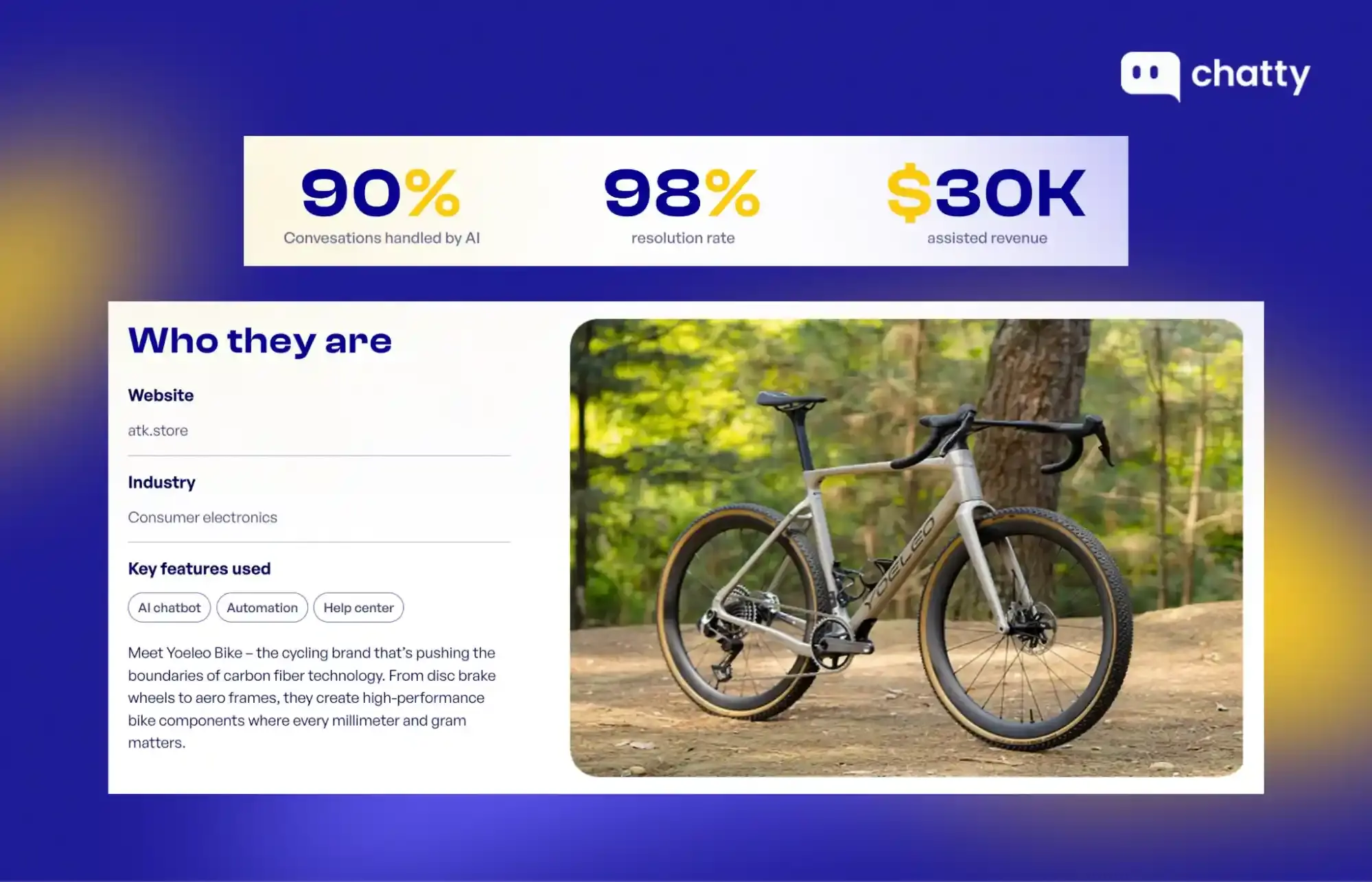
Yoeleo used Chatty to train an AI agent on detailed product specifications, bearing sizes, and compatibility charts. The AI now handles complex inquiries that traditionally required an expert technician. It can, for example, assess whether a SAT C50 DB PRO NxT SL2 wheelset fits a customer’s frame standard, instantly, consistently, and without forcing the buyer to decode technical sheets.
This reduces misinformed purchases, lowers return rates, and creates a smoother buying journey for high-value customers.
Decathlon: scaling helpful guidance across 10,000+ products
Decathlon faces a different challenge: complexity through sheer volume. Customers need help choosing gear across 10,000+ items, each with technical details, use cases, and compatibility rules. Conventional support models cannot deliver consistent guidance at this scale.
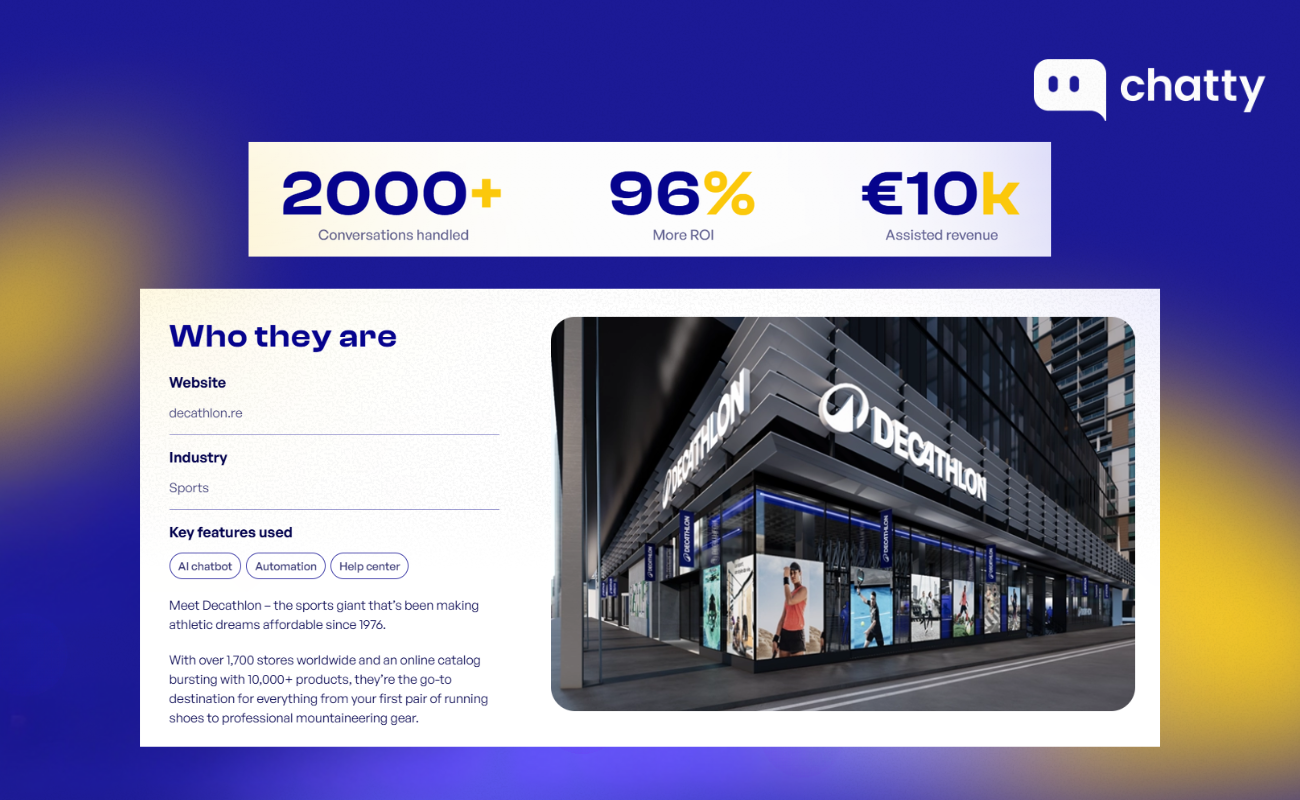
By syncing its full catalog with Chatty, Decathlon enabled an AI assistant that understands product attributes, sizing logic, environmental suitability, and accessory fit. The assistant can answer questions such as:
- “Does this tent withstand strong Alpine wind?”
- “Which hiking boots are better for wide feet?”
- “Is this bike compatible with child seats or pannier racks?”
Because the AI processes data across the entire catalog, the advice remains accurate even when products update or seasonal stock rotates.
For customers, this means faster, more reliable guidance during decision-making. For Decathlon, it means fewer repetitive questions, more confident shoppers, and a measurable lift in online conversion.
Misconceptions that distort the definition of customer service
Several persistent misconceptions continue to narrow how organizations view customer service. These assumptions sound intuitive, but each one misdirects strategy and prevents teams from building a service model that truly supports growth.
- “Customer service = answering messages quickly.” Speed is only one dimension. A fast response that lacks context, accuracy, or follow-through often creates more work: additional tickets, repeated explanations, and frustrated customers. Modern service defines quality by resolution clarity, not by clock time alone.
- “More staff = better service.” Headcount cannot compensate for unclear workflows or scattered ownership. When routing, escalation rules, or knowledge sources are weak, additional agents only spread the inefficiency. Sustainable improvement comes from well-designed processes, intelligent automation, and precise division of responsibility.
- “AI removes empathy.” AI does not eliminate empathy; it enables it. By taking over repetitive questions and preparing context before a human joins, AI gives agents the mental space to slow down, listen, and respond thoughtfully. Empathy is strengthened when humans are freed from mechanical tasks.
- “Service is a cost center, not a value driver.” This mindset belongs to the past. Strong service increases retention, average order value, and word-of-mouth reach. It reduces return rates and boosts customer lifetime value. In competitive markets where products look similar, service becomes the deciding factor, and often the most defensible differentiator.
These misconceptions persist because they oversimplify a complex function. Modern customer service delivers impact precisely because it operates beyond these outdated assumptions.
The future of customer service (2026–2030)
Customer service is entering a decade defined by intelligence, prediction, and deeper integration with the commercial journey. The shift is already visible today, but it will accelerate sharply by 2030.
- The biggest transition is the move from reactive support to predictive and then fully personalized service. By 2030, instead of waiting for issues, systems will surface needs before the customer notices a problem. AI-driven tools, including platforms likeChatty, will interpret behavior patterns and recommend solutions or next steps proactively.
- At the same time, service and sales will merge into conversational commerce. Customers will no longer jump between channels to solve problems, research products, or make decisions. One continuous thread will handle troubleshooting, guidance, and purchase clarity in real time.
- AI will also shift roles as a genuine co-worker for customer service teams. It will prepare context, summarize history, highlight risks, and handle entire categories of routine tasks. Agents will focus on judgment, nuance, and emotional intelligence rather than mechanical steps.
As these capabilities mature, customer service becomes a visible brand asset, not an operational expense. The brands that win will be the ones whose service feels immediate, intelligent, and seamlessly connected to every moment of the customer journey.
Final thought
Customer service now defines the experience as much as the product itself. The next move is clear: examine your journey, remove the friction you can see, and build the support customers expect. Small, deliberate improvements today set the foundation for loyalty tomorrow.
FAQ
What makes customer service “excellent”?
Excellent customer service delivers clear, accurate, and timely support while making the customer feel understood. It combines fast access, personalized guidance, consistent answers across channels, and resolutions that prevent repeat issues.
Can AI provide “real” customer service?
Yes. AI can deliver real customer service for routine questions, product guidance, and predictive support. It handles high-volume tasks instantly and gives agents more time for complex, emotional, or strategic conversations.
What channels are counted as customer service?
Any channel where customers seek help qualifies as customer service. This includes live chat, email, phone support, social platforms, mobile apps, self-service portals, chatbots, and in-store assistance.
Why do companies confuse customer service with customer experience (CX)?
Because customer service is one part of the larger journey. Customer service focuses on support interactions, while CX includes every touchpoint (marketing, product use, checkout, and post-purchase impressions). Companies mix them up when they view support as the whole experience rather than one layer within it.
Excellent customer service delivers clear, accurate, and timely support while making the customer feel understood. It combines fast access, personalized guidance, consistent answers across channels, and resolutions that prevent repeat issues.
Yes. AI can deliver real customer service for routine questions, product guidance, and predictive support. It handles high-volume tasks instantly and gives agents more time for complex, emotional, or strategic conversations.
Any channel where customers seek help qualifies as customer service. This includes live chat, email, phone support, social platforms, mobile apps, self-service portals, chatbots, and in-store assistance.
Because customer service is one part of the larger journey. Customer service focuses on support interactions, while CX includes every touchpoint (marketing, product use, checkout, and post-purchase impressions). Companies mix them up when they view support as the whole experience rather than one layer within it.